📑 Table of Contents
Some pieces of music arrive with trumpets. This one opens like someone gently pushing a door ajar in a dark room, unsure whether anyone is still awake on the other side.
The Adagio that begins the second movement of Beethoven’s Cello Sonata No. 4 lasts only a couple of minutes. It is not a grand statement. It is a hush. The cello sings a long, searching line while the piano answers underneath, and the two instruments seem to lean toward each other the way two people speak quietly so as not to wake the house. If you have ever needed music for the end of a long day, for the moment after the noise stops, this is it.
What makes the moment almost unbearably moving is the circumstance behind it. By the time he wrote these notes, Beethoven could barely hear a thing.
Who Was Beethoven by 1815?
Most people meet Beethoven through the thunder: the four hammered notes of the Fifth Symphony, the storm of the Moonlight Sonata’s finale. That Beethoven is real, but he is not the whole story.
By 1815, Ludwig van Beethoven (1770–1827) was in his mid-forties and almost completely deaf. The bravado of his middle years, the heroic symphonies and the bold public gestures, had begun to give way to something more inward and strange. This was the threshold of what we now call his late period, the music of an artist who had stopped trying to win over a room and started writing as if listening to something only he could hear.
He composed his two final cello sonatas, published together as Op. 102, during 1815, and dedicated them to Countess Marie von Erdődy, a close friend and one of the people who understood him best. These were not crowd-pleasers. They were experiments, the work of a man treading ground no composer had quite walked before.
What Is a “Free Sonata,” and Why Does It Matter?
Here is a small piece of context that unlocks the whole work.
A typical sonata of the era had three or four movements, arranged in a predictable order: fast, slow, fast. Beethoven labeled this one a freie Sonate, a “Free Sonata.” Instead of the usual layout, it has just two movements, and each one begins with a slow, dreaming introduction before breaking into something quicker and more energetic.
So the Adagio we’re focusing on isn’t a standalone slow movement in the traditional sense. It’s the tender opening gate of the sonata’s second half, a moment of stillness that gathers itself before the music springs into a witty, unpredictable finale full of sudden starts and stops. Think of it as the held breath before a laugh.
That structure tells you something about late Beethoven: he was no longer interested in following the rulebook. He was interested in feeling, in shaping time the way a thought actually moves.
One more thing worth knowing. In these sonatas, the cello and the piano are genuine equals. In earlier eras a string instrument often just doubled or decorated the keyboard. Here they trade the lead back and forth, each taking a turn as the primary voice. It’s a conversation, not an accompaniment.
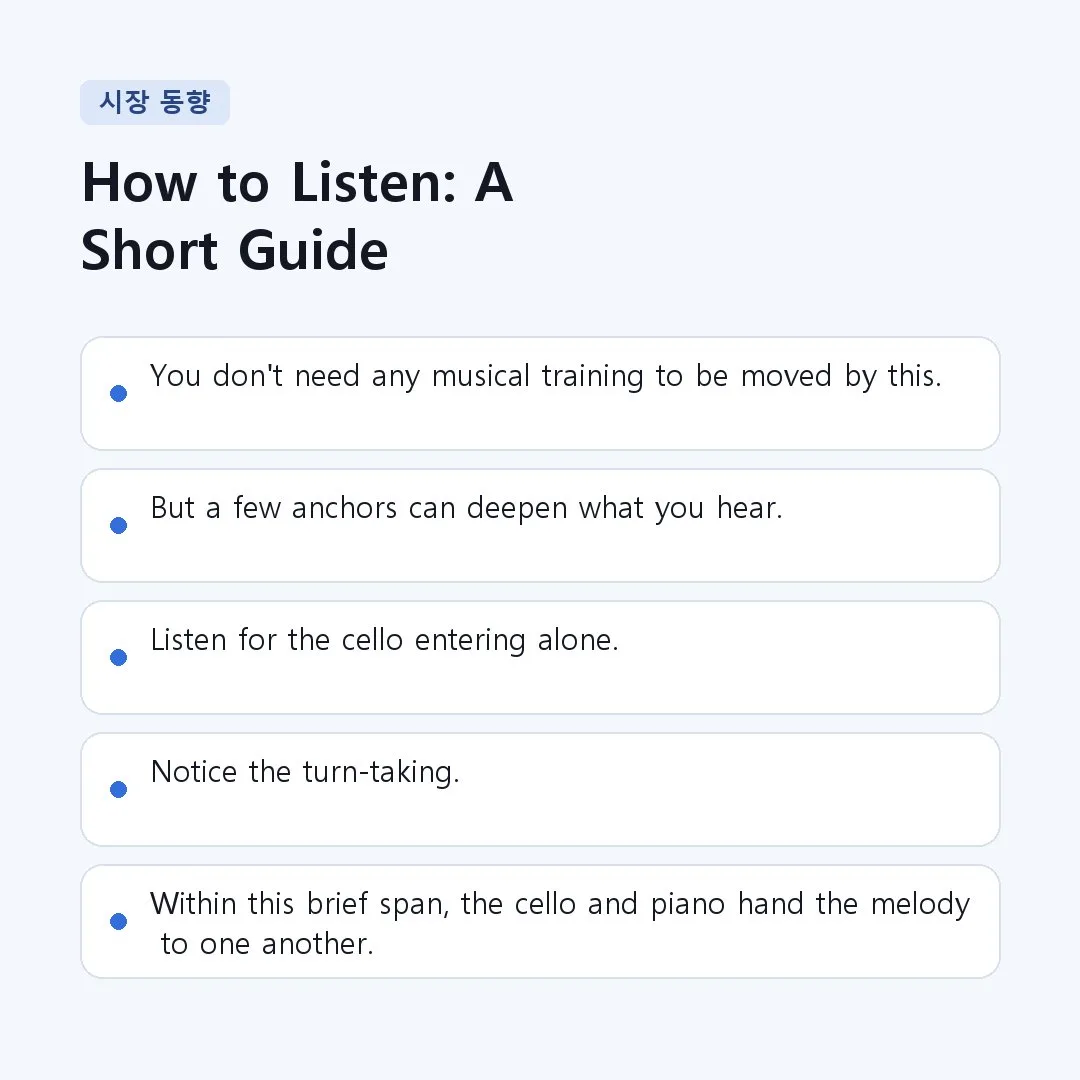
How to Listen: A Short Guide
You don’t need any musical training to be moved by this. But a few anchors can deepen what you hear.
Listen for the cello entering alone. The Adagio opens with the cello carrying the melody, exposed and vulnerable, before the piano joins. Notice how the line seems to search, rising and falling as if feeling its way forward.
Notice the turn-taking. Within this brief span, the cello and piano hand the melody to one another. When one steps forward, the other steps back to support. Try to catch the moment the roles switch; it’s the sound of two voices listening to each other.
Feel the suspension of time. Adagio means “slow,” but it’s slowness with purpose. The music doesn’t drift; it hovers. There’s a quality of waiting, of a question left open.
Wait for the release. This whole Adagio is a setup. It dissolves into a brief, song-like passage and then bursts into the lively Allegro vivace. If you let the track keep playing, the contrast is the entire point: tenderness cracking open into mischief and energy. Beethoven loved that whiplash.
The remarkable thing is that the man who designed this delicate interplay of sound could no longer test it with his ears. He was composing from memory, from imagination, from some internal hearing that deafness could not touch.

Recordings Worth Your Time
A few performances bring out very different sides of this music.
Jacqueline du Pré and Daniel Barenboim recorded the complete Beethoven cello sonatas together, and their account of the Fourth is intensely human and warm. Du Pré’s tone has an almost vocal ache to it, and because she and Barenboim were partners in life as well as music, the give-and-take feels especially intimate. Start here if you want emotion at the surface.
János Starker and Rudolf Buchbinder offer a cooler, more architectural reading. Starker was famous for the clarity and control of his playing, and this recording lets you hear the structure of the music with great precision. Choose this if you want to follow exactly how the lines fit together.
Maria Kliegel and Nina Tichman recorded an accessible, well-balanced complete set that’s easy to find on streaming services and gentle on first-time listeners. A fine, unfussy place to begin if the bigger names feel intimidating.
Whichever you pick, give the Adagio your full attention once, with no distractions. It asks very little of you, and gives back more than its length suggests.
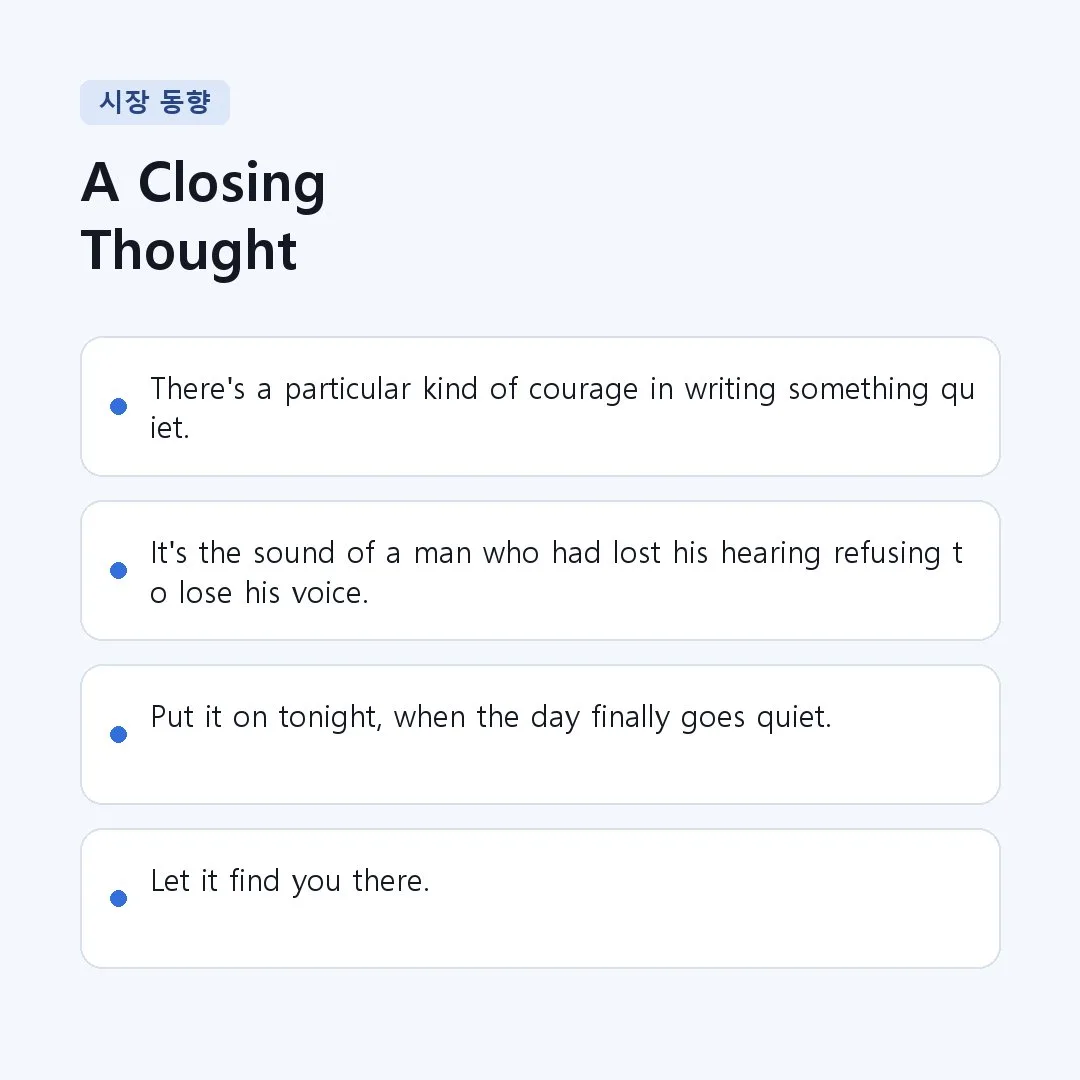
A Closing Thought
There’s a particular kind of courage in writing something quiet. Beethoven could have spent his late years repeating the triumphant gestures that had made him famous. Instead, deaf and increasingly isolated, he turned toward intimacy, toward music that whispers rather than shouts.
This Adagio is barely longer than the time it takes to read these last few paragraphs. But in those two minutes there’s an entire emotional world: searching, tender, unresolved, and then, at the last moment, opening into light. It’s the sound of a man who had lost his hearing refusing to lose his voice.
Put it on tonight, when the day finally goes quiet. Let it find you there.