📑 Table of Contents
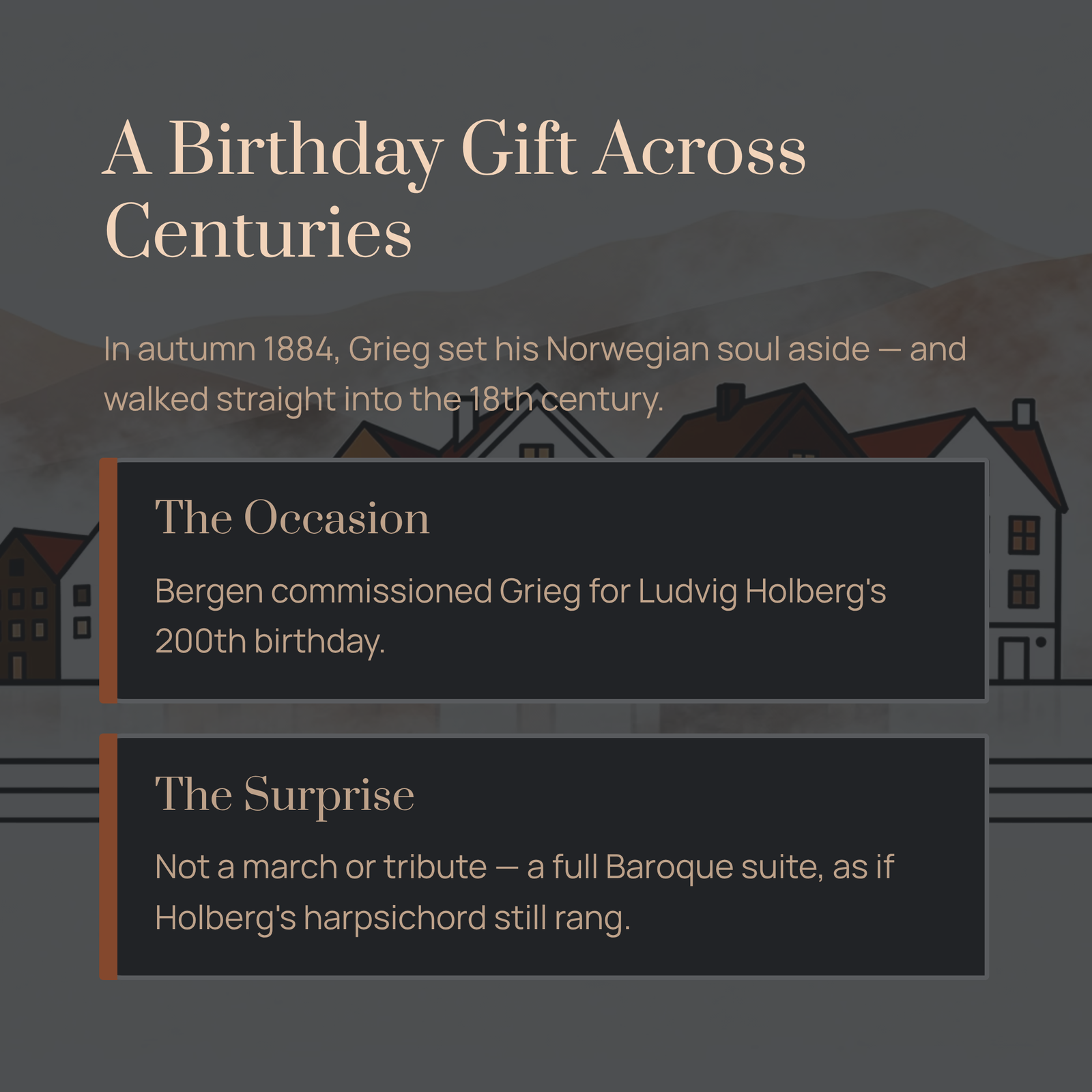
Edvard Grieg is famous for sounding Norwegian — all those sweeping fjords and folk dances encoded into melody. But in the autumn of 1884, he did something no one expected: he put his Norwegian soul temporarily aside and walked straight into the 18th century.
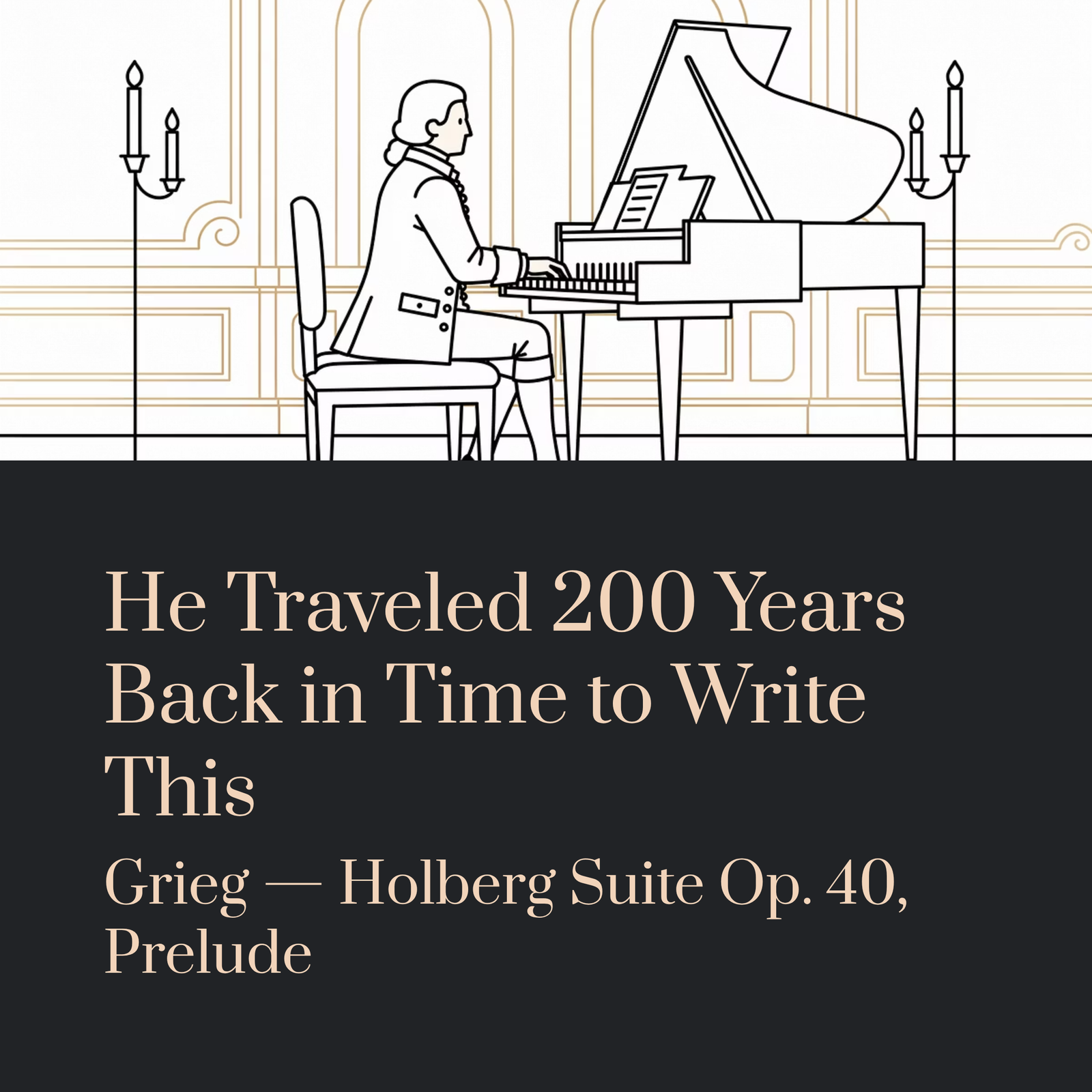
The occasion was the 200th birthday celebration of Ludvig Holberg, a Norwegian-Danish playwright who died in 1754 — thirty years before Grieg was even born. Bergen, Grieg’s hometown, asked him to compose something for the occasion. What Grieg delivered was not a nostalgic tribute or a ceremonial march. He wrote a full Baroque suite, in the style of Bach and Handel, as if Holberg’s own harpsichord were still ringing in the room.
That suite opens with a Prelude — and the moment it begins, something electric moves through you. This is where we start.
Who Was Grieg, and Why Does It Matter Here?
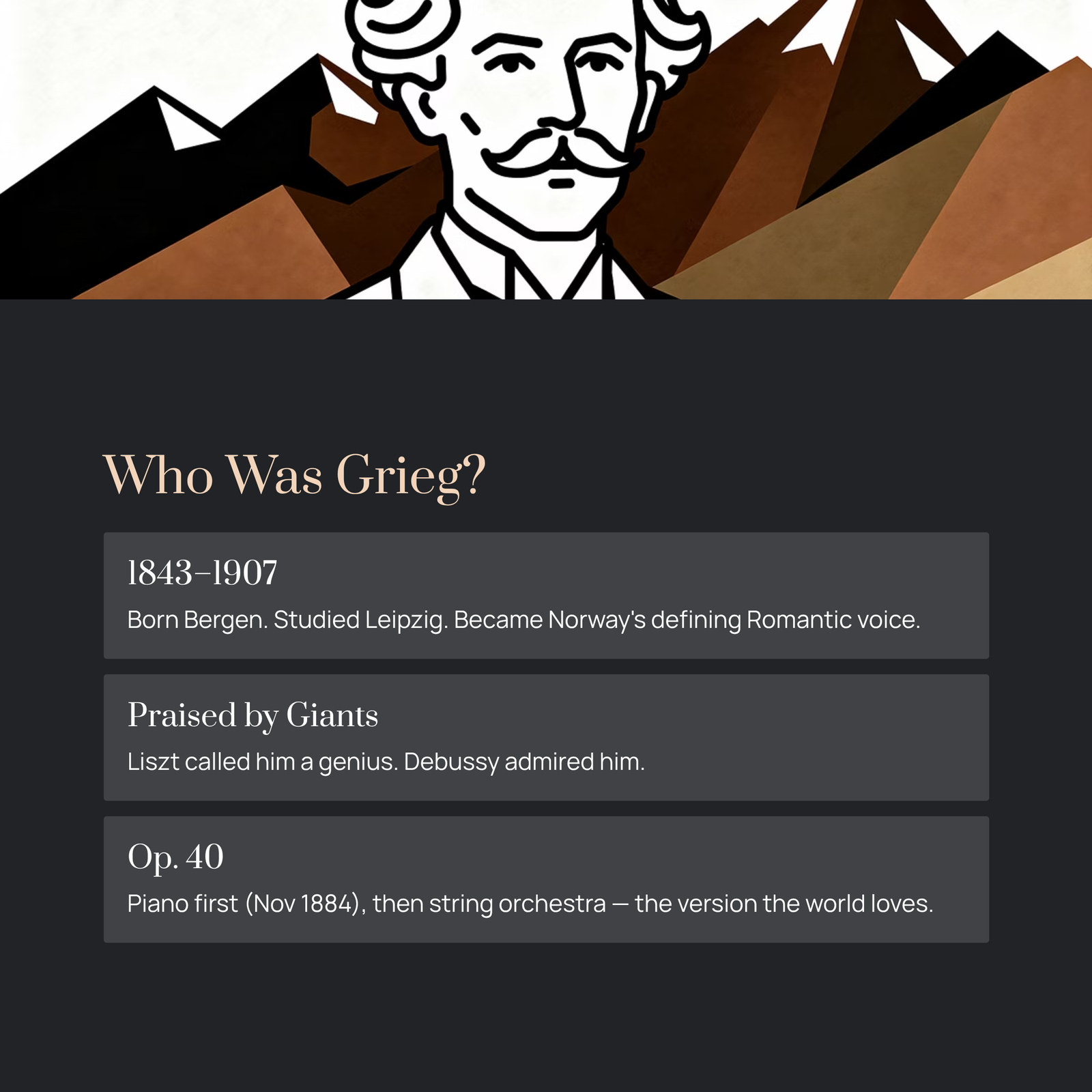
Edvard Grieg (1843–1907) was born in Bergen, Norway, and studied in Leipzig at the heart of the German musical tradition. He went on to become the defining voice of Norwegian Romantic music, most famous for his Piano Concerto in A minor and the Peer Gynt suites. Liszt called him a genius. Debussy admired him. His music feels like landscapes — wide, cold, and luminous.
But Grieg was also a careful craftsman with deep respect for earlier music. He knew Baroque counterpoint. He knew the dances — the Sarabande, the Gavotte, the Air. And when Bergen handed him an assignment, he decided that the most honest tribute to a writer of Holberg’s era wasn’t imitation: it was resurrection.
The result, From Holberg’s Time (Suite in the Olden Style, Op. 40), was first composed for solo piano in November 1884, then rearranged the following year for string orchestra — the version most people know today. The string version transformed a clever homage into one of the most joyful, physically alive pieces in the entire string repertoire.
What You’re About to Hear: The Prelude
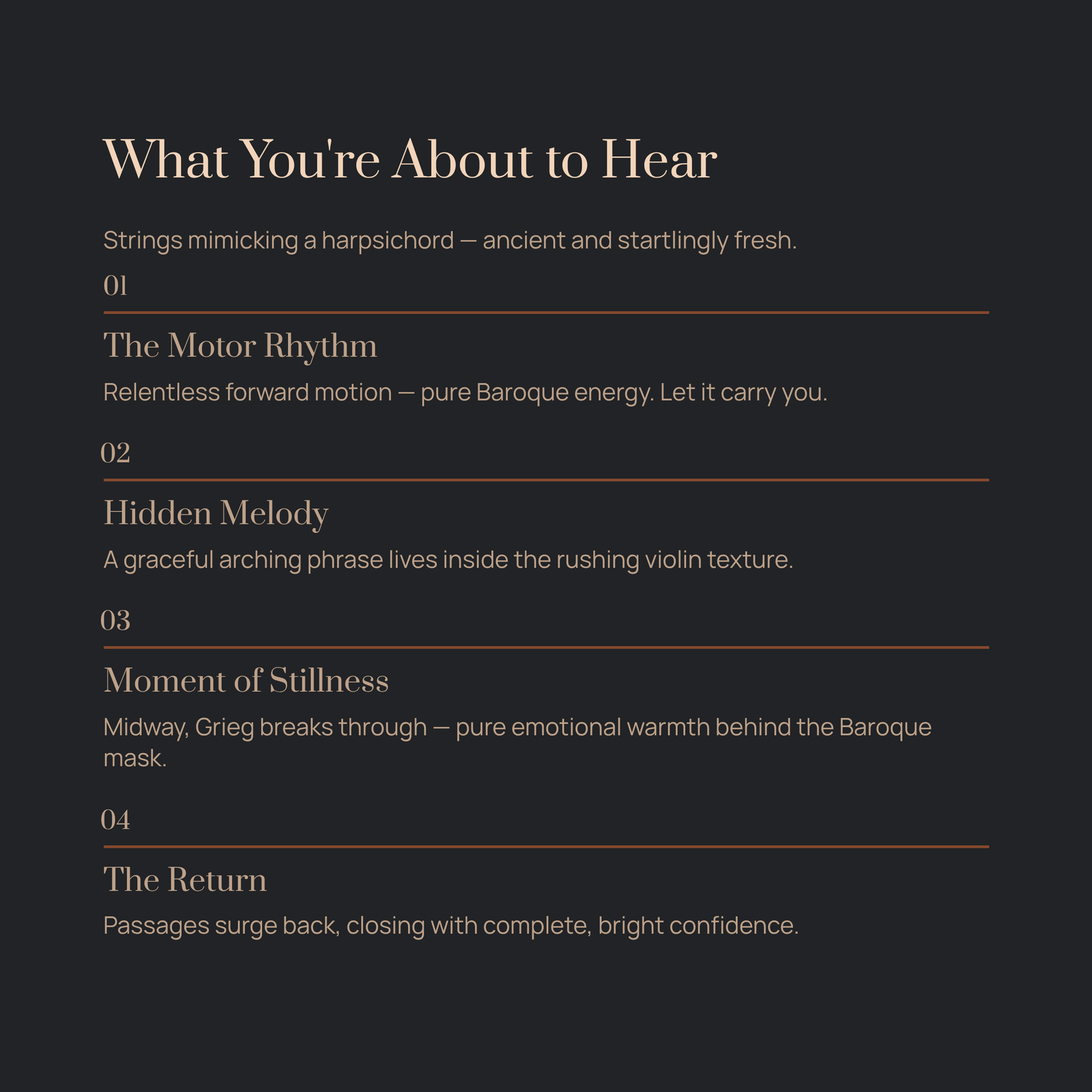
The Prelude opens with what sounds like a harpsichord — except it isn’t. It’s a string orchestra playing fast, rhythmically precise running passages that mimic the crisp articulation of Baroque keyboard writing. The violins climb and cascade, the cello provides a driving bass line, and the whole ensemble locks into a rhythmic pulse that feels both ancient and startlingly fresh.
Key things to listen for:
The motor rhythm. From the very first bar, there is an almost mechanical forward motion. This is characteristic of Baroque preludes — think of Bach’s Prelude in C major from The Well-Tempered Clavier. Grieg understood that Baroque energy comes from perpetual motion, not dramatic contrast. Let yourself be carried by the current rather than analyzing it.
The melodic line hiding inside the texture. Beneath the rushing passages, there is a clear singing melody. On first listen it can be hard to pick out — your ear might register only the texture. Try listening again, focusing on the highest notes of the violin. There it is: a graceful, arching phrase that repeats and develops across the movement.
The moment of stillness at the center. Roughly halfway through, the music briefly opens up — the rushing passages give way to a broader, more harmonically expressive passage. This is pure Grieg breaking through the Baroque costume. For just a moment, you hear the man behind the mask, and the emotional warmth is startling.
The return and the close. The running passages come back with renewed urgency, and the piece drives to a clean, bright ending. There is no ambiguity, no lingering. The Prelude knows exactly what it is, and it finishes with complete confidence.

Why a 19th-Century Romantic Wrote a Baroque Piece — and Why That Tension Is the Point
There is something quietly radical about what Grieg did here. In 1884, Romanticism was still in full swing. Brahms was writing his symphonies. Wagner had just opened Bayreuth. The musical world valued emotional expression, large orchestras, and personal confession.
Grieg chose austerity instead.
He chose counterpoint over harmony, clarity over texture, historical form over personal feeling. And yet — and this is what makes the Holberg Suite so fascinating — his Romantic identity keeps surfacing. The harmonies are not quite Baroque. The emotional temperature runs warmer than Bach would have allowed. The melancholy in the central Air movement is decidedly 19th-century.
The Prelude holds this tension in miniature. It sounds like the past, but it breathes like the present. It’s Grieg in disguise — and a very thin disguise at that.
For a first-time listener, this creates an unusual and delightful experience: the music feels familiar even if you’ve never heard it, because it draws on centuries of musical convention. But it also has a personality that is immediate, modern, and alive.
A Listening Guide for First-Timers
If you’ve never heard the Holberg Suite Prelude before, here’s a suggested approach:
First listen: Don’t analyze. Just follow the energy. Notice how your body responds to the rhythm. Let the motor drive you forward.
Second listen: Focus only on the bass line (the cello and double bass). Notice how it anchors the whole structure. The Baroque style is essentially a conversation between melody and bass — if you hear both at once, you’re hearing the architecture of the piece.
Third listen: Pay attention to the moment the texture opens up in the middle. This is the emotional pivot of the Prelude. Notice whether it feels like relief, surprise, or something else.
After three listens: Put on the full suite — Prelude, Sarabande, Gavotte, Air, and Rigaudon — and let it play through. The Prelude will mean more once you’ve heard what comes after it.
Recommended Recordings
For the string orchestra version, several recordings stand out as particularly good starting points:
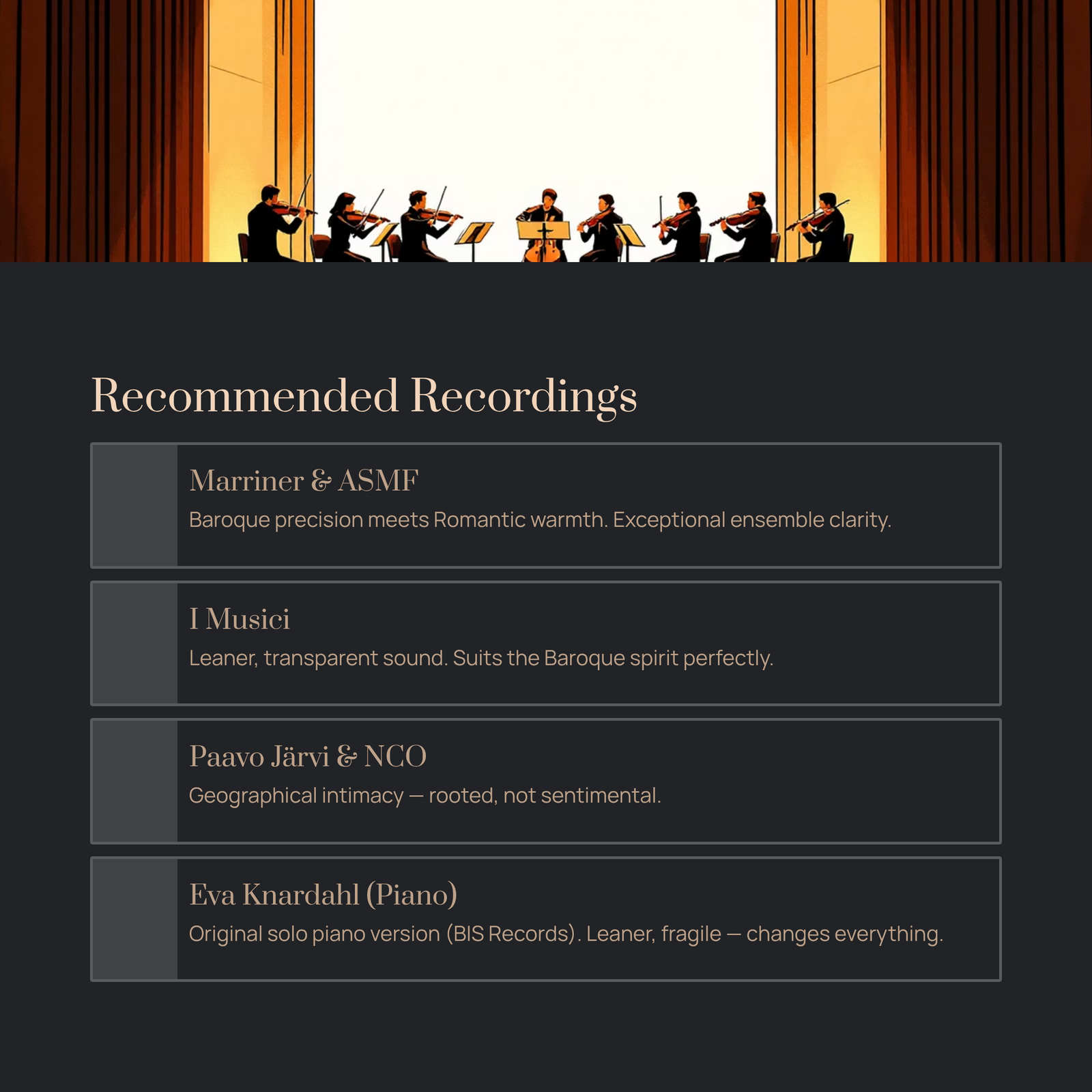
Neville Marriner and the Academy of St Martin in the Fields have recorded this suite multiple times over the decades, and their approach captures both the Baroque precision and the Romantic warmth that makes Grieg’s writing unique. The ensemble clarity is exceptional.
I Musici, the Italian chamber ensemble, offer a slightly leaner, more transparent sound that suits the Baroque spirit of the piece well. Their recording is widely available on streaming platforms and makes an excellent companion to the ASMF version.
Paavo Järvi conducting the Norwegian Chamber Orchestra brings an obvious geographical and cultural intimacy to the material. There is a sense of homecoming in their performance — not sentimental, but genuinely rooted.
For a different perspective, the original piano version performed by Eva Knardahl (Grieg’s complete piano works, BIS Records) reveals the piece’s origins and reminds you that this was written at a keyboard, not for an orchestra. It’s leaner and more fragile — and hearing it once will change how you listen to the string version.
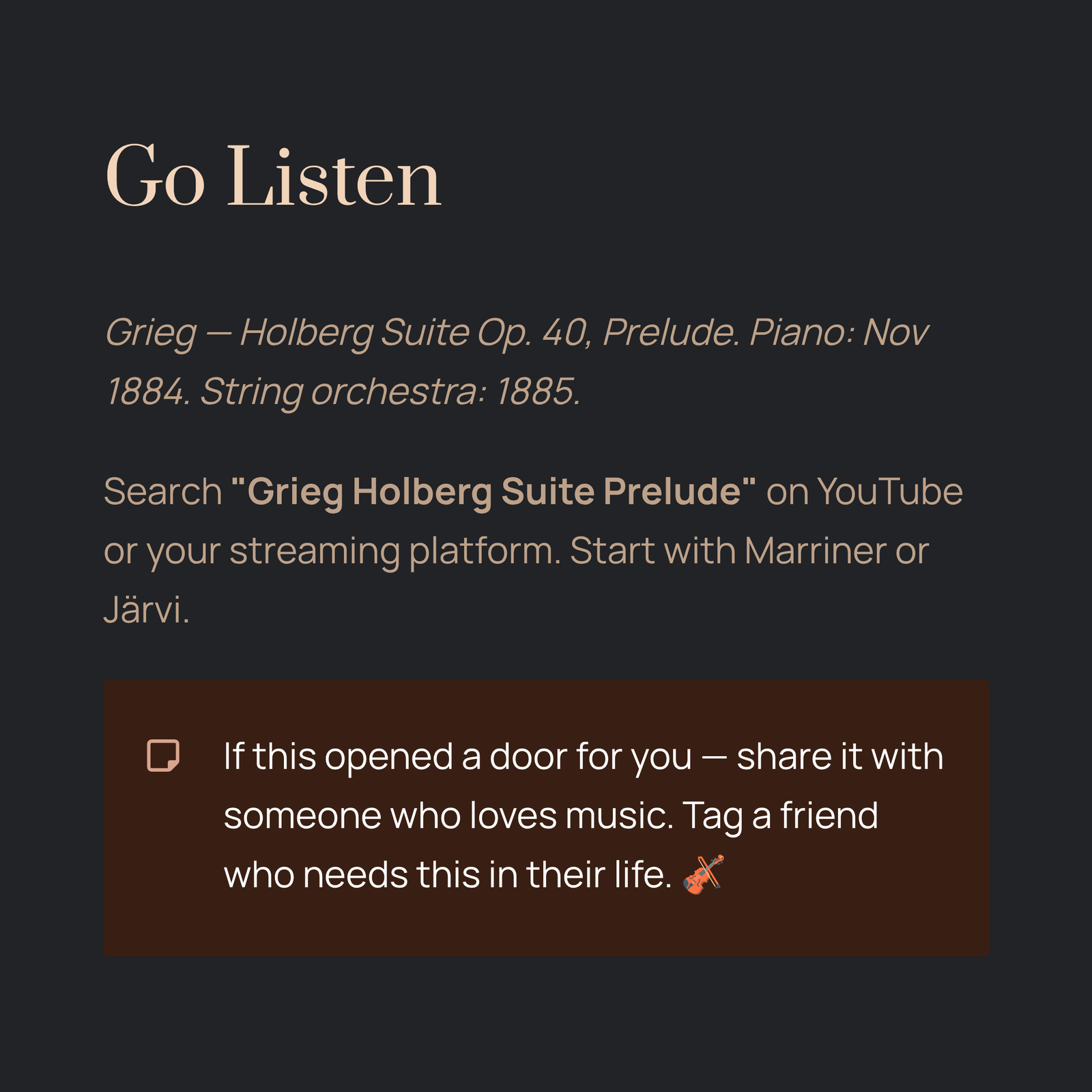
On YouTube, search “Grieg Holberg Suite Prelude” alongside any of the above ensemble names. Live concert recordings from the Oslo Philharmonic chamber performances are also readily available and visually engaging for new listeners.
What the Prelude Teaches Us About Time
There is a philosophical undertow to the Holberg Suite that only becomes apparent with time and repeated listening.
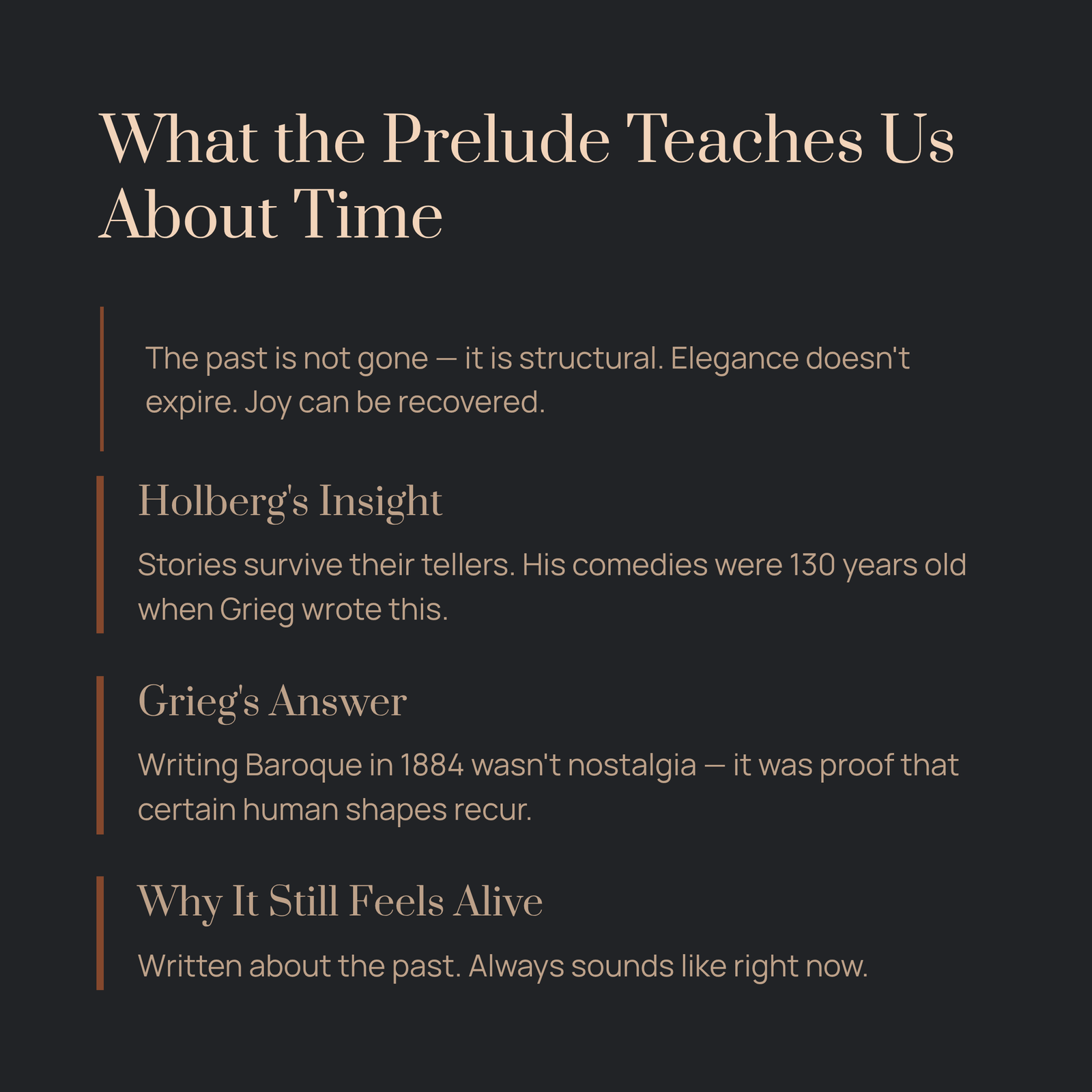
Holberg himself was a playwright — a man who understood that stories survive their tellers. His comedies were already 130 years old when Grieg wrote this music. Yet Grieg found in them something worth preserving: a way of thinking about human life that was formal, witty, and clear-eyed.
The Prelude, in its own way, makes the same argument about music. It says: the past is not gone, it is structural. It lives inside the forms we inherit. When Grieg writes a Baroque prelude in 1884, he is not being nostalgic — he is demonstrating that certain shapes of human experience recur, that elegance doesn’t expire, that joy can be recovered.
When the violins begin their rushing, precise, forward-moving dance, they are not recreating the 18th century. They are saying something about momentum itself — about how music carries us forward even when it looks backward.
That, perhaps, is why the Prelude feels so alive every time you hear it, regardless of when or where you encounter it. It was written about the past, but it always sounds like right now.
Edvard Grieg — Holberg Suite Op. 40 (From Holberg’s Time): Prelude. Originally composed November 1884 for piano solo; arranged for string orchestra 1885.