📑 Table of Contents
There is a particular kind of loneliness that only happens when you are surrounded by people. You laugh at the right moments, you nod, you belong to the scene — and yet some essential part of you is standing just outside the window, looking in. On My Own is the sound of that exact feeling.
Most of us first met this melody with Éponine’s voice draped over it, walking imaginary streets in the rain, loving a boy who would never look back. But strip the lyrics away, and something surprising happens. The instrumental version doesn’t lose the story — it deepens it. Without words telling us what to feel, the melody itself becomes the confession. The strings do the longing. The swelling middle section does the dreaming. And that quiet, deflated ending does the heartbreak no lyric could improve upon.
If you’ve never paid attention to musical theater as “serious” music, this is a perfect doorway. You don’t need to know the plot. You only need to have wanted something you couldn’t have.
The Composer Who Made the World Cry in Every Language
Les Misérables is so woven into global culture that we sometimes forget a person actually wrote it. That person is Claude-Michel Schönberg, a French composer born in 1944 to Hungarian-Jewish parents who had emigrated to France.
Before Les Mis, Schönberg was a record producer and pop songwriter — even a chart-topping singer in France. He wasn’t a conservatory-trained “classical” composer in the traditional sense, and that turns out to matter. His gift is melody that lodges itself in your memory on the first listen, the way a great pop song does, married to the emotional scale of opera.
Working with his longtime collaborator, lyricist Alain Boublil, Schönberg first staged Les Misérables in Paris in 1980. It was the English-language version, produced in London in 1985, that turned it into one of the most performed musicals in history. On My Own belongs to Éponine, a poor young woman hopelessly in love with Marius, who loves someone else. It is, by design, the song of the overlooked.
Why It Sounds the Way It Sounds
You don’t need to read music to understand what makes this melody devastating — you just need a few anchors to listen for.
The piece is built in what’s called a minor key, the tonal “color” we instinctively hear as sad or serious. But Schönberg’s trick is restraint. The melody begins low and small, almost like someone speaking quietly to themselves. It climbs gradually, gaining confidence and warmth as it reaches the middle — the musical equivalent of imagining a happy ending so vividly it feels real.
And then it doesn’t get one. The melody returns to where it started, the dream collapses back into reality, and the final notes settle without triumph. In the sung version, this is where Éponine admits the love exists “only in my mind.” In the instrumental, the music alone delivers that gut-punch. Nothing is resolved; it simply ends, the way real disappointment usually does — not with a bang, but with quiet acceptance.
A Listening Guide for Your First Time
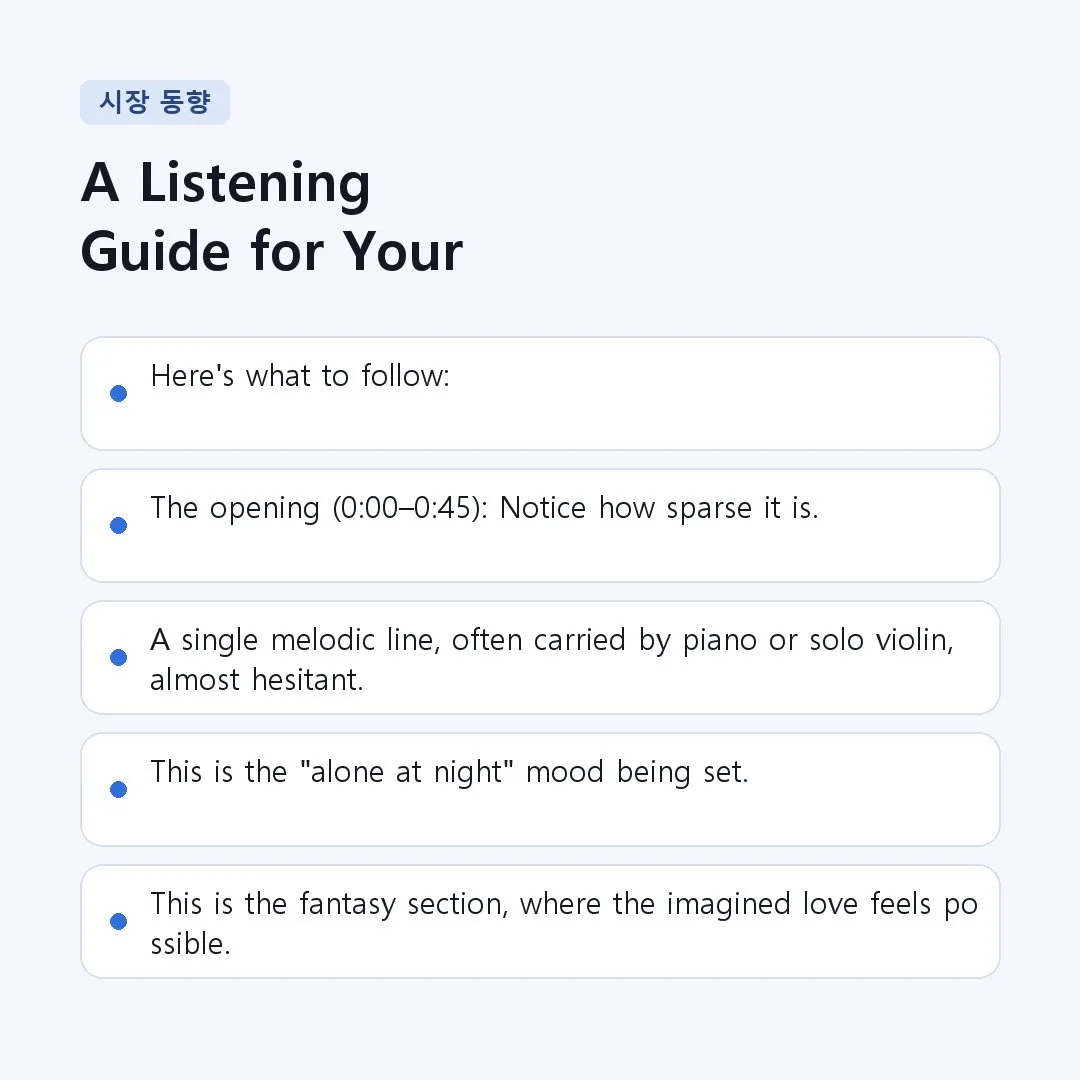
Find a recording around three to four minutes long and give it your full attention once through. Here’s what to follow:
The opening (0:00–0:45): Notice how sparse it is. A single melodic line, often carried by piano or solo violin, almost hesitant. This is the “alone at night” mood being set. Don’t rush it.
The build (around 0:45–2:00): Listen for the arrangement filling in — more strings entering, the volume and emotional temperature rising. This is the fantasy section, where the imagined love feels possible. Let yourself get carried up with it.
The peak and the fall (around 2:00–2:45): There’s usually one soaring high point, the most “hopeful” moment of the whole piece. Pay close attention to what happens right after it — the gentle deflation. That descent is the entire emotional argument of the song.
The ending: Wait for the final note. Notice that it doesn’t feel like a victory. That ache is intentional.
Where to Begin Listening
Because this melody exists in dozens of forms, your choice of recording shapes the whole experience.
For pure orchestral beauty, look for the symphonic and “Les Misérables in Concert” arrangements, where a full string section gives the melody a cinematic sweep — ideal if you want to be swept away.
For something more intimate, seek out solo piano arrangements, widely available from many classical pianists. Here the loneliness is at its most bare and personal, perfect for late-night listening or quiet focus.
For violin lovers, there are gorgeous solo violin renditions where the instrument’s singing, voice-like quality makes the wordlessness feel completely natural — as if the violin is doing the crying so you don’t have to.
If you want to understand why the instrumental hits so hard, listen once to a celebrated vocal version — Frances Ruffelle, who originated Éponine, or Lea Salonga from the 10th Anniversary Concert — and then return to the instrumental. You’ll hear the words even in their absence.
The Beauty of Loving Quietly
What makes On My Own endure isn’t its sadness, exactly. It’s the dignity inside the sadness. Éponine never demands to be loved back. She simply allows herself, for the length of one melody, to imagine that she is — and then gracefully lets the dream go.
There’s something deeply human in that. We all carry a few of these private songs: the things we wanted, the people who never knew, the lives we pictured in passing. The instrumental version of On My Own gives that feeling a place to live for four minutes, no explanation required.
So the next time you feel like the one standing outside the window, press play. You won’t feel less alone, necessarily. But you’ll feel understood — and sometimes that’s the more precious thing.