📑 Table of Contents
If someone told you that the most beginner-friendly gateway into the entire world of opera was written by a composer whose work was initially booed off the stage — would you believe them?
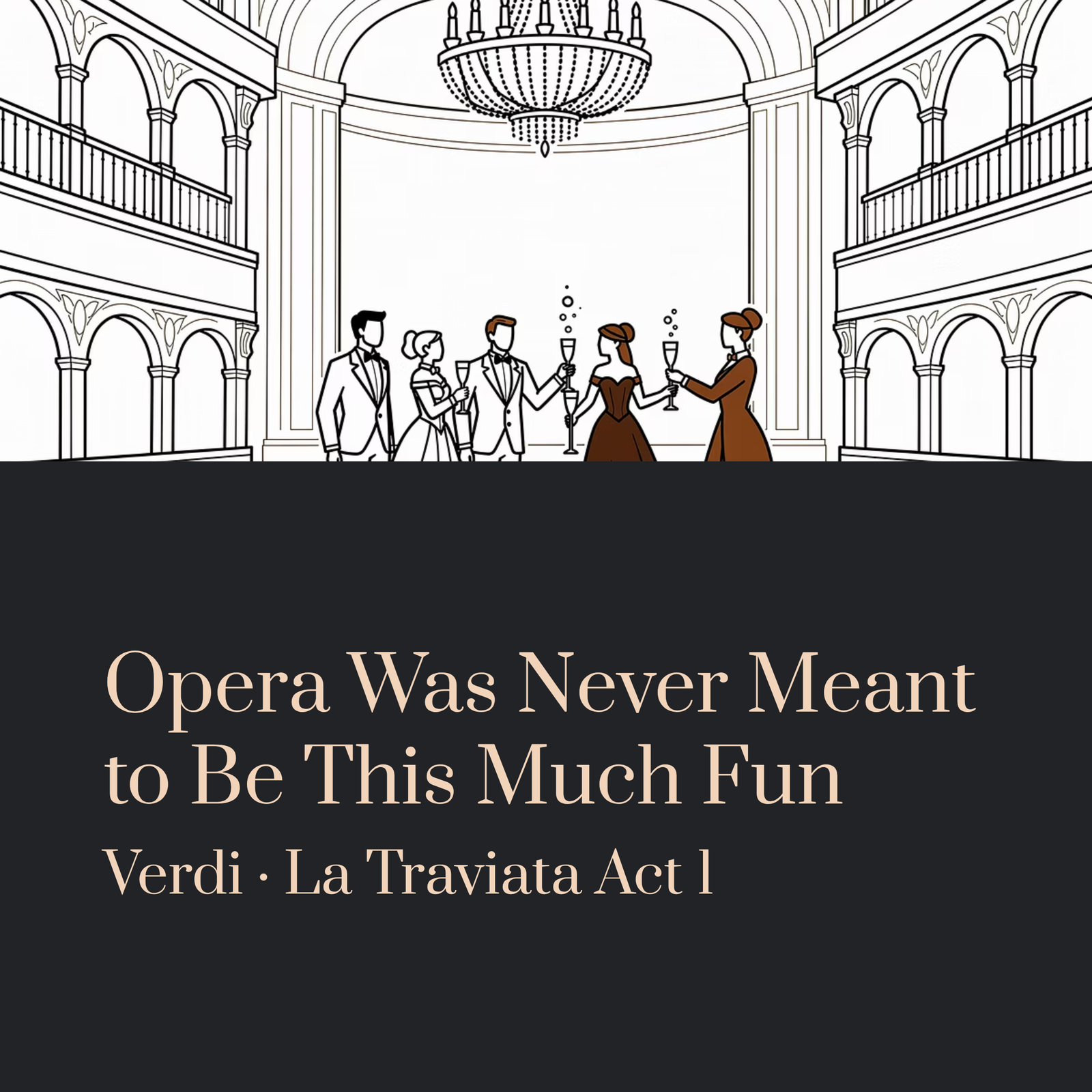
That’s exactly the story of Giuseppe Verdi and La Traviata. And its Act 1, in particular, holds something so immediate, so physically joyful, that it almost feels wrong to call it “classical music.” It feels more like the best party you were never invited to.
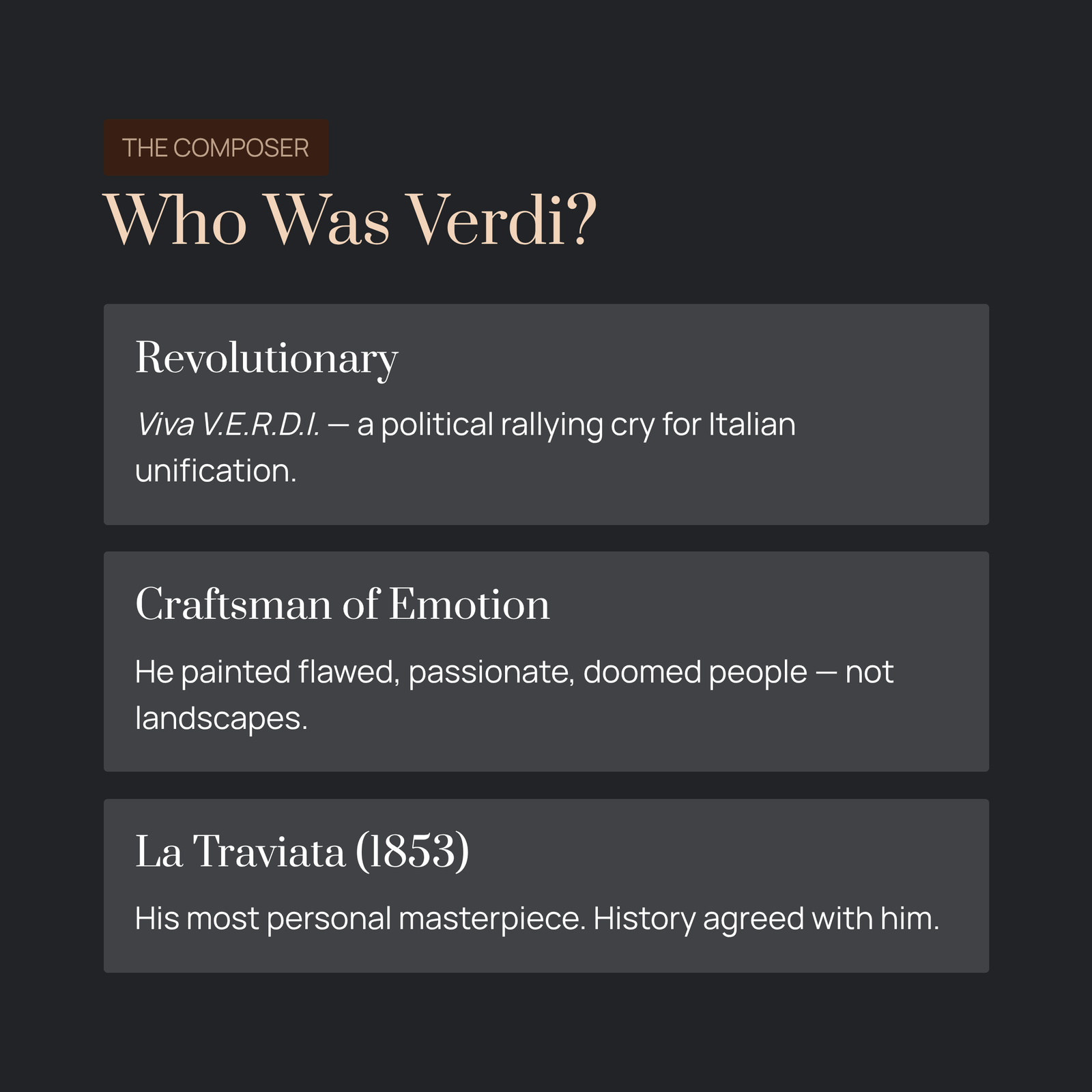
Who Was Verdi, and Why Should You Care?
Giuseppe Verdi (1813–1901) is one of those figures who doesn’t just belong to music history — he belongs to Italian national identity. Born into a modest family in a small village near Parma, he would go on to become the sonic voice of a people fighting for their own unified country. His name even became a political rallying cry: Viva V.E.R.D.I. was scrawled on walls across northern Italy, an acronym for Vittorio Emanuele Re D’Italia — “Victor Emmanuel, King of Italy.” The composer was, quite literally, a revolutionary.
But Verdi wasn’t content being a symbol. He was, first and foremost, a craftsman of human emotion. Where some composers paint landscapes or philosophical abstractions, Verdi painted people — flawed, passionate, doomed, magnificent people. He had an uncanny ability to write a melody that seemed to bypass the rational mind entirely and reach straight into the chest.
La Traviata, premiered in Venice in 1853, is perhaps his most personal masterpiece. Based on Alexandre Dumas fils’ scandalous novel La Dame aux Camélias, it tells the story of Violetta Valéry — a celebrated Parisian courtesan who dares to fall in love, and pays the full price for that daring. The opera was controversial from the first moment: depicting a contemporary woman of “ill repute” as a sympathetic, noble protagonist was a provocation that outraged Venetian audiences at the premiere. Verdi reportedly shrugged and said history would be the judge.
History agreed with him.
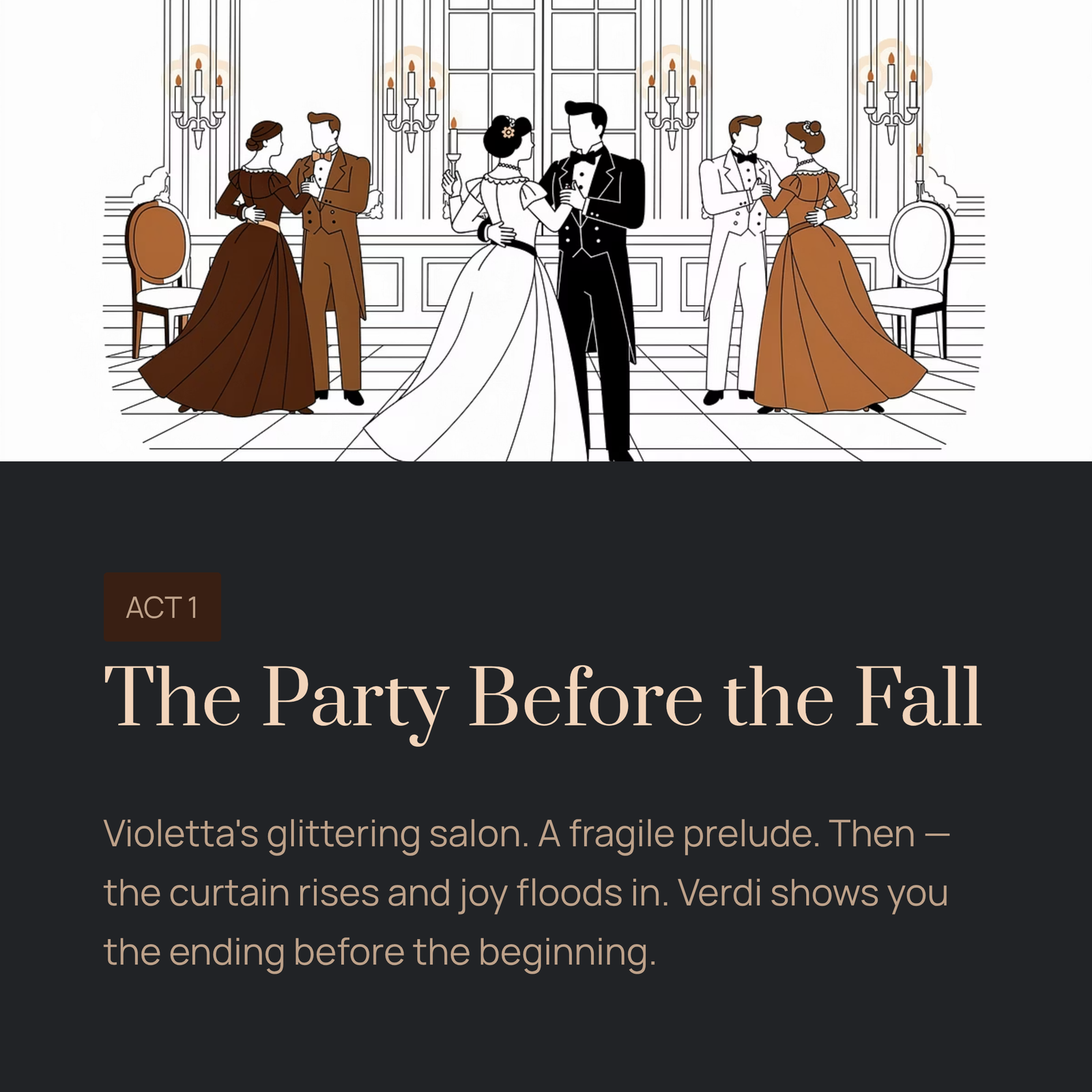
Act 1: The Party Before the Fall
Before the heartbreak, before the tuberculosis, before the devastating farewell — there is a party.
Act 1 takes place in Violetta’s Parisian salon, a glittering late-night gathering of aristocrats, artists, and pleasure-seekers. Into this world walks Alfredo Germont, a young man hopelessly in love with a woman who has made a profession of keeping men at a safe emotional distance. The dramatic machinery is primed. But Verdi, brilliantly, makes you forget that for a while.
The music of Act 1 is suffused with a kind of euphoric, slightly reckless lightness. The opening prelude is a brief, fragile thing — strings floating above a quiet pulse — that foreshadows the opera’s tragic end before immediately giving way to the sounds of festivity. It’s a structural masterstroke: Verdi shows you the ending before the beginning, then pulls the curtain aside to reveal the ball in full swing. The contrast is devastating in retrospect, and intoxicating in the moment.
This is music designed to make your body respond before your mind catches up.
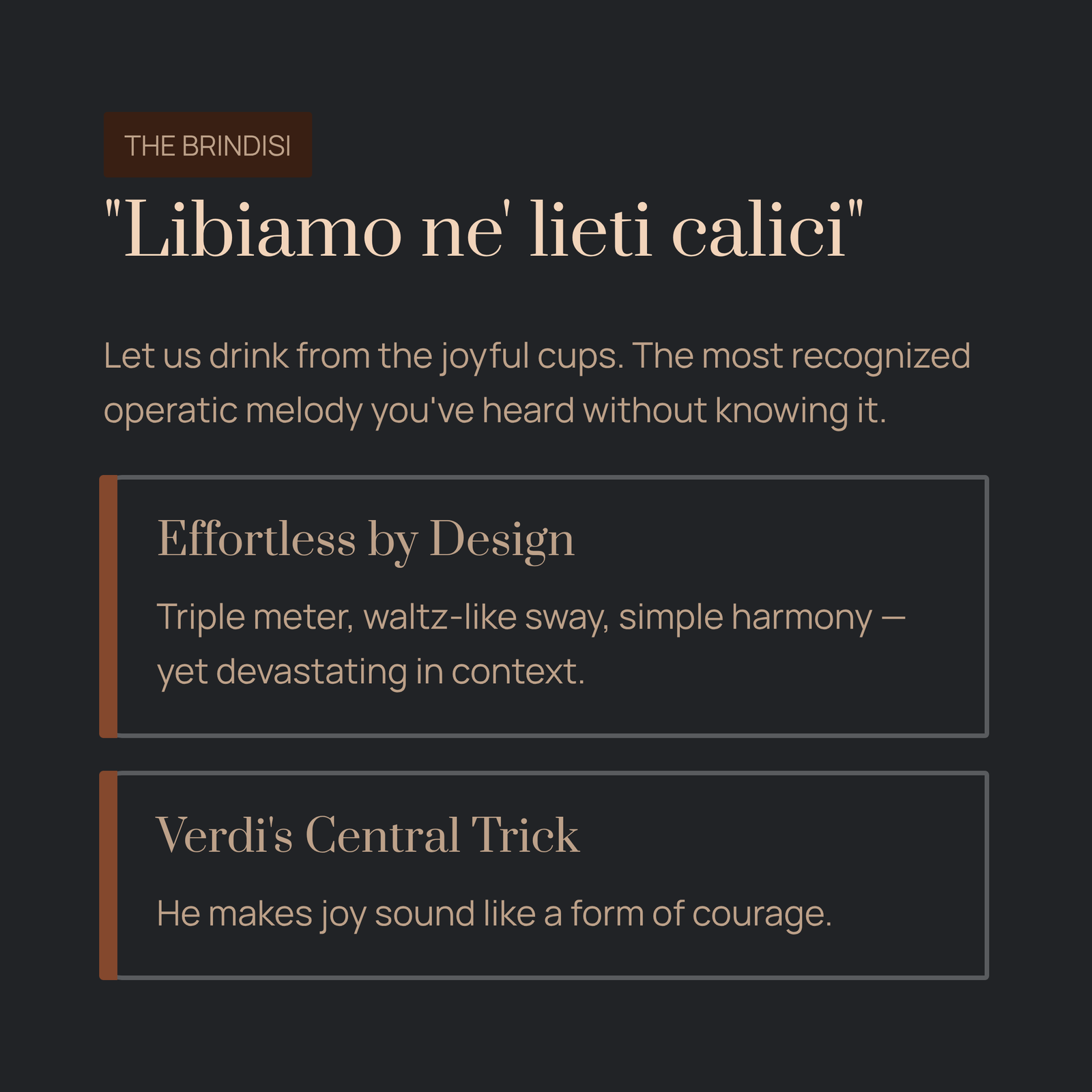
The Brindisi: A Toast That Echoes Through History
If you have ever heard one piece of operatic music without knowing what it was, there is a reasonable chance it was this: the Brindisi — the drinking song — from Act 1 of La Traviata.
“Libiamo ne’ lieti calici” (“Let us drink from the joyful cups”) is the moment Alfredo raises a glass to life, love, and beauty, and Violetta — initially performing the role of the charming hostess — begins, almost imperceptibly, to mean what she’s singing. The melody passes between them, traded back and forth like a game that slowly stops being a game. The chorus joins in. The tempo lifts. The whole room seems to tilt slightly toward joy.
What Verdi understood about this moment is something that takes most composers a lifetime to learn: that the most affecting music is often the music that feels effortless. The Brindisi sounds like something people invented on the spot, collectively, because the night demanded it. Its triple meter gives it the gentle sway of a waltz. Its harmonic language is uncomplicated, even simple. And yet in context — knowing what is coming, knowing what Violetta is beginning to feel and beginning to fear — it becomes heartbreaking in its brightness.
This is Verdi’s central trick, and it never gets old: he makes joy sound like a form of courage.
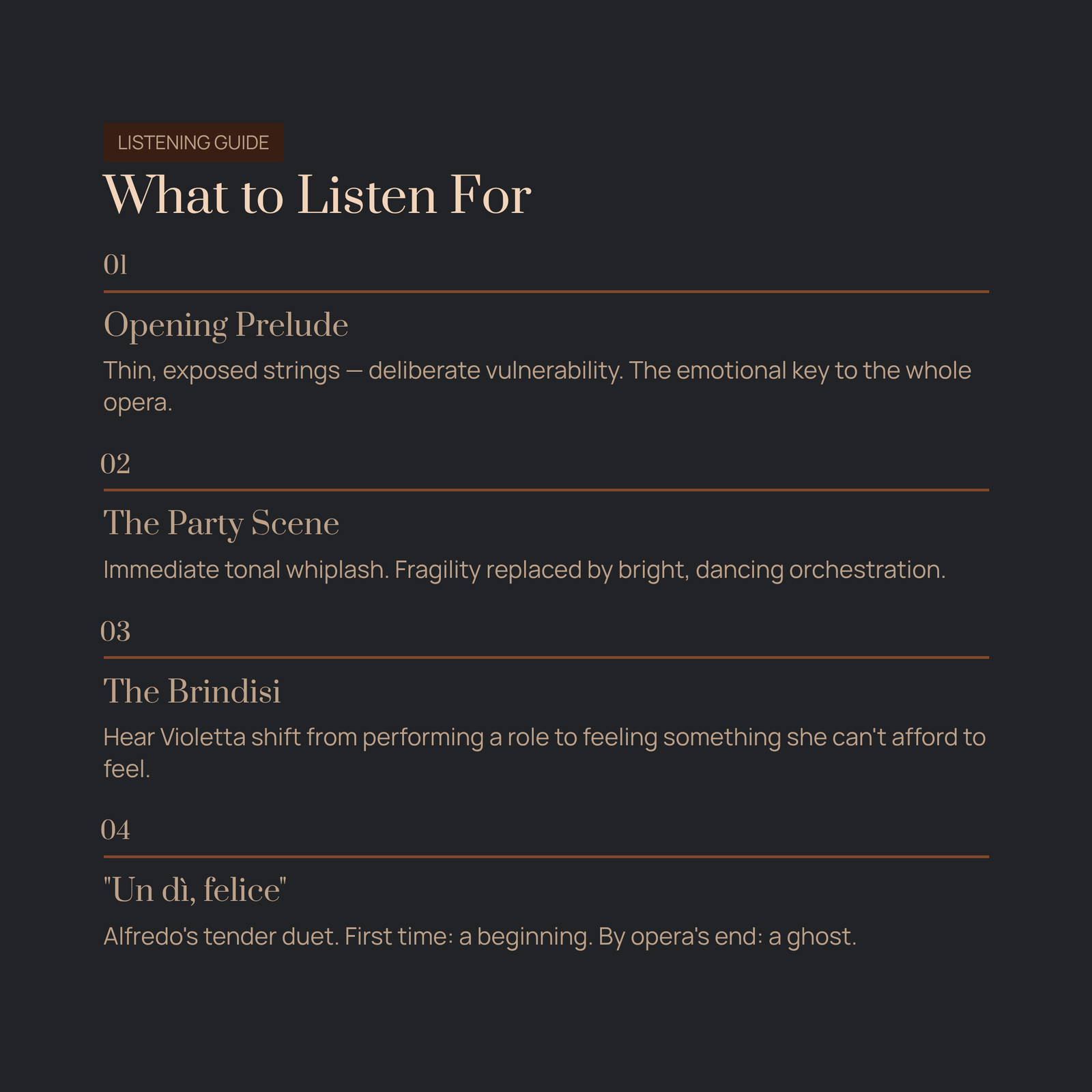
What to Listen For: A Beginner’s Listening Map
If you’re new to opera and to La Traviata specifically, here is a practical guide to what to notice as Act 1 unfolds.
The Opening Prelude (before any singing begins): Listen to how thin and exposed the strings sound — this is deliberate vulnerability. Verdi is giving you the emotional key to the entire opera in about three minutes, before you even meet any of the characters. Some conductors play this almost inaudibly. Let it wash over you without trying to understand it.
The transition into the party scene: Notice the immediate tonal shift when the curtain rises. The fragility vanishes, replaced by bright, dancing orchestration. This whiplash is intentional — Verdi is showing you how Violetta herself functions: she performs lightness while carrying weight.
The Brindisi itself: Pay attention to the way Violetta’s voice changes between her first verse and her later reprises. In skilled performances, you can hear the difference between a woman playing a role and a woman starting to feel something she can’t afford to feel. Anna Netrebko’s 2005 Vienna recording with Carlo Rizzi conducting is particularly good at drawing out this ambiguity.
The duet “Un dì, felice”: After the party noise, Alfredo and Violetta find a quieter corner, and the music follows them there. This is where the opera shifts from festive spectacle to intimate drama. The melodic line Alfredo sings here — tender, almost tentative — will return transformed later in the opera. The first time you hear it, it sounds like a beginning. By the opera’s end, it sounds like a ghost.
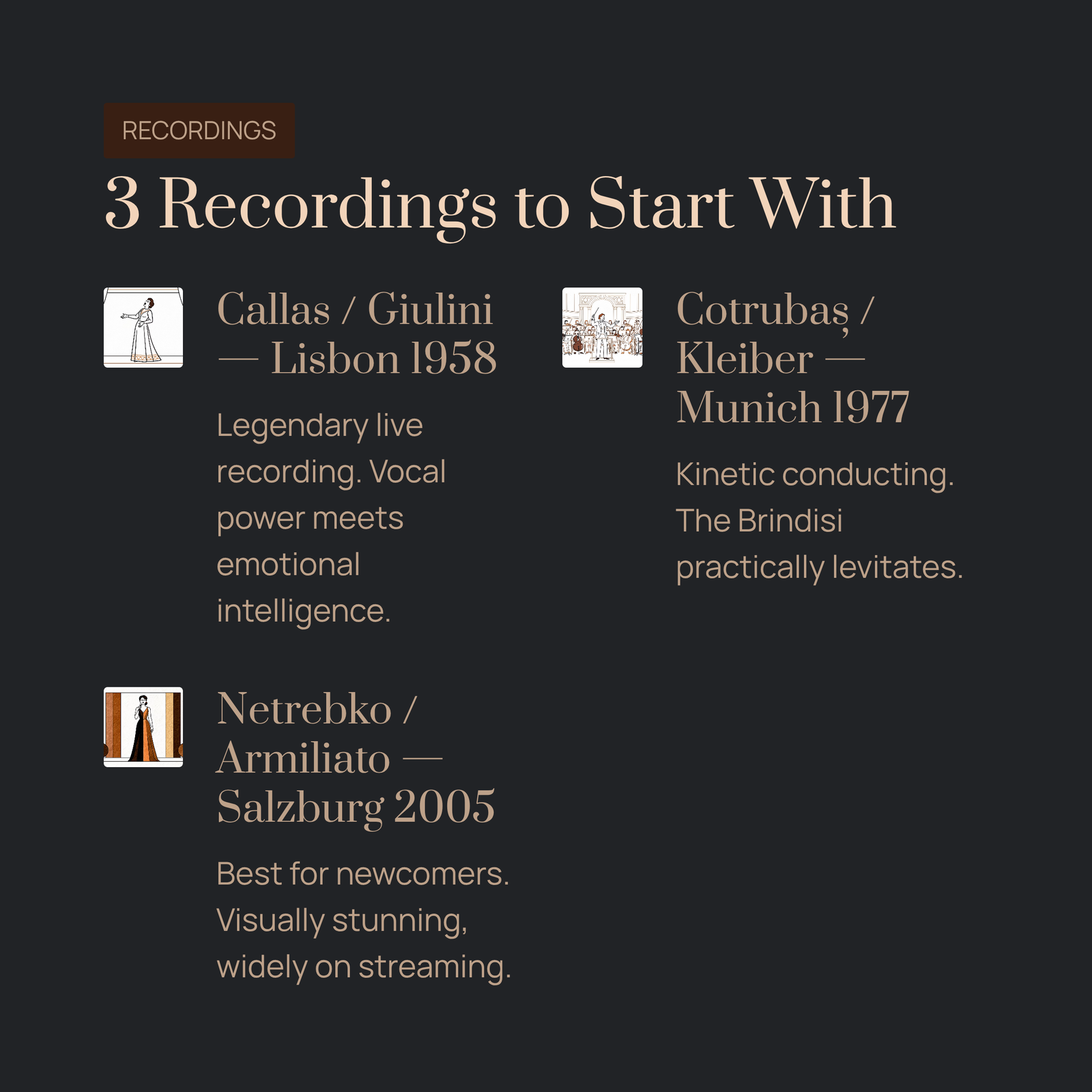
Recommended Recordings and Performances
For a first encounter with La Traviata Act 1, three recordings stand out as particularly accessible without sacrificing depth.
Carlo Maria Giulini / Maria Callas / Alfredo Kraus (1958, Lisbon): This live recording has a legendary status for good reason. Callas at this stage of her career brings an almost unbearable combination of vocal power and emotional intelligence to Violetta. The imperfections of the live recording actually serve the music — this feels like a real night, not a studio product.
Carlos Kleiber / Ileana Cotrubaș / Plácido Domingo (1977, Bavarian State Opera): Kleiber’s conducting is uniquely kinetic — the Brindisi practically levitates under his baton, and Cotrubaș brings a Violetta who is simultaneously worldly and heartbreakingly young. This video recording is widely available and remains visually and musically stunning.
Marco Armiliato / Anna Netrebko / Rolando Villazón (2005, Salzburg): For viewers new to opera who want a production that is also visually compelling, this Salzburg staging directed by Willy Decker is the contemporary reference point. Netrebko’s Violetta is vocally sumptuous and dramatically vivid. This is also the most widely available on streaming platforms.
Why Act 1 Is the Perfect Entry Point
There is a common misconception that opera is inaccessible — that you need special training, cultural knowledge, or a tolerance for unintelligible foreign languages to appreciate it. La Traviata Act 1 is Verdi’s implicit argument against all of that.
The pleasures of Act 1 are immediate and physical: the lift of the Brindisi rhythm, the warmth of the tenor voice against the shimmer of the soprano, the way the whole orchestra seems to exhale at certain moments. You don’t need to understand Italian. You don’t need to know the plot. You don’t even need to like opera.
You just need to be willing to sit at the party for a few minutes before it ends.
And then, if you find yourself wanting to know what happens next — if you find yourself caring what becomes of Violetta, why that fragile prelude sounded the way it did, what it costs to be that alive in the face of everything — then Verdi has already done his work.
Act 1 is the room where he lowers your guard. The rest of the opera is what he does once it’s down.
A Note on “Summer Music”
Act 1 of La Traviata has sometimes been described by music writers as carrying the quality of high summer — not the languid, nostalgic summer of late August, but the reckless, almost violent brightness of midsummer at its peak. There’s a reason for this: the music has the quality of a moment that knows it cannot last.
The party is perfect. The night is warm. Someone is falling in love. And somewhere underneath all of it, the prelude’s quiet strings are still sounding — barely audible, but there.
That’s the genius of Verdi. He never lets you forget, even in the middle of a toast, that summer ends.