Table of Contents
Have you ever stood before something beautiful, knowing it might be the last time you’ll see it?
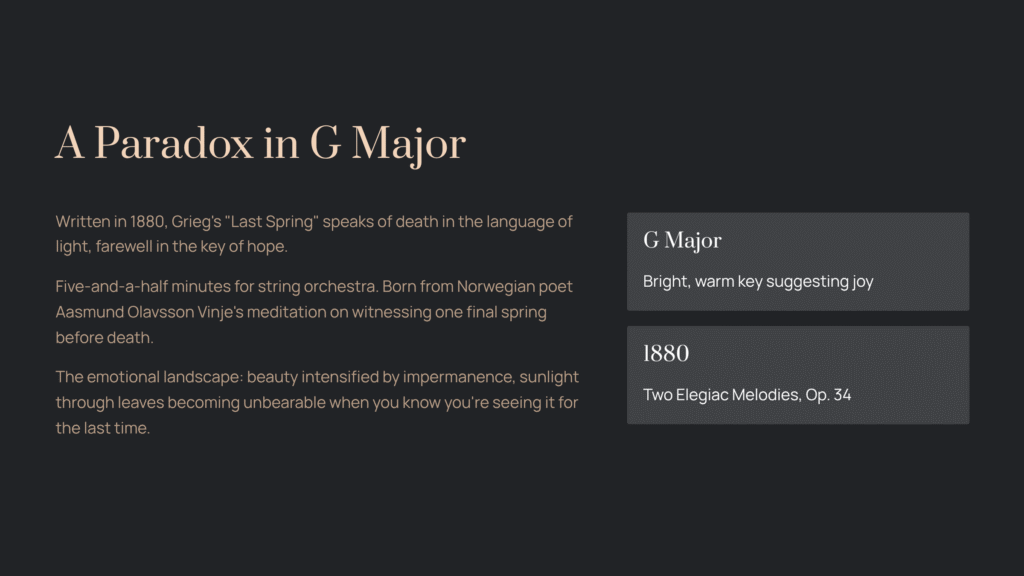
That question lives at the heart of Edvard Grieg’s “Last Spring,” the second movement of his Two Elegiac Melodies, Op. 34. Written in 1880, this five-and-a-half-minute piece for string orchestra carries within it a peculiar paradox: it speaks of death in the language of light, of farewell in the key of hope. It’s music that knows how to hold two truths at once—that spring returns, and that we might not.
I’ve always found it strange how certain pieces refuse to behave the way they should. Grieg’s “Last Spring” is written in G major, a bright, warm key that typically suggests joy or triumph. Yet this is music born from a poem about dying—specifically, from Norwegian poet Aasmund Olavsson Vinje’s meditation on witnessing one final spring before death. The emotional landscape it creates isn’t simple grief. It’s something more complex: the ache of beauty intensified by impermanence, the way sunlight through leaves becomes almost unbearable when you know you’re seeing it for the last time.

The Voice Behind the Music
Before Grieg transformed it into a string orchestra piece, “Last Spring” existed as a song—one of his Twelve Songs, Op. 33, composed for voice and piano. The original poem by Vinje captures a soul caught between seasons: winter melting away, spring returning with its “many joys,” yet the speaker feels themselves “heavy-hearted,” preparing to “from this world sever.”
What draws me to Vinje’s text is its refusal to dramatize. There’s no rage against the dying of the light here, no desperate clinging. Instead, there’s quiet observation, an almost meditative acceptance threaded with longing. The speaker wants to taste spring’s joys “once again” before they fade “forever”—not because spring itself will end, but because their ability to witness it will.
Grieg understood this deeply. Rather than setting this text to minor-key melancholy, he chose to honor the beauty being observed, not just the loss being anticipated. The result is music that glows even as it grieves.

How the Music Breathes
Listen to how “Last Spring” begins: a gentle swell from the first violins, like the sun breaking through morning mist. The melody is simple, almost folk-like in its directness—this is Grieg’s Norwegian soul speaking, his connection to the landscapes and musical traditions of his homeland. The string sound is transparent, warm, uncluttered. It feels like memory itself, soft-edged and golden.
The piece unfolds in two verses, like stanzas in a poem. But here’s where Grieg’s genius emerges: each verse transforms the same melodic material through different orchestration, creating the sensation of deepening emotion without changing the fundamental truth being expressed.
In the first verse, we hear the theme stated clearly, almost tenderly. The first violins carry the melody while the lower strings provide gentle harmonic support. There’s spaciousness in this texture—room for contemplation, for the listener’s own memories to drift in. This is spring as we remember it from childhood, perhaps, uncomplicated and full.
But in the second verse, something shifts. The violins divide into four separate voices, climbing into higher registers. Gradually, the cellos enter, then the violas, then the double basses—each addition enriching the harmonic landscape until the full string orchestra is engaged. The same melody is now draped in layers of color, its emotional weight multiplied. What was once simple remembrance becomes overwhelming presence. This is the moment when nostalgia becomes too much to bear, when the beauty of what we’re about to lose fills the entire frame of vision.
Grieg creates what I think of as “cumulative intimacy”—the piece starts close and personal, then gradually reveals its full depth, like walking from a sunlit clearing deeper into a forest where light filters through countless leaves.

The Architecture of Longing
What makes “Last Spring” so affecting isn’t complexity—there are no dramatic key changes, no virtuosic displays, no sudden dynamic shocks. Instead, Grieg works with the most fundamental elements: melody, harmony, and the gradual intensification of texture.
Think of it as emotional pointillism. Each string instrument adds its voice not to create contrast but to deepen a single, unified feeling. When the second verse reaches its climax and all the strings are singing together, it’s not loud in the aggressive sense. It’s full—the way a room becomes full when it’s packed with people you love, everyone speaking at once in warm overlapping voices.
The genius lies in Grieg’s restraint. He never pushes the piece into the territory of theatrical grief. There’s no Tchaikovsky-style emotional excess here, no Wagner-esque turbulence. Instead, the music maintains its composure even as it swells, like someone determined to witness beauty clearly even through tears.
This is particularly striking when you consider what Grieg chose not to do. He could have modulated to minor keys for the second verse, creating obvious contrast. He could have introduced dramatic rhythmic changes or angular melodies. Instead, he trusted that the same gentle theme, simply clothed in richer harmonies, would be enough. And it is.
Listening as Presence
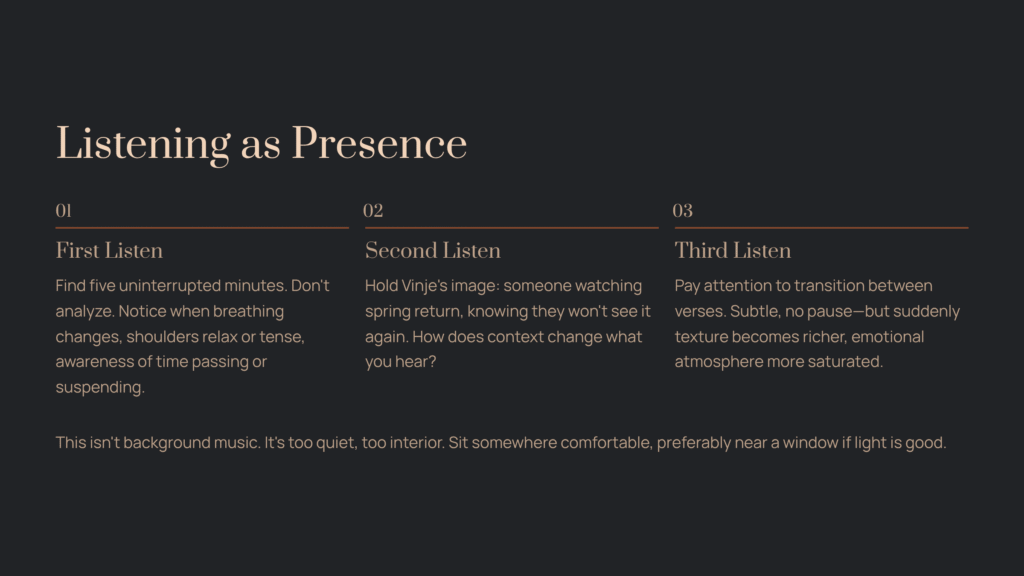
So how do you approach a piece like this? My suggestion: don’t treat it as background music for the first few listens. This isn’t music that reveals itself while you’re doing dishes or scrolling through email. It’s too quiet, too interior for that.
Find five and a half uninterrupted minutes. Sit somewhere comfortable, preferably near a window if the light is good. Close your eyes if that helps, or keep them open—whatever makes you more present.
On your first listen, don’t analyze. Simply let the music move through you. Notice when your breathing changes, when your shoulders relax or tense, when you become aware of time passing or when time seems to suspend itself. These physical responses are the music working on you before your conscious mind catches up.
For your second listen, hold Vinje’s central image in mind: someone watching spring return, knowing they won’t see it again. How does this context change what you hear? Do the bright major-key harmonies now carry an edge of poignancy they didn’t before?
On your third listen, pay attention to the moment of transition between the two verses. It’s subtle—there’s no pause or dramatic shift—but suddenly the texture becomes richer, the emotional atmosphere more saturated. This is where Grieg moves from remembering spring to being overwhelmed by the memory of spring. Can you feel that difference?

The Recordings Matter
While “Last Spring” exists in several arrangements—for piano solo, for violin and piano—I’d recommend beginning with a full string orchestra version. The interplay of multiple string voices is essential to the piece’s emotional arc.
Some recordings I find particularly affecting lean toward warmer, more resonant sound. Others emphasize transparency and clarity. Neither approach is “correct”—they reveal different facets of the same emotional truth. A warmer recording might emphasize the comfort and beauty of the memory itself. A clearer, more transparent recording might highlight the fragility of that beauty, its precariousness.
What matters most is that you give the piece room to work. This isn’t music that grabs you by the lapels. It waits, patiently, for you to meet it halfway.

What Remains
Here’s what stays with me about “Last Spring”: its refusal to choose between acceptance and longing. So much music about loss feels like it’s trying to convince us of something—that death is tragic, that separation is unbearable, that we should rage or resign ourselves. Grieg does neither.
Instead, he offers us a space where both beauty and its passing can coexist. Where we can hold the knowledge that everything ends alongside the equally true knowledge that, for now, it’s still here. The spring in this music doesn’t belong to the past or future—it exists in that suspended present tense of memory, where things are always simultaneously still happening and already gone.
Maybe that’s why Grieg chose a major key. Not to deny the sadness, but to honor the thing itself, not just its loss. To say: this spring was real, its beauty was real, and that beauty doesn’t disappear just because we do.
When the piece ends—and it ends softly, without flourish, the strings gradually diminishing like light fading at dusk—there’s no resolution in the conventional sense. No arrival at a new emotional state. Instead, there’s a kind of opening, a spaciousness. The music doesn’t tell us how to feel about mortality or impermanence. It simply shows us that beauty and loss can share the same breath, the same phrase, the same luminous chord.
And perhaps that’s enough. Perhaps that’s everything.
Listen to Grieg’s “Last Spring” not to understand death, but to understand how we might look at life when we know it won’t last forever. Which is to say: always, if we’re paying attention. Each spring is the last spring, in its way. Each beautiful thing we witness is unrepeatable.
The music doesn’t solve this. It just sits with us while we feel it.