Table of Contents
Music That Became Poetry
Some music penetrates instantly into the deepest corners of your heart. Like the touch of an old lover—familiar yet ever new. Brahms’ Intermezzo in A major, Op.118 No.2 is precisely such a piece. In its brief six minutes, this music tells you a lifetime’s worth of stories.
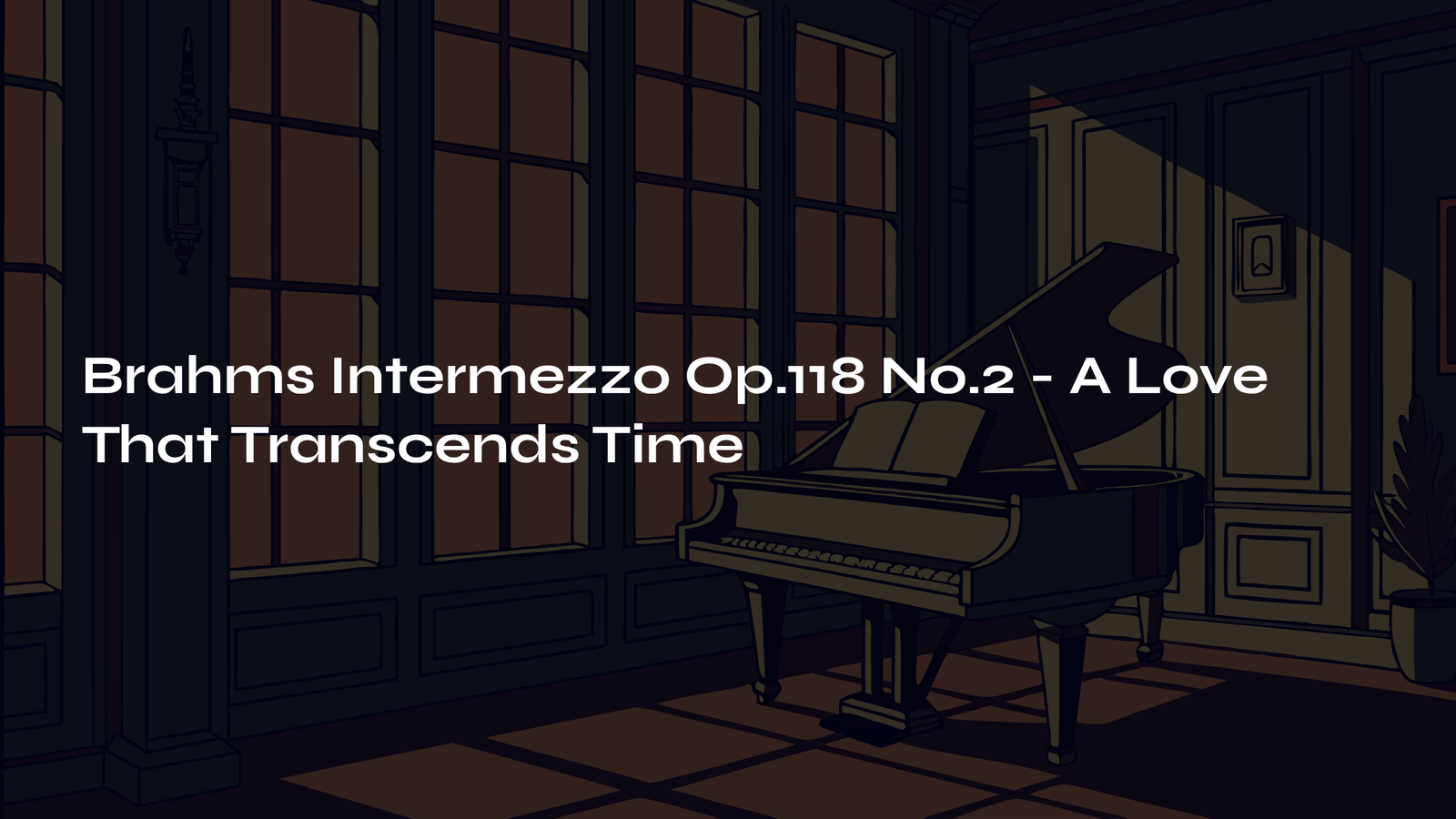
The moment the first note sounds, I always envision the same scene: someone quietly playing piano in a room where late afternoon sunlight slants through the windows. The melody unfolds like letters accumulated over the years, opened one by one—times of love, moments of regret, and ultimately the beauty of partings that had to be accepted.
This is not merely a classical music review. It is the story of a man’s lifelong confession of love, spoken in the purest of languages.
Master Brahms, Mapping the Heart
Johannes Brahms was born in Hamburg in 1833 and died in Vienna in 1897, a German composer who stands as one of the “Three Bs”—Bach, Beethoven, Brahms—those titans of musical history who perfectly fused classical formal beauty with romantic expression.
Brahms’ music appears restrained on the surface, but within flows molten emotion like lava beneath the earth. While inheriting Beethoven’s tradition, he created his own distinctive colors. Complex counterpoint and cross-rhythms, and above all, deep introspective contemplation, characterize his musical language.
Particularly in his late works, Brahms ventured into increasingly personal and intimate emotional territories. Op.118, composed in 1893 when he was 60, contains the mature sensibilities of a composer entering life’s twilight years.
Clara, A Name That Completed Destiny
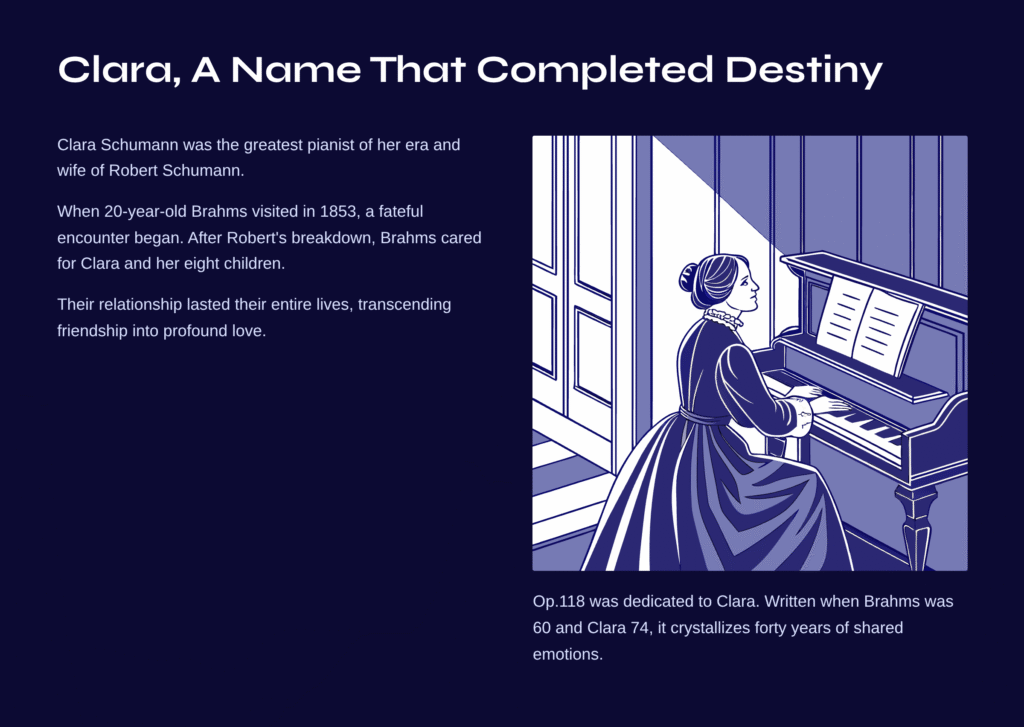
To truly understand this piece, we cannot ignore the story of one woman who defined Brahms’ entire life: Clara Schumann. She was the greatest pianist and composer of her era, and the wife of Robert Schumann.
In 1853, when 20-year-old Brahms visited the Schumann household in Düsseldorf, a fateful encounter began. Robert Schumann was so moved by young Brahms’ talent that he proclaimed him “the chosen one” in a famous article. But when Schumann suffered a mental breakdown and was hospitalized the following year, Brahms found himself caring for Clara and her eight children.
The relationship that began then between Brahms and Clara lasted their entire lives. Many musicologists speculate that this transcended mere friendship into profound love. Brahms never married, and Clara never remarried after Schumann’s death. Their relationship, constrained by Victorian moral codes, was sublimated into the purest yet most poignant form of love.
Op.118 was dedicated to Clara. Written when Brahms was 60 and Clara 74, this piece crystallizes forty years of their shared emotions into musical notes.
Architecture Hidden in Melody
The First Story – Opening Memory’s Door
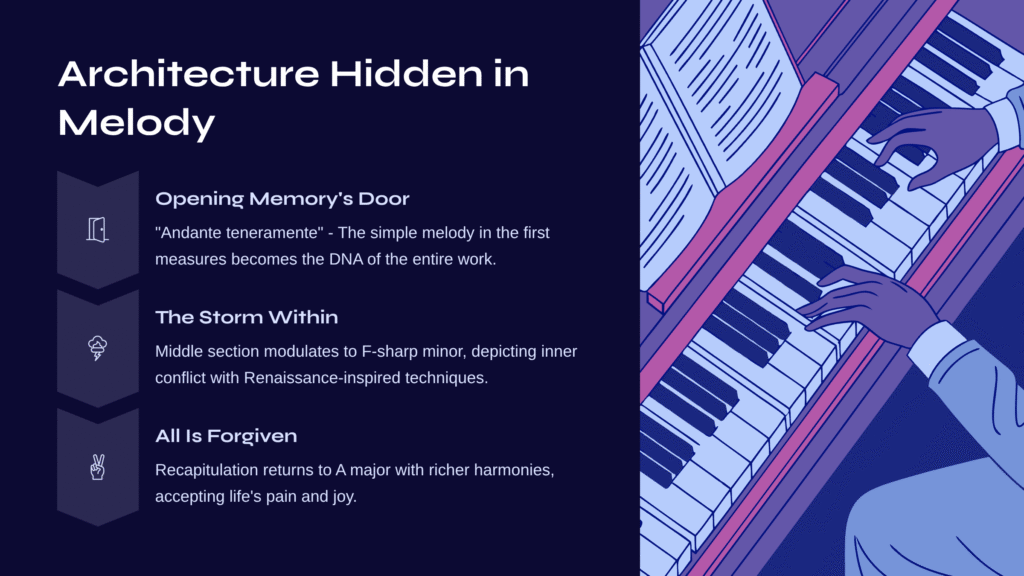
The piece begins with the marking “Andante teneramente” (gently, with tenderness). The simple melody appearing in the first two measures becomes the DNA of the entire work. The upper voice’s descending second and ascending third, plus that special ascending seventh leap—these small sonic fragments gather to build a vast emotional cathedral.
The way the main melody flows over A major’s warm harmonies is like turning pages in an old photo album. Each note holds memories; each chord accumulates time. Brahms doesn’t seek to display virtuosity here. Instead, he conveys the most honest heart in the most beautiful way possible.
The Second Story – The Storm Within
The middle section beginning at measure 49 modulates to F-sharp minor, leading us into an entirely different world. Here Brahms employs choral textures and canonic techniques reminiscent of Renaissance motets, yet the harmonic language is unmistakably that of late 19th-century Romanticism.
This section depicts inner conflict and anguish. The irregular rhythmic patterns (3-3-4-2) create metrical ambiguity that musically embodies emotional turmoil. The pain of love that could not be, emotions that could not be expressed, seep between the notes.
The Third Story – All Is Forgiven
The recapitulation beginning at measure 76 returns us to A major’s peaceful world. But this time the first theme returns with richer, deeper harmonies. This is Brahms’ genius—the same melody, but after experiencing the middle section, it carries completely new meaning.
One performer described this recapitulation as “All is forgiven”—accepting all of life’s pain and joy, ultimately reaching peace.
The Story My Heart Hears
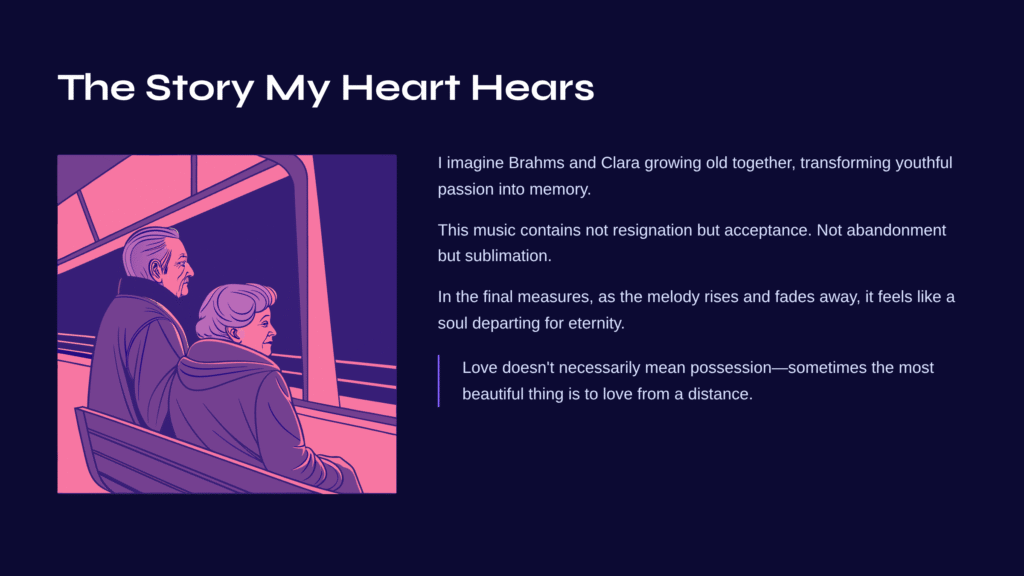
Every time I hear this piece, I imagine Brahms and Clara growing old together, transforming youthful passion into memory. They probably smiled at each other, saying, “This path we’ve walked together has been truly beautiful.”
This music contains not resignation but acceptance. Not abandonment but sublimation. It teaches us that love doesn’t necessarily mean possession—sometimes the most beautiful thing is to love from a distance.
Particularly in the final measures, where the melody gradually rises and fades away, it feels like a soul departing the body for eternity. This is music’s magic—mortal humans creating immortal beauty.
Secrets for Deeper Listening
Listen to the Inner Voices
Many people focus only on the beautiful upper melody. But Brahms’ real magic lies in the inner voices. Independent melodies flow in the bass and middle voices played by the left hand, like multiple people simultaneously telling different stories that combine into one grand narrative.
Feel the Art of Pedaling
In piano music, the pedal is like a painter’s brush creating colors. Especially in late Romantic composers like Brahms, subtle pedaling creates tonal changes. Notice how the color palette shifts with each harmonic change.
Silence Is Also Music
Brahms was a master of rests. In this piece too, moments where sound breaks sometimes say more than the notes themselves. Particularly the brief silence transitioning from the middle section to the recapitulation creates an effect like a deep sigh.
Various Interpretations from Performers
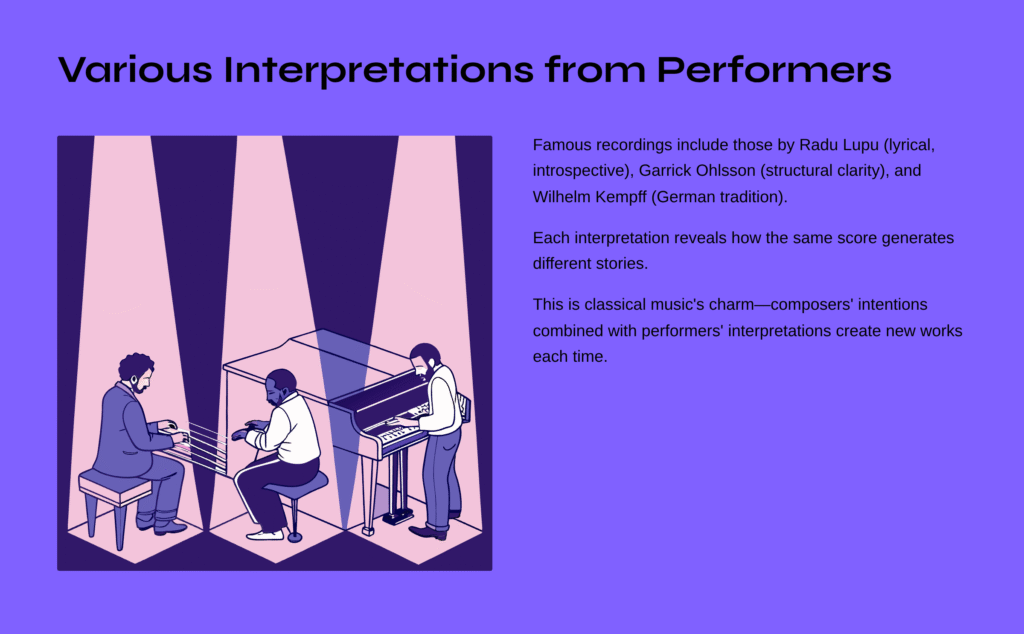
Famous recordings of this piece include those by Radu Lupu, Garrick Ohlsson, and Wilhelm Kempff. Lupu’s performance is lyrical and introspective; Ohlsson’s demonstrates structural clarity; Kempff’s conveys the weight and depth of German tradition.
Listening to each interpretation reveals how the same score can generate such different stories. This is classical music’s charm—composers’ intentions combined with performers’ interpretations create new works each time.
A Language of Love That Transcends Time
Brahms’ Intermezzo Op.118 No.2 is not merely a beautiful piano piece. It is testimony to an era, confession of human emotion, and above all, a language of love that transcends time.
Listening to this piece, I wonder: What is love? Is it possession, or is it contemplation? Though Brahms and Clara could never spend their lives together, their love lives eternally through this music. Perhaps this is the most complete form of love.
Today someone will hear this melody and remember their own love. Whether that love was fulfilled or unfulfilled, this music will understand and console everything. This is why classical music is great—it connects human hearts across time and space.
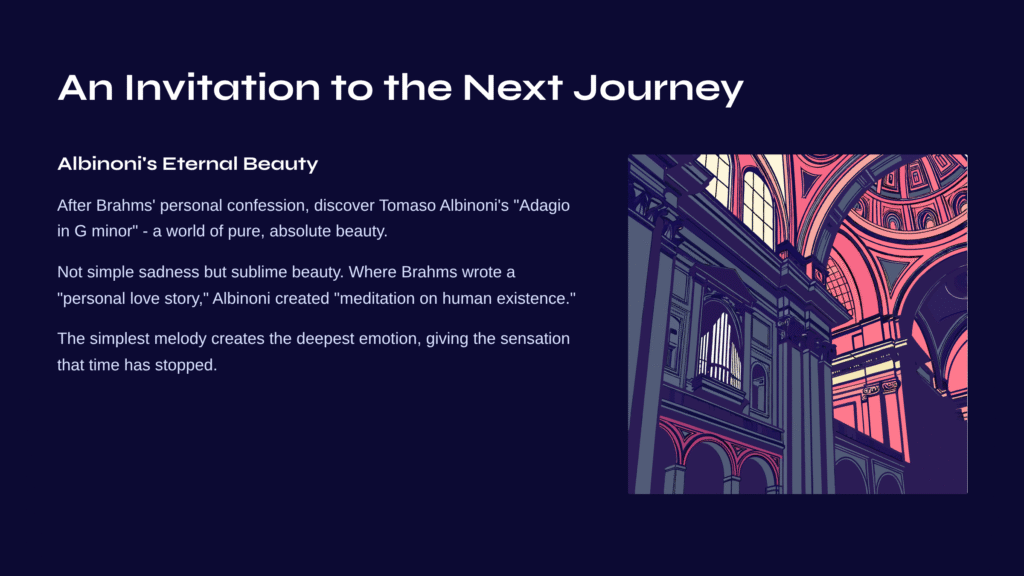
An Invitation to the Next Journey – Albinoni’s Eternal Beauty
Having experienced Brahms’ personal and intimate confession of love, it’s time to encounter another kind of beauty that transcends time. Tomaso Albinoni’s “Adagio in G minor” guides us into a world of pure, absolute beauty, different from Brahms’ complex emotions.
Not Sadness, but the Language of the Sublime
This work is often called “the most beautiful sad music in the world.” But when you listen deeply to this music, you discover not simple sadness but sublime beauty. If Brahms’ Intermezzo is a “personal love story,” then Albinoni’s Adagio is “meditation on human existence itself.”
The celestial harmonies created by strings and organ are like prayers echoing from a Baroque cathedral. When this melody begins to flow, you will find yourself immersed in a world of pure beauty, freed from all daily distractions.
Infinity Hidden in Simplicity
Where Brahms expressed emotion through complex harmonies and intricate structures, Albinoni creates the deepest emotion with the simplest melody. The recurring thematic melody penetrates deep into the heart like a mantra, helping listeners find inner peace.
Listening to this piece especially gives you the sensation that time has stopped. This is Baroque music’s magic—allowing us to touch eternity through unadorned, pure beauty.
Through Albinoni’s work, you will experience a completely different dimension of musical journey from Brahms’ complex emotional voyage. You’ll discover that sometimes the simplest things provide the deepest emotion.