📑 Table of Contents
Somewhere in the back of your mind, there’s a melody that goes da-da-da-da-da-da-da-dum. You might have heard it as a ringtone, in a commercial, or drifting out of a practice room where a twelve-year-old is hammering away at the keys. It’s Mozart’s “Alla Turca” — the Turkish March — and it might just be the single most recognizable piece of classical piano music on the planet. But here’s what almost nobody tells you: this piece wasn’t meant to be cute. It was meant to be dangerous.
Let me explain.
Mozart, Vienna, and the Ottoman Obsession
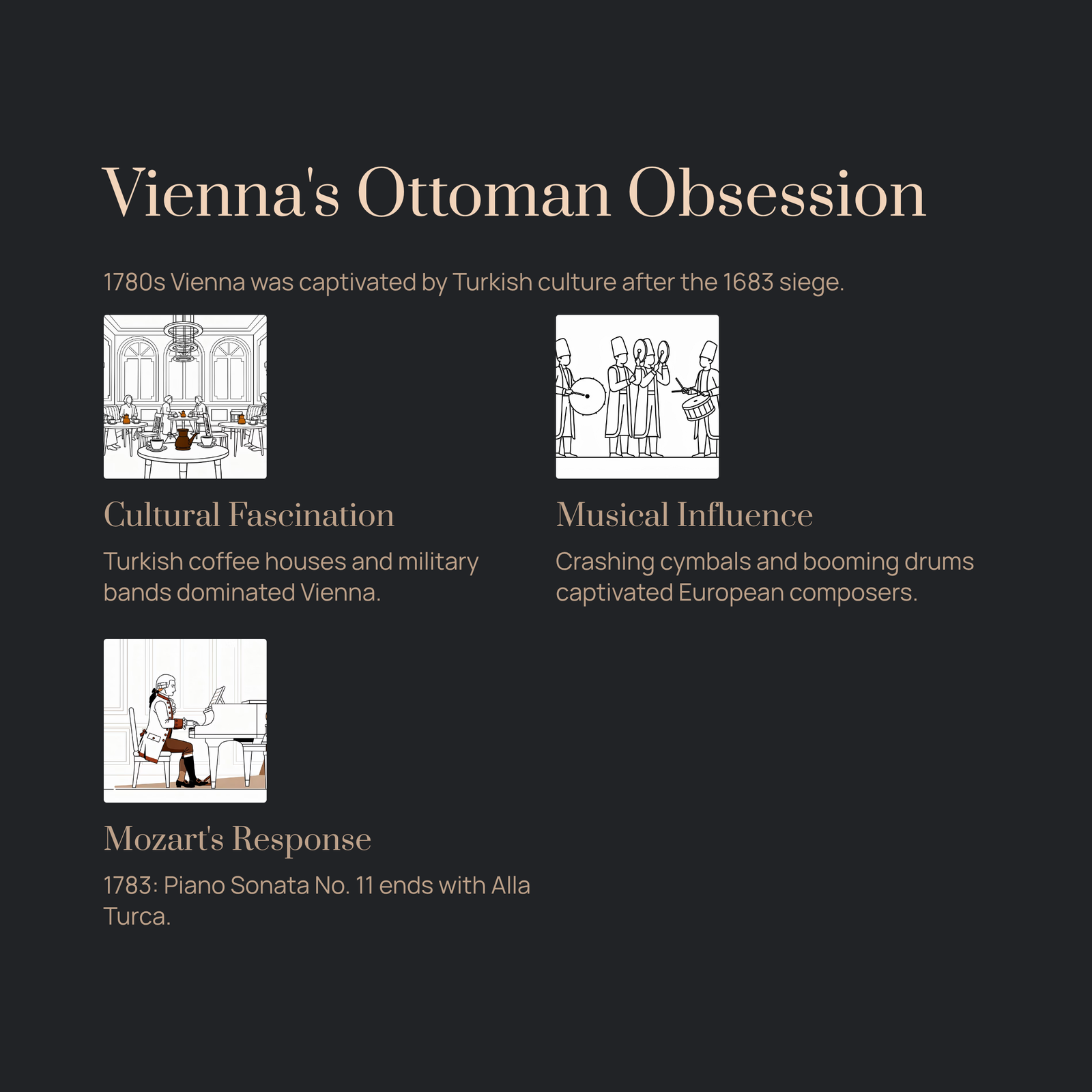
To understand the Turkish March, you need to understand the world Mozart was living in. It was the 1780s, and Vienna was in the grip of a full-blown cultural obsession with all things Turkish. The Ottoman Empire had besieged the city just a century earlier, in 1683, and the collective memory of that near-catastrophe had fermented into something unexpected — fascination. Turkish coffee houses were everywhere. Turkish-style military bands, with their crashing cymbals, booming bass drums, and piercing oboes, were the hottest sound in Europe. Composers couldn’t get enough of it.
Mozart was no exception. He’d already written a wildly popular opera called Die Entführung aus dem Serail (The Abduction from the Seraglio), set in an Ottoman palace and dripping with “exotic” Turkish flavor. So when he sat down in 1783 to compose his Piano Sonata No. 11 in A major, K.331, he made a radical decision: instead of ending it with a traditional fast movement, he’d close with a piece marked Alla Turca — “in the Turkish style.”
This was Mozart being playful, provocative, and a little bit subversive. He was taking the terrifying sound of an invading army and turning it into something you could play in a parlor.
What Makes It Sound “Turkish”?
If you listen closely, the Turkish March doesn’t actually sound like anything from Istanbul. It sounds like what an 18th-century Viennese composer imagined Turkish music might sound like — and that difference is part of what makes it so fascinating.
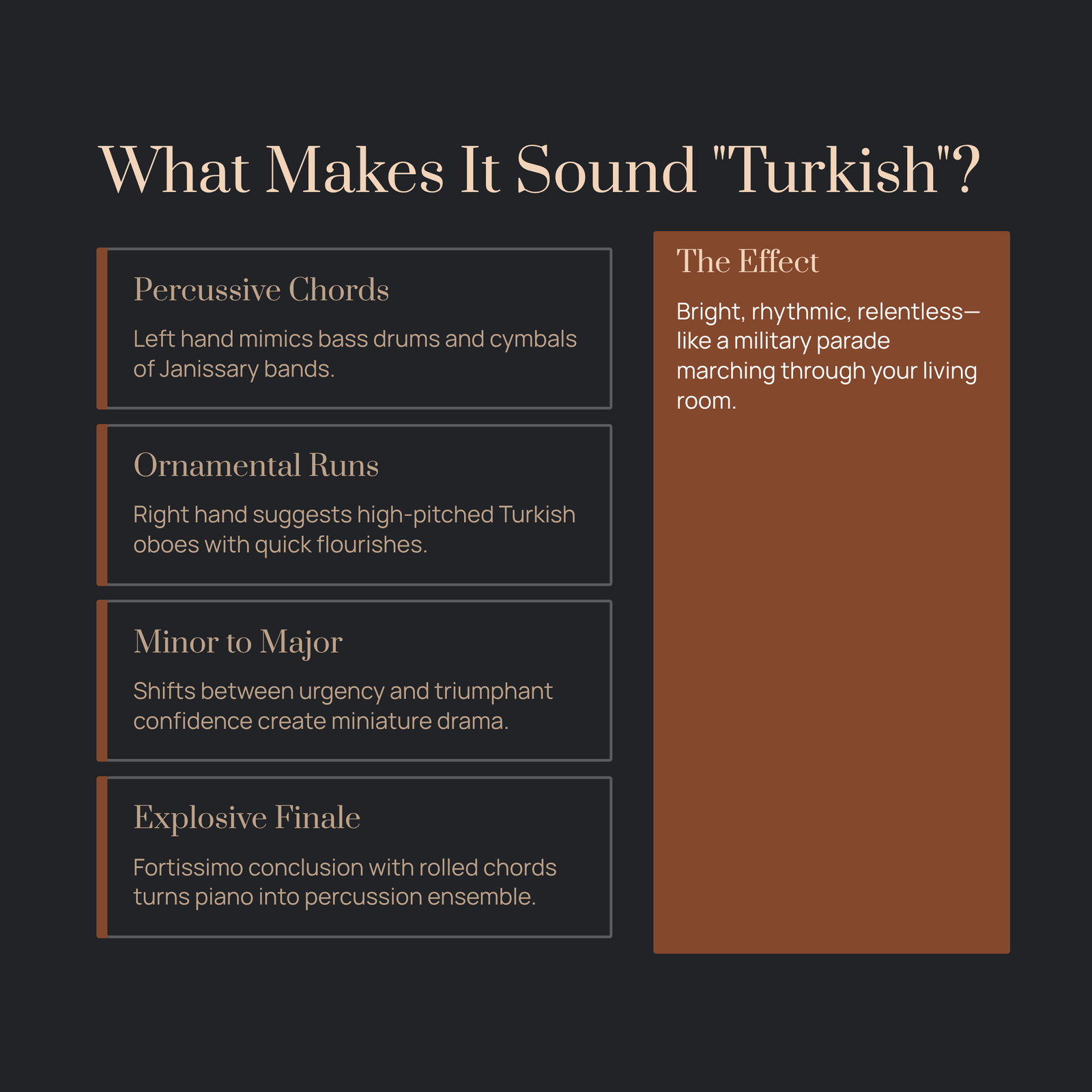
The “Turkish” elements are all about texture and attack. Mozart uses loud, percussive chords in the left hand to mimic the bass drum and cymbals of a Janissary band — the elite Ottoman military musicians whose sound had captivated Europe. The right hand dances with quick, ornamental runs that suggest the high-pitched reeds of Turkish oboes. The overall effect is bright, rhythmic, and relentless, like a military parade marching straight through your living room.
The piece is written in a rondo-like structure, alternating between the famous A minor theme and contrasting episodes in A major. That shift between minor and major keys is worth paying attention to. The minor sections carry a certain urgency, almost a nervous energy, while the major sections burst open with triumphant confidence. It’s a miniature drama — tension and release, shadow and light — compressed into roughly three and a half minutes.
And then there’s that ending. Mozart doesn’t just let the piece fade away. He builds to a crashing, fortissimo conclusion with rolled chords and octave passages that turn the piano into a one-person percussion ensemble. On the pianos of Mozart’s era, which were lighter and more delicate than modern grand pianos, this finale must have sounded almost violent.
Why This Movement, Not the Whole Sonata?
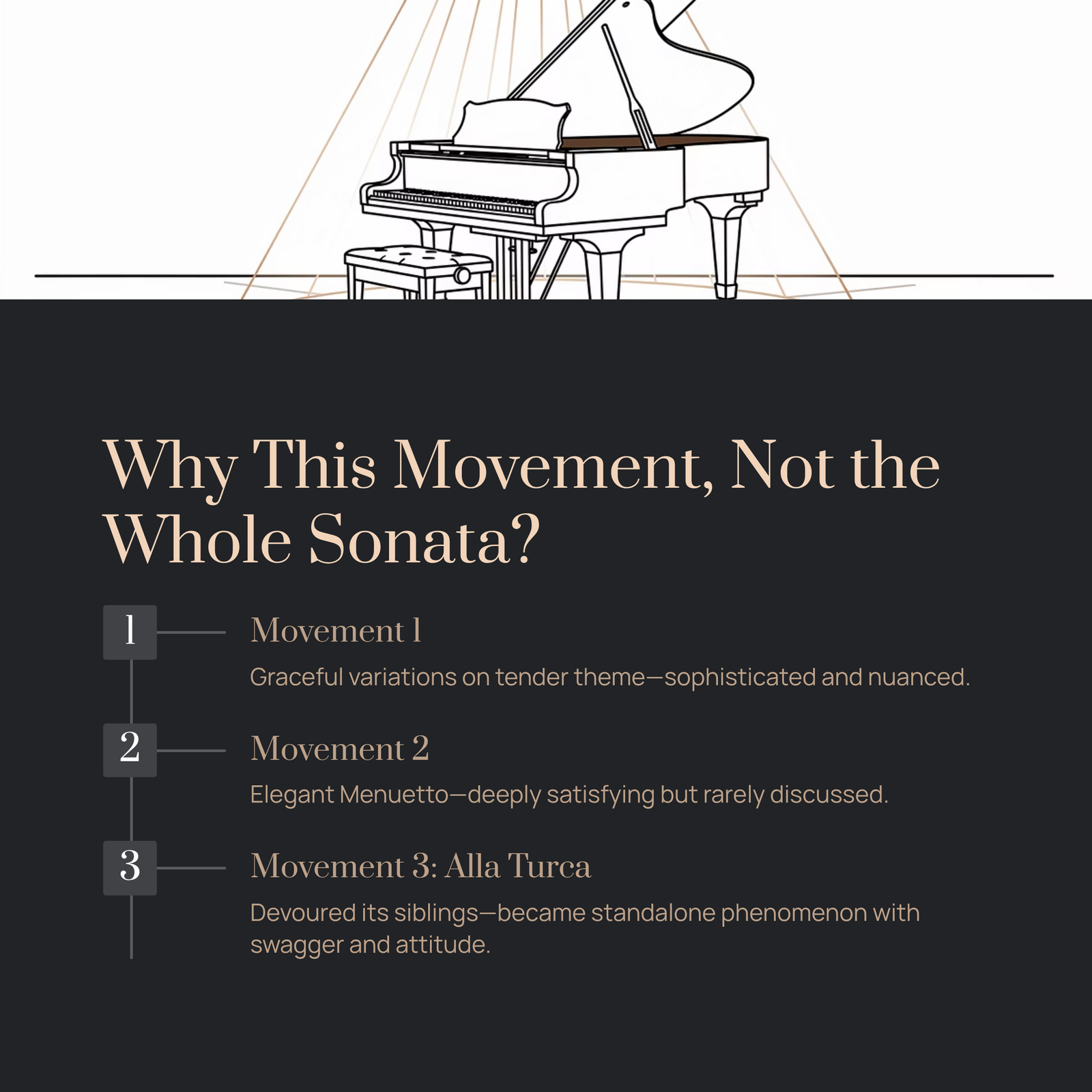
Here’s a curious thing: Piano Sonata No. 11 has three movements, and the first two are gorgeous. The opening is a set of graceful variations on one of Mozart’s most tender themes, and the second movement is an elegant Menuetto. Both are sophisticated, nuanced, and deeply satisfying.
But nobody talks about them.
The Alla Turca has completely devoured its siblings. It’s one of those rare cases in classical music where a single movement has broken free from its sonata and become a standalone phenomenon. Part of this is the melody’s sheer memorability — once it’s in your head, it refuses to leave. But part of it is also the energy. In a world of measured elegance and aristocratic restraint, the Turkish March feels like something crashing through the door uninvited. It has swagger. It has attitude. And crucially, it has rhythm that your body actually wants to move to.
How to Listen: Three Levels of Attention
First listen — just enjoy the ride. Don’t analyze anything. Let the melody wash over you. Notice how it makes you feel. Most people report something like “energized” or “amused” or “strangely nostalgic.” All of those responses are valid. Mozart wrote this to entertain, and two and a half centuries later, it still works.
Second listen — follow the structure. Pay attention to the alternation between the minor-key theme (the famous one) and the major-key episodes. Notice how Mozart varies the dynamics — soft passages suddenly erupting into loud ones. The piece has an almost cinematic sense of pacing, building toward that explosive finale.
Third listen — compare performers. This is where things get really interesting. The Turkish March has been recorded by virtually every major pianist alive, and the interpretations vary wildly. Try these three for strikingly different experiences:
Glenn Gould’s recording is famously eccentric — slow, deliberate, almost deconstructed, as if he’s examining each note under a magnifying glass. Mitsuko Uchida plays it with crystalline clarity and a sense of joy that feels effortless. And for a historically informed approach, listen to Ronald Brautigam on fortepiano, where the instrument itself changes everything — the thinner, more transparent sound of Mozart’s own era gives the “Turkish” percussion effects a sharper, more startling edge.
The differences between these recordings aren’t just matters of taste. They reveal genuine interpretive questions: Is this piece a joke? A tribute? A gentle parody? The answer changes with every pianist who sits down to play it.
The Piece That Refuses to Stay in Its Box
What strikes me most about the Alla Turca is its stubborn refusal to be confined. It was written as the finale of a piano sonata, but it became an anthem. It was composed as an imitation of Turkish music, but it became more famous than any actual Turkish piece in the Western canon. It was meant for aristocratic salons, but it ended up as the default ringtone on Nokia phones in the early 2000s.
There’s a lesson in that, I think. The best music doesn’t care about the categories we build for it. Mozart wrote the Turkish March as a witty, slightly irreverent crowd-pleaser — and that’s exactly what it remains. But beneath the playful surface, there’s a composer operating at the peak of his craft, turning three minutes of keyboard music into something that millions of people across centuries and cultures recognize instantly.
The next time you hear those opening notes — and you will, because they’re inescapable — try listening past the familiarity. Underneath the melody everyone knows, there’s a whole world of cultural history, musical invention, and sheer compositional brilliance waiting to be discovered. Mozart hid it all in plain sight, which might be the most Mozart thing of all.