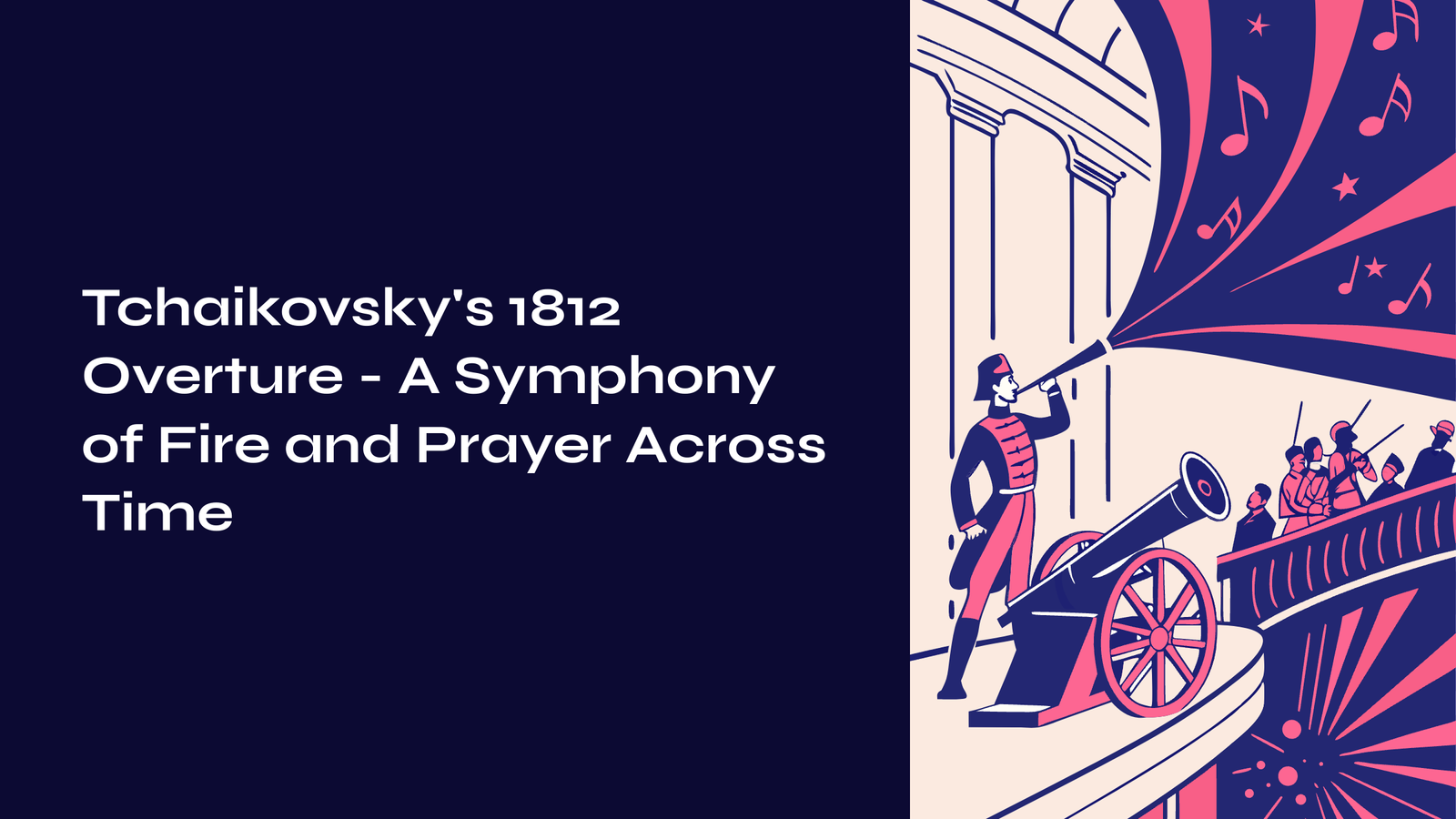
Pyotr Ilyich Tchaikovsky wrote the 1812 Overture in 1880 for a public celebration in Moscow. The title refers to the year of Napoleon’s invasion of Russia, a campaign the music retells through an Orthodox hymn, rival national tunes, and a finale with bells and cannon fire.
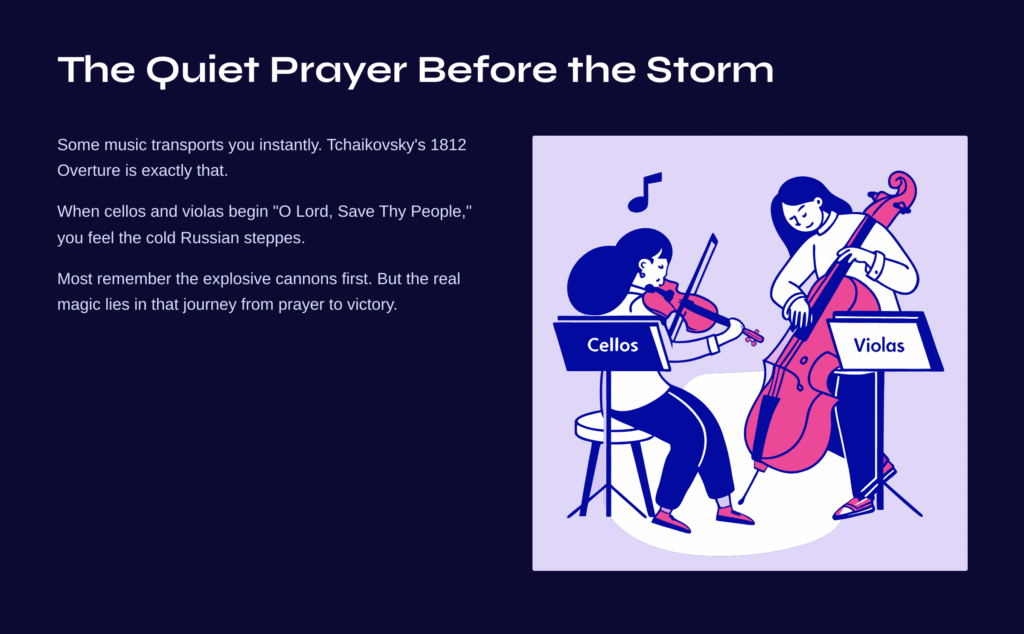
If the finale is the part you know, start at the very beginning. The quiet tune played by violas and cellos comes back near the end, and remembering how it first sounded changes the way you hear the celebration.
📑 Table of Contents
Why Was the 1812 Overture Written?
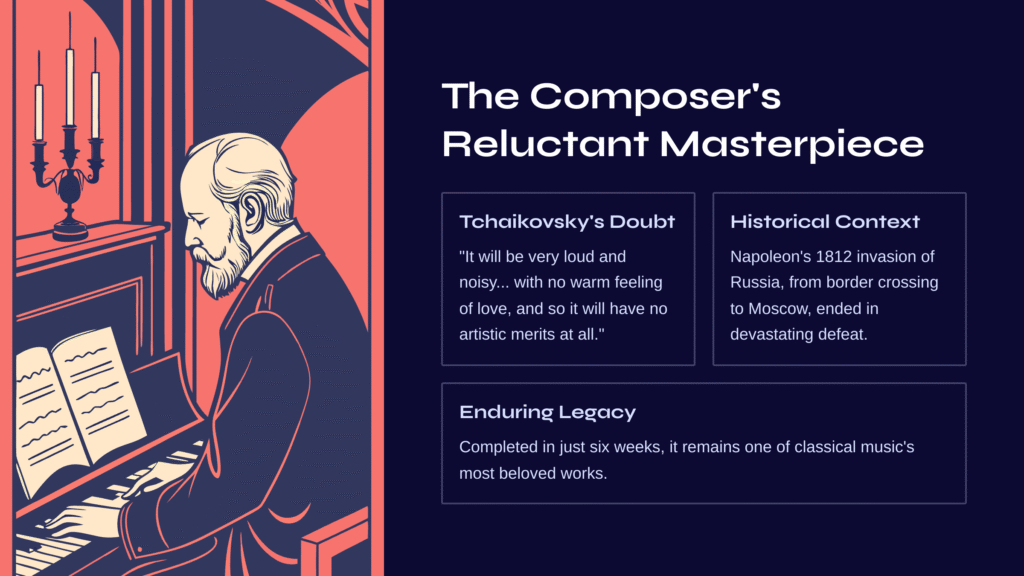
The musician Nikolai Rubinstein suggested that Tchaikovsky compose a large ceremonial work. Moscow had several occasions on the horizon, including an arts and industry exhibition and the planned consecration of the Cathedral of Christ the Savior. The cathedral itself commemorated Russia’s deliverance from Napoleon’s invasion, which explains why its name so often comes up in the story of the overture. The first performance took place in Moscow in 1882 during the All-Russian Arts and Industrial Exhibition.
Tchaikovsky completed the overture in about six weeks. Writing to his patron Nadezhda von Meck, he described it as loud and noisy and expressed little affection for what he had written. The scale of the work suited a public ceremony, and its short, recognizable melodies helped make the story clear in a single stretch of music lasting about fifteen minutes.
Napoleon’s Invasion and the Anthems Tchaikovsky Chose
Napoleon’s army advanced into Russia and reached Moscow in 1812. The retreat that followed proved disastrous. Russian resistance, dwindling supplies, disease, and severe cold all took a toll. Tchaikovsky gives the campaign a broad dramatic shape, moving from prayer through conflict to a public celebration.
Two familiar tunes help tell you who is who. Tchaikovsky uses “La Marseillaise” to represent the French forces and “God Save the Tsar” to mark the Russian victory. Both are historical shortcuts. “La Marseillaise” already existed in 1812, though it was out of official use under Napoleon, and “God Save the Tsar” was written later. A listener in Tchaikovsky’s time could identify the two sides as soon as the tunes appeared.
The overture tells the story from the Russian side, giving the prayer that opens the work a central place in the victory. For another example of a short orchestral work that turns a political struggle into a dramatic ending, try Beethoven’s Egmont Overture.
What to Listen for in the 1812 Overture
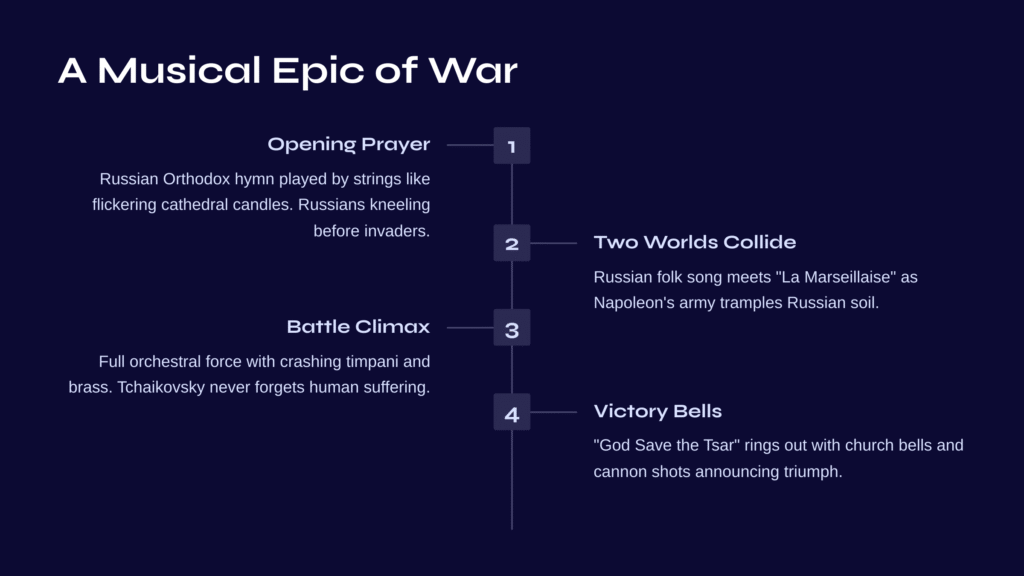
The opening prayer. Start with the first notes, where a small group of violas and cellos plays the Russian Orthodox hymn often translated as “O Lord, Save Thy People.” Notice how evenly the melody moves and how closely the lower strings blend. The first phrase is enough to give you something to recognize when the whole orchestra takes it up.
The tunes that compete for your ear. Once the tempo picks up, listen for the opening phrase of “La Marseillaise,” which cuts through the rushing orchestral music. The French tune appears in bursts, and the Russian folk song “At the Gate, at My Gate” offers a lilting melody of its own. Try following the French phrase each time it surfaces. Near the climax, the first group of cannon shots and a fast downward sweep in the strings help clear the way for the opening prayer to return.
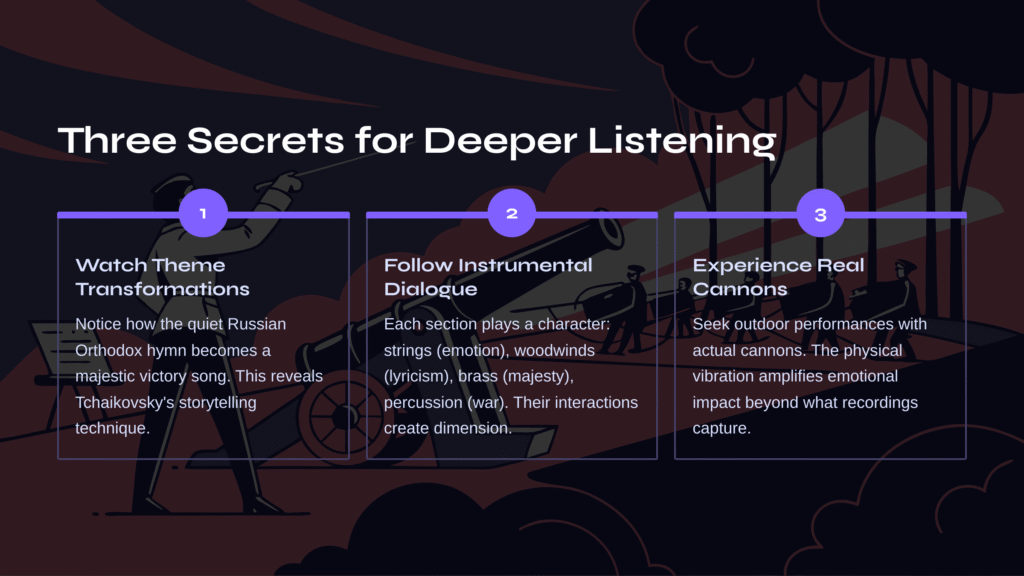
The prayer comes back with bells. That same melody, first heard in low strings, now rings out across the orchestra. Then “God Save the Tsar” takes the finale into its last stretch, with bells and more cannon fire. The score calls for sixteen shots in all, spread across the late battle music and the closing celebration. You can hear Tchaikovsky use a related device in the finale of his Fifth Symphony, where a theme you’ve heard before returns with a different character.
The 1812 Overture in Film and on the Fourth of July
In V for Vendetta, the masked V uses the overture to accompany the destruction of London’s Old Bailey. The finale gives the scene its rhythm, with the music’s artillery accents suited to the explosions on screen. The film borrows a sound many listeners already associate with a spectacular ending and gives it a new political meaning through the scene.
In the United States, the overture also became a Fourth of July concert tradition. The Boston Pops helped establish that association when Arthur Fiedler programmed it for the orchestra’s 1974 Independence Day celebration. Bells and cannon fire fit easily into an outdoor program with fireworks, and the ending gives an audience a clear cue for the celebration even if they’ve never heard the full piece. That American concert tradition grew out of the finale’s sound, while the title still points to Napoleon’s campaign in Russia.
Listen to This Piece
Frequently Asked Questions
Is the 1812 Overture about the American War of 1812?
The overture depicts Napoleon’s invasion of Russia and the French retreat. The American association comes from later Independence Day performances, especially the Boston Pops tradition.
Are the cannons in the 1812 Overture real?
The score calls for cannon fire, and some outdoor performances use real cannons. Recordings and concerts can also use recorded effects or percussion, so the weight and sharpness of the shots vary from one performance to another.
What is the song at the beginning of the 1812 Overture?
It’s a Russian Orthodox hymn often translated as “O Lord, Save Thy People,” also known as the Troparion of the Holy Cross. Listen for the same tune played much more loudly near the end, just before the imperial anthem takes over.
Sources
- 1812 Overture
- 1812 Overture, Op. 49 (Tchaikovsky, Pyotr) — IMSLP
- French invasion of Russia
- V for Vendetta (film)
Part of: Heard It Somewhere? · Start Here