📑 Table of Contents
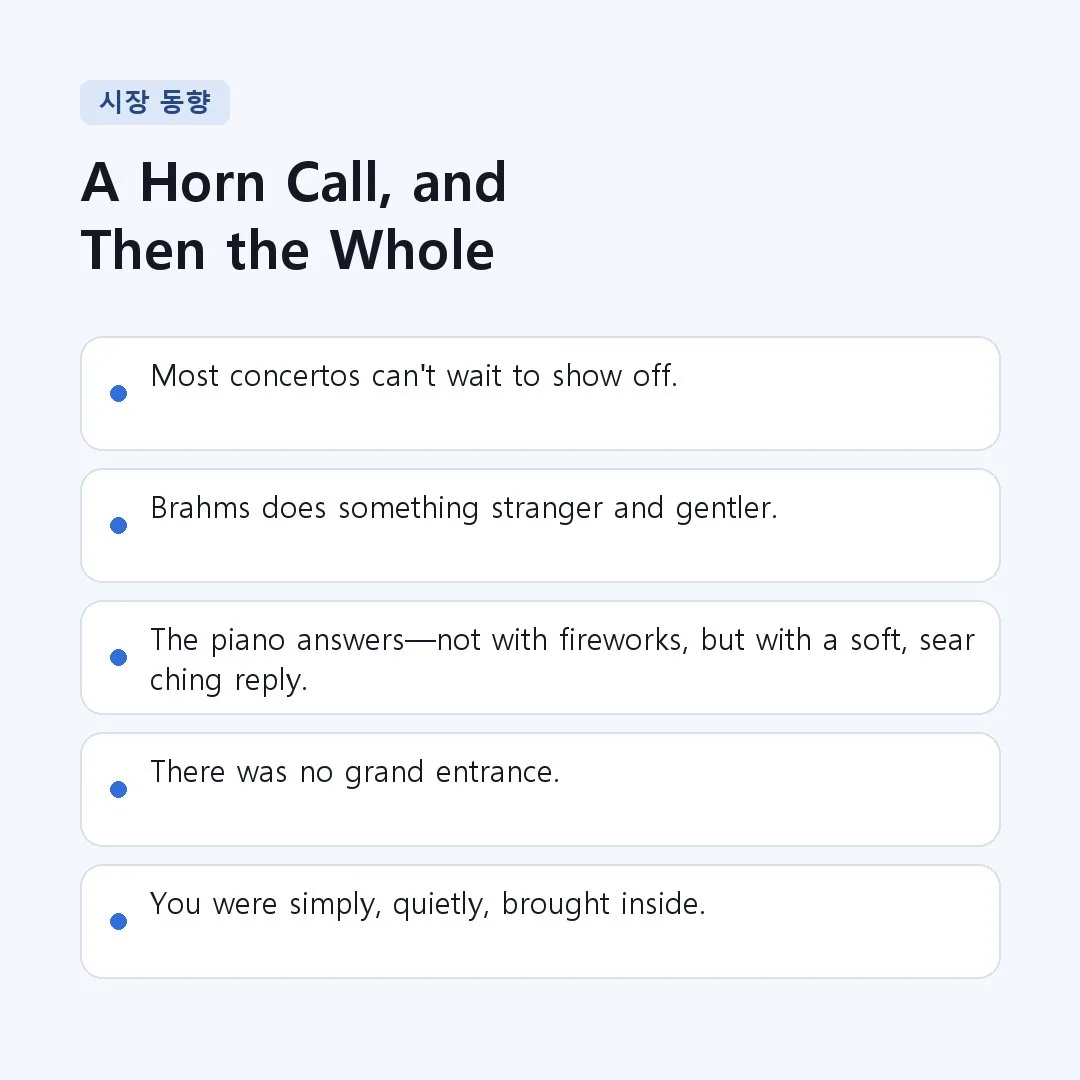
Most concertos can’t wait to show off. The orchestra clears its throat, and the soloist comes charging in to claim the spotlight.
Brahms does something stranger and gentler. A single horn plays a quiet phrase, almost like someone calling across a valley at dawn. The piano answers—not with fireworks, but with a soft, searching reply. They pass the idea back and forth, two voices in a private conversation, before the orchestra slowly rises around them like a sunrise you didn’t notice beginning.
By the time the full force of the music finally arrives, you realize you’ve already been pulled in. There was no grand entrance. You were simply, quietly, brought inside.
That opening tells you everything about what kind of piece this is. It is enormous—nearly fifty minutes long, with four movements instead of the usual three—yet it keeps reaching for intimacy inside all that scale. Brahms once joked in a letter that he had written “a tiny, tiny piano concerto with a tiny, tiny wisp of a scherzo.” It was a private joke. The piece is one of the largest, most physically demanding concertos in the entire repertoire.
Who Was Brahms, and Why Did He Wait So Long?
If you’re new to classical music, here’s the shorthand: Johannes Brahms (1833–1897) was a German composer who carried an almost unbearable weight on his shoulders. People kept calling him the heir to Beethoven, the man who would continue the great German symphonic tradition. That’s a crushing thing to be told when you’re young.
Brahms responded to the pressure by being ferociously self-critical. He destroyed dozens of his own works he judged unworthy. He waited until he was over forty to release his first symphony, terrified of comparison.
His First Piano Concerto, written in his early twenties, had been stormy, raw, and full of youthful turbulence—and audiences initially rejected it. So when the Second Piano Concerto arrived more than twenty years later, in 1881, it came from a completely different man. By then Brahms was established, secure, no longer fighting to prove himself. The music has the confidence of someone who has stopped trying to win you over and simply tells the truth as he sees it.

The Background: A Sunlit Trip and a Quiet Confidence
Brahms wrote much of this concerto after a trip to Italy, and people have long heard southern warmth in it—an openness and glow that his earlier music sometimes held back. He finished it in the small Austrian town of Pressbaum, near Vienna, in the summer of 1881.
He dedicated it to Eduard Marxsen, his old piano teacher—a touching gesture from a man who rarely showed sentiment in public. There’s something fitting in that. This is mature music written by someone who had quietly made peace with where he came from.
The first movement carries the marking Allegro non troppo, which means “fast, but not too much.” That phrase is almost a portrait of Brahms himself: powerful, but never reckless. Grand, but always holding something in reserve.
How to Listen: Your Guide to the First Movement
You don’t need to read music to follow this. Just listen for a few landmarks, and the movement will start to feel like a journey with recognizable scenery.
The opening dialogue (0:00–1:30): Notice the horn, then the piano’s gentle reply. This is the seed of everything. Hold onto that horn melody in your memory—Brahms will return to it.
The eruption (around 1:30–2:30): After the tender opening, the piano suddenly breaks into thunderous chords and rolling figures. This is the moment the music shows its true size. Don’t worry about “understanding” it—just feel the shift from intimacy to power.
The two main ideas: Romantic concertos usually build on contrasting themes. Here, listen for the bold, striding first idea and a warmer, more lyrical second one that follows. Brahms loves to take a single small motif and grow it, twist it, and reveal it in new lights—like watching one color shift across an entire painting.
The piano and orchestra as equals: This is the key to loving this piece. The piano is not a star with backup singers. It argues, agrees, interrupts, and embraces the orchestra as a partner. When you stop waiting for “the solo” and start hearing a conversation, the whole movement opens up.
The return home: Near the end, that opening horn-and-piano idea comes back, and it lands differently now—you’ve traveled with it, and it feels earned. That sense of homecoming is one of the deep pleasures of Brahms.
If your attention drifts, that’s completely fine. This is long music. Let it wash over you and return when something catches your ear. The first few listens are about atmosphere, not analysis.
Recordings Worth Your Time
A few performances make excellent entry points, each with a different personality:
Emil Gilels with the Berlin Philharmonic (Eugen Jochum conducting). Widely considered one of the greatest recordings ever made of this concerto. Gilels combines titanic power with surprising tenderness, and the partnership with Jochum feels genuinely shared. If you buy only one version, this is the safe and glorious choice.
Krystian Zimerman with Leonard Bernstein and the Vienna Philharmonic. Warmer, more spacious, almost cinematic. Lovely if you want to sink into the music’s lyricism rather than its muscle.
Hélène Grimaud (with the Bavarian Radio Symphony, Andris Nelsons). A more modern, transparent reading—clear textures and a thoughtful, introspective touch. A good choice for newer ears that want to hear the inner detail.
Start with Gilels for the definitive experience, then explore the others to hear how differently great artists shape the same notes.
Why This Movement Stays With You
What makes the first movement of Brahms’s Second Concerto so quietly addictive isn’t its difficulty, even though it’s famously hard to play. It’s the emotional honesty underneath all that grandeur.
This is music written by a man who had nothing left to prove, who could afford to be both monumental and tender in the same breath. It begins with a whisper and ends having shown you something vast—but it never forgets that whisper. The intimacy and the immensity are not opposites here. They’re the same impulse, just at different volumes.
Give it your patience, and it gives back more each time. That’s the rare gift of late Brahms: it doesn’t shout to be heard. It simply waits, sure of itself, for you to lean in.