📑 Table of Contents
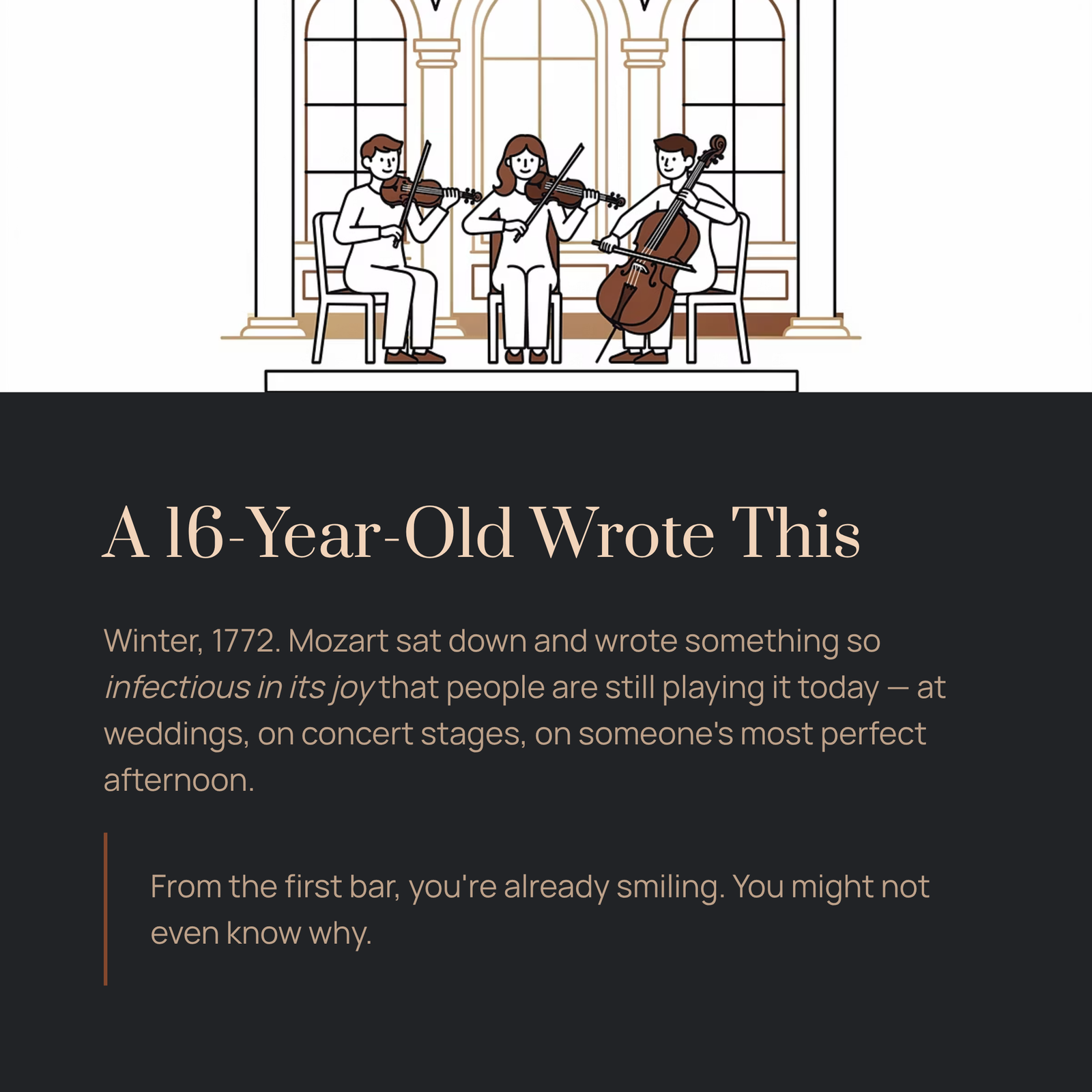
Imagine you’re 16. Maybe you’re stressing over homework, scrolling your phone, figuring out who you want to be. Now imagine that at 16, you sit down and write something so full of life, so infectious in its joy, that people are still playing it 250 years later—at weddings, on concert stages, in film scores, in the background of someone’s most perfect afternoon.
That’s exactly what Wolfgang Amadeus Mozart did in the winter of 1772.
The first movement of the Divertimento in D Major, K.136 doesn’t open with ceremony or gravitas. It simply leaps in—strings surging forward like a crowd of friends bursting through a door. And from that first bar, you’re already smiling. You might not even know why.
That’s the secret this piece has been keeping for centuries.
Who Was Mozart in 1772—And Why Does It Matter?
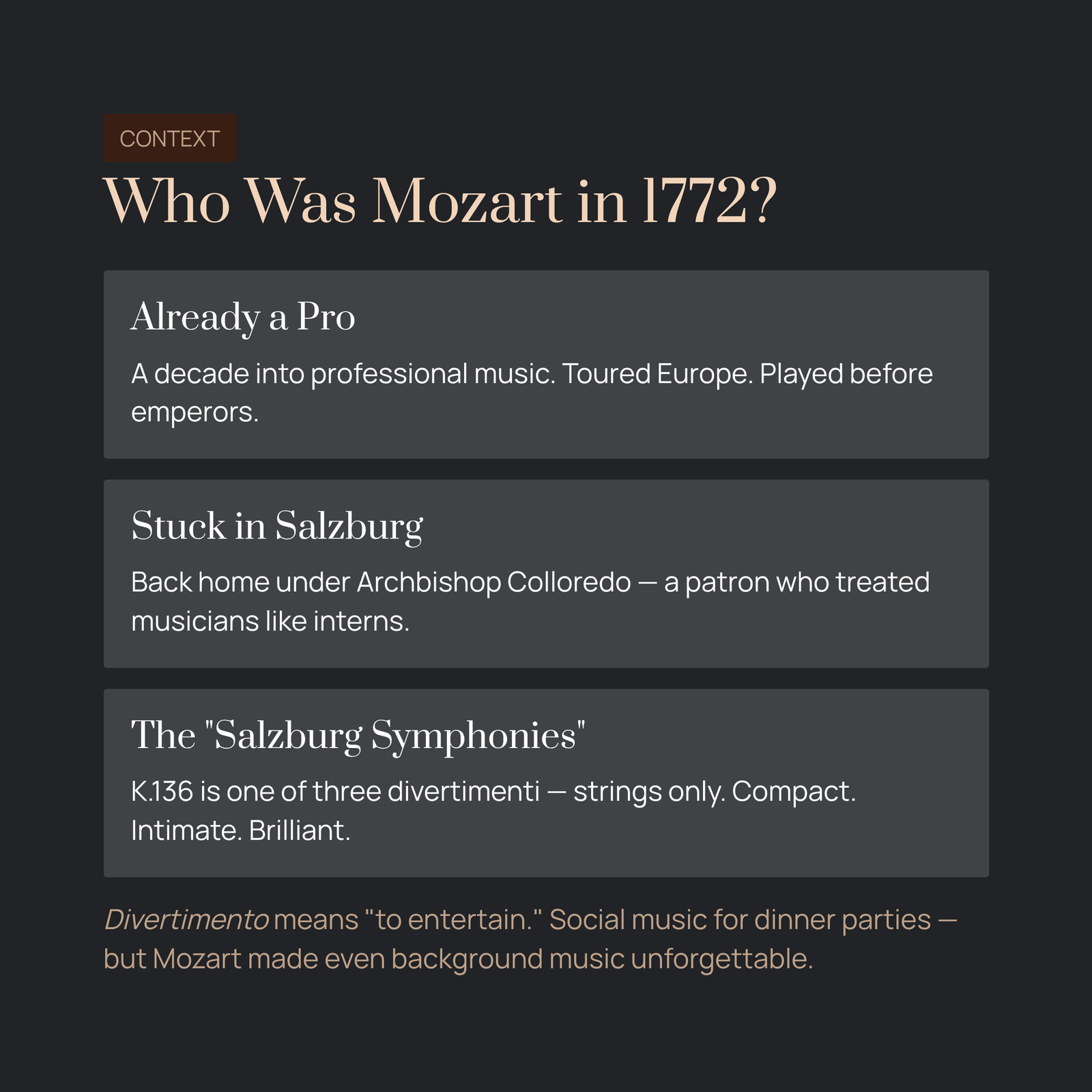
By the time Mozart composed K.136, he was already a decade into being a professional musician. He had toured Europe as a child prodigy, played before emperors, and dazzled courts from Vienna to London. But in 1772, he was back in Salzburg—his hometown, a city he loved and resented in equal measure—working under Archbishop Colloredo, a patron who viewed musicians roughly the way a modern manager views interns.
Salzburg was beautiful but provincial. Mozart, even at 16, was already dreaming of bigger stages.
K.136 was written as part of a set of three divertimenti (K.136, K.137, K.138), often called the “Salzburg Symphonies,” though they’re scored only for strings—no winds, no brass, no percussion. Just violins, viola, cello, and bass. Compact. Intimate. Brilliant.
The word divertimento comes from the Italian divertire—to entertain, to amuse. These weren’t heavy philosophical statements. They were social music: crafted for private gatherings, for aristocratic dinner parties, for moments when people wanted to feel good without working too hard for it.
But don’t let the casual function fool you. Mozart took even “background music” and turned it into something unforgettable.
What You’re Actually Hearing in the Allegro
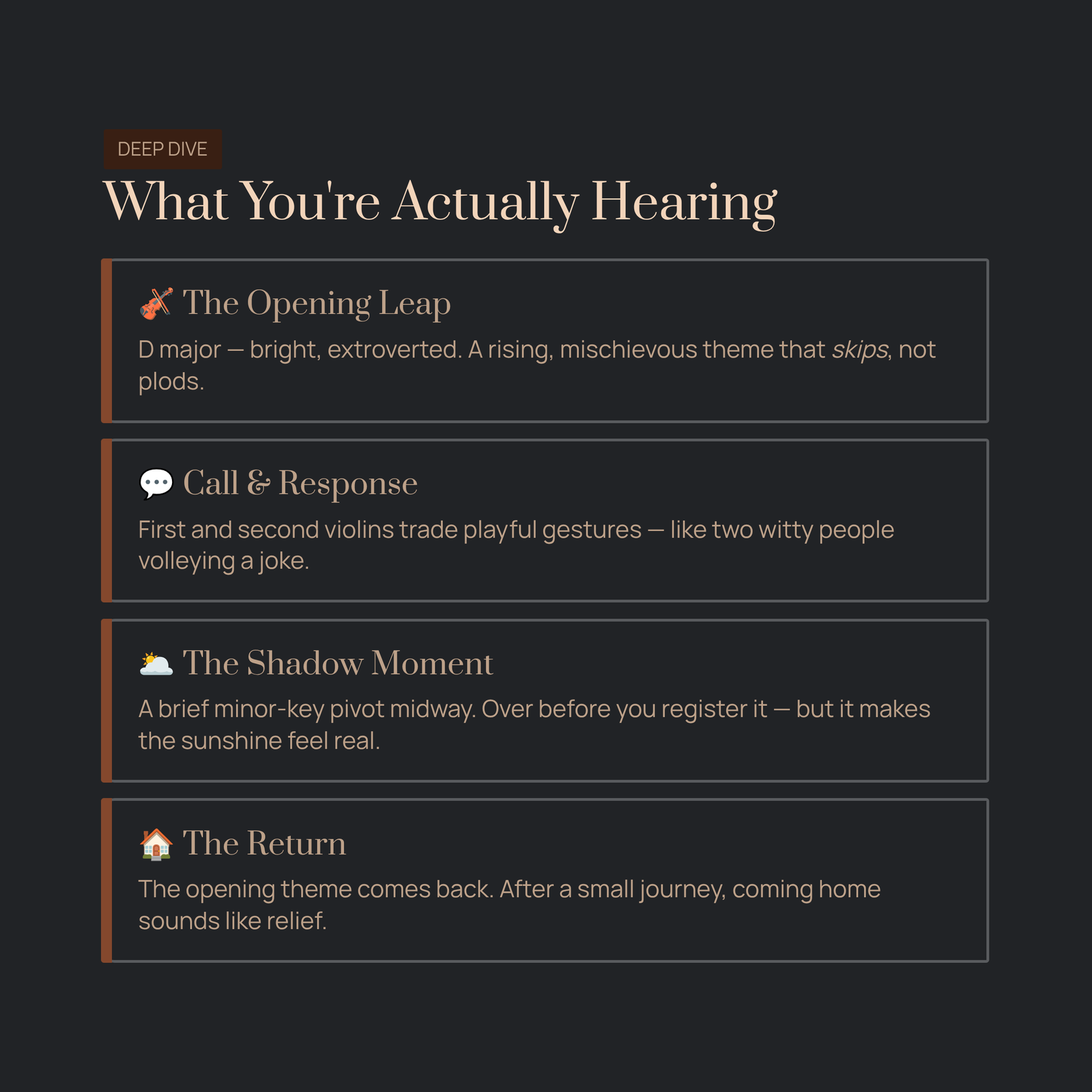
The first movement is in D major, a key Mozart often associated with brightness and extroversion—think of it as the musical equivalent of a well-lit room on a clear day.
It opens with what’s called the primary theme: a rising, bouncing figure in the first violins, light on its feet, almost mischievous. It doesn’t plod. It skips. Within seconds, the whole string ensemble joins in, and you have this sense of synchronized excitement—everyone in the room suddenly alert, leaning forward.
A few things to listen for as the movement unfolds:
The call-and-response dialogue. Mozart loves to set up a “question” in one group of instruments and have another group “answer.” In the Allegro, the first and second violins often trade these gestures back and forth. It’s conversational, almost playful—like watching two witty people volley a joke.
The moment of shadow. Around the development section (roughly the middle of the movement), Mozart briefly pivots toward the minor key. The brightness doesn’t disappear—it tilts, just slightly, into something more complex. It’s over before you fully register it, but that’s the point. Even pure joy needs a fleeting cloud to make the sunshine feel real.
The return. When the opening theme comes back (the “recapitulation” in sonata form terminology), it feels earned. You’ve been on a small journey. Coming home sounds like relief.
The whole movement lasts about four to five minutes, depending on the ensemble. That’s it. Mozart says everything he needs to say and then steps aside. No overstaying the welcome.
Why This Piece Hits Differently Than You’d Expect
There’s a category of music that sounds effortless—and it’s the hardest kind to write.
K.136’s Allegro has no rough edges. Nothing drags. Nothing overexplains itself. For a listener encountering classical music for the first time, this can feel almost disorienting: you were braced for difficulty, for grandeur, for something that demanded concentration—and instead you got something that just… works on you, the way good weather works on you.
What Mozart understood, even as a teenager, is that pleasure in music isn’t accidental. It’s engineered. The rising lines create anticipation. The repeated motifs give your ear something to hold onto. The rhythmic regularity keeps your body subtly engaged. And the sudden minor passage—that small dip into shadow—resets your emotional baseline just enough that the return to major feels like a gift.
He’s not showing off in K.136. He’s serving the listener. That’s a kind of sophistication that many composers twice his age never develop.
How to Listen: A Practical Guide for First-Timers
You don’t need a concert hall or a music degree. Here’s how to get the most from this four-minute piece:
Find a quiet moment. K.136 doesn’t demand silence the way late Beethoven does, but it rewards attention. Headphones help.
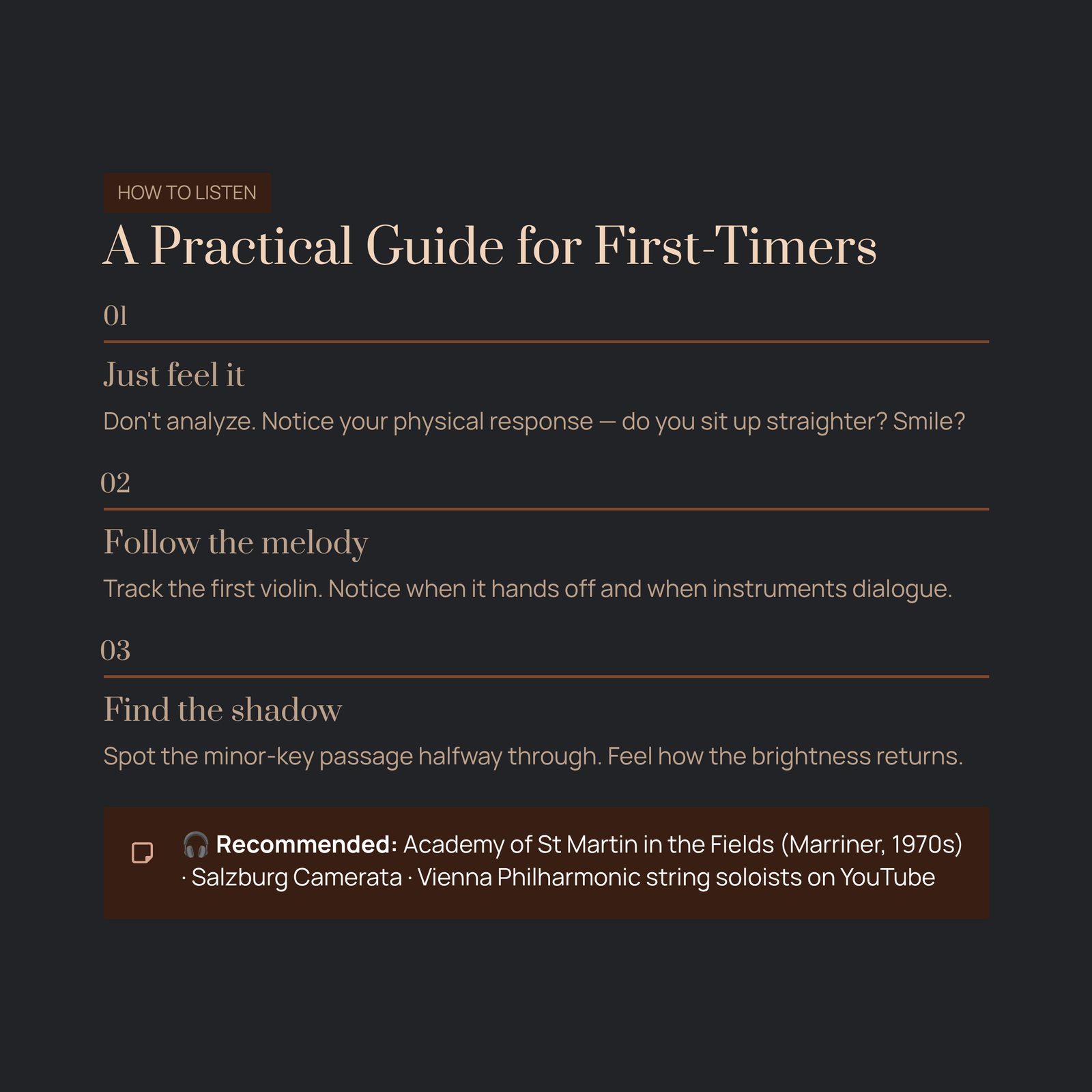
Listen once just to feel it. Don’t analyze. Let the opening bars land on you. Notice your own physical response—does your posture change? Does your breathing shift? Many people find themselves sitting up straighter, or smiling without meaning to.
On the second listen, follow the melody. Track where the first violin goes. Notice when it hands off to other instruments. Notice when the whole ensemble plays together versus when they’re in dialogue.
On the third listen, find the shadow moment. It’s brief—a minor-key passage roughly halfway through. When you spot it, notice how quickly the brightness returns, and how that return feels different now that you were watching for it.
For recommended recordings, seek out the Academy of St Martin in the Fields (the Neville Marriner recordings from the 1970s remain reference-grade), or the Salzburg Camerata for a leaner, more historically-informed sound. If you’re on YouTube, the Vienna Philharmonic string soloists’ chamber recordings are widely available and sonically stunning.

The Longer Story This Four-Minute Piece Tells
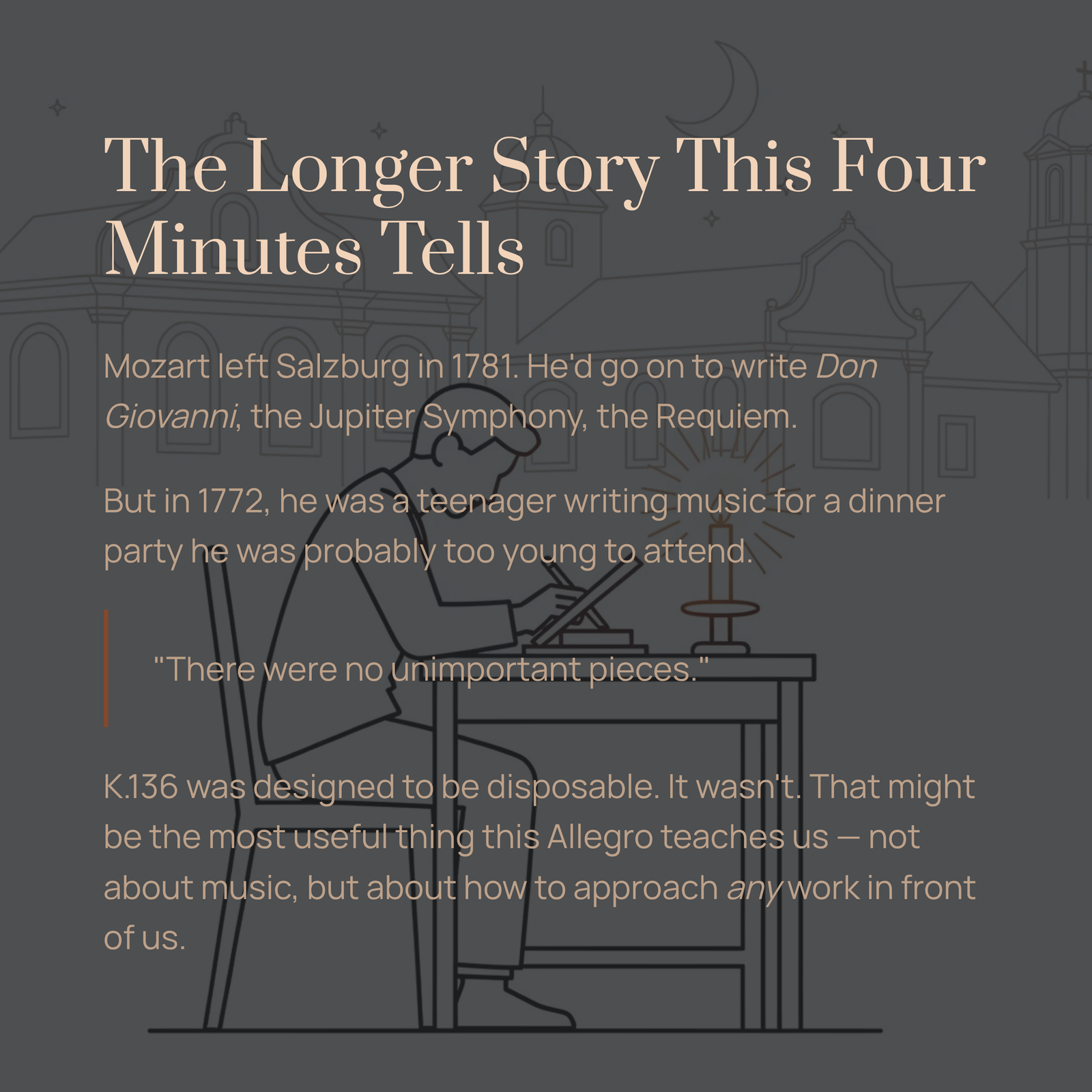
Mozart would leave Salzburg for good in 1781, famously dismissed by Archbishop Colloredo in what history records as a fairly undignified exit. He would go on to write Don Giovanni, the Jupiter Symphony, the Requiem. He would become the composer everyone invokes when they want to describe genius.
But in the winter of 1772, he was still a teenager in a provincial town, writing music for a dinner party he was probably too young to attend.
And he wrote this.
There’s something worth sitting with in that: the idea that a piece designed purely to entertain, written quickly, scored for a modest ensemble, with no grand ambitions attached—can outlast almost everything else from its era. The divertimento was supposed to be disposable. It wasn’t.
What K.136 really is, underneath its charming surface, is a record of a mind that couldn’t help but make everything it touched into something worth keeping. Mozart wasn’t saving his best ideas for the important pieces. There were no unimportant pieces.
That might be the most useful thing this four-minute Allegro has to teach us—not about music, but about how to approach the work in front of us, whatever it is.
Tags: #MozartK136 #DivertimentoK136 #ClassicalMusicForBeginners #MozartAllegro #ChamberMusic #StringMusic #SalzburgSymphonies #ClassicalMusicGuide #MozartListeningGuide #CalmClassical #StudyMusic #FocusMusic #MusicAppreciation #ClassicalMusicBlog