📑 Table of Contents
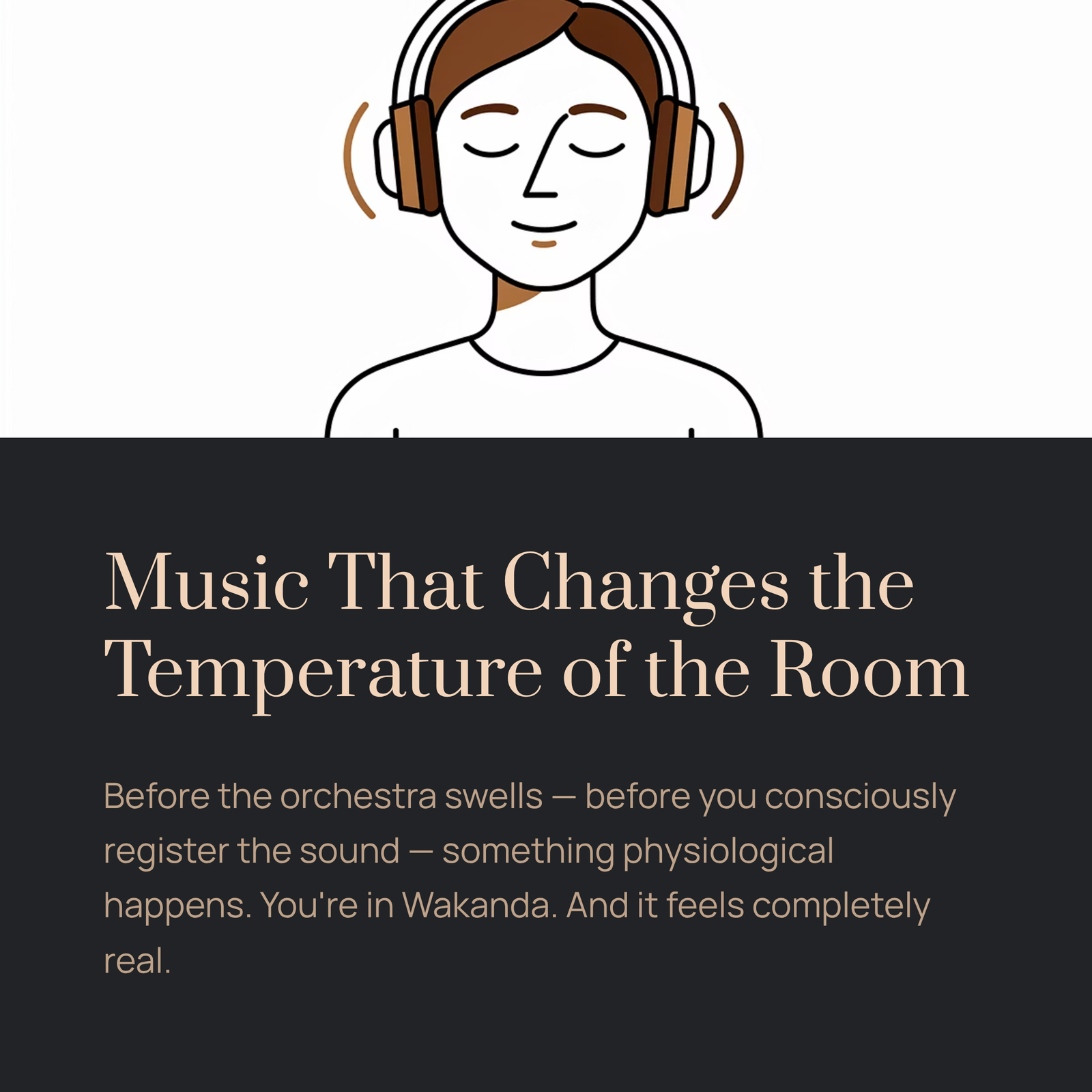
There are film scores you admire intellectually — you recognize the craft, the harmonic choices, the clever leitmotifs — and then there are scores that do something more unsettling: they change the temperature of the room before you consciously register the sound.
Ludwig Göransson’s Wakanda Theme from Black Panther (2018) belongs firmly in the second category.
The moment those low, resonant drums begin — before the orchestra swells, before the choir enters — something physiological happens. Your posture straightens. Your breathing slows. And if you’re listening with your eyes closed, you realize you’re not sure where in the world you are, because the music isn’t from any place you’ve ever visited. It’s from Wakanda. And somehow, that feels completely, irrationally real.
How does a composer build a sonic world for a nation that exists only in imagination? That’s the question worth sitting with.
A Swedish Composer Walks Into Senegal
Ludwig Göransson was 32 years old when director Ryan Coogler handed him the Black Panther assignment. The two had already collaborated on Creed (2015) and Fruitvale Station (2013), so there was trust between them. But this project was different in scale and in cultural responsibility.
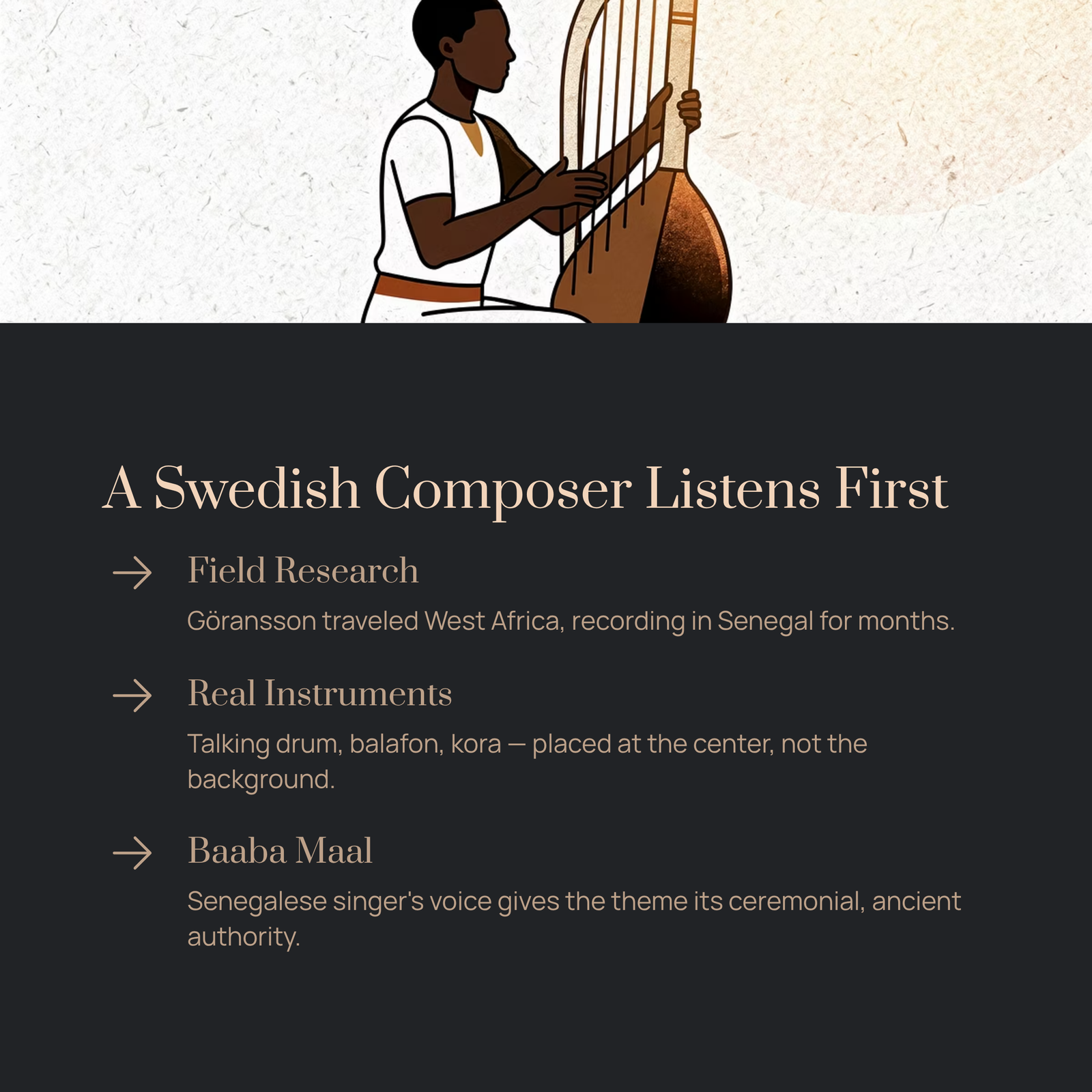
Göransson’s instinct was not to invent Wakanda’s sound at a studio console — it was to listen first. He spent months traveling through West Africa, recording musicians in Senegal and other countries, studying traditional instruments like the talking drum, the balafon (a wooden xylophone), and the kora (a 21-string instrument that sits somewhere between a harp and a lute). He brought in West African vocalists, South African choral traditions, and Senegalese percussion ensembles, and then he did something unusual: he didn’t blend these elements into the background to create “African atmosphere.” He put them at the center.
The Wakanda Theme is built on the voice of Senegalese singer Baaba Maal, whose vocal timbre gives the theme its ceremonial, ancient authority. When you hear that voice, you’re hearing a real human tradition refracted through an imaginary nation — and the combination creates something that feels neither documentary nor fantasy, but mythological in the deepest sense.
What You’re Actually Hearing: A Listener’s Anatomy
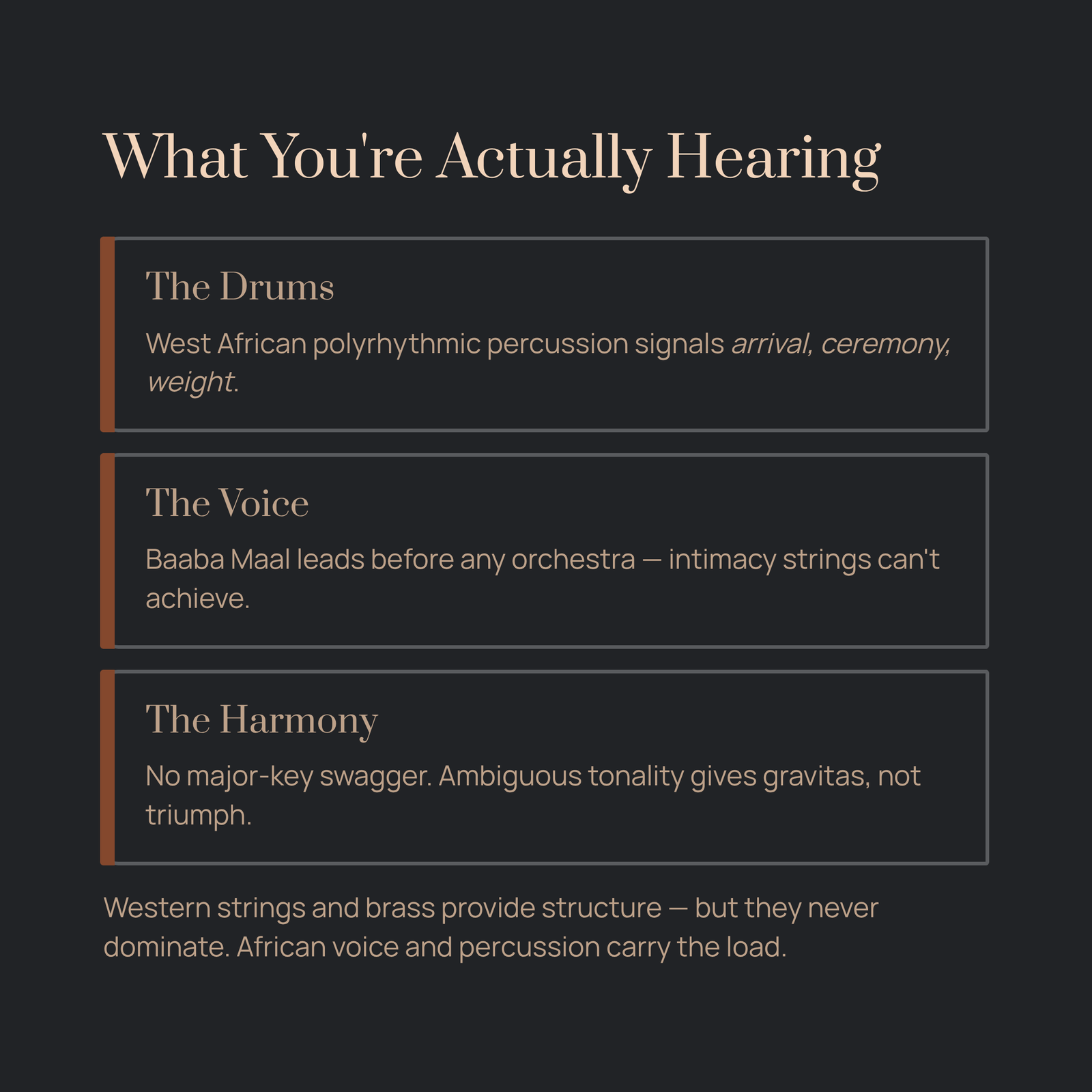
The theme opens with percussion — specifically, low frame drums and talking drums that establish a rhythmic pattern rooted in West African polyrhythmic traditions. These aren’t just “exotic flavor.” The rhythmic structure itself is doing semantic work: it signals arrival, ceremony, weight.
Then comes Baaba Maal’s voice — wordless, declarative, almost like a proclamation from a mountaintop. Western film scores would typically place the melody in strings or brass at this moment. Göransson’s choice to foreground the human voice before any orchestral instrument creates an immediate intimacy that orchestral writing often can’t achieve.
As the theme builds, notice what happens in the lower register: there are Western orchestral elements (string basses, brass undertones) that act as structural support, but they never dominate. The African percussion and voice remain the load-bearing elements throughout. This is the compositional philosophy in action — the Western musical language is in service of something older, not the other way around.
The harmonic language is also worth attention. Göransson avoids the obvious “epic hero” harmonics that dominate superhero scores — the major-key swagger, the ascending perfect-fifth brass figures. The Wakanda Theme works in a more ambiguous tonal space, which gives it gravitas rather than triumph. Wakanda doesn’t need to be proven to you; it simply is.
The Weight of Representing Something That Matters
For audiences who had grown up with Hollywood’s long, uncomfortable history of representing Africa — as spectacle, as background, as Other — hearing the Wakanda Theme in a theater in 2018 was an experience that exceeded music.
This is something Göransson understood he was navigating. In interviews, he’s spoken about his awareness that Wakanda, as a concept, was carrying a particular kind of emotional freight for Black audiences globally: a vision of an African civilization that had never been colonized, never been diminished, never been erased. The music couldn’t simply illustrate that vision. It needed to embody it.
The decision to make the score not just African-influenced but African in its foundational instrumentation was itself a political and artistic choice. When the theme plays over images of vibranium mountains and advanced architecture, the music is making an argument: this civilization has a real, specific cultural inheritance — not a generic pan-African pastiche, but a sound that came from actual people in actual places, transformed through an imaginative act of world-building.
Whether or not you think deeply about any of this while watching the film, your nervous system responds to it. That’s what great film music does. It carries meaning into the body before the mind has time to analyze it.
How to Listen: Three Ways In
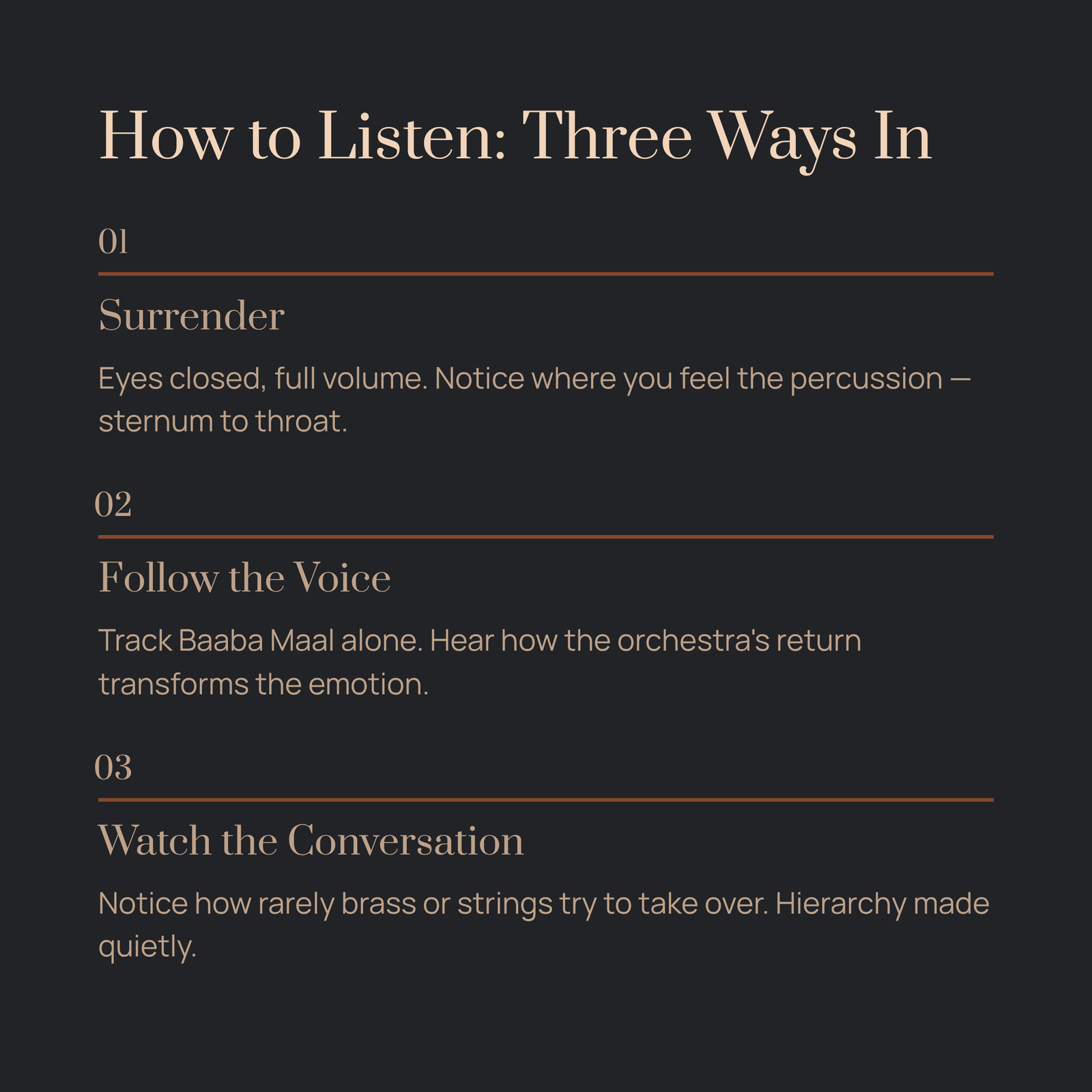
First listen — surrender. Don’t try to identify anything. Play the theme at volume, close your eyes, and simply let the percussion patterns do their work on your body. Notice where you feel it — usually somewhere between the sternum and the throat.
Second listen — follow the voice. Track Baaba Maal’s vocal line specifically. Listen to how it breathes, how it pauses, how it phrases. Imagine stripping away every other element and just having that voice in an empty room. Then notice how different the emotional experience is when the orchestra returns — the contrast is doing deliberate work.
Third listen — watch the conversation. Pay attention to the relationship between the African percussion in the foreground and the Western orchestral elements in the background. Notice how rarely the brass or strings try to take over. There’s a musical argument being made about hierarchy — and it’s made quietly, through arrangement choices, not through volume.
Where to Hear It
The definitive version is in the film itself — specifically the scenes set in Wakanda, where visual and sonic worlds reinforce each other completely. But for pure musical listening:
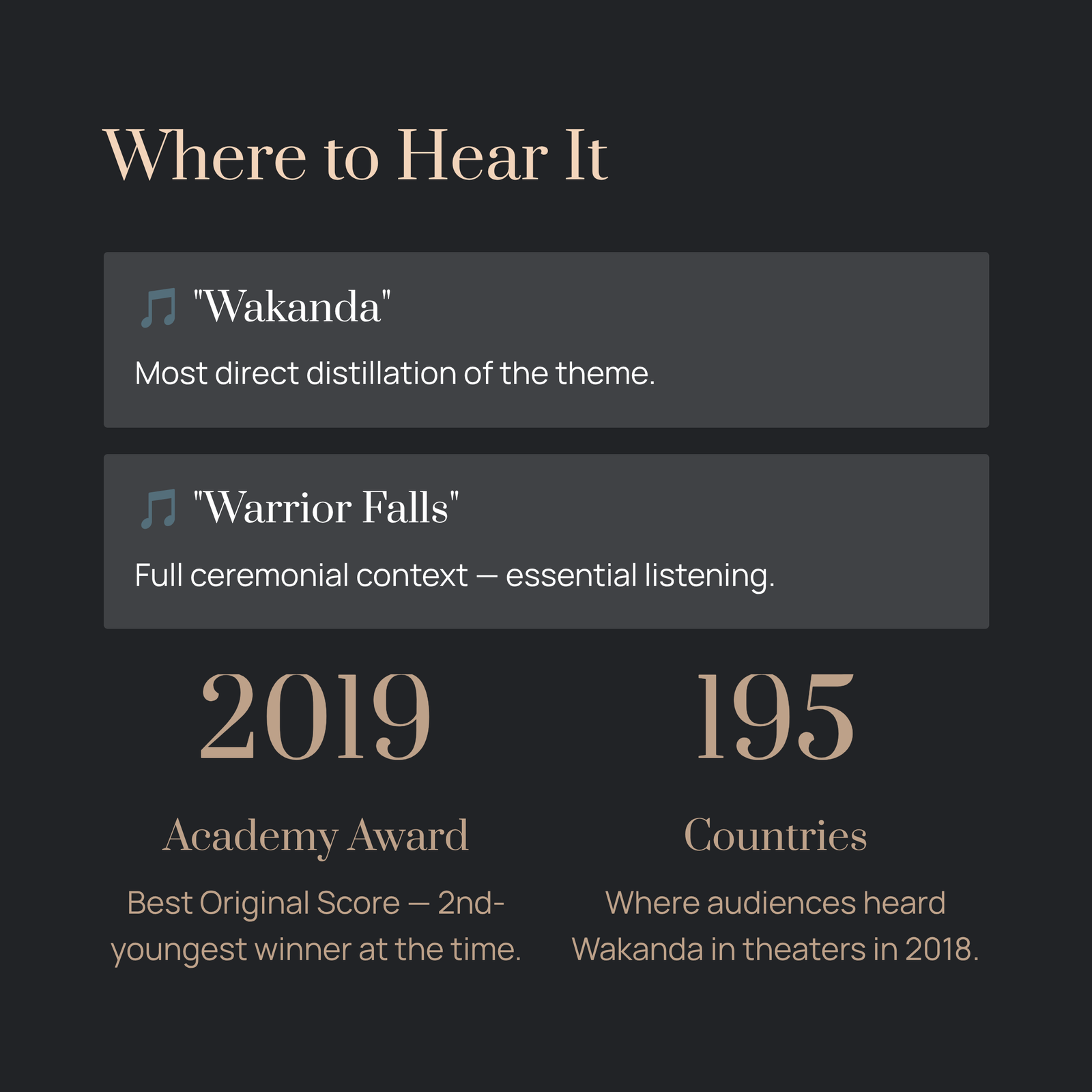
“Black Panther” (Original Score) by Ludwig Göransson (2018) — the official soundtrack release contains the full thematic material. The track “Wakanda” is the most direct distillation. “Warrior Falls” is essential for hearing the theme in its full ceremonial context.
Göransson won the Academy Award for Best Original Score in 2019 for this work — the second-youngest composer to win in that category at the time. For comparison listening, his scores for Tenet (2020) and Oppenheimer (2023) show a very different compositional personality, making the specificity of what he built for Wakanda even more striking in retrospect.
A Kingdom Exists If Enough People Can Hear It
There’s a concept in music called diegesis — the distinction between music that exists within the world of the story (a character playing piano) and music that exists outside it (the swelling strings the characters can’t hear). Film scores are almost always the latter: invisible architecture, supporting a world the audience observes from the outside.
The Wakanda Theme does something stranger. When it plays, it feels diegetic — as if the people of Wakanda can hear it, as if the music is emanating from the ground itself, from the vibranium deposits, from the collective memory of the civilization. It’s a perceptual trick accomplished through the specificity of real cultural sound. Because Baaba Maal’s voice is genuinely connected to a living tradition, and because those percussion patterns carry actual historical weight, the imaginary world acquires a kind of acoustic archaeology.
Wakanda never existed. But when the drums begin, the question of existence starts to feel less relevant than the question of recognition. Something in the music asks: do you hear this? Do you understand what this represents?
And the answer, across movie theaters in 195 countries in 2018, was overwhelmingly yes.
That’s the only metric that finally matters for music.