📑 Table of Contents
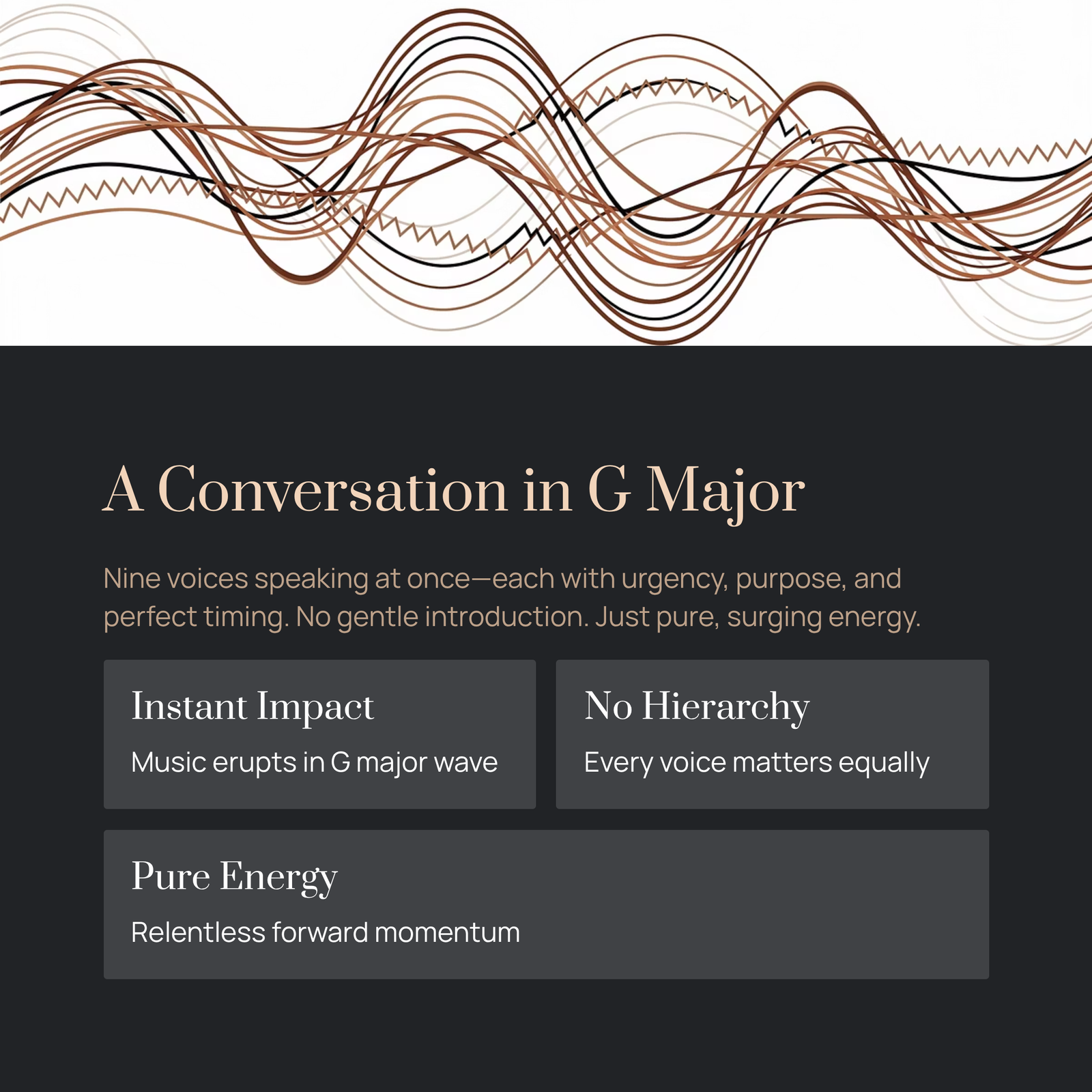
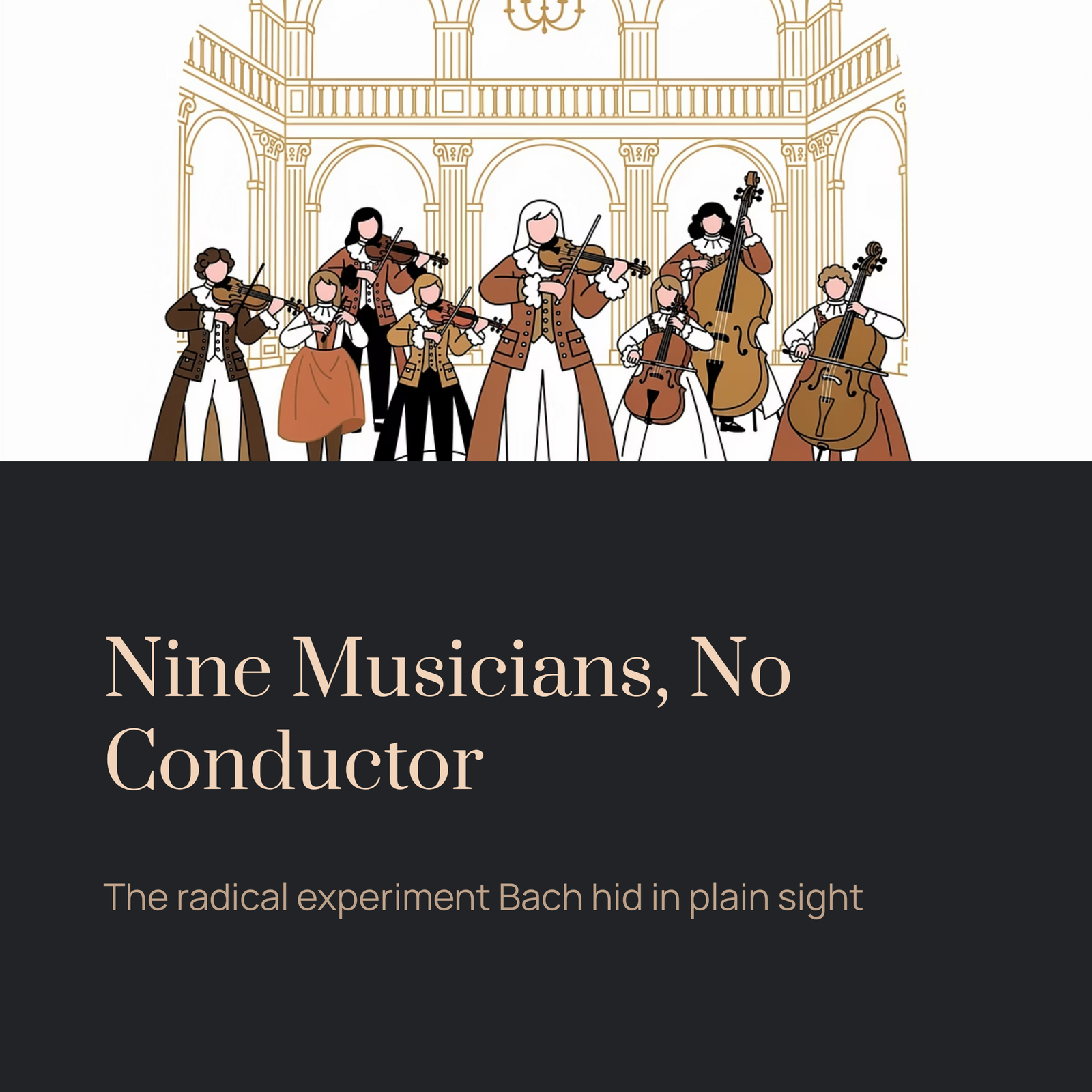
Imagine walking into a room where nine people are talking at once — and somehow, miraculously, every single voice makes perfect sense. No one is shouting over anyone else. No one is waiting politely in the corner. Each person speaks with urgency, with purpose, and at exactly the right moment. That’s what it feels like the first time you really listen to the opening of Bach’s Brandenburg Concerto No. 3.
There’s no gentle introduction here, no slow warmup. The music simply erupts — a surging wave of G major that grabs you by the collar and says, keep up. It’s the kind of energy that makes you sit up straighter, breathe a little faster, and feel like something important is happening. Because it is.
The Man Behind the Music
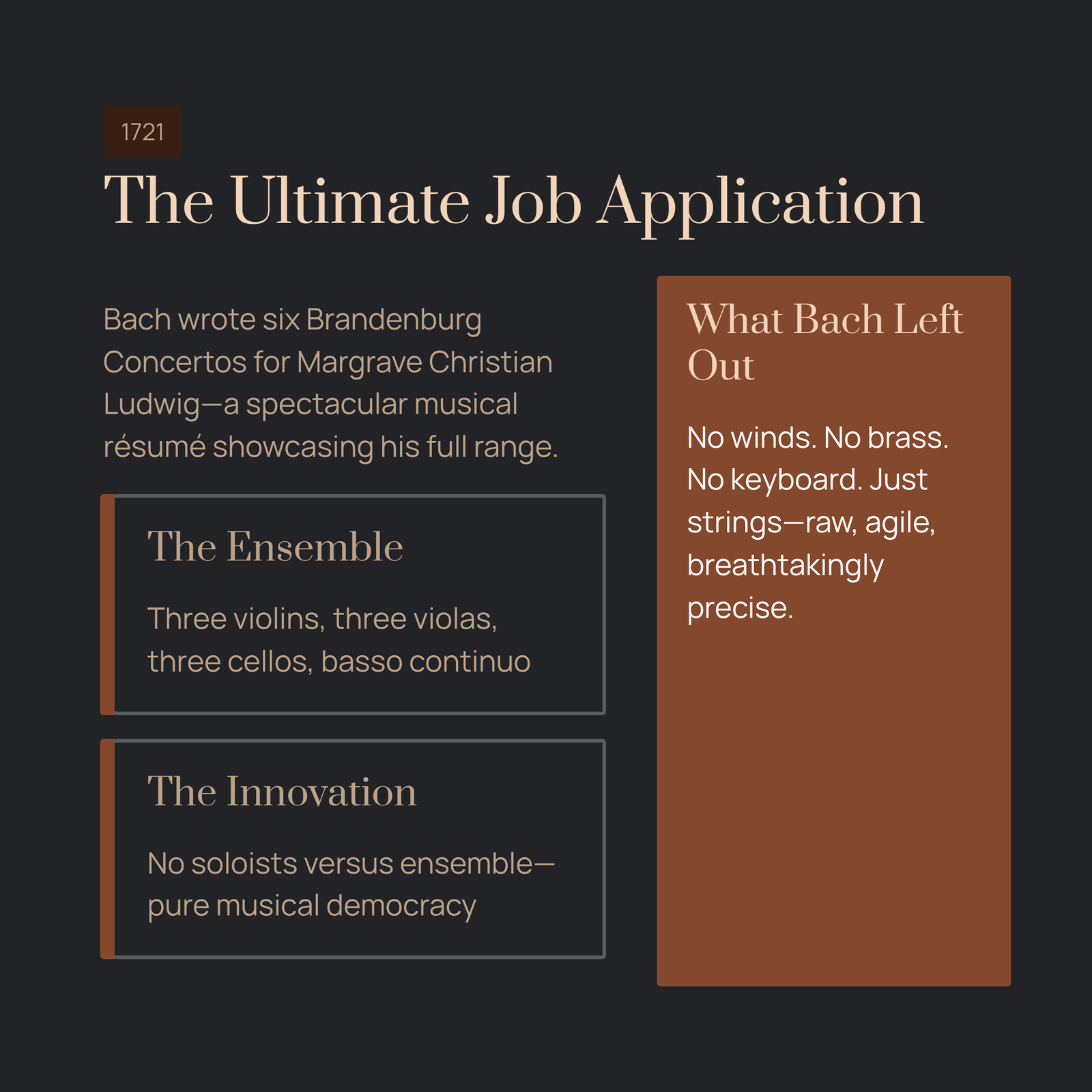
Johann Sebastian Bach wrote the six Brandenburg Concertos around 1721 and dedicated them to Christian Ludwig, the Margrave of Brandenburg. It was essentially a job application — one of the most spectacular résumés ever assembled. Bach was working in Köthen at the time, serving as court composer to Prince Leopold, a music-loving employer who gave Bach unusual creative freedom.
Each of the six concertos showcases a different combination of instruments, almost like Bach was deliberately showing off the full range of what he could do. The Third Concerto is scored for the leanest ensemble of the set: three violins, three violas, three cellos, and basso continuo. No winds. No brass. No keyboard pyrotechnics. Just strings — raw, agile, and breathtakingly precise.
What makes this choice so striking is what Bach doesn’t do. In an era when the concerto grosso format typically featured a small group of soloists set against a larger ensemble, Bach levels the playing field entirely. Every instrument here is both soloist and accompanist. The hierarchy dissolves. What remains is pure musical democracy.
Why the First Movement Hits Different
The Allegro opens with a motif so infectious it could have been written yesterday. A rapid, ascending figure ripples through the ensemble like a stone skipped across water — first in the violins, then the violas, then the cellos. Within seconds, you’re caught in a web of interlocking patterns, each voice tossing melodic fragments back and forth with the precision of a clockwork mechanism and the warmth of a living, breathing conversation.
Here’s where things get fascinating for anyone new to classical music: you don’t need to understand counterpoint or fugal technique to feel what’s happening. Your ear naturally tracks the way one melody passes from instrument to instrument. It’s like watching a relay race where the baton never stops moving, and somehow every runner is sprinting at the same time.
A few things to listen for:
The ritornello theme — that bold, propulsive opening gesture — returns again and again throughout the movement, but each time it appears in a different key and a different instrumental color. It’s Bach’s way of creating structure without repetition ever feeling stale. Think of it as a familiar face appearing in unexpected places.
Pay attention to the episodes — the passages between each return of the main theme. This is where Bach lets the instruments engage in intimate, small-group dialogues. Two violins might weave around each other while the cellos provide a steady pulse below. Then suddenly the full ensemble snaps back together with exhilarating force. The contrast between these moments of chamber-music intimacy and full-throttle ensemble power is one of the movement’s greatest pleasures.
And then there’s the rhythmic drive. The movement never lets up. There are no grand pauses, no moments of repose. It’s relentless in the best possible way — like a river that’s moving too fast to freeze, carrying you forward with an energy that feels simultaneously inevitable and free.
What This Music Means to Me
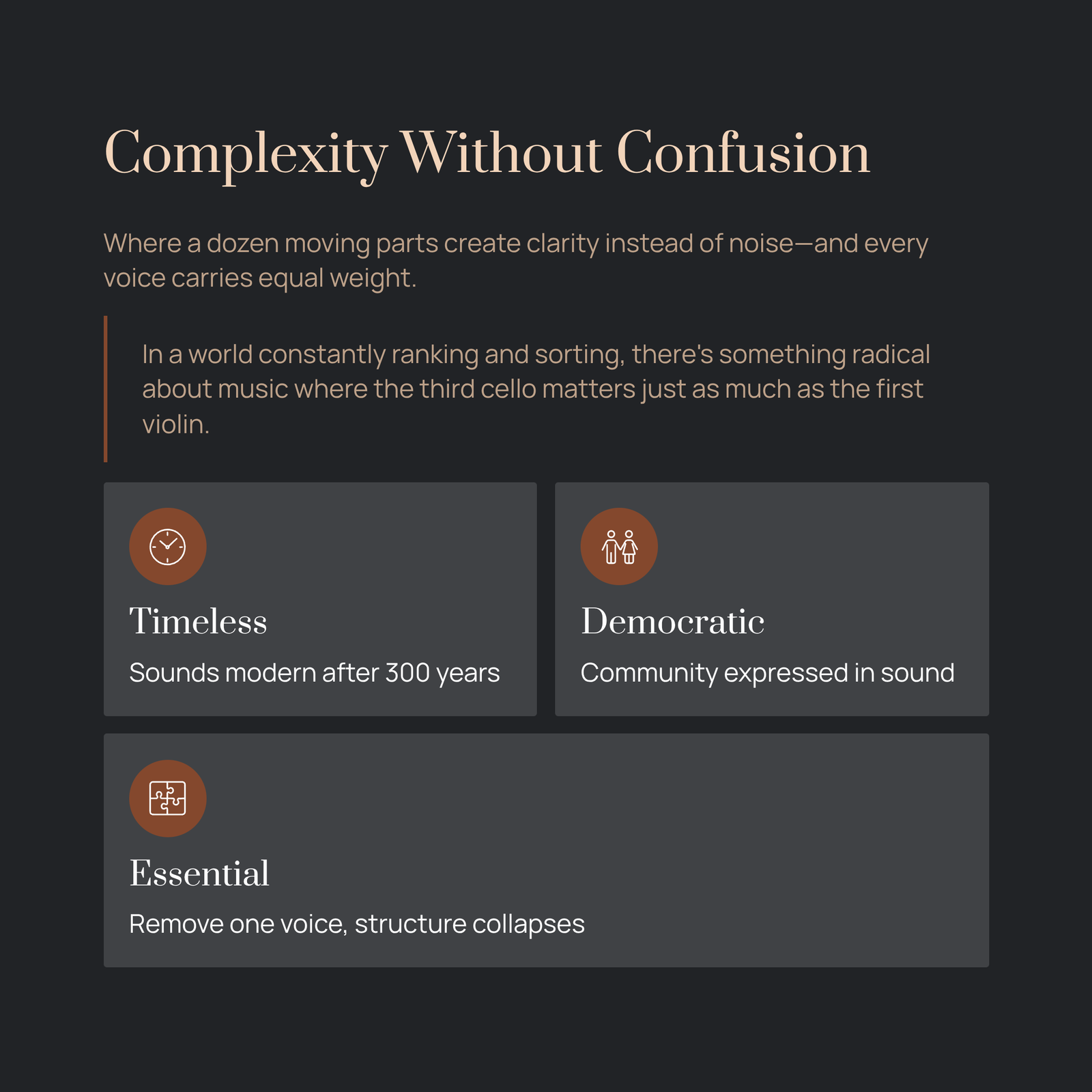
I keep coming back to the Brandenburg No. 3 whenever life starts to feel chaotic. There’s something deeply reassuring about music where complexity doesn’t mean confusion — where a dozen moving parts create clarity instead of noise.
The first time I heard it, I remember being struck by how modern it sounded. There’s a motoric intensity to this movement that wouldn’t feel out of place in a film score or even an electronic music set. Bach couldn’t have known that, of course. He was writing for a minor German court in the early eighteenth century. But great music has a way of outrunning its own era.
What moves me most, though, is the equality of the voices. In a world that’s constantly ranking, sorting, and hierarchizing, there’s something radical about a piece of music where the third cello matters just as much as the first violin. Every part carries weight. Every voice has something essential to say. Remove any single line and the whole structure would collapse. It’s a vision of community expressed in sound — and it’s three hundred years old.
Your Listening Roadmap
If you’re hearing this piece for the first time, here’s a simple way in.
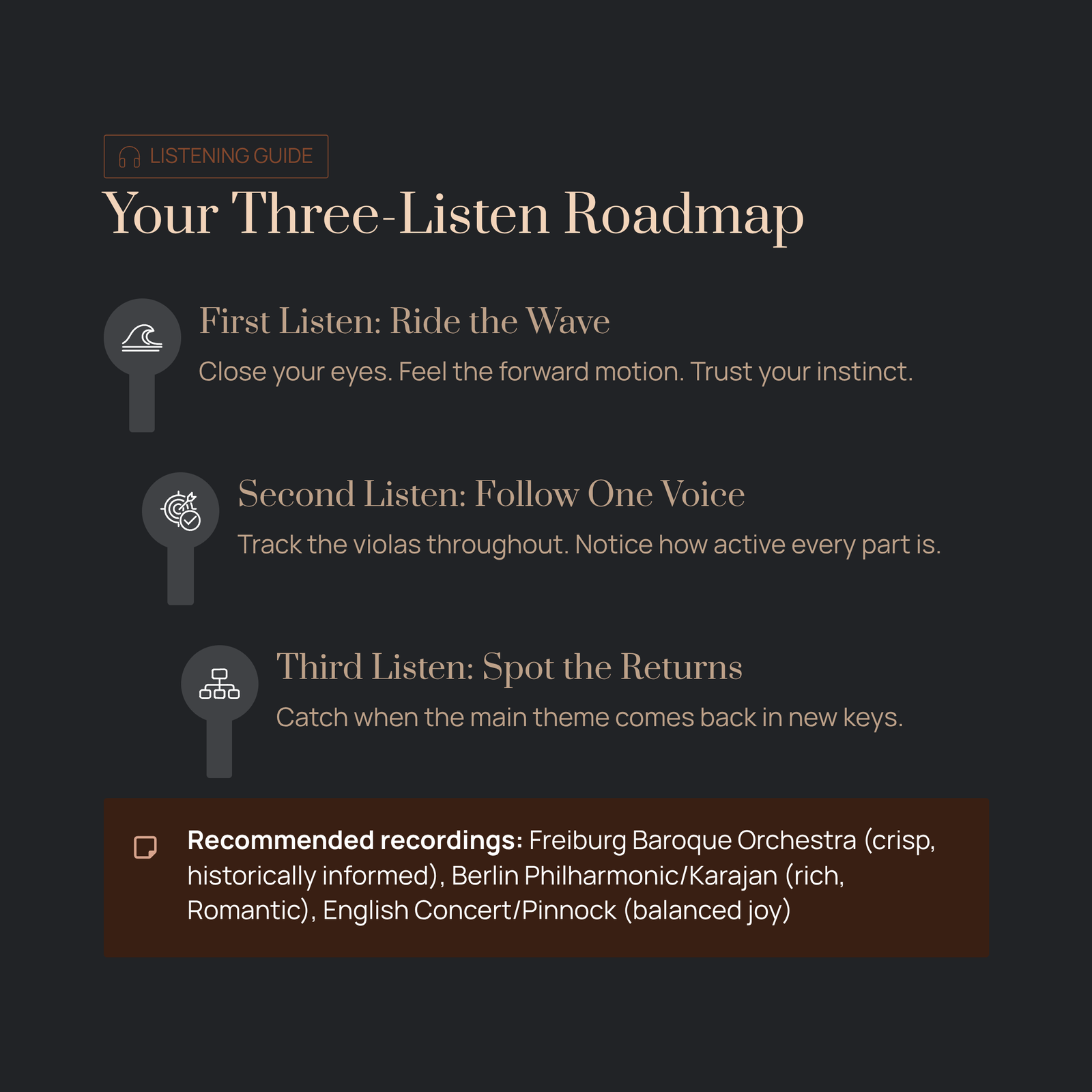
First listen — just ride the wave. Don’t try to analyze anything. Put on a good recording, close your eyes, and let the energy carry you. Notice how the music makes your body feel. Most people report a sense of forward motion, almost physical momentum. Trust that instinct.
Second listen — follow one voice. Pick an instrument group — say, the violas — and try to track what they’re doing throughout the movement. You’ll be amazed at how active they are. This isn’t background filler. Every part is melodically rich and rhythmically engaged.
Third listen — spot the returns. Now try to catch the moments when the main theme comes back. You’ll hear the full ensemble lock into that signature opening gesture, usually in a new key. These structural signposts give the movement its architecture, and recognizing them is one of the great satisfactions of getting to know any piece of Bach.
For recordings, the Freiburg Baroque Orchestra offers a historically informed performance that’s both crisp and deeply musical — their tempos are brisk, the articulation is vivid, and you can hear every voice with remarkable clarity. If you prefer a richer, more Romantic sound, the classic recording by the Berlin Philharmonic under Herbert von Karajan remains a powerful listening experience, though it reimagines the piece through a very different aesthetic lens. For something in between, the English Concert led by Trevor Pinnock strikes an ideal balance of scholarly rigor and sheer joy.
The Conversation That Never Ends
There’s a reason this concerto has survived for over three centuries. It isn’t because music historians deemed it important, though they certainly have. It’s because every time someone presses play, nine invisible musicians start talking to each other — and the conversation is so compelling, so alive, so perfectly balanced between order and spontaneity, that you can’t help but lean in and listen.
Bach wrote this music for a patron who probably never performed it. The manuscript gathered dust for decades. It could easily have been lost. But the conversation it started — about equality, about complexity, about the sheer thrill of human voices working together — that conversation is still going. All you have to do is listen.