📑 Table of Contents
Here is a story that sounds almost too dramatic to be true — and yet every word of it is real.
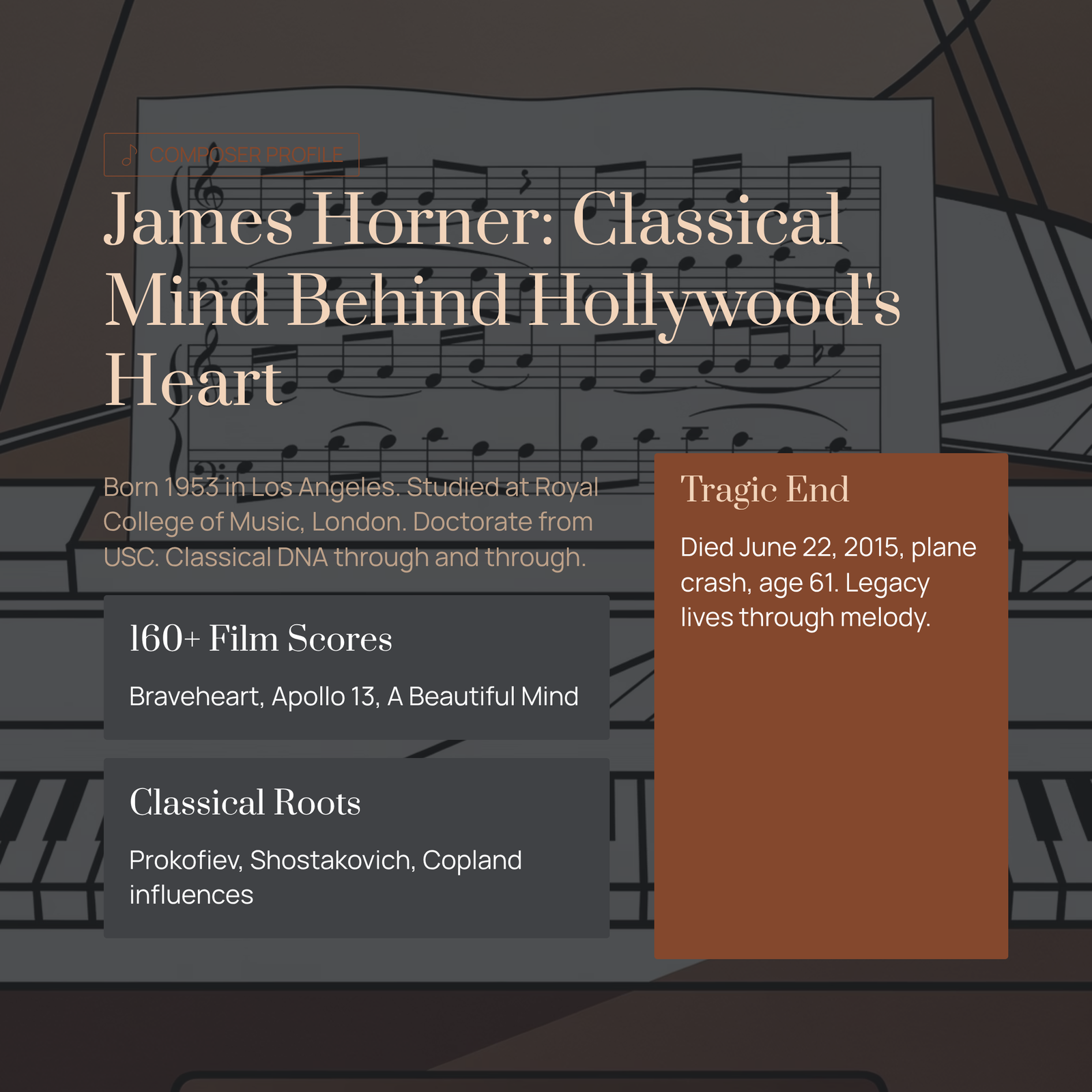
In 1997, director James Cameron was deep in the final stages of editing what would become one of the highest-grossing films in cinema history. He had a clear vision for his film’s ending: no pop song, no radio-friendly ballad. The sinking of the RMS Titanic was a real tragedy that claimed over 1,500 lives, and Cameron believed a pop song over the end credits would cheapen everything he had built.
His composer, James Horner, disagreed. And rather than argue, Horner simply went behind Cameron’s back.
He secretly developed an instrumental motif — one that had been woven quietly throughout the entire film score, from the “I’m flying” scene to the moment Jack sketches Rose — into a full vocal piece. He brought in lyricist Will Jennings, who wrote the words entirely from the perspective of an elderly woman looking back across a lifetime of love and loss. And then Horner went looking for a voice.
The voice he found belonged to Céline Dion. She said no.
Her husband and manager, René Angélil, convinced her to at least record a demo. Dion later admitted she was furious at the time — she had just come off massive hits and had no interest in another movie tie-in. But she walked into the studio one evening, sang the song exactly once, and by the time she finished, everyone in the room was in tears.
That single take is the recording the world knows today. And when Horner finally played it for Cameron — carefully choosing a moment when the director was in a receptive mood — Cameron gave his reluctant approval.
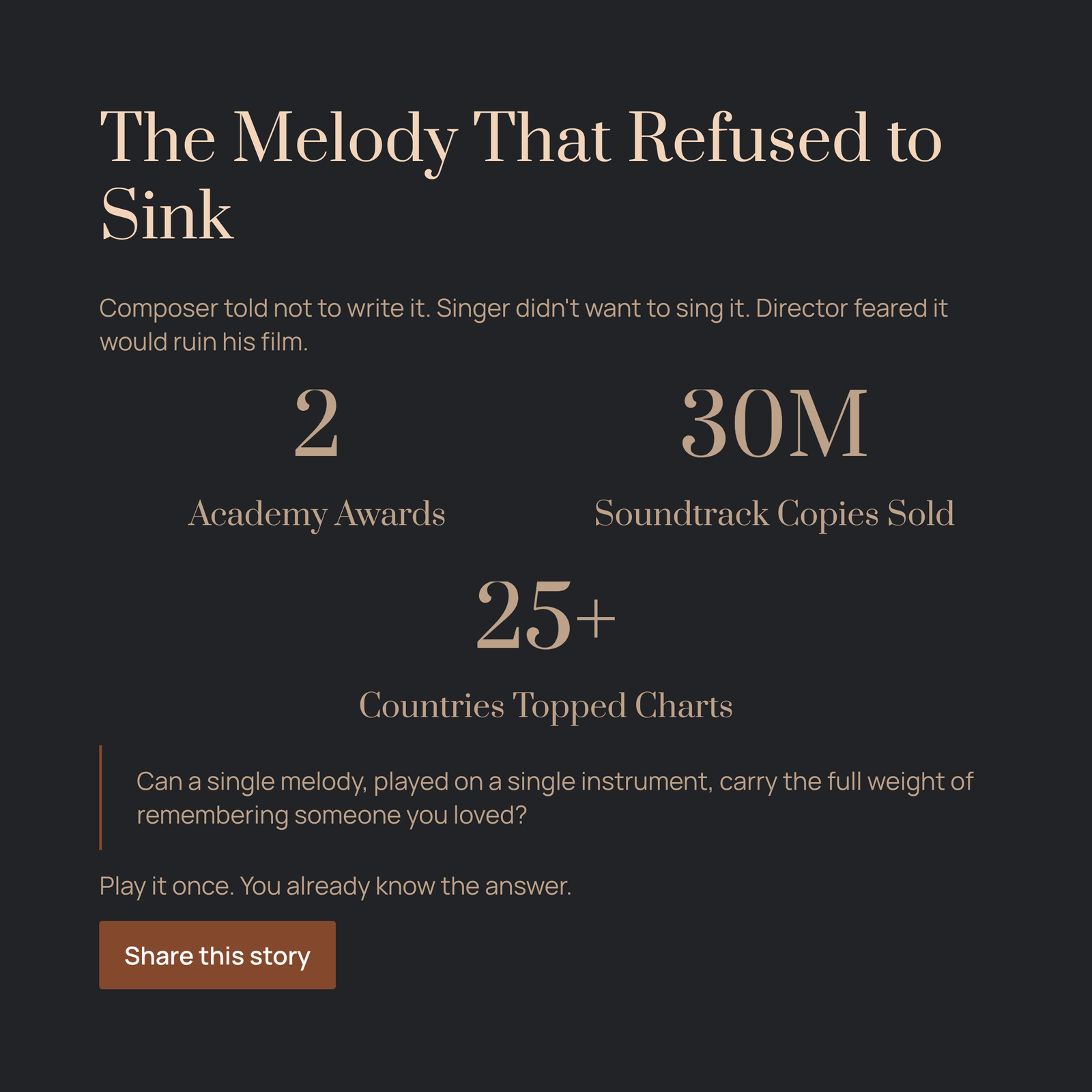
The rest is history. Two Academy Awards. Over 30 million soundtrack copies sold. A song that topped the charts in more than twenty-five countries.
But here is what I want you to consider: strip all of that away. Forget the Oscars, forget the box office numbers, forget Céline Dion’s powerhouse vocals. What remains when you reduce this song to its bare bones — just a piano, just the melody?
That is where the real magic lives.
James Horner: The Classical Mind Behind Hollywood’s Heart
James Horner was not your typical Hollywood composer. Born in Los Angeles in 1953, he spent his formative years studying at the Royal College of Music in London before returning to the United States to complete his doctorate at the University of Southern California. His musical DNA was classical through and through — Prokofiev, Shostakovich, Copland, and Khachaturian all left fingerprints on his compositional voice.
What made Horner extraordinary was not just his technical command, but his rare ability to merge classical sophistication with cinematic storytelling. Listen carefully to his scores for Braveheart, Apollo 13, or A Beautiful Mind, and you will hear a composer who thinks in long arcs, who builds tension the way a symphonist does — not through sudden shocks, but through the patient accumulation of emotional weight.
This is precisely what makes the piano arrangement of “My Heart Will Go On” so revealing. Horner originally conceived the theme as an instrumental motif, not a pop song. The melody was born at the piano, shaped by a mind steeped in classical tradition. When you hear it played on piano alone, you are hearing the piece in something close to its original form — before the orchestrations, before the synthesizers, before the vocals.
You are hearing what Horner heard in his own head before anyone else in the world knew this melody existed.
Tragically, Horner died in a plane crash on June 22, 2015, at the age of 61. He left behind a body of work spanning over 160 film scores — but it is this melody, perhaps more than any other, that continues to carry his name across generations.
What the Piano Reveals: A Listening Guide
The orchestral version of “My Heart Will Go On” is a grand, sweeping thing — layers of strings, synthesized choir, Celtic instrumentation, and Dion’s voice soaring above it all. It is designed to overwhelm. The piano version does something fundamentally different: it invites you to sit down and listen closely.
Here is what to pay attention to.
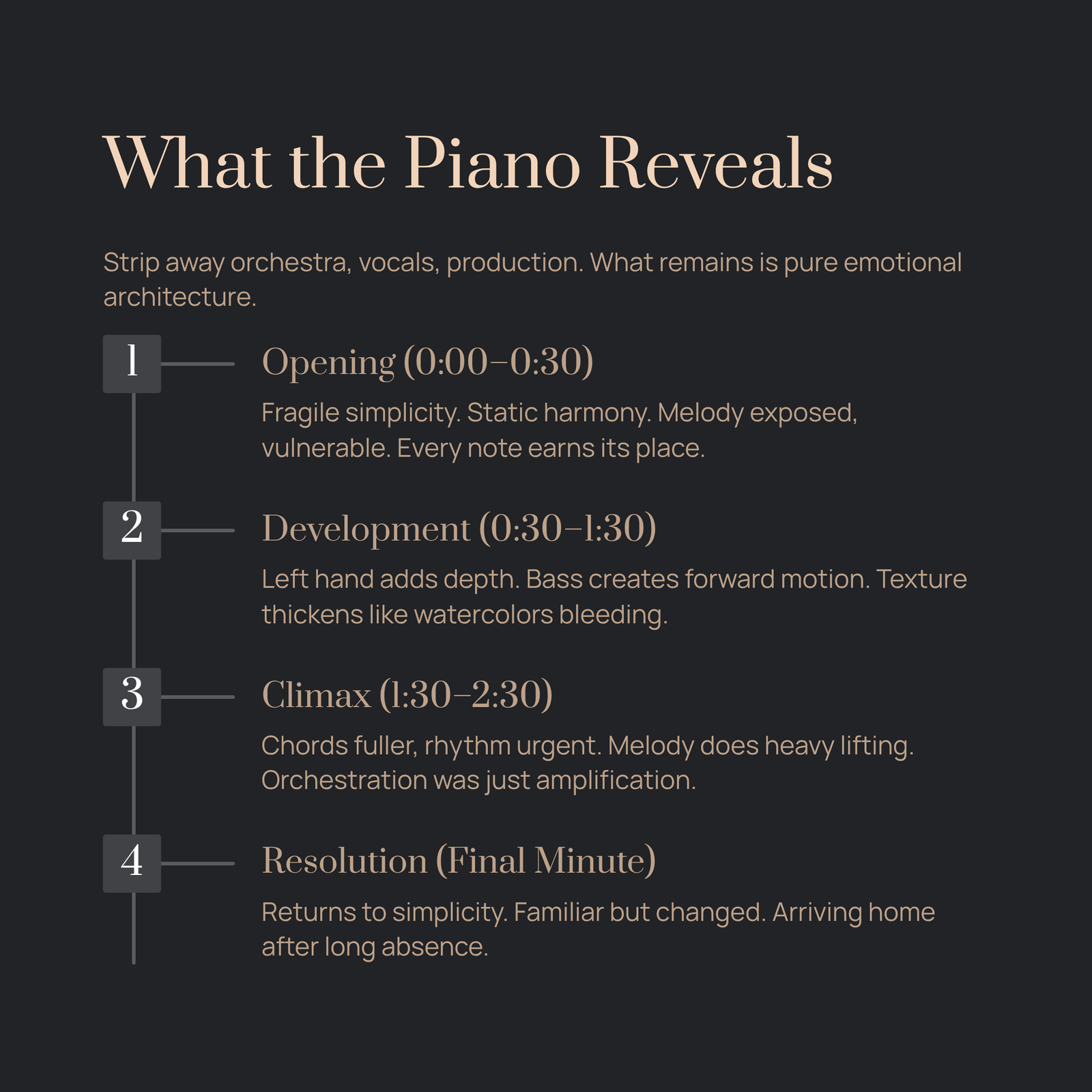
The opening phrase (0:00–0:30): The melody enters with a simplicity that borders on fragile. There is no harmonic fireworks here — the chord progression stays deliberately static, almost understated. This is a technique Horner borrowed from classical film scoring tradition: keep the harmonic language transparent so the emotional arc can speak for itself. Notice how exposed the melody feels. On piano, there is nowhere to hide. Every note either earns its place or it does not.
The middle development (0:30–1:30): This is where Horner’s classical training becomes most apparent. The left hand begins to move with more purpose, adding harmonic depth without disturbing the melody’s trajectory. Listen for the way the bass notes create a sense of forward motion — not rushing, but gently pulling you deeper into the piece. The texture thickens gradually, like watercolors bleeding slowly into wet paper.
The climactic passage (1:30–2:30): In the original recording, this is where the full orchestra crashes in and Dion’s voice reaches its peak. On piano, the same emotional peak is achieved through dynamics and voicing alone. The chords become fuller, the right hand reaches higher, and the rhythm gains just enough urgency to make your chest tighten. This is the moment where you realize the melody itself was always doing the heavy lifting — the orchestration was just amplification.
The resolution (final minute): The piece pulls back, the dynamics soften, and the melody returns to something close to its opening simplicity. But it does not sound the same anymore. You have traveled somewhere with this music, and the return feels like arriving home after a long absence — familiar, but changed.
Why This Piece Hits Differently on Piano
There is a reason piano arrangements of famous melodies sometimes feel more emotionally direct than their orchestral originals. An orchestra can dazzle you. A piano can only speak to you.
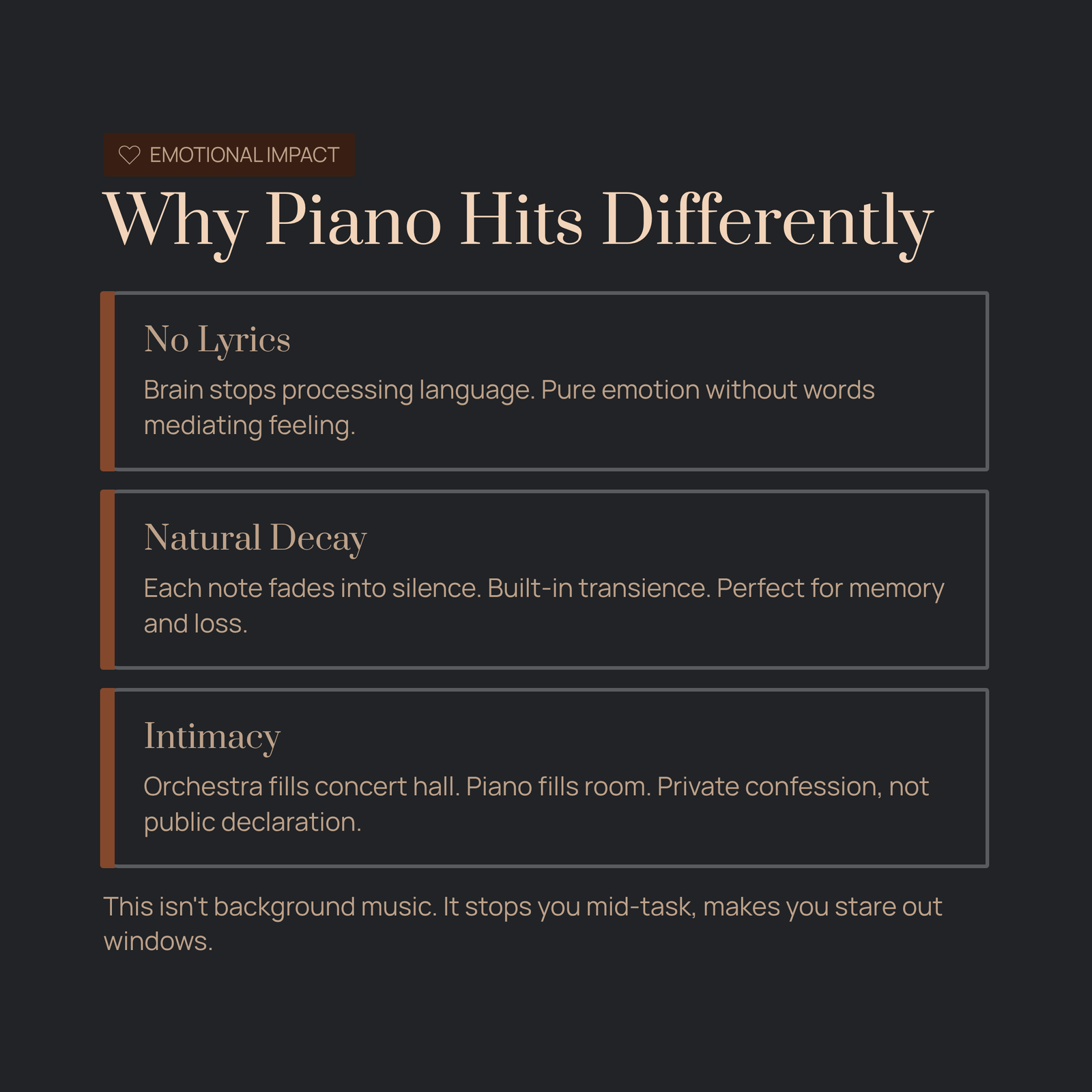
When “My Heart Will Go On” is performed on piano, several things happen simultaneously. First, the absence of lyrics forces your brain to stop processing language and start processing pure emotion. You are no longer hearing about love and loss — you are feeling it, without the mediation of words. Second, the piano’s natural decay — the way each note fades into silence after being struck — gives the music a built-in quality of transience. Every note is already disappearing the moment it sounds. For a piece about memory, about holding onto something that has already slipped beneath the surface, this quality is devastatingly appropriate.
And third, the intimacy. An orchestra fills a concert hall. A piano fills a room. When you listen to this arrangement through headphones or in a quiet space, the music feels like it is being played just for you — a private confession, not a public declaration.
This is not background music. This is the kind of piece that stops you mid-task and makes you stare out the window for a while.
Recommended Recordings and How to Listen
For those exploring this piece for the first time, here are some ways to approach it.
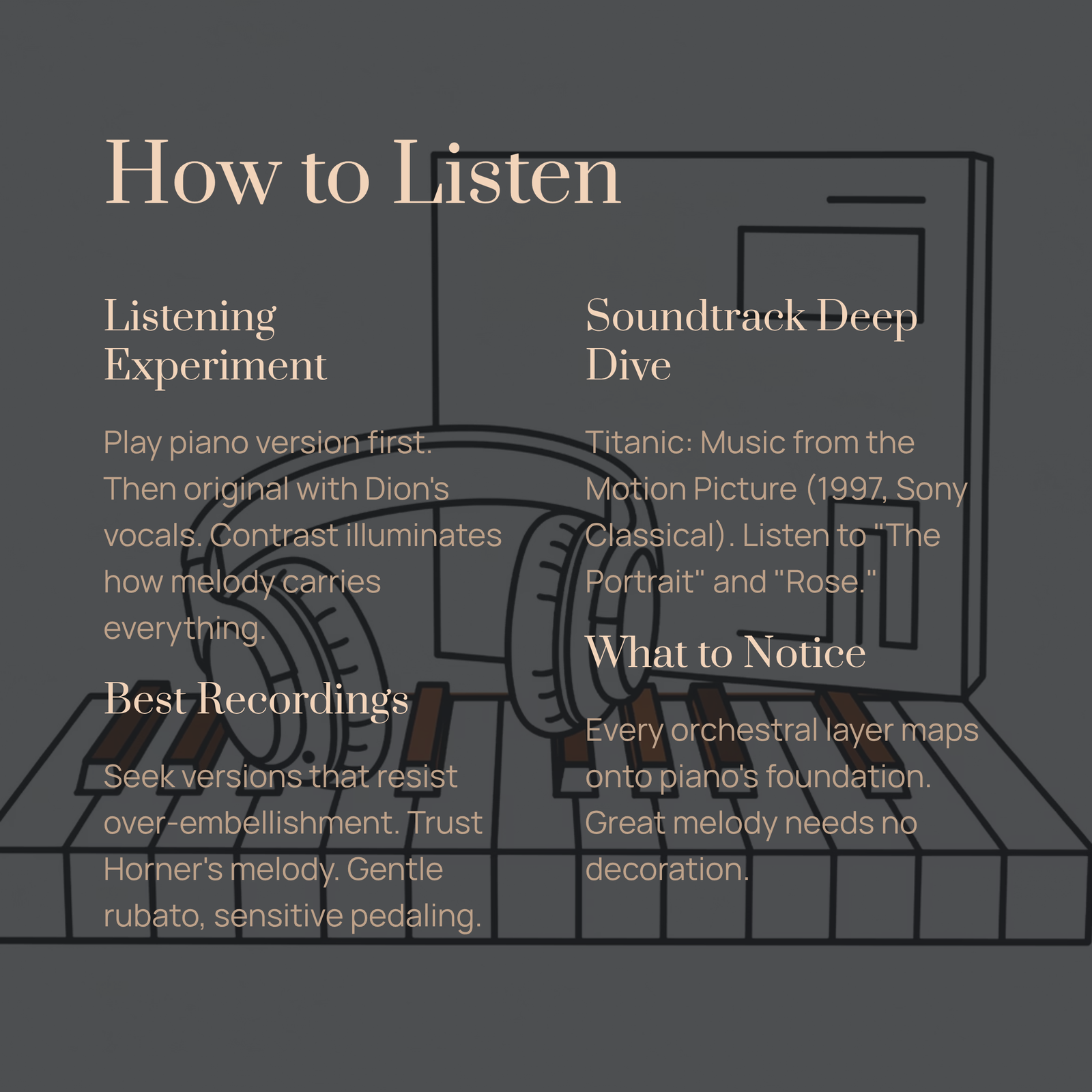
The piano arrangement has been recorded by numerous artists, but look for versions that resist the temptation to over-embellish. The best renditions trust Horner’s melody and let it breathe — gentle rubato, sensitive pedaling, no unnecessary flourishes. Search for solo piano covers that maintain the piece’s original key structure and allow the harmonic simplicity to work its quiet power.
If you want to go deeper, try this listening experiment: play the piano version first, then immediately follow it with the original film soundtrack recording featuring Dion’s vocals and Horner’s full orchestration. The contrast is illuminating. You will hear how every orchestral layer maps onto something the piano was already doing alone — and you will understand, viscerally, that a great melody does not need decoration. It only needs space.
For the full cinematic experience, the Titanic: Music from the Motion Picture soundtrack album (1997, Sony Classical) remains the definitive recording. Pay particular attention to tracks like “The Portrait” and “Rose,” where the instrumental version of this theme appears in its most tender, unadorned form — closest to what Horner originally conceived at his piano.
The Melody That Refused to Sink
There is a poetic symmetry to this piece that extends beyond the music itself. A composer who was told not to write it. A singer who did not want to sing it. A director who was afraid it would ruin his film. And yet here we are, nearly three decades later, and the melody persists — not because of the fame, not because of the film, but because Horner wrote something that taps into a fundamental human experience: the ache of remembering someone you loved.
The piano version strips away every possible distraction and asks a simple question. Can a single melody, played on a single instrument, carry the full weight of that emotion?
Play it once. You already know the answer.