📑 Table of Contents
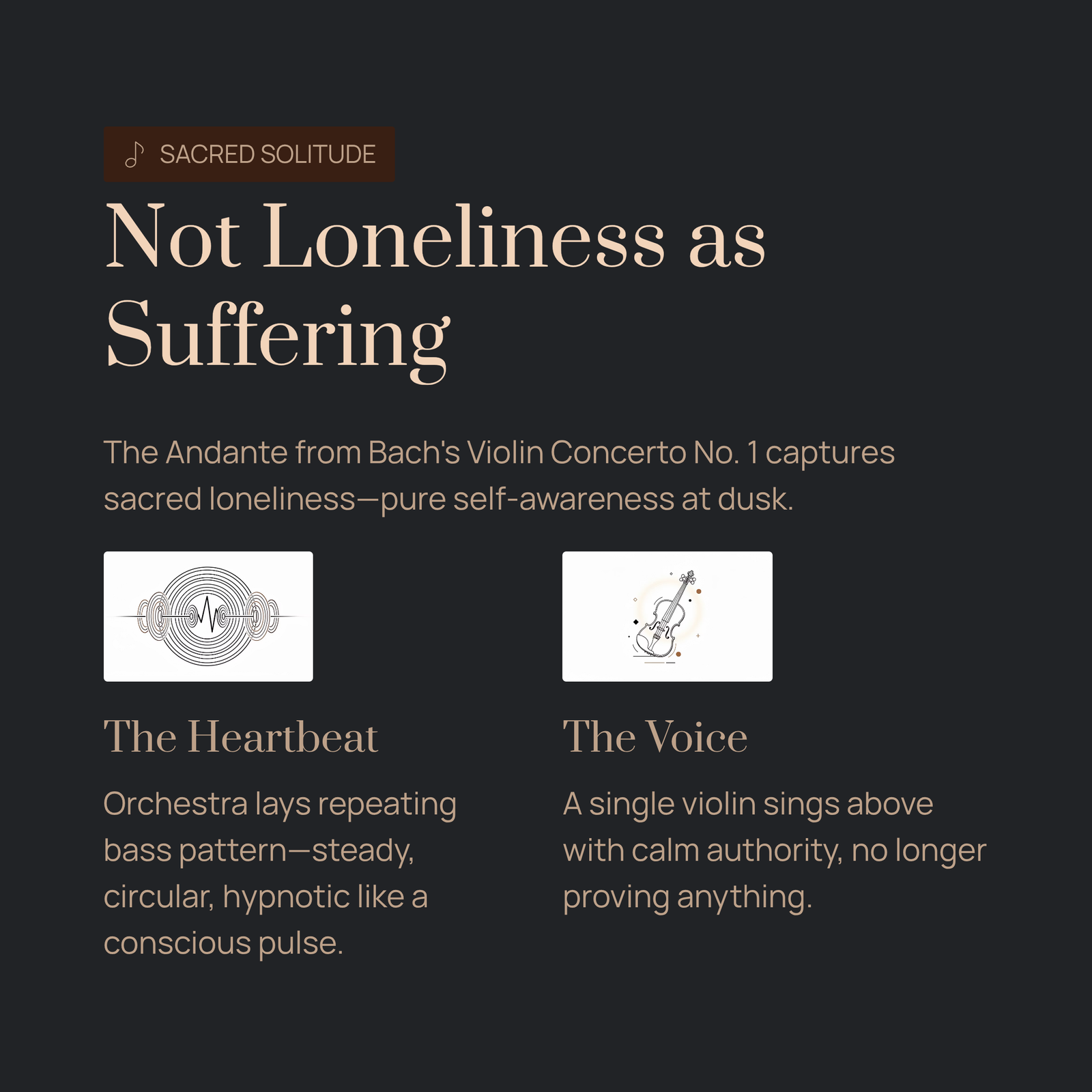
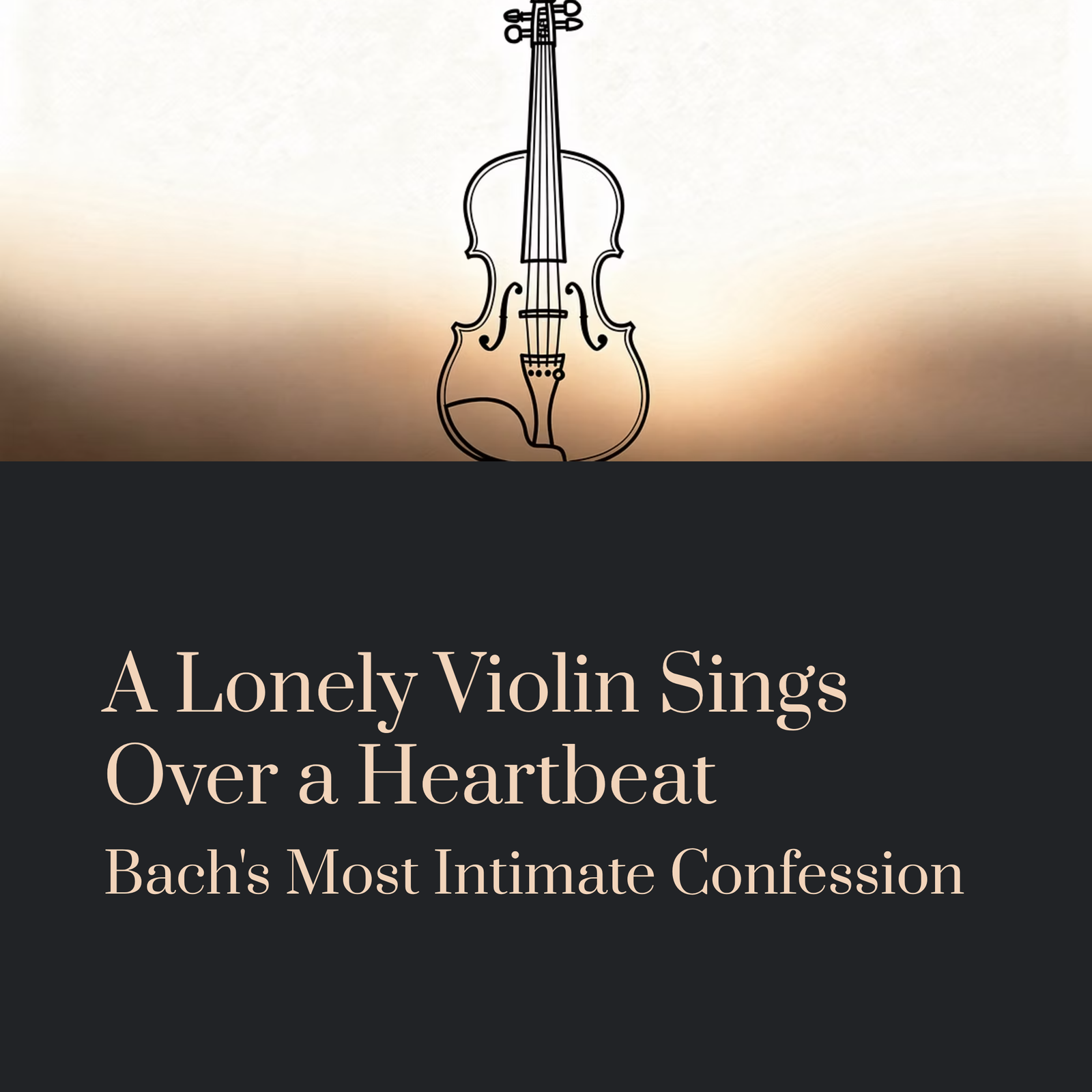
There’s a particular kind of loneliness that isn’t sad — it’s sacred. It’s the feeling you get standing at a window at dusk, watching the sky bruise from gold to violet, knowing that no one else sees exactly what you see from exactly where you stand. That’s the Andante from Bach’s Violin Concerto No. 1 in A minor, BWV 1041. Not loneliness as suffering, but loneliness as the purest form of self-awareness.
The movement opens and you’re immediately caught in something unusual: the orchestra lays down a repeating bass pattern — steady, circular, almost hypnotic — like a heartbeat you suddenly become conscious of in a quiet room. And over that pulse, a single violin begins to sing. Not perform. Not dazzle. Sing. The melody floats above the bass with the kind of calm authority that only comes from someone who has stopped trying to prove anything.
If you’ve never listened to Bach’s slower movements, this is the door you’ve been looking for.
Bach in Köthen: The Happiest Years of a Complicated Life
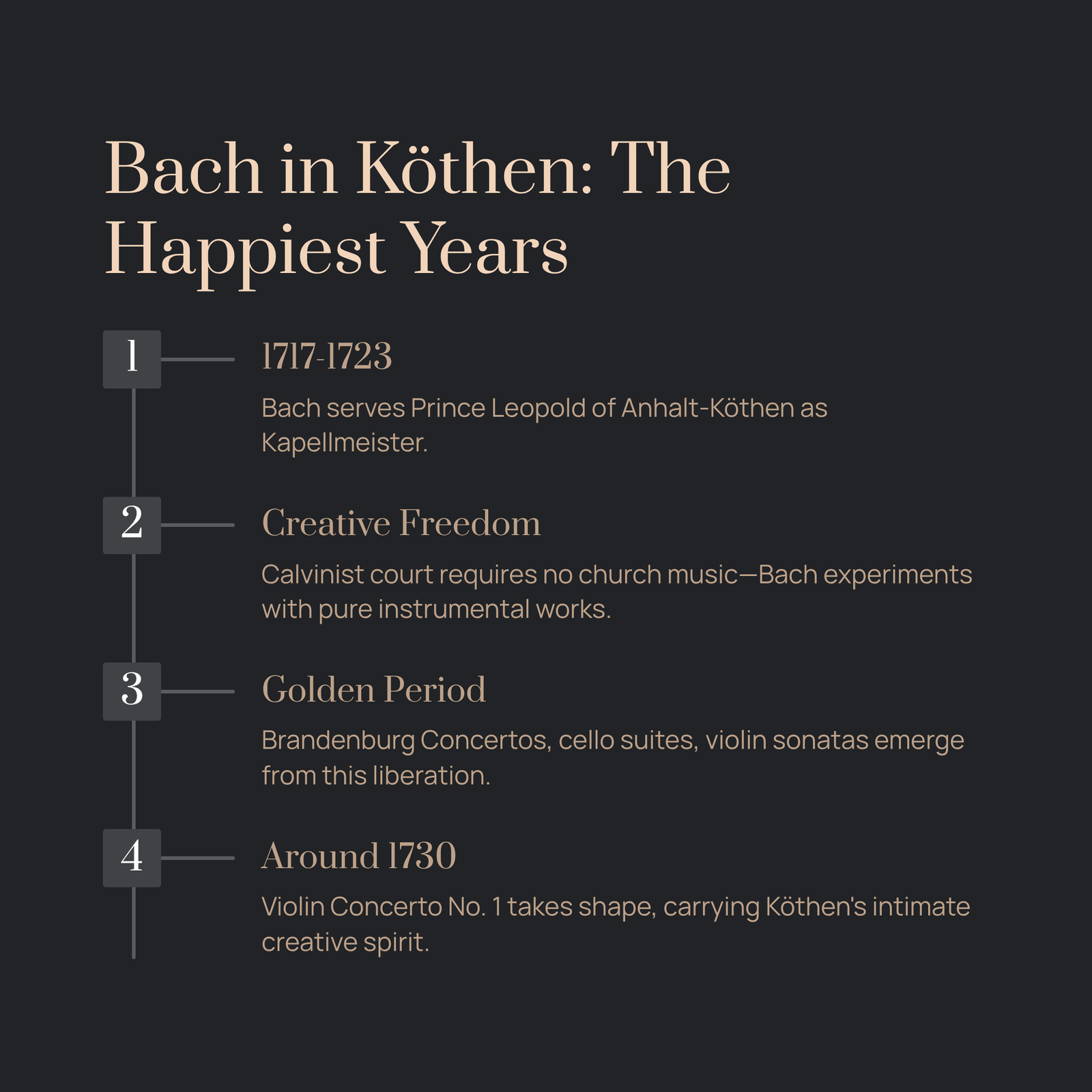
To understand why this music sounds the way it does, you need to know where Bach was when he wrote it. Around 1717 to 1723, Johann Sebastian Bach served as Kapellmeister — essentially music director — at the court of Prince Leopold of Anhalt-Köthen. And here’s the thing that changed everything: Prince Leopold was a Calvinist. His church services required no elaborate music. No cantatas. No grand organ works.
For the first time in his career, Bach was free. Free from liturgical obligations, free to experiment, free to pour his genius into pure instrumental music. The Brandenburg Concertos, the solo cello suites, the sonatas and partitas for solo violin — all of them emerged from this period. The Violin Concerto No. 1 in A minor, BWV 1041, likely took shape during or shortly after these golden Köthen years, probably around 1730 when Bach had moved to Leipzig but still carried the spirit of that creative liberation.
The result is music that feels intimate in a way Bach’s church works rarely do. There’s no congregation to address, no theological argument to make. It’s just a composer and his instrument, having a private conversation.
What Makes the Andante So Unforgettable
Let’s talk about what actually happens in this movement, because its construction is deceptively simple — and that simplicity is exactly what makes it devastating.
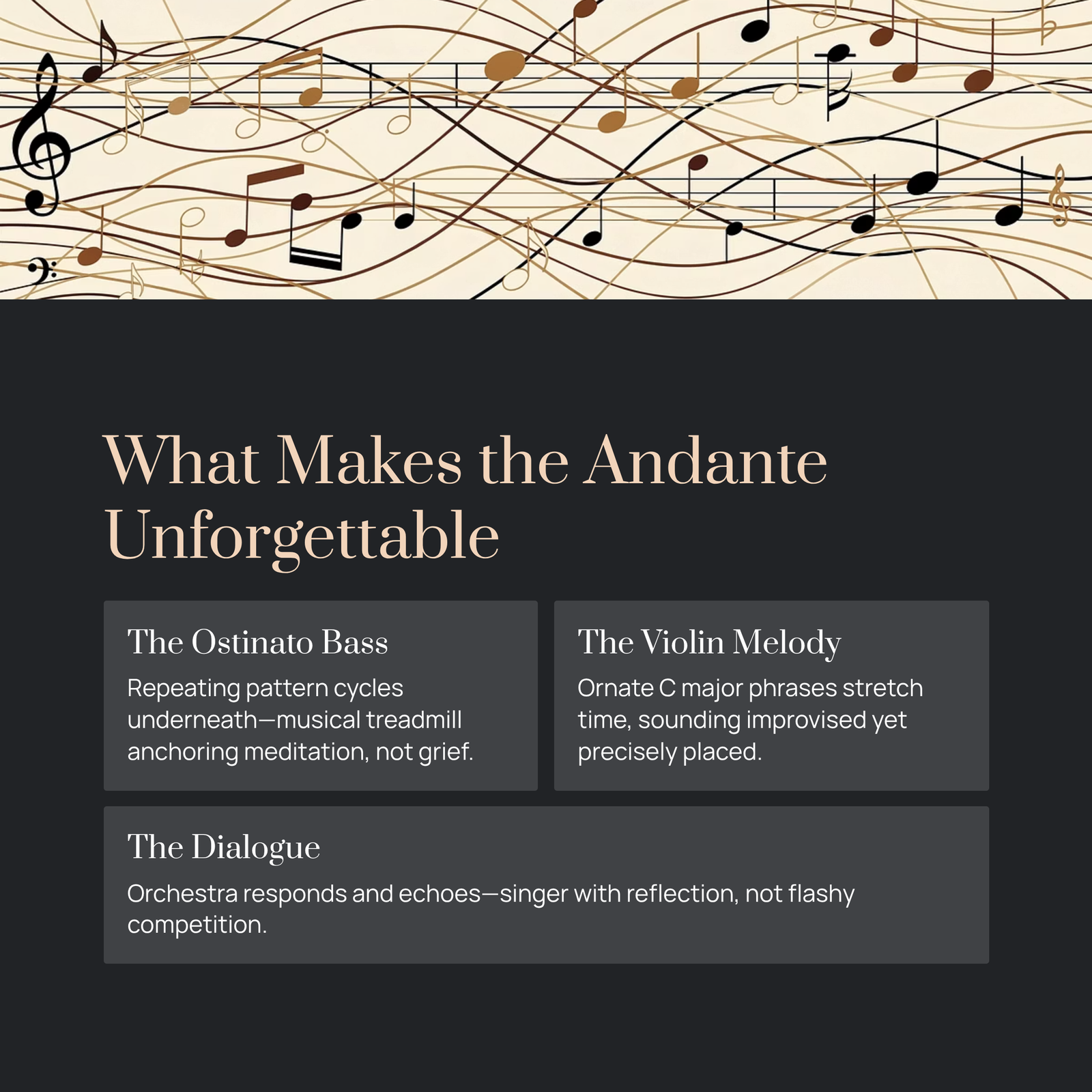
The ostinato bass — a ground that never lets go. The entire movement is built over a basso ostinato: a repeating bass line pattern that cycles underneath everything. Think of it as a musical treadmill. The ground keeps moving at the same pace, the same pattern, the same gravitational pull. In early Baroque music, this technique was often used for lament — the famous “Dido’s Lament” by Purcell uses the same idea. But Bach doesn’t use it for grief. He uses it for meditation. The repetition becomes a kind of breathing exercise, anchoring you while the violin takes flight above.
The violin melody — freedom within constraint. Against that steady bass, the solo violin spins an ornate, deeply expressive melody in C major. What’s remarkable is how free it sounds despite the rigid structure below. The violin weaves long, arching phrases that seem to stretch and bend time itself. There are moments where the melody pauses, takes a breath, and then continues as if picking up a thought mid-sentence. It feels improvised. It feels like someone thinking out loud. But every note is precisely where Bach intended it to be.
The dialogue with the orchestra. The accompanying strings don’t just provide background. They respond, echo, and sometimes shadow the soloist in subtle ways. It’s not a concerto in the flashy, combative sense — there’s no competition here. The relationship is more like a singer and their own reflection, or a person walking through a garden while their shadow moves alongside them.
Listening as If for the First Time
Here’s how I’d suggest approaching this movement, especially if Baroque music still feels unfamiliar.
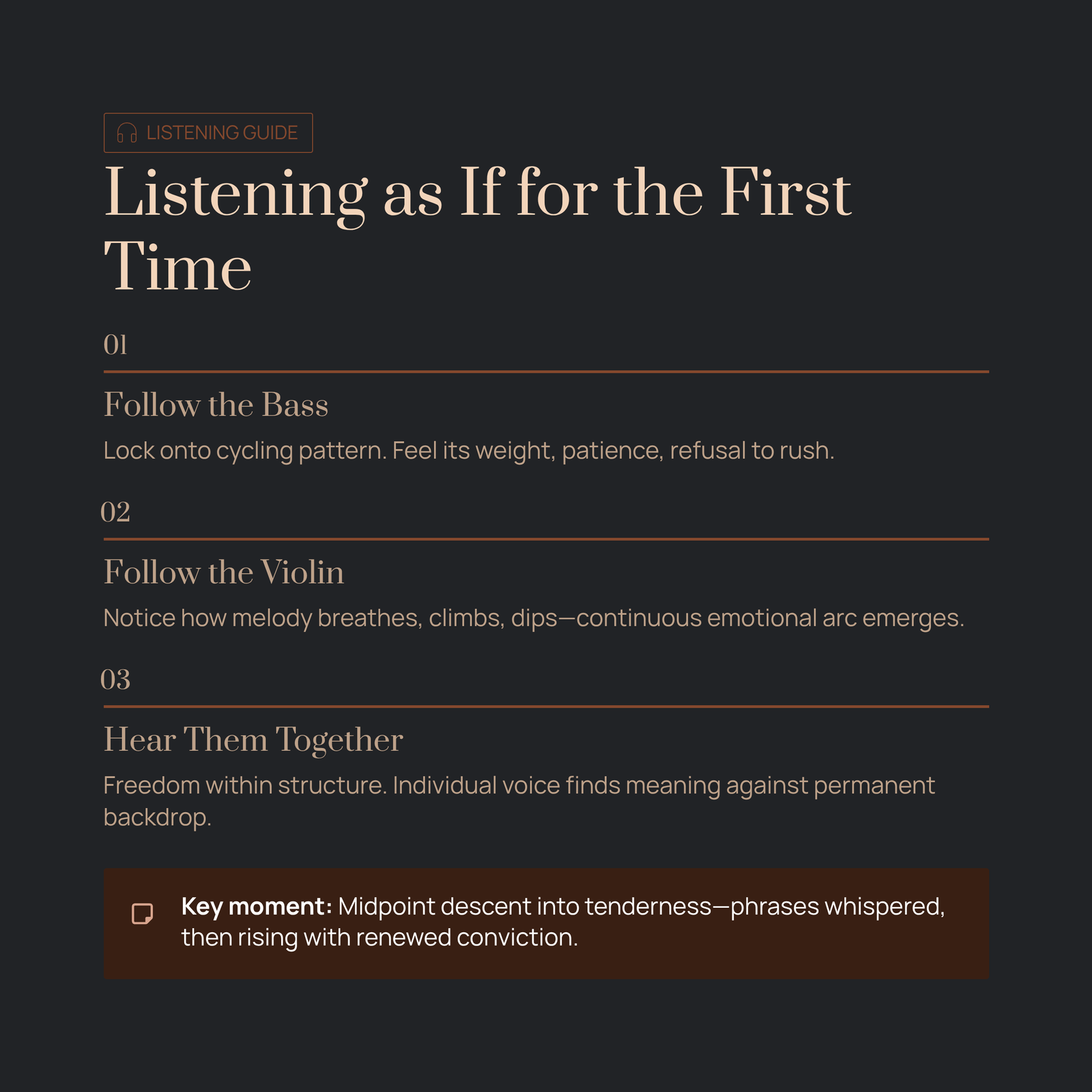
First listen — just follow the bass. Ignore the violin entirely. I know that sounds counterintuitive, but try it. Lock your ear onto that cycling bass pattern. Feel its weight, its patience, its refusal to rush. Once you internalize that pulse, you’ll understand the architecture of the movement — the floor the violin is dancing on.
Second listen — now follow the violin. This time, let the bass fade into your peripheral hearing and give all your attention to the solo line. Notice how it breathes. Notice the moments it climbs higher, the moments it dips into something darker, the moments it seems to hover in midair before resolving. You’ll start hearing the melody not as a sequence of notes but as a continuous emotional arc.
Third listen — hear them together. Now let both layers exist simultaneously. This is where the magic happens. The tension between the unchanging bass and the ever-changing melody creates something that neither can produce alone: the feeling of freedom within structure, spontaneity within order, the individual voice finding meaning against the backdrop of something larger and more permanent.
A timestamp to watch for: Around the midpoint of the movement, the violin descends into a passage of unusual tenderness — the phrases become shorter, more hesitant, almost whispered. Then it gathers itself and rises again with renewed conviction. That arc, from vulnerability to quiet strength, is the emotional heart of the entire piece.
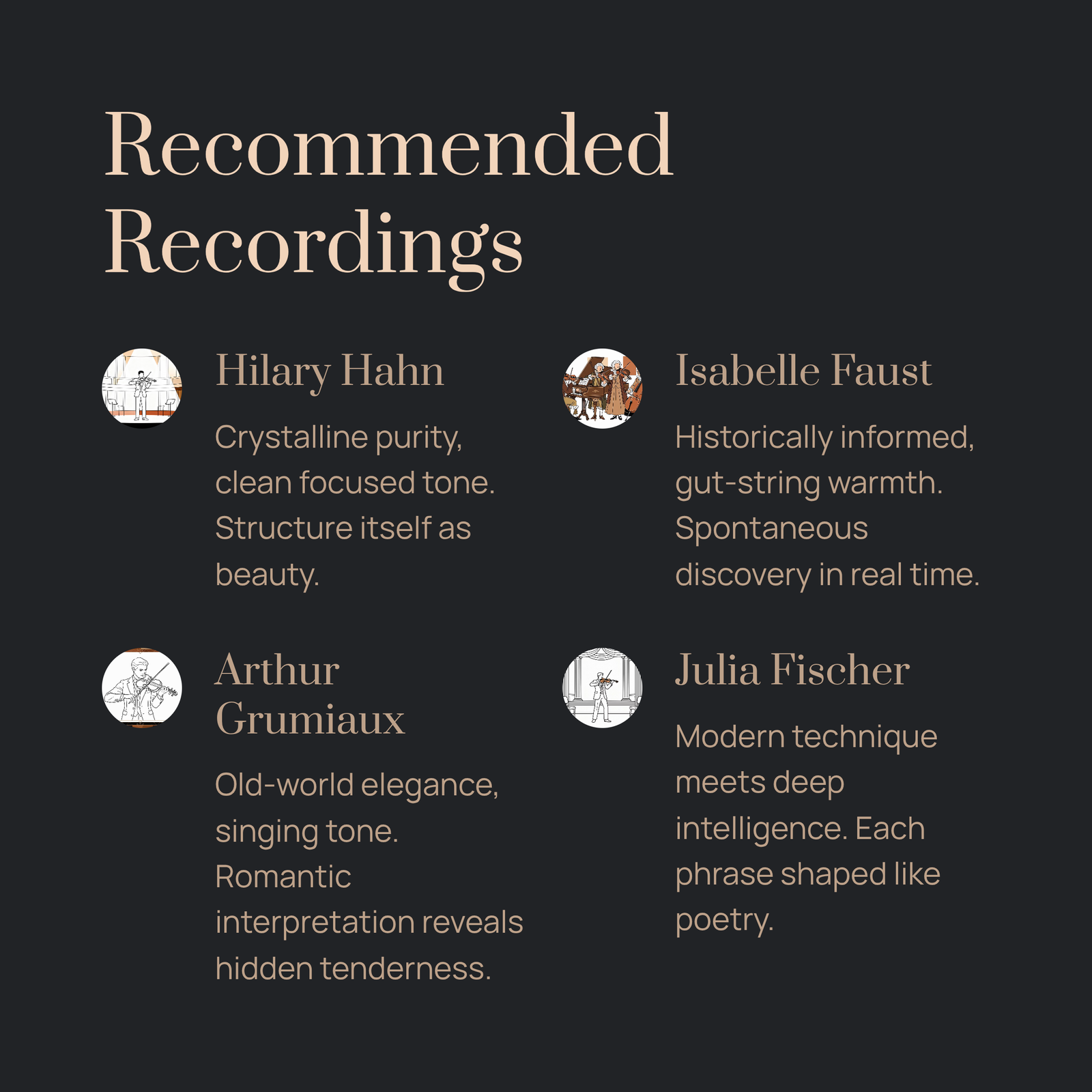
Recommended Recordings
The Andante has been recorded by virtually every major violinist, and each brings something different to its deceptive simplicity.
Hilary Hahn delivers a reading of crystalline purity. Her tone is clean, focused, and luminous — she trusts Bach’s architecture completely and lets the notes speak without unnecessary vibrato or romantic inflection. If you want to hear the structure itself as beauty, start here.
Isabelle Faust, with the Akademie für Alte Musik Berlin, offers a historically informed performance that breathes with natural phrasing and gut-string warmth. There’s a quality of spontaneity to her playing, as if she’s discovering the melody in real time. Her recording captures the improvisatory spirit that likely characterized Bach’s own performances.
Arthur Grumiaux, in his classic Philips recording, brings old-world elegance and a singing tone that makes the violin sound almost like a human voice. It’s a more Romantic interpretation, but it reveals dimensions of tenderness that period-instrument performances sometimes overlook.
For a different perspective entirely, try Julia Fischer’s recording, which balances modern technique with deep musical intelligence — she shapes each phrase with the care of someone reading poetry aloud.
Why This Movement Finds You When You Need It
There’s a reason people discover the BWV 1041 Andante during transitional moments in their lives — late-night study sessions, long drives through unfamiliar landscapes, those in-between hours when the day’s noise has finally stopped and you’re left alone with your thoughts. This music doesn’t demand your attention. It earns it, note by note, breath by breath.
Bach, in this movement, seems to be saying something that transcends the Baroque period, transcends classical music itself: that the deepest truths don’t need to be loud. That repetition isn’t monotony — it’s ritual. That a single voice, singing honestly over the steady pulse of existence, is enough.
You don’t need to know anything about counterpoint or basso ostinato or 18th-century court politics to feel what this movement offers. You just need about four minutes, a pair of headphones, and the willingness to sit still long enough to hear your own heartbeat synchronize with Bach’s.
Press play. The violin is already waiting for you.