📑 Table of Contents
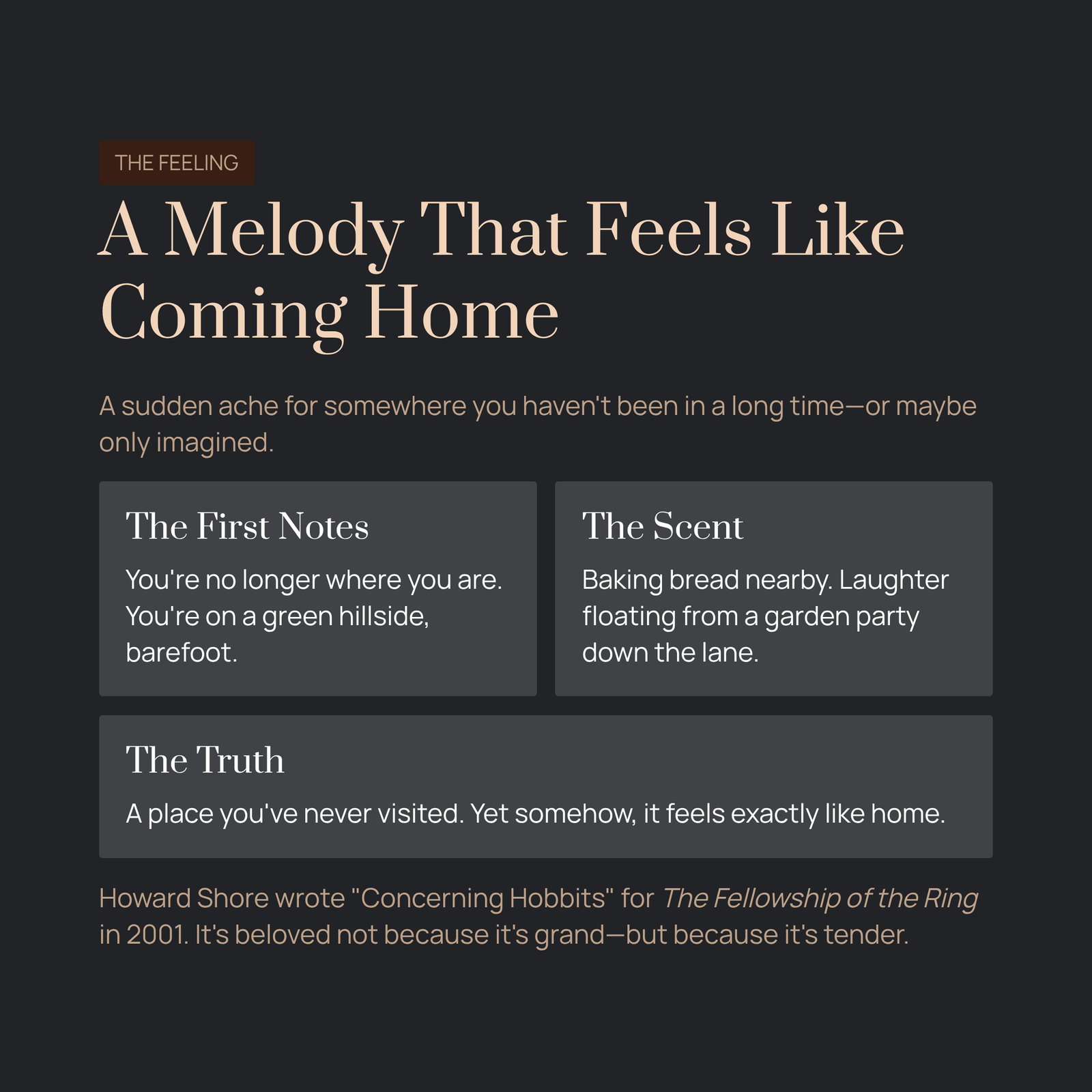
There’s a feeling that sneaks up on you without warning — a sudden, quiet ache for somewhere you haven’t been in a long time, or maybe a place that only ever existed in your imagination. You might be walking home from work, staring out of a rain-streaked window, or lying on the couch with nothing particular on your mind. And then a melody drifts in, thin and bright as morning light through curtains, and suddenly you’re somewhere else entirely.
That’s what happens when you hear “Concerning Hobbits.” Within the first few notes, you’re no longer sitting where you are. You’re standing on a green hillside, barefoot, with the scent of baking bread somewhere nearby and the sound of laughter floating from a garden party down the lane. It’s not a place you’ve ever visited. And yet, somehow, it feels exactly like coming home.
Howard Shore wrote this piece for Peter Jackson’s The Fellowship of the Ring in 2001, and it has quietly become one of the most beloved themes in modern orchestral music — not because it’s grand or dramatic, but because it’s the opposite. It’s small. It’s tender. It’s the sound of a world where the most important thing that happened today was a good meal shared with a friend.
The Composer Who Built an Entire World in Sound
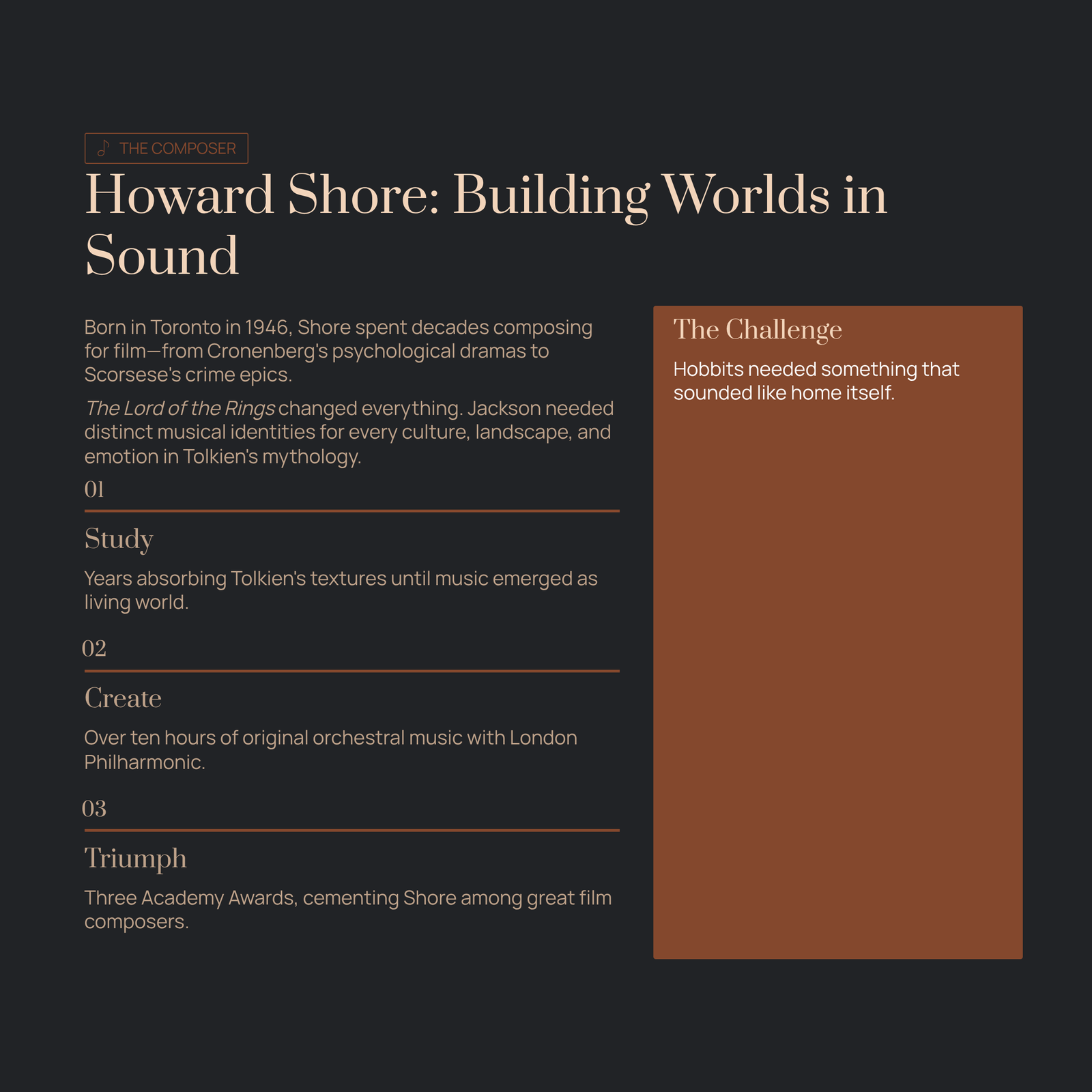
Howard Shore is not a name most people associate with classical music in the traditional sense. Born in Toronto in 1946, he spent decades composing for film — everything from David Cronenberg’s unsettling psychological dramas to Martin Scorsese’s gritty crime epics. His musical language was versatile, dark when it needed to be, restrained when the scene demanded silence more than sound.
But The Lord of the Rings changed everything. When Peter Jackson approached Shore to score the entire trilogy, it wasn’t just a film assignment — it was a world-building project on a scale that few composers have ever attempted. Shore needed to create distinct musical identities for every culture, every landscape, every emotional undercurrent in Tolkien’s sprawling mythology. The Elves needed their own harmonic language. Mordor required its own rhythmic menace. And the Hobbits — those cheerful, comfort-loving, utterly ordinary little people — needed something that sounded like home itself.
Shore spent years studying Tolkien’s writing, absorbing the textures of Middle-earth until the music began to emerge not as accompaniment, but as a living part of the world. The result was over ten hours of original orchestral music recorded with the London Philharmonic Orchestra and the New Zealand Symphony Orchestra — a body of work that earned Shore three Academy Awards and cemented his place alongside the great film composers of the twentieth century.

What Makes “Concerning Hobbits” So Disarmingly Beautiful
The genius of this piece lies in what it refuses to do. In a trilogy filled with sweeping battle themes, ethereal choral passages, and thundering brass, “Concerning Hobbits” does something radical: it stays small.
The melody begins on a solo tin whistle — an instrument associated with Celtic folk traditions, rustic and unpretentious. It’s the kind of sound you might hear at a village pub, not in a concert hall. The tune is simple, almost childlike in its contour, stepping gently up and down like someone wandering through a meadow without any particular destination.
Then the strings enter, but softly — not with the full force of an orchestra, but with the intimate warmth of a chamber ensemble. A solo violin picks up the melody, adding just a touch of sweetness, the way afternoon sunlight adds gold to everything it touches. The harmony underneath is uncomplicated, built on open intervals that feel spacious and unhurried, like a long exhale after holding your breath.
What Shore understood instinctively is that the Shire doesn’t need musical complexity. It needs musical honesty. The Hobbits aren’t heroes when we first meet them. They’re gardeners and cooks, storytellers and birthday-party-goers. Their music should sound like the life they live — unassuming, warm, rooted in the earth. And so Shore gave them a melody that feels less composed than remembered, as if it had always existed somewhere in the back of your mind, waiting for you to hear it again.
Pay attention to the middle section, where the texture fills out slightly and a gentle rhythmic pulse appears beneath the melody. It’s almost like a heartbeat — steady, calm, reassuring. This is the Shire breathing. This is the sound of a world where nothing terrible has happened yet, where the worst crisis of the day is whether there will be enough cake.
Why This Music Reaches So Deep
There’s a reason “Concerning Hobbits” has transcended its origins as a film cue and become something people listen to on its own — during study sessions, before sleep, in moments of anxiety, or simply when they need to feel that the world is, at its core, a gentle place.
It works because it taps into something universal: the longing for simplicity. We live in a world that constantly demands more — more productivity, more ambition, more noise. And here is a piece of music that says, quietly but firmly, that the most valuable things are the ones we already have. A warm kitchen. A familiar path. The company of someone who knows you well enough to sit in comfortable silence.
Tolkien himself understood this. The Hobbits aren’t important because they’re powerful. They’re important because they love ordinary life so fiercely that they’re willing to walk into darkness to protect it. And Shore’s music carries that same message: that the small and the simple are not lesser. They are, in fact, the whole point.
If you’ve ever felt overwhelmed by the pace of your own life, if you’ve ever wished you could step off the road for a while and just be, this piece will meet you exactly where you are. It won’t ask anything of you. It will simply remind you of what you already know but sometimes forget — that peace is not something you have to earn. It’s something you can return to, anytime, just by listening.

How to Listen: Three Ways Into the Shire
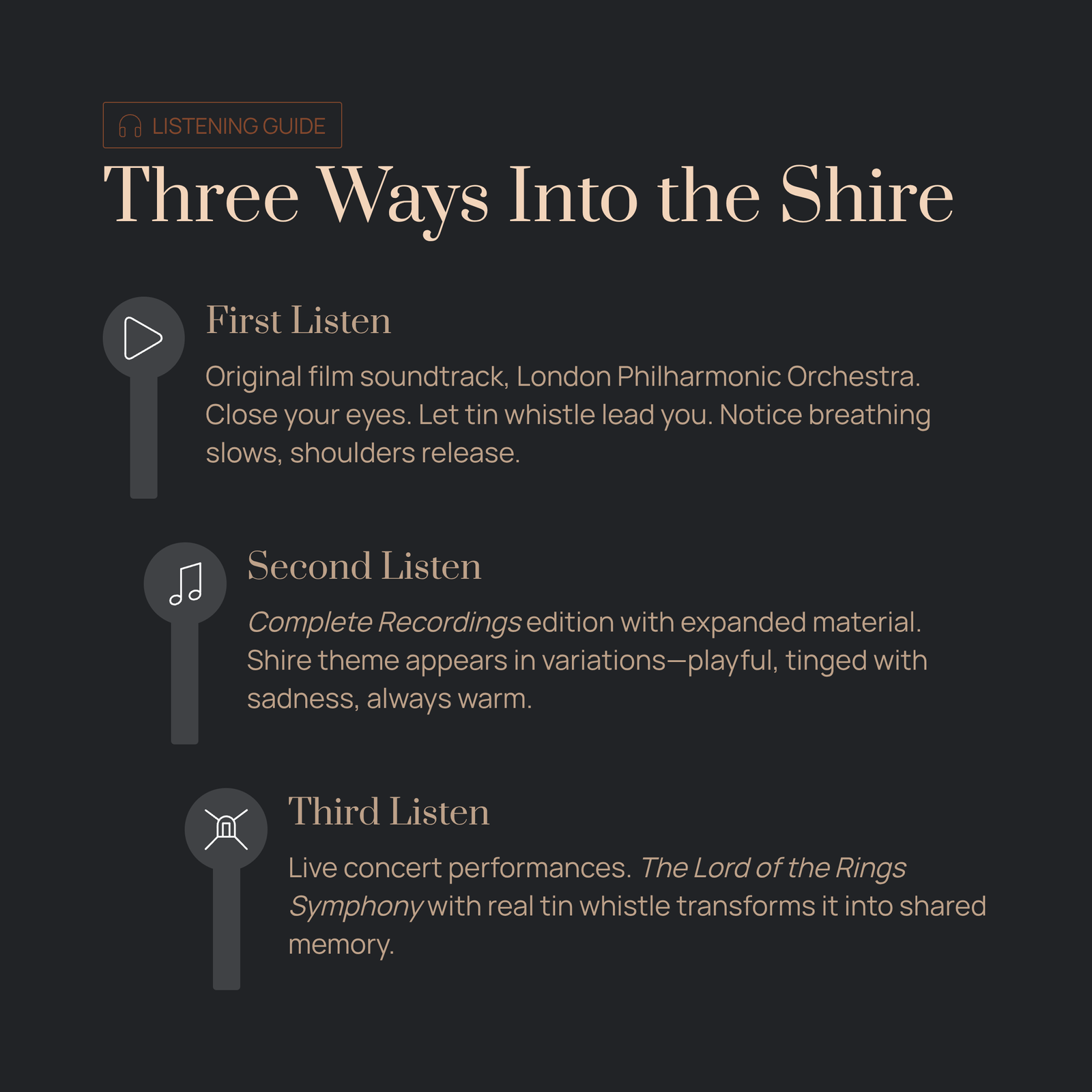
Your first listen should be the original film soundtrack version, performed by the London Philharmonic Orchestra under Howard Shore’s direction. Close your eyes if you can. Don’t try to analyze anything — just let the tin whistle lead you in, and follow wherever the melody goes. Notice how your breathing slows. Notice how the tension in your shoulders starts to release. The piece is only about three minutes long, but it creates an enormous space.
Your second listen, try the Complete Recordings edition of The Fellowship of the Ring soundtrack, which Shore released as an expanded version with additional material and richer orchestration. In this version, the Shire theme appears in several variations, woven through different scenes, and you can hear how Shore develops the melody — sometimes playful, sometimes tinged with the sadness of leaving home, but always recognizable, always warm.
Your third listen, seek out live concert performances. Howard Shore has conducted The Lord of the Rings Symphony, a concert work drawn from the film scores, with orchestras around the world. Hearing “Concerning Hobbits” performed live, with a real tin whistle and real strings filling a concert hall, transforms it from a film cue into something that feels like a shared memory between you and everyone in the audience.
A Green Hill Under a Wide Sky
Some music tries to change you. It wants to shake you, challenge you, remake you into something different than you were before. And there’s value in that — great value.
But “Concerning Hobbits” does something rarer. It doesn’t try to change you at all. It simply holds up a mirror to the part of you that already knows what matters — the part that remembers the smell of fresh bread, the warmth of a familiar blanket, the sound of a door opening to someone you love.
Howard Shore once said that the Shire theme was the emotional foundation of the entire trilogy. Everything that follows — the battles, the betrayals, the long march into Mordor — only matters because of what the Hobbits stand to lose. And what they stand to lose is this: a green hill under a wide sky, a song that needs no words, and the unshakable belief that the simple things are worth protecting.
Press play. Let the tin whistle find you. And for three quiet minutes, let yourself be home.