📑 Table of Contents
There is a particular kind of sadness that doesn’t announce itself. It smiles politely, keeps its voice low, and only later — when you’re alone — does it let the mask slip. The second movement of Mozart’s Piano Sonata No. 8 sounds exactly like that.
On the surface, it’s gentle. The marking is Andante cantabile, which simply means “at a walking pace, singing.” So the right hand sings a calm, graceful melody over a quiet accompaniment, and for a while you might mistake it for one of Mozart’s many pretty, untroubled tunes. But listen a little longer and something underneath begins to ache. The music is too tender, too careful, as if it’s holding something fragile that it’s afraid to drop.
That feeling isn’t an accident. To understand it, we have to go back to a terrible year in Mozart’s life.
Who Was Mozart, and Why Does This Sonata Sound Different?
Wolfgang Amadeus Mozart (1756–1791) is probably the composer most people picture when they hear the word “genius.” A child prodigy who toured Europe performing for royalty before most kids learn to ride a bike, he wrote music that can feel almost effortlessly bright — elegant, balanced, full of charm.
Which is exactly why this sonata stands out.
Most of Mozart’s eighteen piano sonatas are in major keys, the tonal “color” we tend to associate with happiness and light. Piano Sonata No. 8 is one of only two he wrote in a minor key — the color of shadow, longing, and grief. Mozart almost never let the darkness in this openly. When he did, it’s worth paying attention.

Paris, 1778: The Background You Need to Know
In 1778, a twenty-two-year-old Mozart traveled to Paris hoping to find work and recognition. His mother, Anna Maria, came along to look after him. The trip went badly. Paris was cold to him professionally, money was tight, and then his mother fell seriously ill.
She died there, in a foreign city, far from home. Mozart was at her bedside. He even delayed telling his father the full truth at first, gently breaking the news in stages to soften the blow.
Scholars have long connected this loss to the unusual darkness of K.310, written around the same time. We can’t prove the music is a literal diary of his grief — Mozart rarely spelled out such things — but it’s hard to hear this sonata, with its minor key and its sudden eruptions of pain, without feeling the weight of that year pressing on every phrase.
Listening Guide: What to Notice
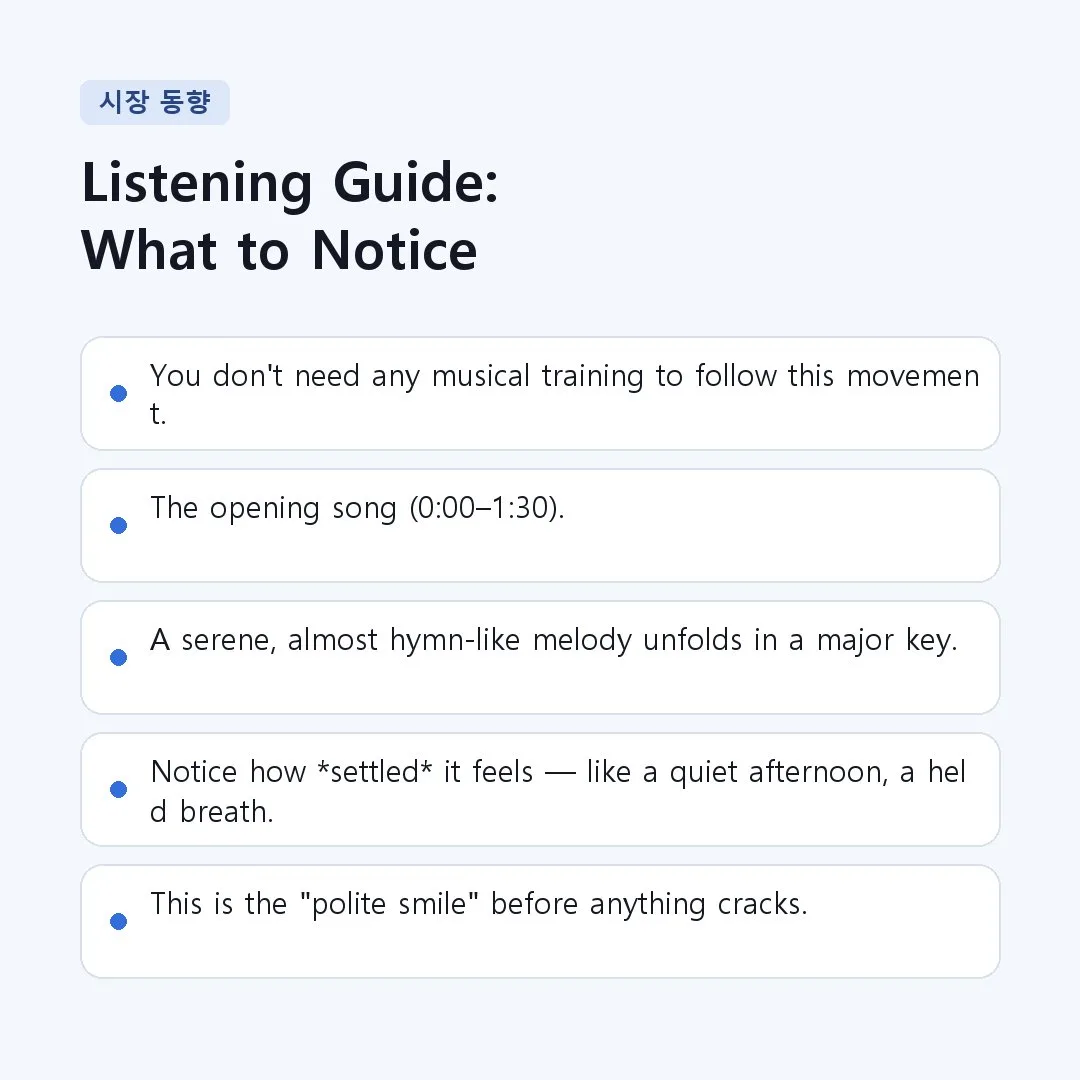
You don’t need any musical training to follow this movement. Here’s a simple map for a first listen (timings are approximate and vary by performer).
The opening song (0:00–1:30). A serene, almost hymn-like melody unfolds in a major key. Notice how settled it feels — like a quiet afternoon, a held breath. This is the “polite smile” before anything cracks.
The storm in the middle (around 2:30–3:30). This is the heart of the movement, and the moment that gives away the grief. Out of nowhere, the music darkens. The left hand churns with restless, repeated notes, and the harmony turns anxious and unstable. It feels like composure breaking — the moment alone when the tears finally come. For many listeners, this is the passage that stays with them for days.
The return (after the storm). The opening melody comes back, but it can’t quite pretend nothing happened. We’ve heard what lies underneath now, and that knowledge changes how the same notes feel. The movement ends quietly, not resolved so much as resigned.
If you listen for just one thing, listen for that contrast: the calm surface, and the thing breaking loose beneath it.

Recommended Recordings
A great performance of this piece lives in restraint — too much drama and the grief turns into melodrama; too little and it goes cold. A few interpretations worth seeking out:
Mitsuko Uchida — Often considered a benchmark for Mozart’s piano music. Her playing is clear, intelligent, and deeply human, with a touch that makes the singing melody truly sing. A wonderful place to start if you want the “definitive” feel.
Maria João Pires — Warm, intimate, and unhurried. Pires plays Mozart as if she’s confiding in you. If you want the emotional core of the movement to come through most directly, her recording is hard to beat.
Glenn Gould — A famously eccentric, polarizing choice. Gould does unusual things with tempo and phrasing that some love and others find frustrating. Worth a listen after you know the piece, as a fascinating second opinion rather than a first introduction.
Any of these is easy to find on major streaming platforms — search the sonata by its catalog number (K.310) to make sure you land on the right work.
Why It Stays With You
What makes this movement quietly extraordinary is its honesty. Mozart, the composer of so much sunshine, lets us see for a few minutes what it costs to keep smiling through loss. The grief doesn’t shout. It hides inside something graceful and only shows itself when it can’t hold back any longer — which is, perhaps, the most human way grief actually behaves.
You don’t need to know a single thing about sonata form to feel that. Put it on in a quiet room, let the opening melody lull you, and wait for the middle. When the storm comes, you’ll understand exactly what Mozart wasn’t able to say out loud.