📑 Table of Contents
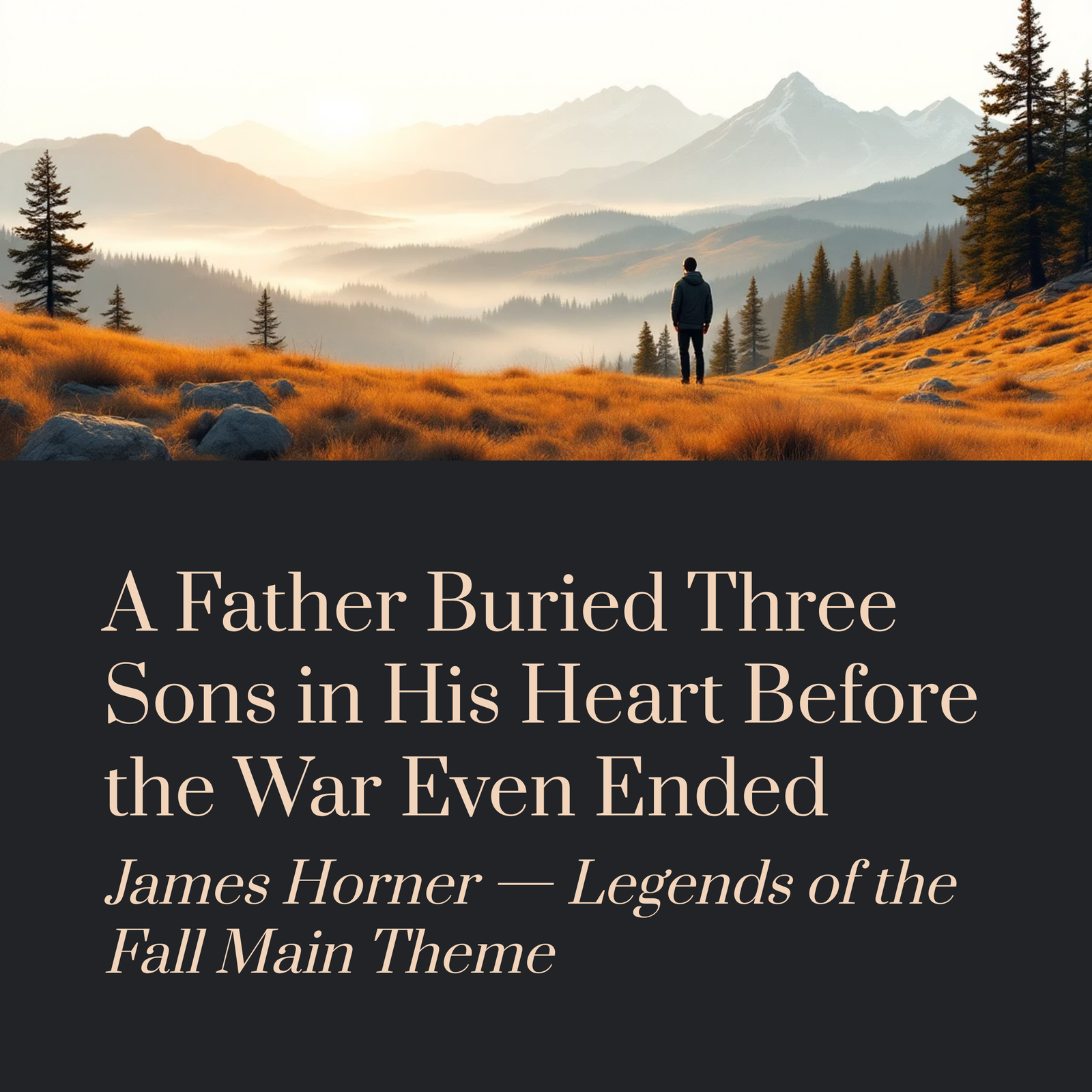
There is a particular kind of sadness that doesn’t announce itself. It doesn’t crash through the door or shatter glass. It arrives the way morning fog rolls over a Montana valley — quietly, completely, until you realize you can no longer see the path ahead. That is exactly what happens the first time you hear the main theme from Legends of the Fall.
The melody begins with a single French horn, solitary and unhurried, as though someone is standing on a ridge at dawn, calling out to no one in particular. And then the strings enter — not with drama, but with something closer to a sigh. Within thirty seconds, you feel a weight settle in your chest that you cannot quite explain. You haven’t watched the film. You don’t know who Tristan Ludlow is. Yet somehow, the music has already told you everything about loss, about wildness, about the kind of love that survives long after the people who carried it are gone.
I have returned to this piece more times than I can count, and every single time, it finds a new room inside me that I didn’t know existed.
James Horner: The Composer Who Listened to Landscapes
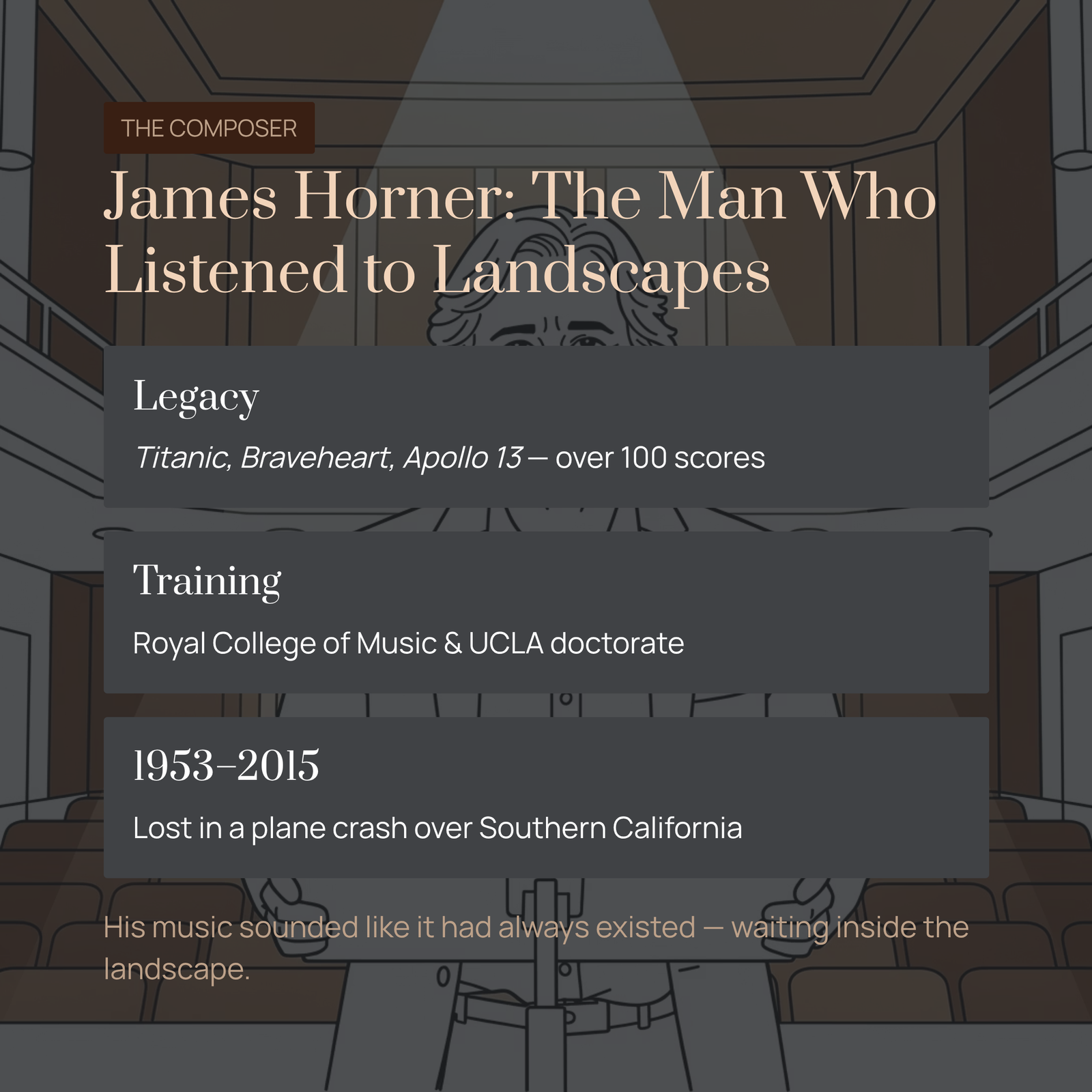
James Horner (1953–2015) was one of Hollywood’s most celebrated film composers, known for scores that didn’t merely accompany images but elevated them into something mythic. His body of work includes Titanic, Braveheart, A Beautiful Mind, and Apollo 13 — each score unmistakable, each carrying his signature blend of Celtic folk textures, soaring French horn melodies, and lush string writing that could make even silence feel emotional.
But Horner was not simply a craftsman of sentiment. He studied at the Royal College of Music in London and completed his doctorate in music composition at UCLA. His academic roots in twentieth-century concert music gave his film work a structural sophistication that most audiences felt instinctively without ever needing to analyze. He understood counterpoint. He understood how to develop a motif across ninety minutes so that by the final scene, a four-note phrase could carry the emotional weight of an entire story.
What set Horner apart was his ability to write music that sounded like it had always existed — as if the melody had been waiting inside the landscape, and he had simply been the one to write it down. Nowhere is this more evident than in Legends of the Fall.
Tragically, Horner died in a plane crash in 2015 at the age of 61, piloting his own aircraft over the mountains of Southern California. The loss was devastating to the film music community. He left behind a catalog of over one hundred scores, each one a testament to his belief that music should speak to the most private, unguarded corners of the human heart.

Born from the Wilderness: The Story Behind the Score
Edward Zwick’s 1994 film Legends of the Fall tells the story of Colonel William Ludlow and his three sons — Alfred, Tristan, and Samuel — living on a remote ranch in early twentieth-century Montana. The narrative spans decades, tracing the family through World War I, prohibition, love, betrayal, and grief. At its center is Tristan, played by Brad Pitt, a figure of restless, almost feral intensity whose life becomes a canvas for both extraordinary passion and devastating loss.
When Horner approached the score, he understood that the film’s emotional core was not any single event but rather the passage of time itself — the way years accumulate like snow on a mountain, beautiful and heavy in equal measure. The main theme needed to capture not just one feeling but an entire arc of feeling: youth and its recklessness, war and its theft, love and its impossibility, and finally, the strange peace that comes only after you have survived everything you feared.
Horner built the theme around a long, arching melody carried primarily by the French horn and strings, supported by subtle woodwind textures and gentle percussion that evokes the natural rhythms of the American West. He wove in elements inspired by Native American musical traditions and Celtic folk idioms, creating a sonic world that feels both ancient and deeply personal. The result is a theme that sounds less like a composition and more like a memory — something you once knew but had forgotten until the first note reminded you.
How to Listen: Following the Grief and the Grace
If you are new to orchestral film music, or even if you’ve listened casually before, I want to offer a way into this piece that might open it up differently for you. Because the main theme from Legends of the Fall rewards not just hearing, but truly listening.
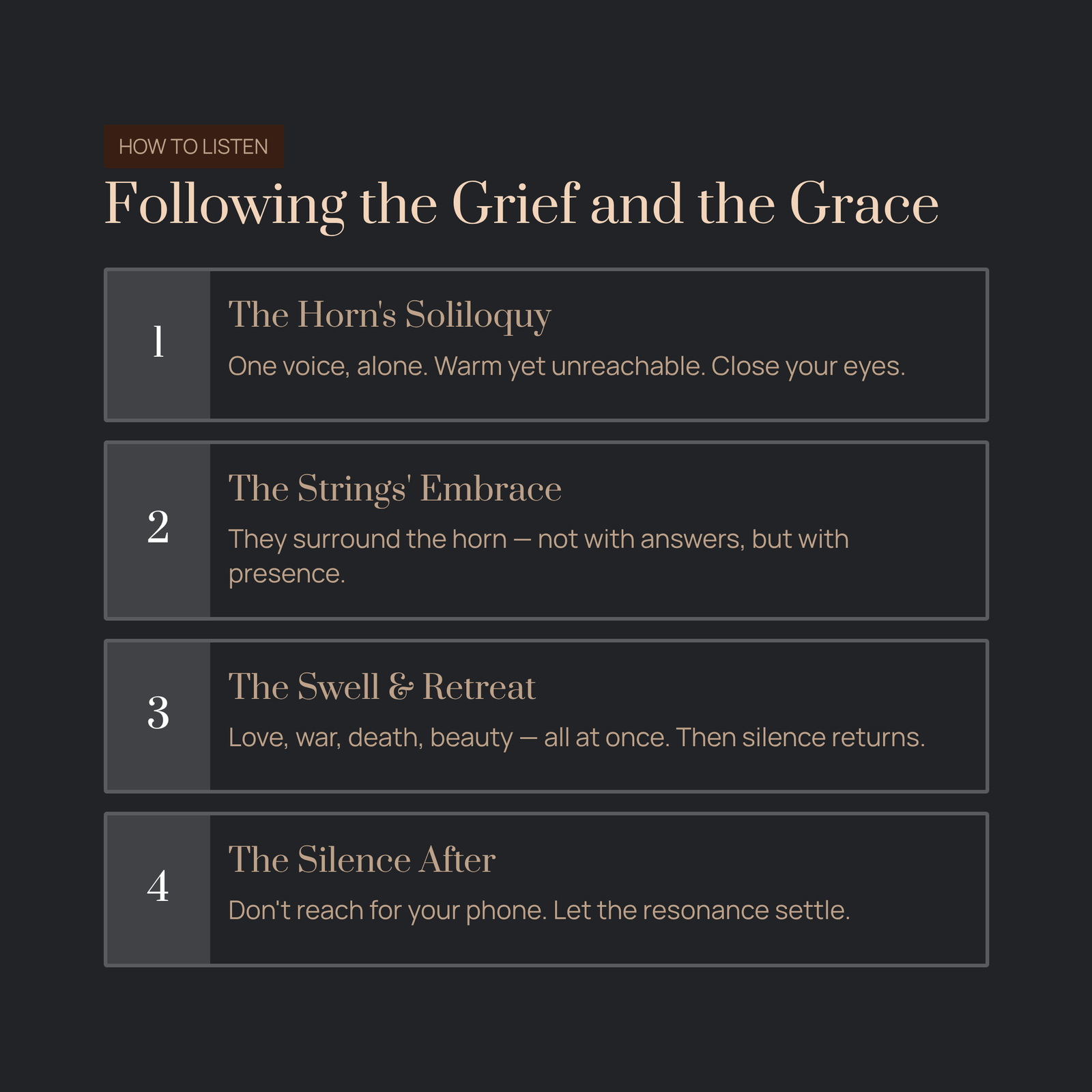
The Horn’s Soliloquy (Opening)
Pay attention to the very first moments. The French horn enters alone, playing the central melody with no accompaniment. This is not accidental. Horner is telling you that this story begins with one voice, one perspective, one man standing in a vast and indifferent landscape. The horn has a quality that no other instrument can replicate — it is both warm and distant, intimate and somehow unreachable. Close your eyes during this passage. Let the melody find its own rhythm in your breathing.
The Strings’ Embrace (Development)
When the string section enters, notice how they don’t compete with the horn. They surround it, the way a family surrounds its most troubled member — not with answers, but with presence. The violins carry the upper register with an aching sweetness, while the cellos and violas provide a darker, richer foundation beneath. This layering is Horner at his finest: every voice in the orchestra has a role, and none of them are decorative.
The Swell and Retreat (Climax)
There comes a moment — and you will feel it before you identify it — where the full orchestra rises together in a passage of extraordinary emotional intensity. This is not a triumphant climax. It is something more complicated. It is the sound of everything happening at once: love, war, death, the beauty of the land, the futility of trying to hold on to anything. And then, just as quickly, the music recedes, leaving you with the horn again, quieter now, as though the story has been told and there is nothing left to say.
The Silence After
I always recommend sitting with the silence for a moment after the piece ends. Don’t immediately reach for your phone or start another track. Let the resonance settle. Some music gives you its meaning in the listening; this music gives you its meaning in the silence that follows.
Recommended Recordings and Performances
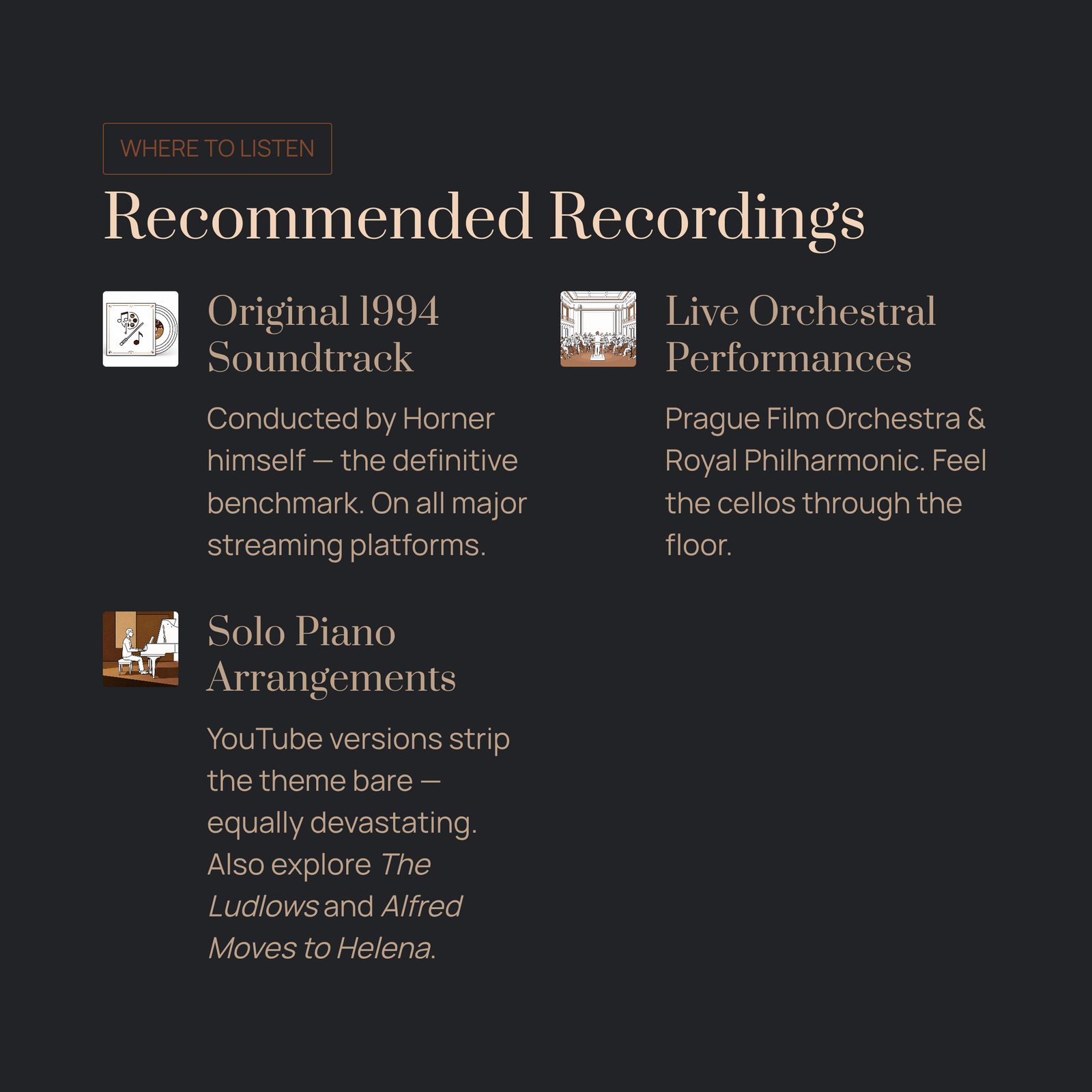
The definitive recording remains the original 1994 soundtrack album conducted by James Horner himself. This version captures the specific acoustic warmth of the original sessions, and Horner’s own interpretation of the tempi and dynamics remains the benchmark against which all other versions are measured. It is available on most major streaming platforms.
For a live orchestral experience, search for performances by ensembles such as the Prague Film Orchestra or the Royal Philharmonic Orchestra, both of which have performed Horner’s film music in concert settings. Hearing this theme played by a live orchestra, feeling the vibration of the cellos through the floor of a concert hall, is an experience I cannot recommend highly enough.
There are also several beautiful solo piano arrangements available on YouTube that strip the theme down to its melodic essence. These versions reveal just how strong Horner’s melody is — it doesn’t need the full weight of an orchestra to move you. A single piano, playing those notes in a quiet room, can be just as devastating.
If you enjoy this theme, I would also encourage you to explore the complete score beyond just the main title. Tracks like “The Ludlows”, “Tristan and Samuel”, and “Alfred Moves to Helena” expand the emotional world of the main theme into territory that is, if anything, even more heartbreaking.
What Remains When the Music Fades
There is a line often attributed to the philosophy of the Cree people: the land does not belong to us; we belong to the land. Whether or not this attribution is precise, the sentiment lives at the heart of what Horner achieved with this score. The music of Legends of the Fall does not belong to the film alone. It belongs to anyone who has ever stood at the edge of something vast and felt, simultaneously, how small they are and how deeply they are capable of feeling.
I think about this piece often — not always consciously, but in the way certain melodies embed themselves in the architecture of your inner life. It surfaces when I am driving through open country. It surfaces in the moments after difficult conversations. It surfaces, sometimes, for no reason at all, the way grief does, the way love does, arriving uninvited and undeniable.
James Horner once said that he wanted his music to reach the place in people that words could not touch. With the main theme from Legends of the Fall, he didn’t just reach that place. He built a home there.
If you have never listened to this piece with intention — with headphones, with stillness, with the willingness to be moved — I hope today might be the day. Not because I can promise you will feel what I feel, but because music this honest deserves at least one listener who is equally honest in return.