📑 Table of Contents
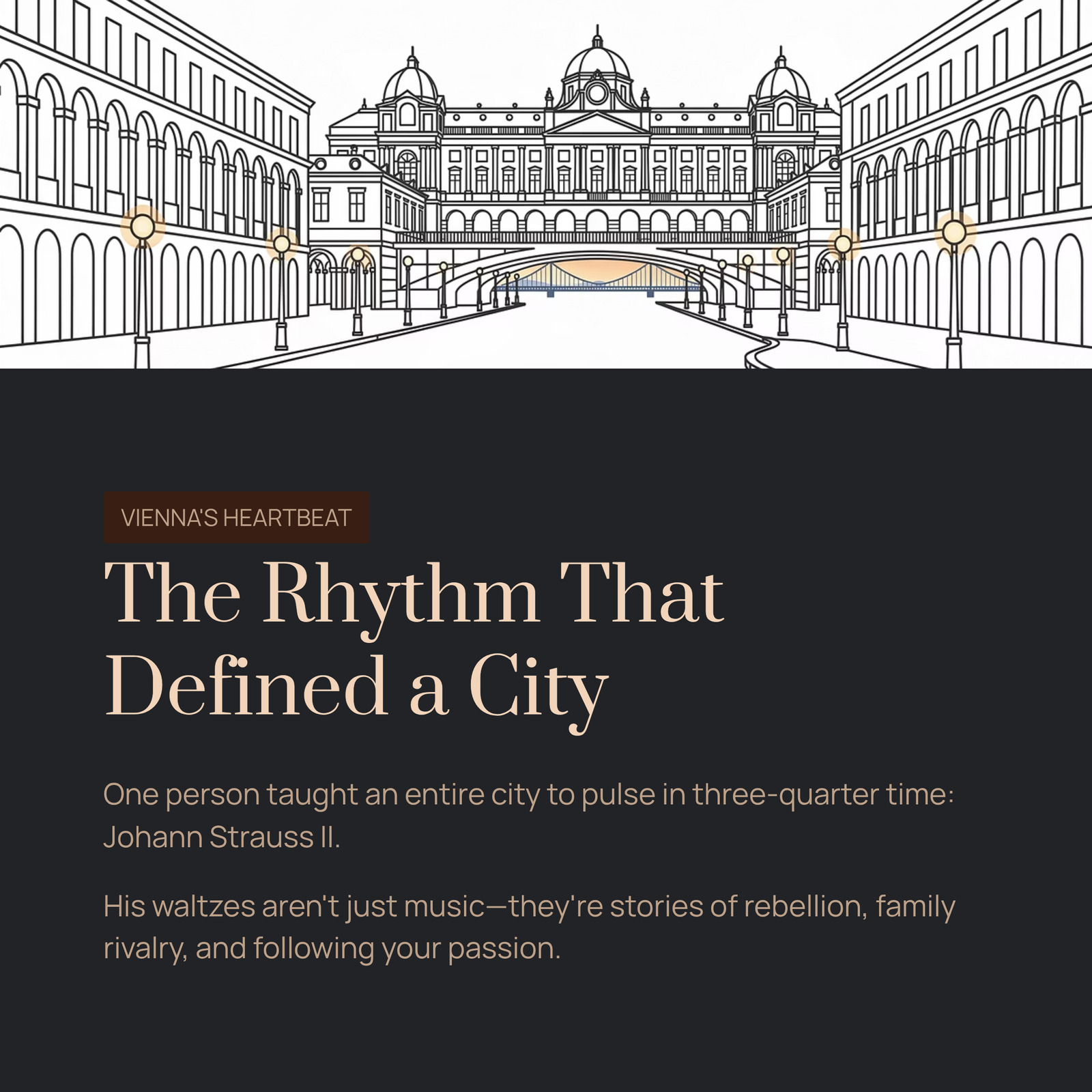
Imagine standing on a bridge over the Danube just before dawn. The streetlamps along the Ringstrasse are still glowing, and the air carries that particular silence only a sleeping city can produce. Then, from somewhere — maybe a café, maybe a memory — you hear it: a slow, swaying triple meter that seems to rise from the cobblestones themselves.
That rhythm is Vienna’s heartbeat. And if one person is responsible for teaching an entire metropolis to pulse in three-quarter time, it is Johann Strauss II.
You don’t need to know a single thing about classical music to feel a Strauss waltz. You’ve heard it — at New Year’s concerts, in movie soundtracks, at weddings, in elevators. But hearing it and truly listening to it are two very different things. Today, I want to invite you to listen. Really listen. Because buried inside these elegant, spinning melodies is a story of rebellion, family rivalry, and a young man who risked everything to follow the music he loved.
The Boy Who Practiced in Secret
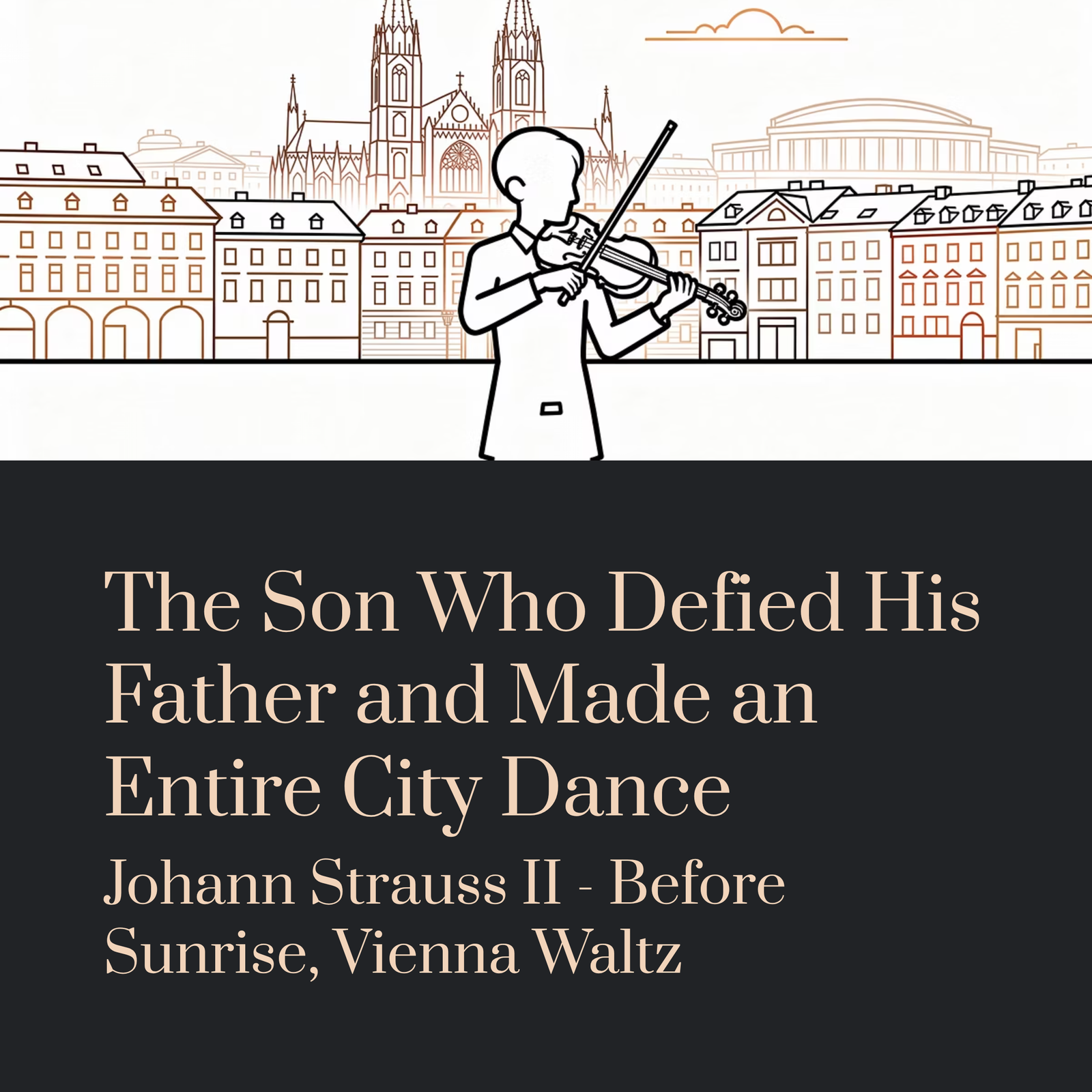
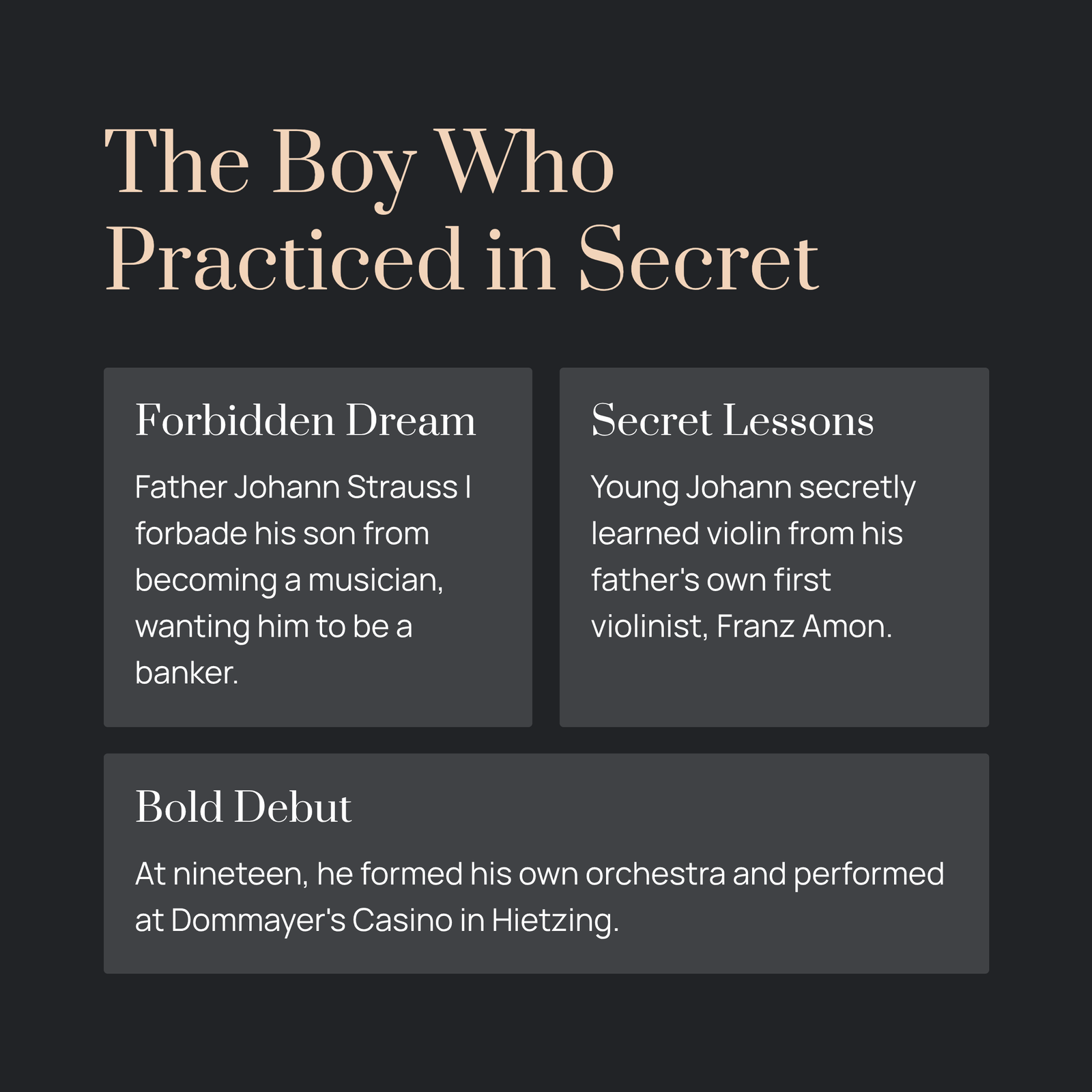
Here’s the part most people don’t know: Johann Strauss II was never supposed to become a musician.
His father, Johann Strauss I, was already a celebrity — one of Vienna’s most famous composers and conductors. You’d think he would have been thrilled to see his son follow the same path. Instead, he did everything in his power to stop it. Strauss I wanted his son to become a banker, a businessman — anything stable, anything safe. He had tasted the uncertainty of a musician’s life and wanted to spare his child from it.
But young Johann had other plans. While his father was away conducting, the boy secretly took violin lessons from Franz Amon, his father’s own first violinist. Picture that for a moment — a teenager sneaking music lessons behind his father’s back, learning the very instrument his father wielded on stages across Europe. It was an act of quiet, determined defiance.
When his parents’ marriage fell apart and his father left the family, Johann finally had the freedom to pursue music openly. He formed his own orchestra and, at just nineteen years old, made his public debut at Dommayer’s Casino in Hietzing. His father, furious at both his son and the venue owner, swore never to perform there again.
The critics, however, told a different story. One reviewer wrote that three-quarter time would find a strong footing in the younger Strauss. It was the understatement of the century.
When Father and Son Divided a City
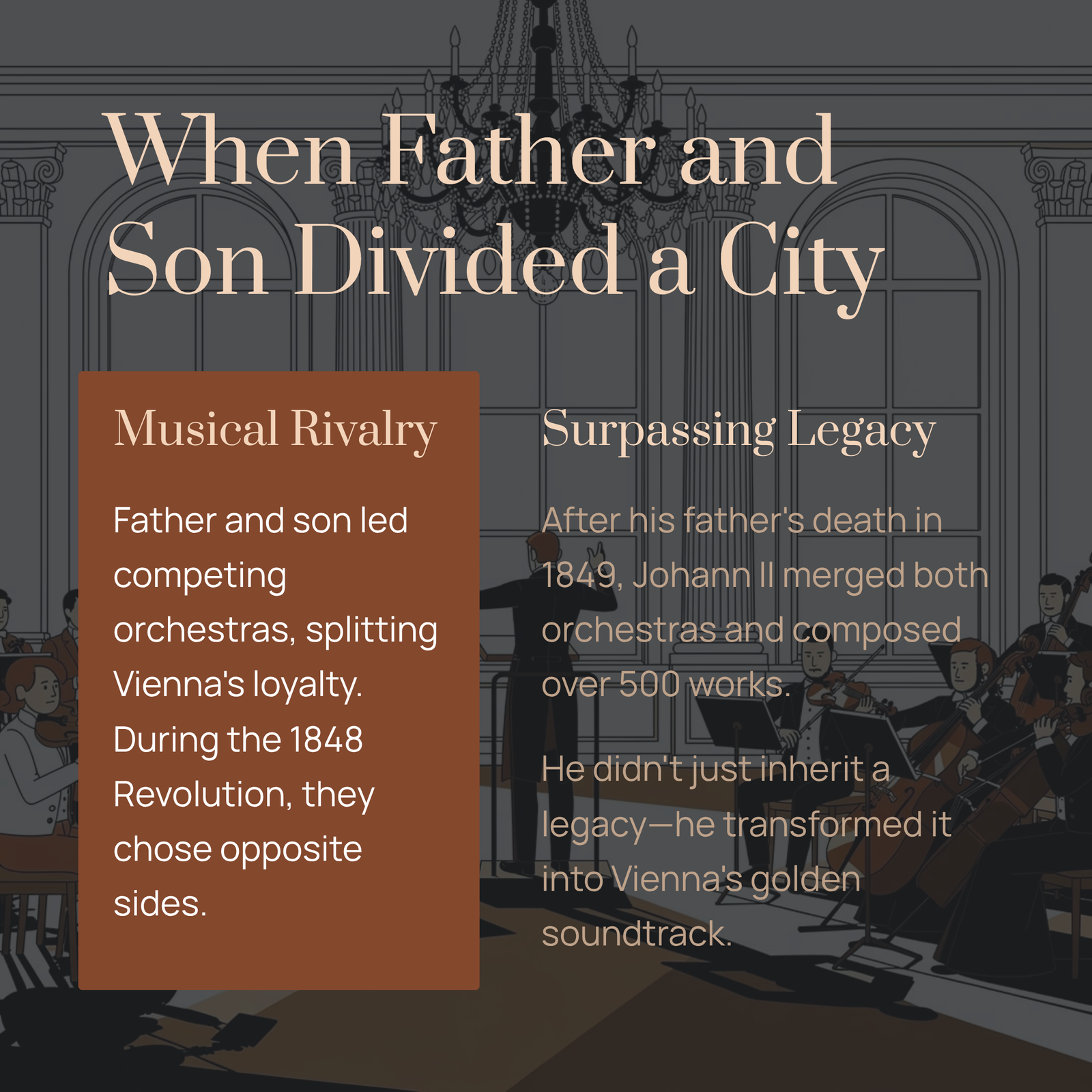
What followed was one of the most extraordinary musical rivalries in history — and it split Vienna right down the middle.
Father and son each led their own orchestras, each commanding fierce loyalty from their respective audiences. During the Revolution of 1848, the tension became political: the father sided with the monarchy, the son with the revolutionaries. Vienna’s ballrooms became battlegrounds of a different sort, where the waltz you danced to declared your allegiance.
When Strauss I died of scarlet fever in 1849, the rivalry ended — but not quietly. Johann II merged his father’s orchestra with his own, inheriting not just musicians but an entire legacy. And then, steadily and brilliantly, he surpassed it.
Over the next four decades, Johann Strauss II composed more than 500 works — over 150 of them waltzes. He wasn’t just writing dance music. He was composing the soundtrack of an era, capturing the elegance, the optimism, and the barely concealed melancholy of a city that sensed, perhaps unconsciously, that its golden age couldn’t last forever.
The Waltz as Emotional Architecture
If you’re new to Strauss, you might wonder: what makes a waltz more than just pleasant background music?
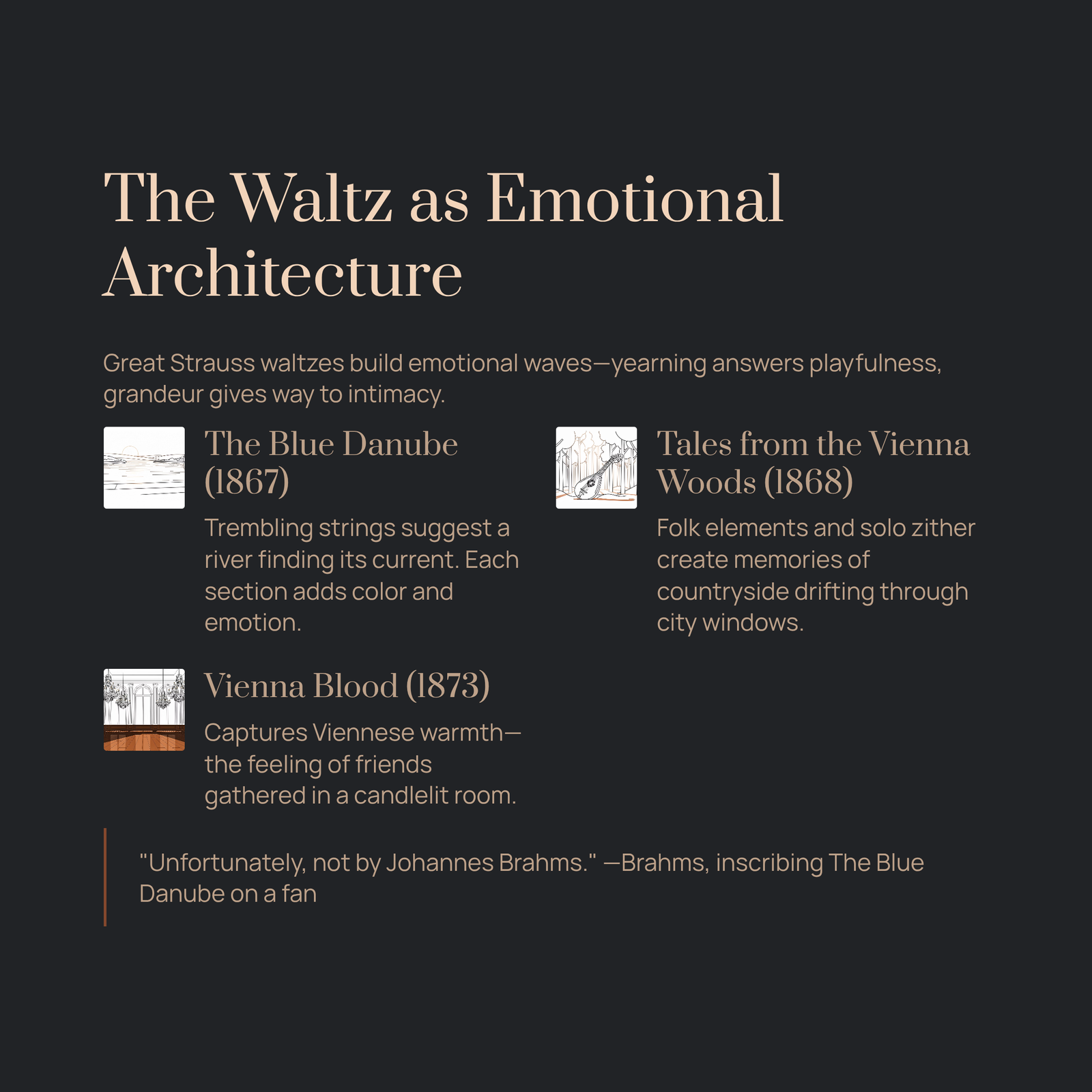
The answer lies in what I call emotional architecture. A great Strauss waltz doesn’t simply repeat a pretty tune. It builds. It’s a structure of rising and falling emotional waves, each section introducing a new melody that comments on the ones before it. Think of it as a conversation between different moods — yearning answers playfulness, grandeur gives way to intimacy, and just when you think you’ve settled into a feeling, the music pivots and reveals something unexpected.
Take “The Blue Danube,” his most famous work, premiered in 1867. The opening is tentative, almost hesitant — trembling strings that suggest a river at dawn, still finding its current. Then the main waltz theme enters, and suddenly you’re swept into a flow that feels both inevitable and surprising. Each new section adds color: one is tender, another is exuberant, yet another carries a wistful quality, as if the dancers know the night must eventually end.
Johannes Brahms, one of the era’s most serious composers, once inscribed the opening notes of “The Blue Danube” on a lady’s fan and wrote beneath them: “Unfortunately, not by Johannes Brahms.” That a composer of Brahms’s stature would express such admiration tells you everything about the depth hidden within these seemingly effortless melodies.
Then there’s “Tales from the Vienna Woods” (1868), where Strauss weaves folk elements — including a solo zither — into the orchestral fabric, creating something that sounds like a memory of the countryside drifting through a city window. “Vienna Blood” (1873) captures the particular warmth of Viennese sociability, the feeling of being among friends in a candlelit room. “Emperor Waltz” (1889) is grander, more ceremonial, composed to mark a diplomatic meeting between Emperor Franz Joseph I and Kaiser Wilhelm II, yet beneath its official purpose runs an unmistakable current of genuine emotion.
Each of these works is a small world. You can enter it, wander around, and come out feeling like you’ve been somewhere real.
How to Listen: Your First Steps into Strauss
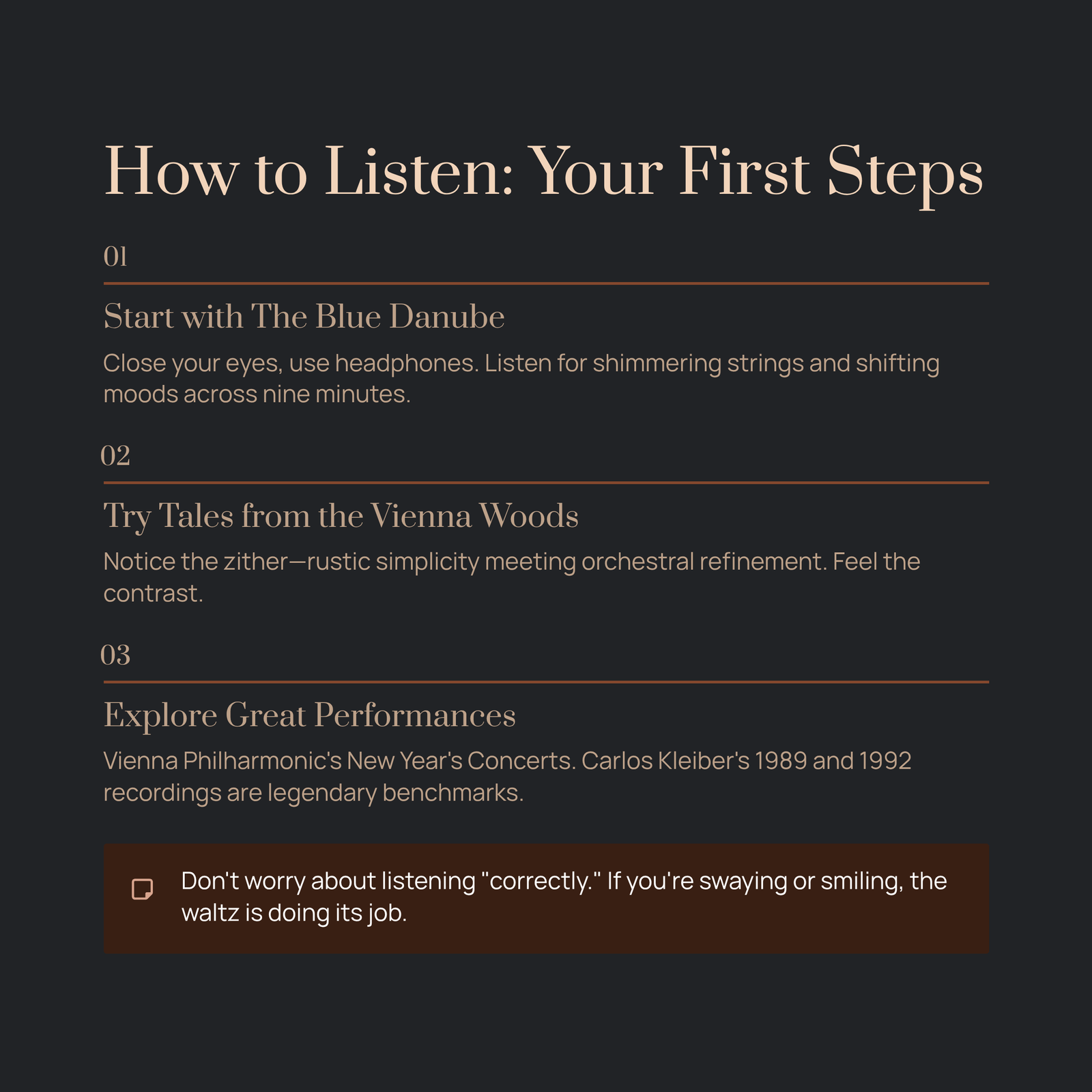
If you’ve never deliberately sat down to listen to Strauss, here’s how I’d suggest beginning.
First, choose “The Blue Danube” — but don’t play it in the background. Put on headphones, close your eyes, and give it your full attention for nine minutes. Listen for the introduction: those quiet, shimmering strings that seem to hover in the air before the first waltz theme gently takes shape. Notice how each new section brings a shift in mood. Feel the moments where the orchestra pulls back to almost nothing before surging forward again.
Next, try “Tales from the Vienna Woods.” Pay attention to the zither — that plucked, slightly rustic instrument that appears unexpectedly in the middle of a full orchestra. It’s Strauss’s way of reminding you that beneath Vienna’s polished ballrooms lies a landscape of forests and meadows. The contrast between refinement and folk simplicity is what gives this waltz its particular magic.
For performers, I’d recommend starting with the Vienna Philharmonic’s New Year’s Concert recordings. Carlos Kleiber’s legendary 1989 and 1992 performances remain benchmarks — his conducting was so fluid and spontaneous that the music seemed to breathe on its own. More recently, conductors like Riccardo Muti and Andris Nelsons have brought fresh energy to these familiar scores. Herbert von Karajan’s studio recordings with the Berlin Philharmonic offer a slightly different perspective: more polished, more controlled, but with an extraordinary sense of line and elegance.
Don’t worry about listening “correctly.” There is no correct way. If your foot starts tapping, if you find yourself swaying slightly, if a particular melody makes you smile for no reason you can name — that’s the waltz doing exactly what it was designed to do.
Why Strauss Still Matters at Dawn
There’s a reason I titled this piece “Before Sunrise.” It’s because Strauss’s music occupies that liminal space between night and day — between nostalgia and hope, between what was and what might still be.
The Viennese waltz was declared a UNESCO Intangible Cultural Heritage in 2017, and 2025 marks the 200th anniversary of Strauss II’s birth. Vienna is celebrating with exhibitions, concerts, and events across all twenty-three districts. But you don’t need to be in Vienna to experience what he created. You just need a quiet room, a good recording, and the willingness to be carried.
What strikes me most about Strauss, after years of listening, is how his waltzes refuse to be merely nostalgic. Yes, they evoke a vanished world of gaslit ballrooms and horse-drawn carriages. But they also contain something stubbornly present — a joy that insists on existing right now, in this moment, in this spinning revolution of melody.
He was a rebel who became an institution. A son who defied his father and, in doing so, gave a city its voice. And every New Year’s morning, when the Vienna Philharmonic plays “The Blue Danube” to a global audience of millions, that voice rings out again — as fresh and as urgent as it was on a February evening in 1867 when the Danube first turned blue.
Close your eyes. Press play. Let the three-quarter time carry you somewhere you’ve never been — and somewhere, somehow, you’ve always known.