📑 Table of Contents
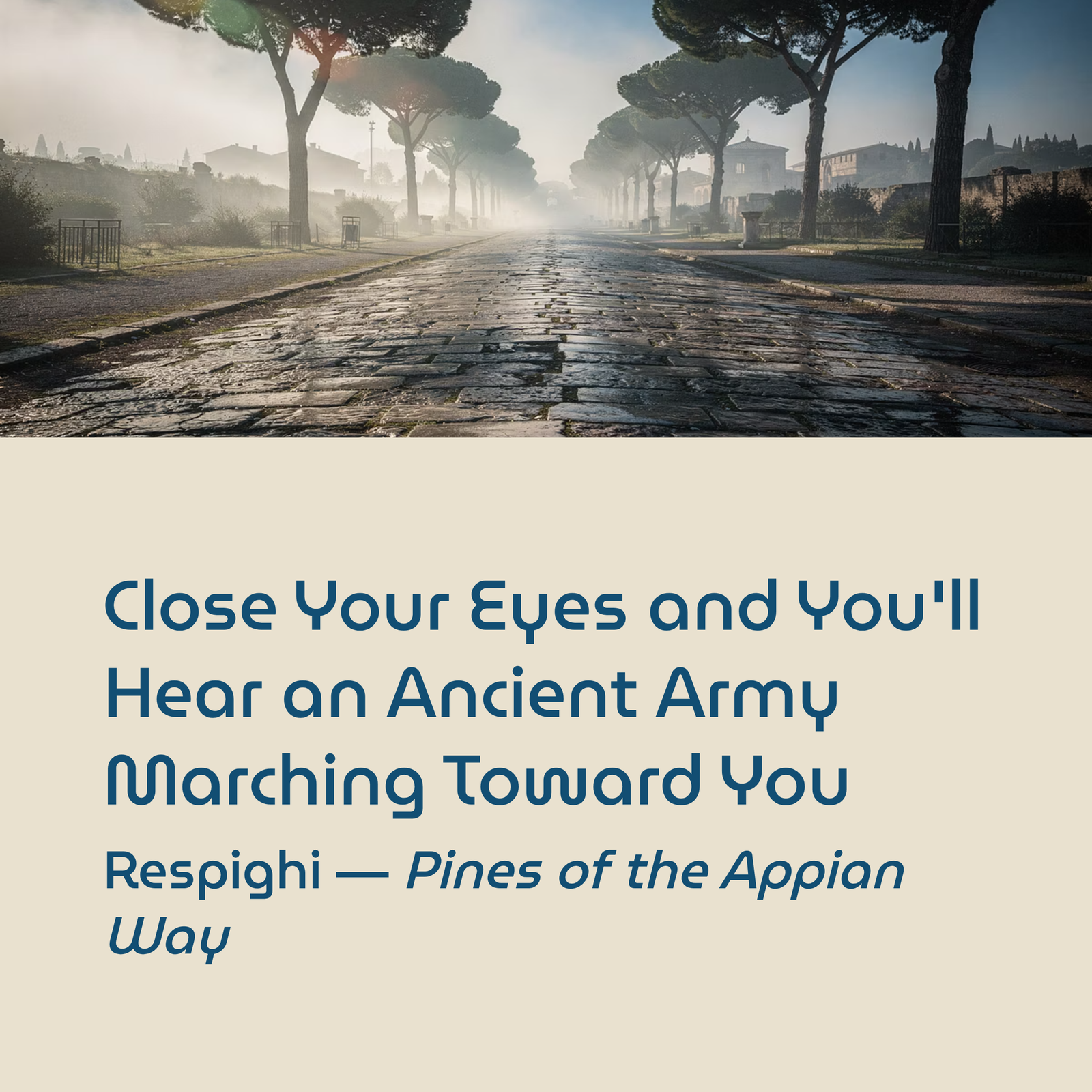
There is a moment, just before the music begins, when you can almost feel the dust rising from an ancient road. The air thickens. Something enormous is approaching from far away, and every fiber of your body knows it before your ears confirm it.
That is what it feels like to listen to the final movement of Ottorino Respighi’s Pines of Rome — a piece called Pines of the Appian Way. It is, without exaggeration, one of the most physically overwhelming experiences you can have while sitting perfectly still. The first time I heard it on a proper sound system, I realized my hands were gripping the armrests. Not out of fear, but out of the sheer bodily sensation of something massive rolling toward me like a slow, unstoppable tide.
If you have never listened to orchestral music that made your chest vibrate, this is where you start.
Respighi: The Painter Who Chose an Orchestra Instead of a Canvas
Ottorino Respighi (1879–1936) is not a name that comes up as often as Beethoven or Mozart, and that is a shame. Born in Bologna, Italy, he studied with Rimsky-Korsakov in Russia — a composer legendary for his mastery of orchestral color — and brought that education back to Italy with a singular obsession: making an orchestra paint pictures.
Where many composers of his era were experimenting with dissonance and abstraction, Respighi went in a completely different direction. He wanted you to see things when you listened. Fountains catching afternoon light. Sunset burning over Roman hills. And in this piece, the ghosts of Roman legions marching down the oldest road in Western civilization.
His Roman Trilogy — Fountains of Rome (1916), Pines of Rome (1924), and Roman Festivals (1928) — stands as one of the most vivid acts of sonic world-building in all of classical music. Pines of Rome is the emotional centerpiece, and its final movement, Pines of the Appian Way, is the moment where everything converges into pure, overwhelming power.
What You Are Actually Hearing: A Ghost Army Comes to Life
The Appian Way — the Via Appia — was Rome’s first and most famous highway, stretching south from the capital. Lined with stone pines and ancient tombs, it was the road along which legions marched out to conquer and returned in triumph. Respighi imagined standing on this road at dawn, watching the spectral vision of a Roman army materialize out of the morning mist.
The movement opens in near-silence. A low, pulsing rhythm in the lowest strings and bass drum begins like a heartbeat heard through the earth itself. It is barely audible at first — you might think your speakers are malfunctioning. They are not. This is intentional. Respighi is placing that army at the far edge of the horizon.
Then, gradually, with a patience that borders on cruelty, the music grows. Layer by layer, instrument by instrument, the army approaches. A melody appears in the low brass — not heroic yet, but ancient and steady, like a hymn sung by men who have marched a thousand miles. The strings add texture. The woodwinds add height. And the percussion adds weight, an ever-increasing gravitational pull that you feel in your sternum.
What makes this buildup extraordinary is its discipline. There are no sudden jumps, no tricks. It is one long, continuous crescendo that takes roughly five minutes to travel from a whisper to one of the loudest, most glorious climaxes in all of orchestral music. When the full brass section finally unleashes the main theme at full power — often reinforced by an organ in performances that include one — the effect is not just loud. It is triumphant in a way that goes beyond volume. It feels like standing at the edge of history and watching it crash over you.
Why This Piece Hits Differently: The Architecture of Inevitability
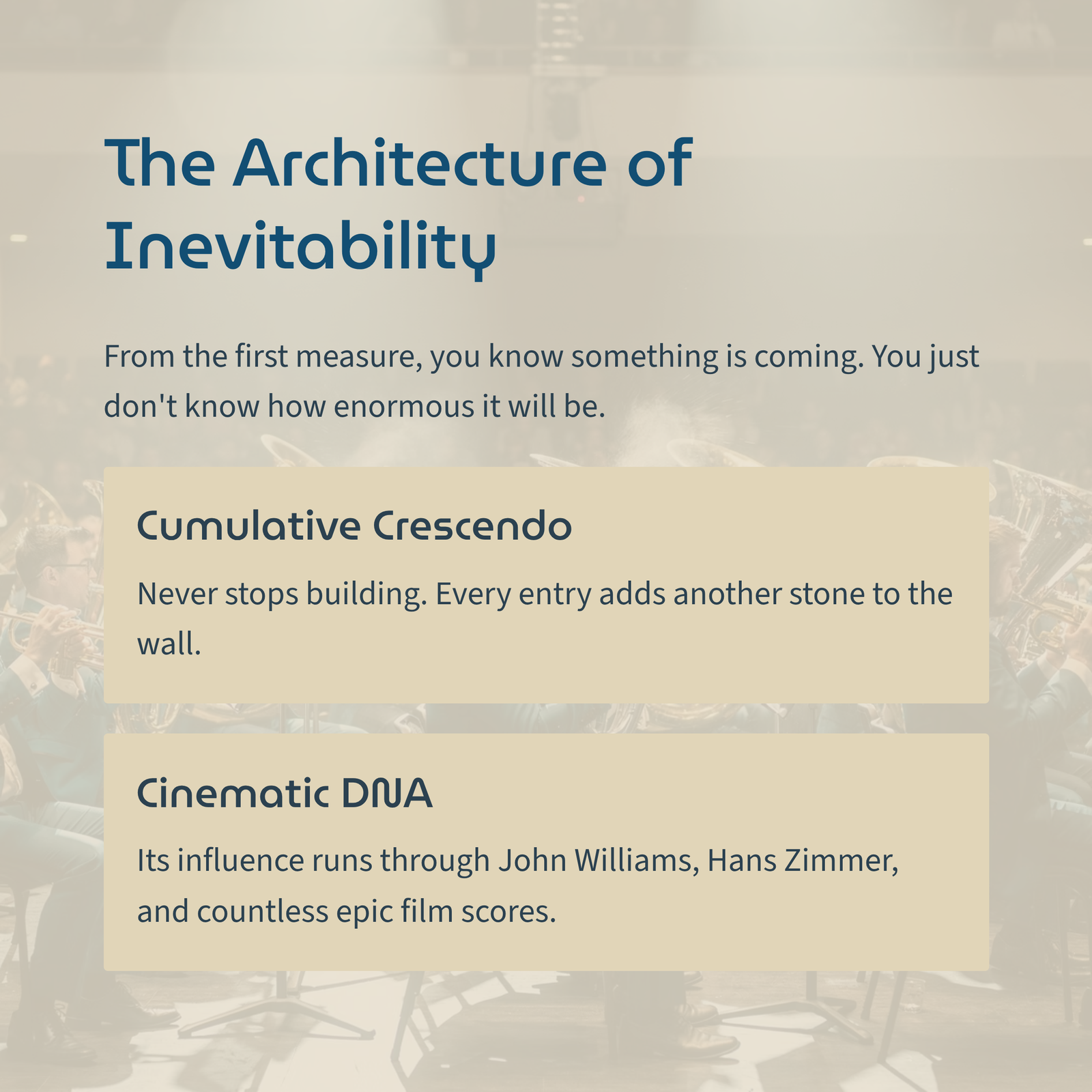
Many pieces of music are loud. Many pieces build to a climax. What separates Pines of the Appian Way from everything else is the sense of inevitability. From the very first measure, you know something is coming. You just do not know how enormous it will be when it arrives.
Respighi achieves this through a technique sometimes called a “cumulative crescendo.” Instead of building tension and releasing it in waves, he simply never stops building. The dynamic level rises almost continuously across the entire movement. Each new instrumental entry adds another stone to the wall. By the time the trumpets and trombones are blazing at full volume and the organ is shaking the hall, there is nowhere left to go — and that is exactly where Respighi wants you. Pinned to your seat, ears ringing, heart pounding, feeling as though something genuinely majestic has passed through the room.
This is also why the piece works so powerfully in film and media. If you have ever heard a movie trailer that made you feel like the world was about to end in the most magnificent way possible, there is a decent chance the composer studied this movement. Its DNA runs through countless cinematic scores, from John Williams to Hans Zimmer.
How to Listen: Practical Tips for First-Timers
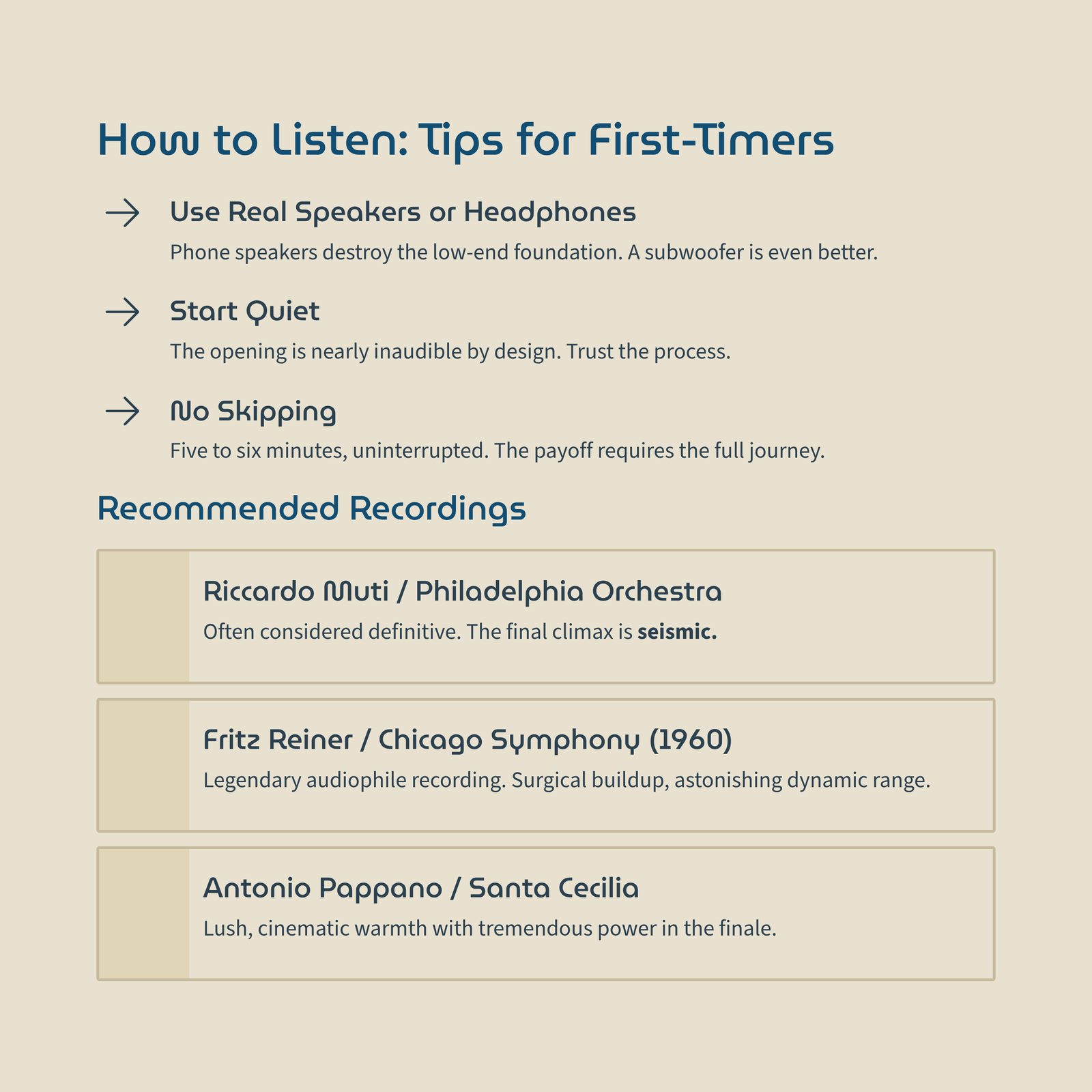
Use headphones or real speakers. This is non-negotiable. Phone speakers will rob you of the entire low-end foundation that makes this piece work. If you have access to a decent pair of over-ear headphones, use them. If you have a subwoofer, even better.
Start quiet and resist the urge to turn it up early. The opening is supposed to be nearly inaudible. Trust the process. If you set your volume so the beginning is comfortably soft, the ending will hit you exactly as Respighi intended.
Listen to the full final movement without interruption. It runs roughly five to six minutes. Do not skip ahead. The entire emotional payoff depends on experiencing the journey from silence to thunder in real time.
Try these recordings:
- Riccardo Muti with the Philadelphia Orchestra — Often considered the definitive recording. The Philadelphia brass section during this era was arguably the finest in the world, and it shows. The final climax is seismic.
- Fritz Reiner with the Chicago Symphony Orchestra (1960) — A legendary audiophile recording on the RCA Living Stereo label. The engineering captures an astonishing dynamic range, and Reiner’s control of the buildup is surgical.
- Antonio Pappano with the Orchestra dell’Accademia Nazionale di Santa Cecilia — A more recent Italian perspective with lush, cinematic warmth and tremendous power in the finale.
For a visual experience, search for live concert performances on YouTube. Watching the brass players’ faces during the final minutes — the physical effort, the concentration — adds an entirely new dimension.
Standing on the Appian Way at Dawn
There is something about this music that bypasses the analytical mind entirely. You do not need to understand orchestration or music theory to feel the ground shake. You do not need to know anything about Roman history to sense the weight of something ancient passing by.
Respighi wrote Pines of the Appian Way not as a history lesson, but as an act of resurrection. For five minutes, the dead march again. The road that has been silent for two thousand years fills with the sound of iron and leather and ten thousand footsteps, and you are standing right there at the edge, watching it all go by.
When the final chord cuts off and the silence rushes back in, you will realize you have been holding your breath. And you will press play again.
That, I think, is the highest compliment any piece of music can receive.