📑 Table of Contents
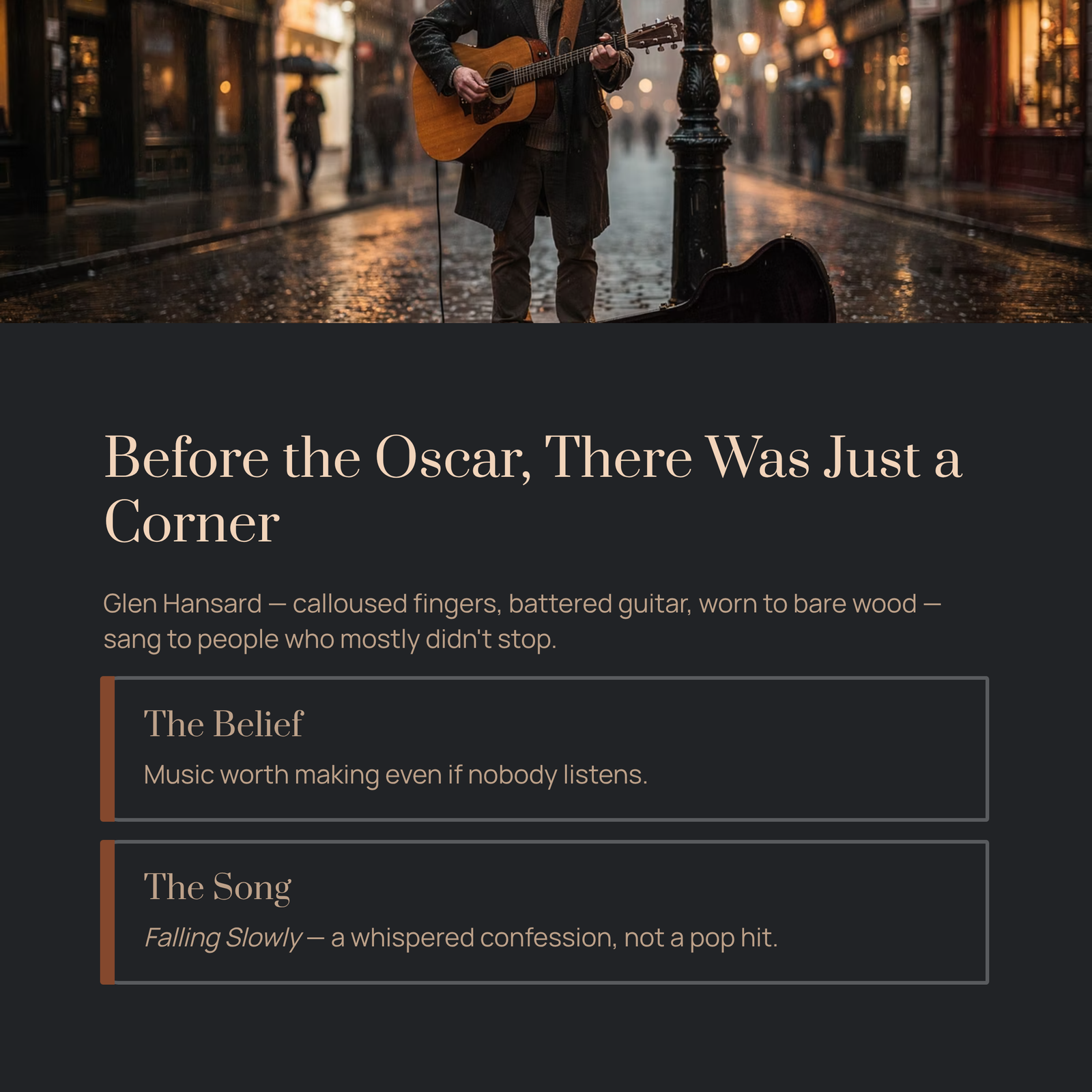
There is a street corner in Dublin where the wind carries salt from the River Liffey and the sound of loose change dropping into an open guitar case. If you had walked past that corner in the early 2000s, you might have seen a man with calloused fingers and an old, battered guitar — its pickguard worn through to bare wood — singing his lungs out to people who mostly didn’t stop. That man was Glen Hansard.
Before the Oscar, before the standing ovation at the Academy Awards ceremony, before millions of streams and countless piano covers flooding the internet, there was just this: a guy on a street corner who believed that music was worth making even if nobody was listening. And that belief — stubborn, fragile, almost reckless — is the very heartbeat of “Falling Slowly.”
I want to talk about this song today not as a pop hit or a film soundtrack highlight, but as something closer to a whispered confession. Specifically, I want to talk about its piano arrangement — the version that strips away guitars and voices and leaves nothing but keys and silence. Because sometimes, when you remove everything extra, what remains tells the truth more clearly.
The Improbable Story Behind “Once”
To understand “Falling Slowly,” you have to understand the film it came from — and the film is one of the most improbable success stories in modern cinema.
“Once” (2007) was directed by John Carney, a fellow Dubliner who had almost no budget. The entire movie was shot for roughly $160,000, which in Hollywood terms is barely enough to cater lunch for a week. There were no professional actors in the lead roles. Glen Hansard, the frontman of Irish rock band The Frames, played “Guy” — a vacuum cleaner repairman by day, street busker by night. Markéta Irglová, a Czech musician Hansard had been collaborating with, played “Girl” — a pianist and immigrant who stumbles into his music and, eventually, his life.
The film tells a story that refuses to follow the expected script. Guy and Girl meet, they make music together, they fall into something that looks and sounds a lot like love — but they don’t end up together. There is no dramatic kiss in the rain. No airport chase. The film ends with longing intact, with the space between two people honored rather than closed.
It was within this atmosphere of beautiful incompleteness that “Falling Slowly” was born. Hansard and Irglová wrote it together, and the collaboration itself mirrored the story they were telling — two people from different worlds finding a shared language in melody and chord.
When the song won the Academy Award for Best Original Song in 2008, Irglová was initially cut off by the orchestra during her acceptance speech. The show went to commercial, but host Jon Stewart brought her back onstage afterward to finish what she had to say. It was an unscripted moment that felt entirely in the spirit of the film: messy, honest, and deeply human.
Listening to the Piano Arrangement — Where Silence Becomes the Second Voice
The original recording of “Falling Slowly” is built on acoustic guitar, layered vocals, and a gradual crescendo that feels like two people daring each other to be vulnerable. It’s a beautiful recording. But the piano arrangement does something different — something that, I’d argue, takes you even deeper.
When the guitar is removed and the melody is placed on piano keys, the song’s harmonic skeleton is suddenly exposed. You hear the chord progression with startling clarity: those descending movements that pull you gently downward, the way the bass notes in the left hand create a foundation that feels both steady and fragile, like walking on a frozen lake that might hold your weight or might not.
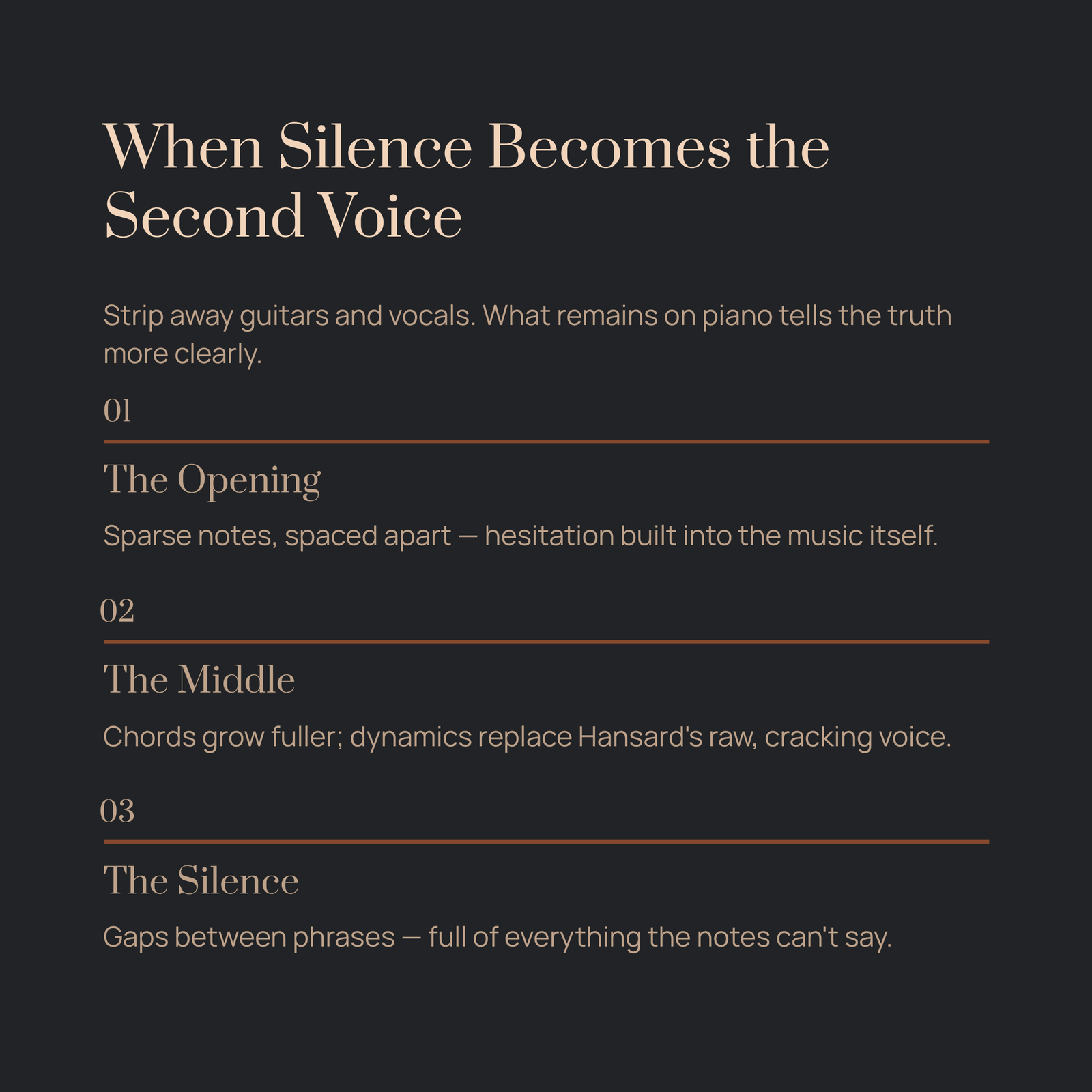
The opening measures are deceptively simple. A few notes in the upper register, spaced apart, as if the pianist is testing whether it’s safe to begin. There is hesitation built into the music itself — not as a flaw, but as an emotional truth. This is a song about the courage it takes to let yourself care about someone when you already know how much caring can cost.
Pay attention to the middle section, where the melody rises and the chords grow fuller. In the original, this is where Hansard’s voice strains and cracks with raw emotion. In the piano version, that strain translates into dynamics — the way a pianist might press harder into the keys, letting the hammers strike the strings with more weight. You can hear the wood and felt and wire doing the work that a human voice does in the original. It’s a different kind of vulnerability, but it’s vulnerability all the same.
And then there’s the space. The piano arrangement lives and breathes in its pauses. Between phrases, there are gaps where no sound exists, and those gaps are not empty — they’re full of everything the notes can’t say. If you listen in a quiet room, late at night, those silences will reach you in ways the notes themselves cannot.
Why This Song Refuses to Age
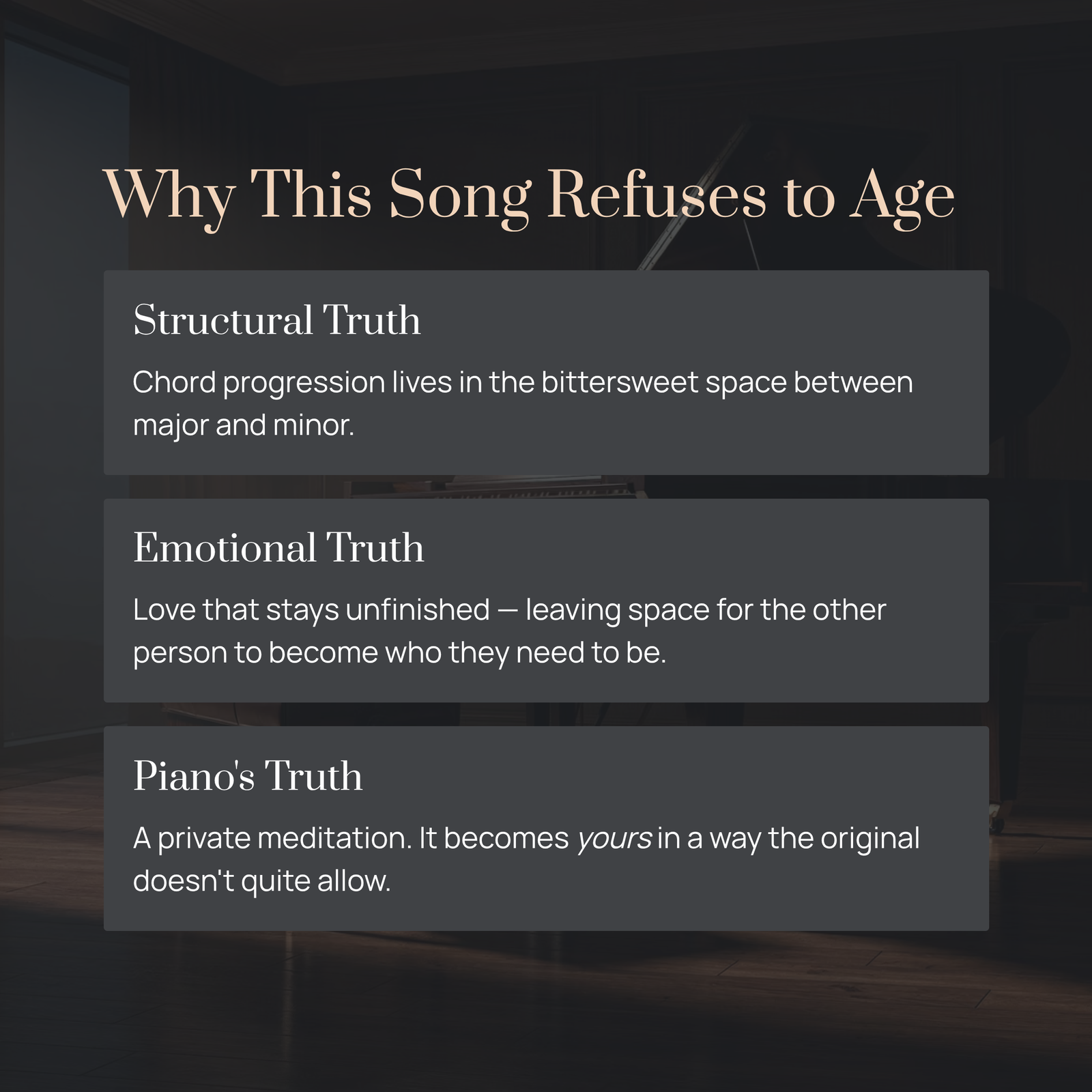
Nearly two decades have passed since “Once” premiered, and “Falling Slowly” has only grown more resonant with time. Part of this is structural: the song’s chord progression and melodic shape tap into something almost universal in Western harmonic language — that bittersweet territory between major and minor where most of our deepest emotions live.
But I think the real reason is simpler. This song tells the truth about love — not the triumphant, all-conquering version, but the quiet, complicated kind. The kind where two people recognize something real between them and still choose to let it remain unfinished. The kind where the most loving thing you can do is leave space for the other person to become who they need to become, even if that means becoming someone who walks away.
The piano arrangement amplifies this quality because piano is, by nature, an instrument of solitude. A guitarist can play on a street corner, surrounded by noise and strangers. But a pianist sits alone at a bench, in a room, with only the instrument and the silence for company. When “Falling Slowly” is rendered on piano, it becomes a private meditation rather than a public declaration. It becomes yours in a way the original, for all its beauty, doesn’t quite allow.
I’ve listened to this arrangement during long work sessions and sleepless nights, during seasons of change and seasons of waiting. Each time, it reveals a slightly different facet of itself — a harmonic detail I hadn’t noticed, a rhythmic nuance that suddenly matters. This is the mark of music that lives: it grows with you.
How to Listen — A Few Gentle Suggestions
If you’re coming to this piece for the first time, here’s how I’d suggest approaching it.
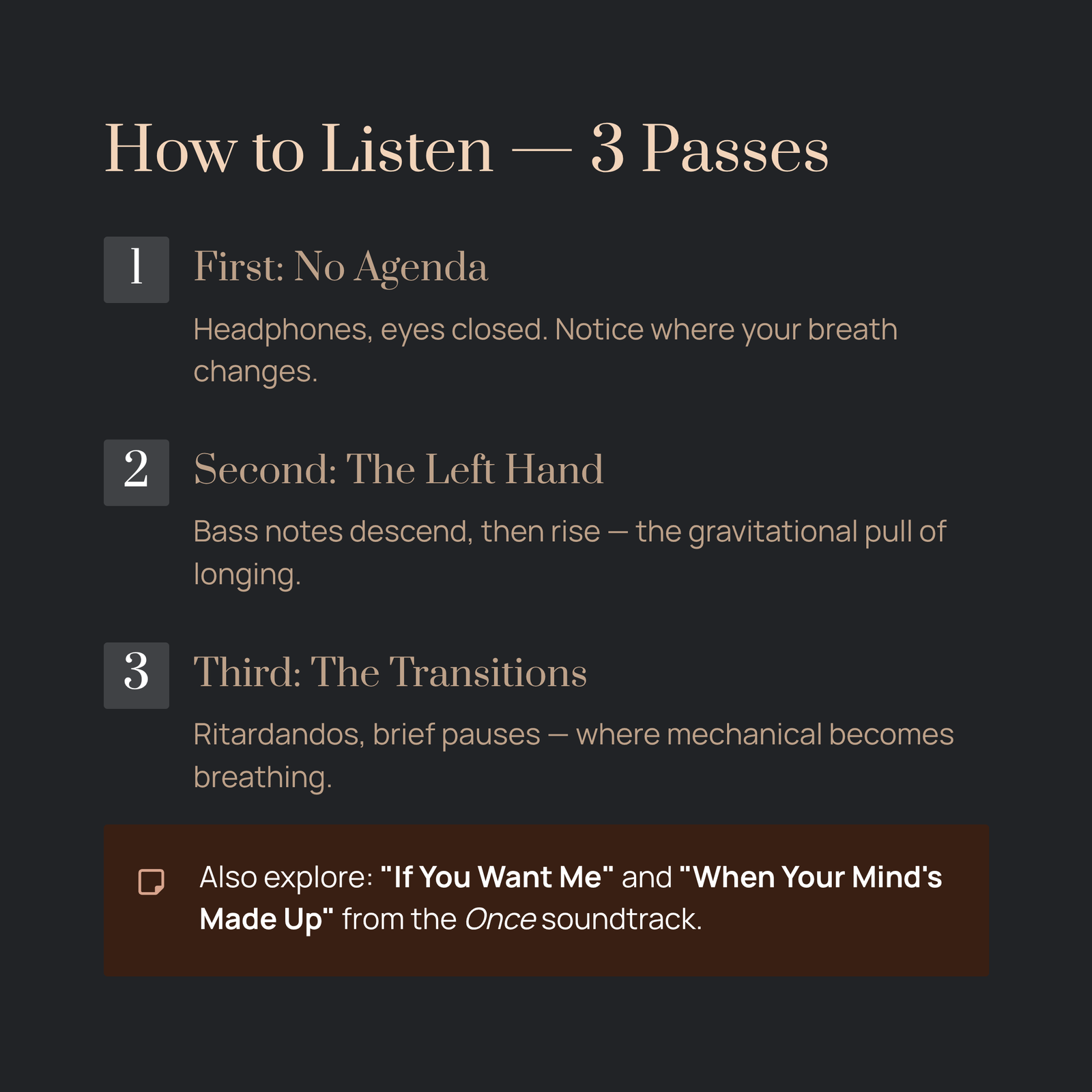
First, listen once without any agenda. Don’t try to analyze it, don’t read along with anything, don’t multitask. Just put on a good pair of headphones, close your eyes, and let the music happen to you. Notice what you feel. Notice where your breath changes. Notice which moments make you want to hold still.
On your second listen, pay attention to the left hand — the bass notes and lower chords that underpin the melody. These are the emotional foundation of the piece, and they do more work than you might initially realize. The way they move, descending and then gently rising, creates a kind of gravitational pull that gives the melody its sense of longing.
On your third listen, focus on the transitions — the moments between sections where the music shifts mood or intensity. These are the joints and hinges of the song’s architecture, and they’re where the pianist’s interpretation matters most. A slight ritardando here, a brief pause there — these small choices are what separate a mechanical performance from one that breathes.
For recommended recordings, seek out acoustic piano covers that prioritize emotional nuance over technical showmanship. The many talented pianists on YouTube who have interpreted this piece offer a wonderful range of approaches — some lean into the melancholy, others find unexpected warmth and hope. Each interpretation is a conversation with the original, and no two are quite the same. The “Once” original soundtrack album, of course, remains essential listening for context.
If you enjoy this piece, you might also explore the broader “Once” soundtrack, which includes other Hansard-Irglová collaborations like “If You Want Me” and “When Your Mind’s Made Up” — each carrying that same quality of unguarded emotional honesty.
The Courage of Unfinished Things
There’s a particular kind of bravery in leaving something incomplete. We live in a culture that celebrates resolution — the solved problem, the closed deal, the happy ending. But “Falling Slowly,” especially in its piano form, asks us to sit with something that doesn’t resolve neatly, and to find beauty in that openness.
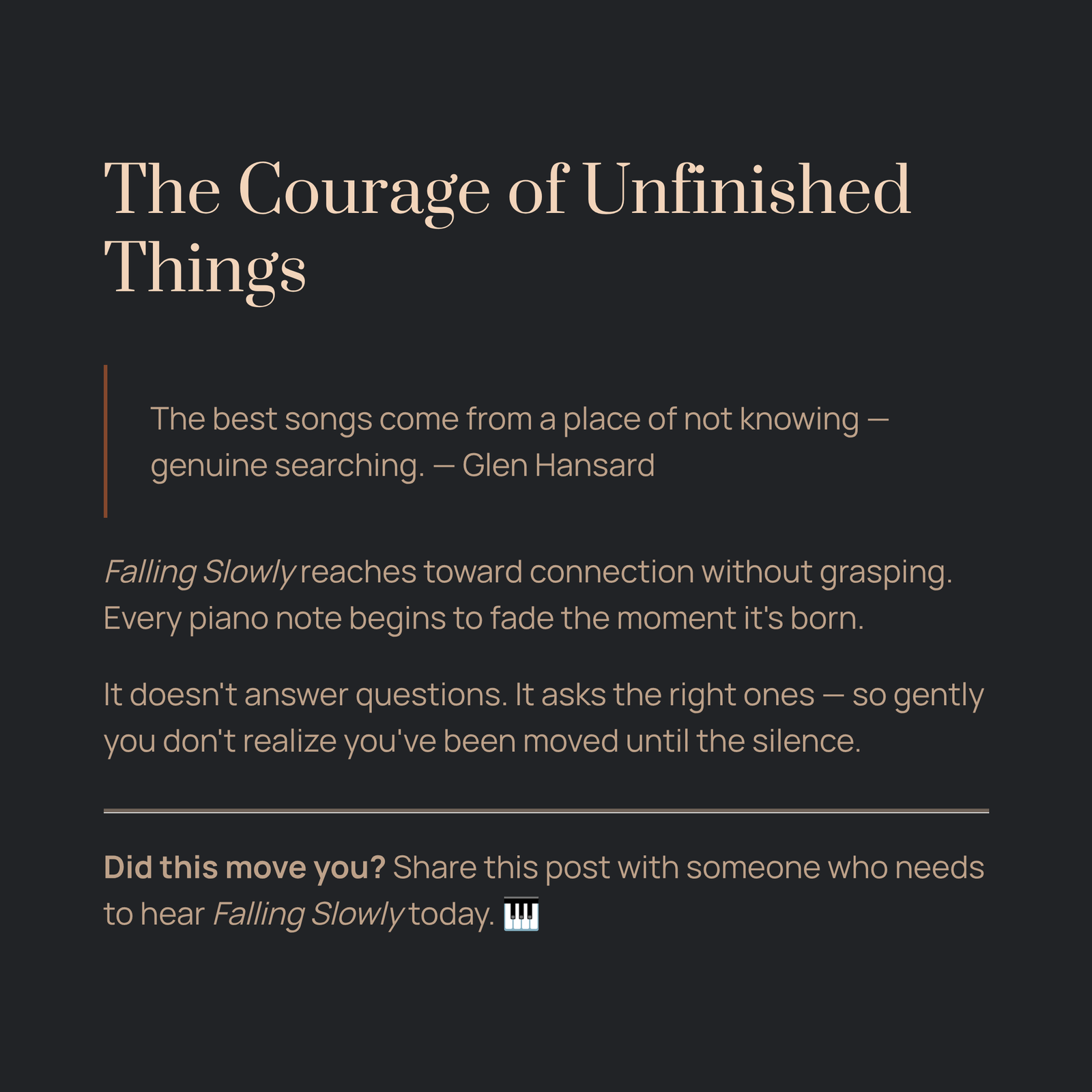
Glen Hansard once said in an interview that the best songs are the ones that come from a place of not knowing. Not from certainty or authority, but from genuine searching. “Falling Slowly” is a searching song. It reaches toward connection without grasping. It admits desire without demanding fulfillment. And in the piano arrangement, where the melody is carried by an instrument that can only strike and then let go — where every note begins to fade the moment it’s born — that quality of reaching-and-releasing becomes almost unbearably poignant.
This, I think, is why the song continues to find new listeners year after year. Not because it answers any questions, but because it asks the right ones. And it asks them so gently, so musically, that you don’t even realize you’ve been moved until the last note fades and you’re sitting in silence, feeling something you can’t quite name but don’t want to let go of.
That’s the gift of “Falling Slowly.” It falls, and it’s slow, and it doesn’t land anywhere definitive. And that’s exactly why it stays with you.