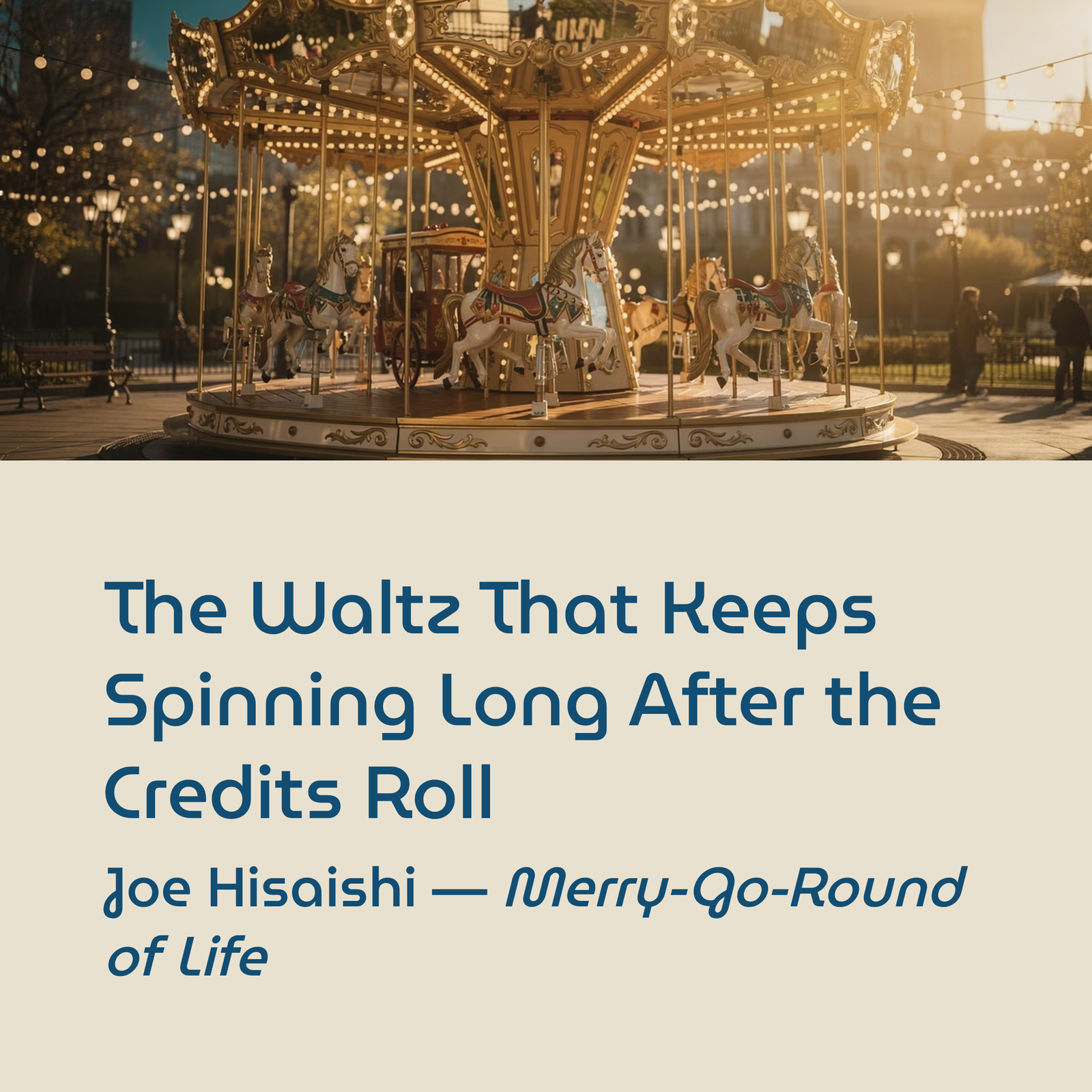
Joe Hisaishi wrote “Merry-Go-Round of Life” for Hayao Miyazaki’s 2004 animated film Howl’s Moving Castle. Its turning waltz rhythm gives the film a recognizable musical thread, while the melody can sound intimate or expansive depending on how it is played.
If you know the tune but cannot place it, Howl’s Moving Castle is the place to start. The piece belongs to Hisaishi’s score for the film, rather than to an older ballroom waltz that the filmmakers borrowed.
📑 Table of Contents
Why Joe Hisaishi Wrote the Howl’s Moving Castle Waltz
Hisaishi composed the music for Howl’s Moving Castle, Miyazaki’s adaptation of Diana Wynne Jones’s fantasy novel. The film follows Sophie, a young hat maker who is cursed to appear elderly, and Howl, a wizard whose life is bound up with a fire demon. Their story moves through uncertainty, affection, danger, and change. A melody that can return in different forms is useful in a film with so much movement.
The waltz was written for that film score. There is no need to attach a more specific occasion to it, such as a particular scene or private event in the composer’s life. Its purpose is clear enough on screen: it gives the film a theme that listeners can recognize even when the arrangement changes.
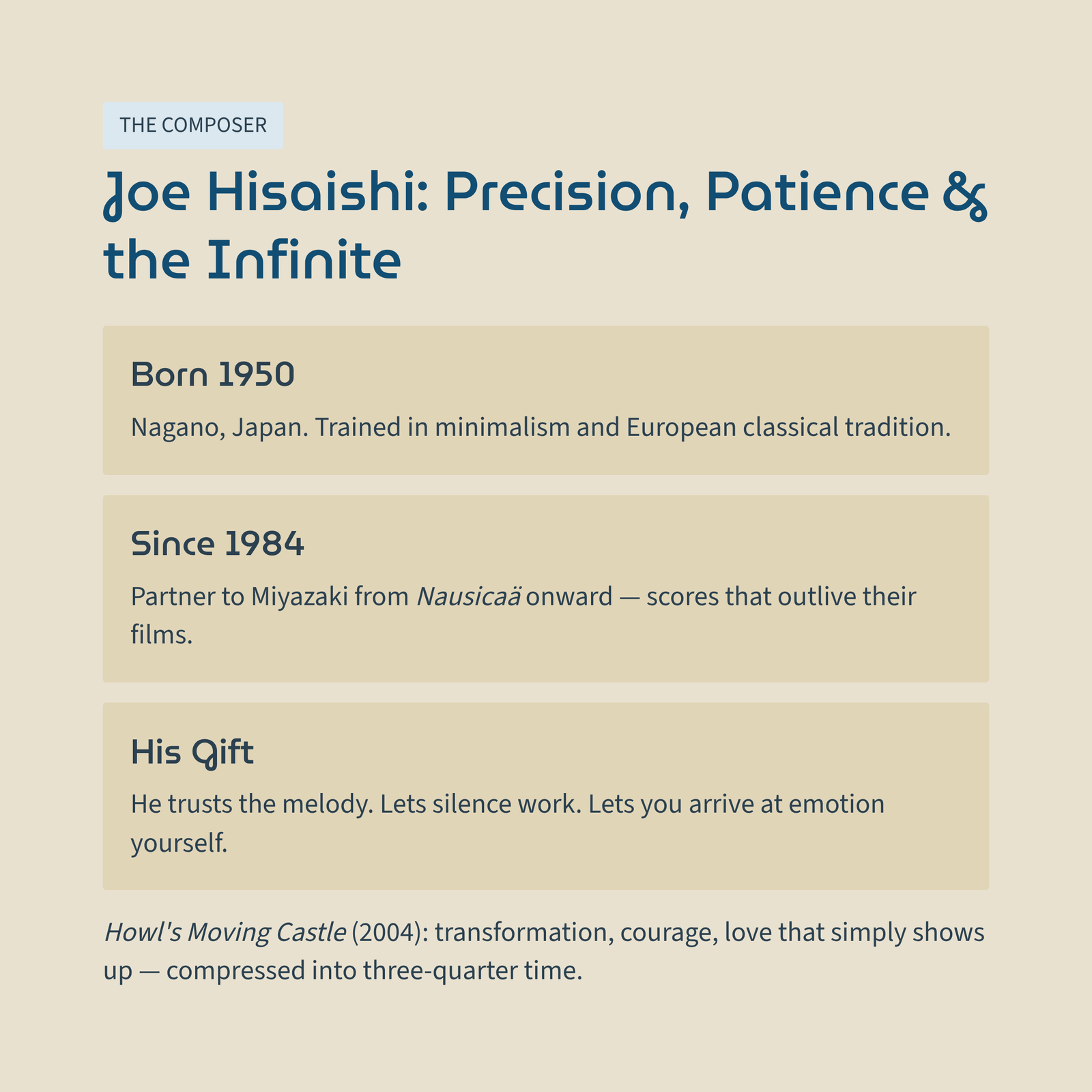
Hisaishi and Miyazaki had worked together since Nausicaä of the Valley of the Wind, released in 1984. By the time of Howl’s Moving Castle, their collaboration had already produced music for several animated films. Hisaishi, born Mamoru Fujisawa in Japan in 1950, also had a musical life beyond those scores. Knowing that history helps explain why the waltz feels carefully shaped as music in its own right, even if you first encountered it in a movie.
The film’s setting has moving castles, crowded streets, and moments of quiet domestic life. The waltz can fit all of them because its pulse is steady without fixing its mood. It can suggest a dance, but it can also keep the music gently in motion while a scene changes around it.
Where You Hear Merry-Go-Round of Life
The documented connection is Howl’s Moving Castle: “Merry-Go-Round of Life” is part of its music, and the film’s soundtrack brought the theme to listeners outside the theater. You may also know it through Hisaishi performances or arrangements made for piano and other ensembles. Those versions can differ substantially from what you remember hearing in the film.
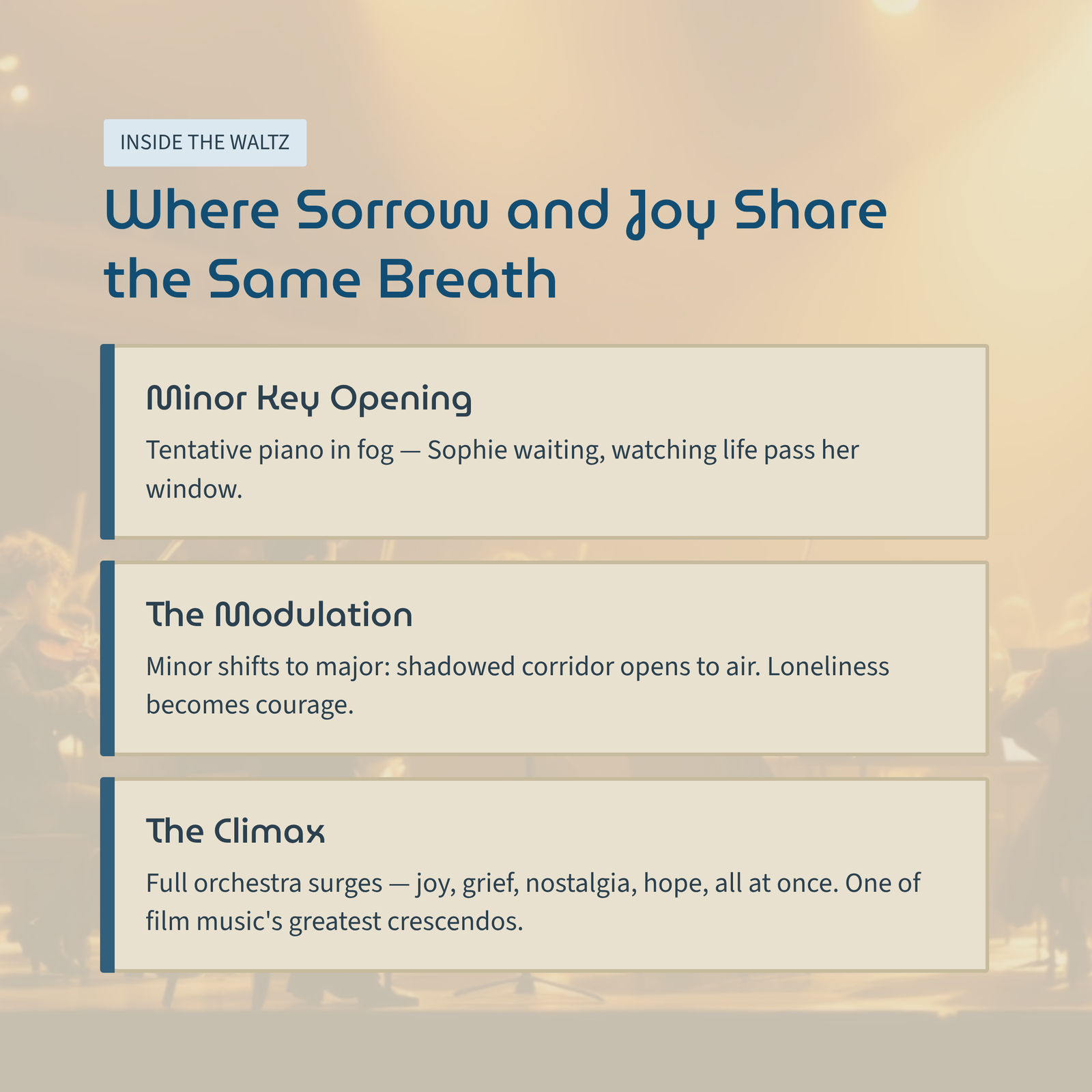
That distinction matters when someone describes an “opening” or a “climax.” A piano arrangement may begin alone and build through added notes. An orchestral performance may distribute the tune among instruments. Neither description applies to every version, so use the melody and its three-beat rhythm as your bearings rather than expecting an identical sequence of sounds.
Hisaishi wrote music for other Miyazaki films that rewards the same kind of attention. In his theme “A Town with an Ocean View” from Kiki’s Delivery Service, a clear melody helps establish the feeling of a new place. His “One Summer’s Day” from Spirited Away offers another chance to hear how much space a simple phrase can leave around itself.
If you have seen “Merry-Go-Round of Life” paired online with unrelated scenes, treat those pairings as uses of the music, not evidence that it was written for another film, show, advertisement, or game. Its original screen home is Howl’s Moving Castle.
Three Moments to Notice in the Waltz
First, find the pulse beneath the tune. A waltz groups beats in threes: you can count “one-two-three, one-two-three” as it moves. Try following that pattern for a few measures without humming the melody. Once you feel it, notice how the tune can stretch across the beats while the underlying motion keeps turning.
Next, listen for the melody’s return. Rather than introducing an entirely new tune every time, the music brings back a shape you already know. Pay attention to what has changed around it. A shift in harmony, register, or instrumentation can make a familiar phrase feel more tentative or more open without making it unrecognizable.
Finally, notice what happens when the texture grows fuller. In a larger arrangement, more instruments can support the melody and give it a broader sweep. The change is effective partly because your ear remembers its smaller form. When the music eases back, see whether the tune feels different to you after that expansion.
These are listening cues, not a fixed map of every recording. If your version is for solo piano, you can still hear changes in register, harmony, and the weight of the accompaniment. If it is orchestral, follow which sounds carry the tune and which ones keep the dance moving underneath.
What Does Merry-Go-Round of Life Mean?
The title invites an image of circling, and the waltz makes that image easy to hear. Its beat continually begins another group of three, while the melody returns after moving away. That combination can suggest motion through change: you arrive somewhere familiar, but what surrounds it has shifted.
It is reasonable to connect that feeling with Sophie’s story. She changes in appearance, learns to act with greater confidence, and forms a bond with Howl. The film gives the theme a context in which returning and changing can feel meaningful. But a precise claim such as “this chord represents Sophie’s courage” would go beyond what the music itself establishes. You can hear the phrase differently without missing a hidden official answer.
The tune also makes room for more than one mood. Its lilting rhythm can sound graceful, while a turn in the harmony can bring a more searching quality. That is part of its appeal: the music does not have to settle into pure celebration or pure sadness. Listen once for the dance, then again for the places where the harmony complicates it.
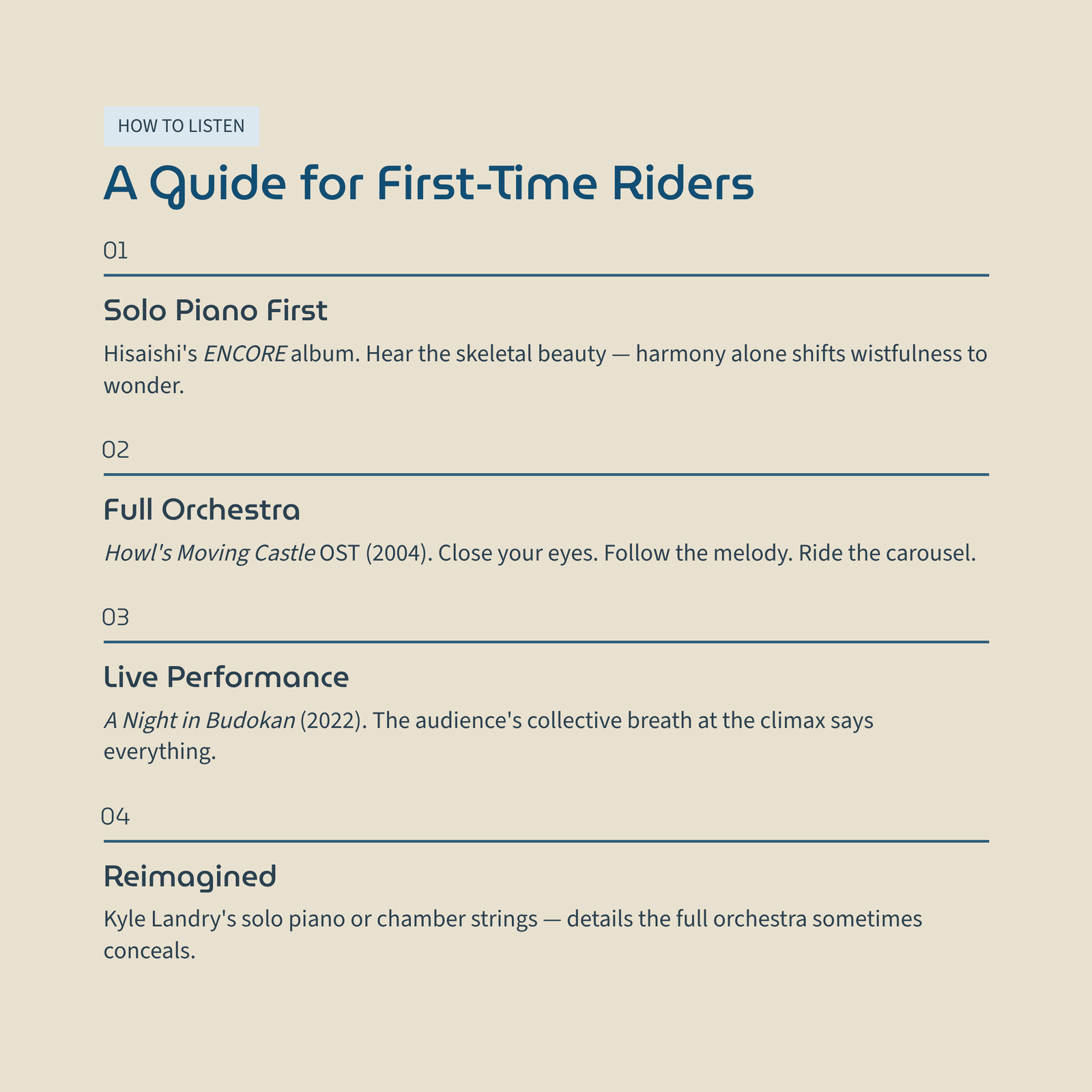
You do not need to have seen the film recently to enjoy the piece tonight. Put on a version you like, count the waltz for a few bars, and then let the melody take over. If it feels as though it keeps arriving at the same place from a different direction, you have found one of the pleasures of this score.
Listen to This Piece
Frequently Asked Questions
Who wrote Merry-Go-Round of Life?
Joe Hisaishi wrote it for the 2004 film Howl’s Moving Castle, directed by Hayao Miyazaki. It is part of Hisaishi’s score, although you may hear it performed separately from the film.
Is Merry-Go-Round of Life a classical waltz?
It is a modern film theme with a waltz’s three-beat pulse. Calling it a waltz describes how it moves; it does not mean it was written for a nineteenth-century ballroom.
What is the meaning of Merry-Go-Round of Life?
The title and recurring melody suggest a life that keeps moving and changing, but they do not prescribe a single interpretation. In Howl’s Moving Castle, the theme gains meaning alongside Sophie and Howl’s story.
Sources
Part of: Heard It Somewhere? · Start Here