📑 Table of Contents
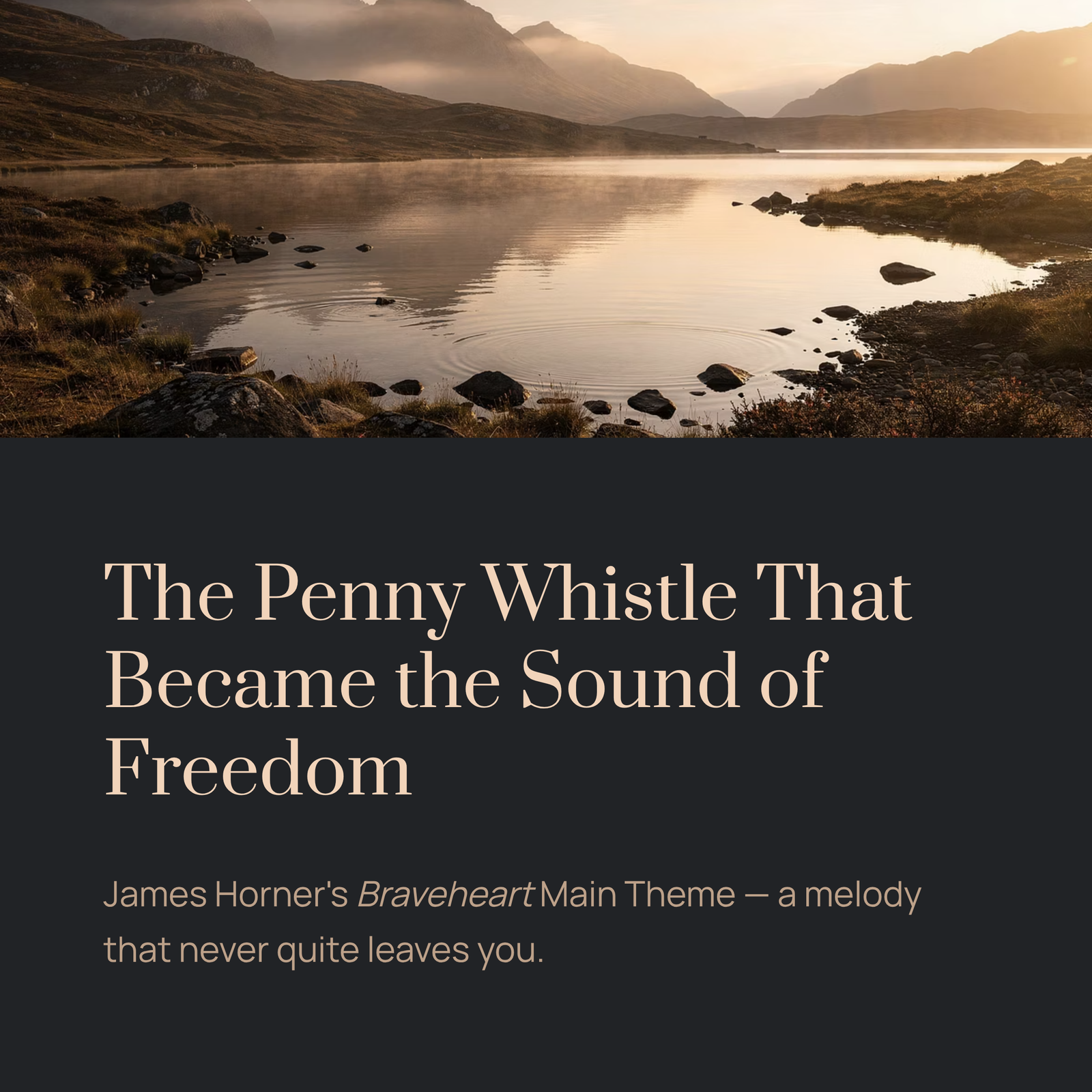
There are certain pieces of music that, once they enter your life, never quite leave. They settle somewhere deep, in a place you didn’t even know existed, and every time you hear them again, something inside you shifts. For me, the Braveheart Main Theme by James Horner is exactly that kind of music.
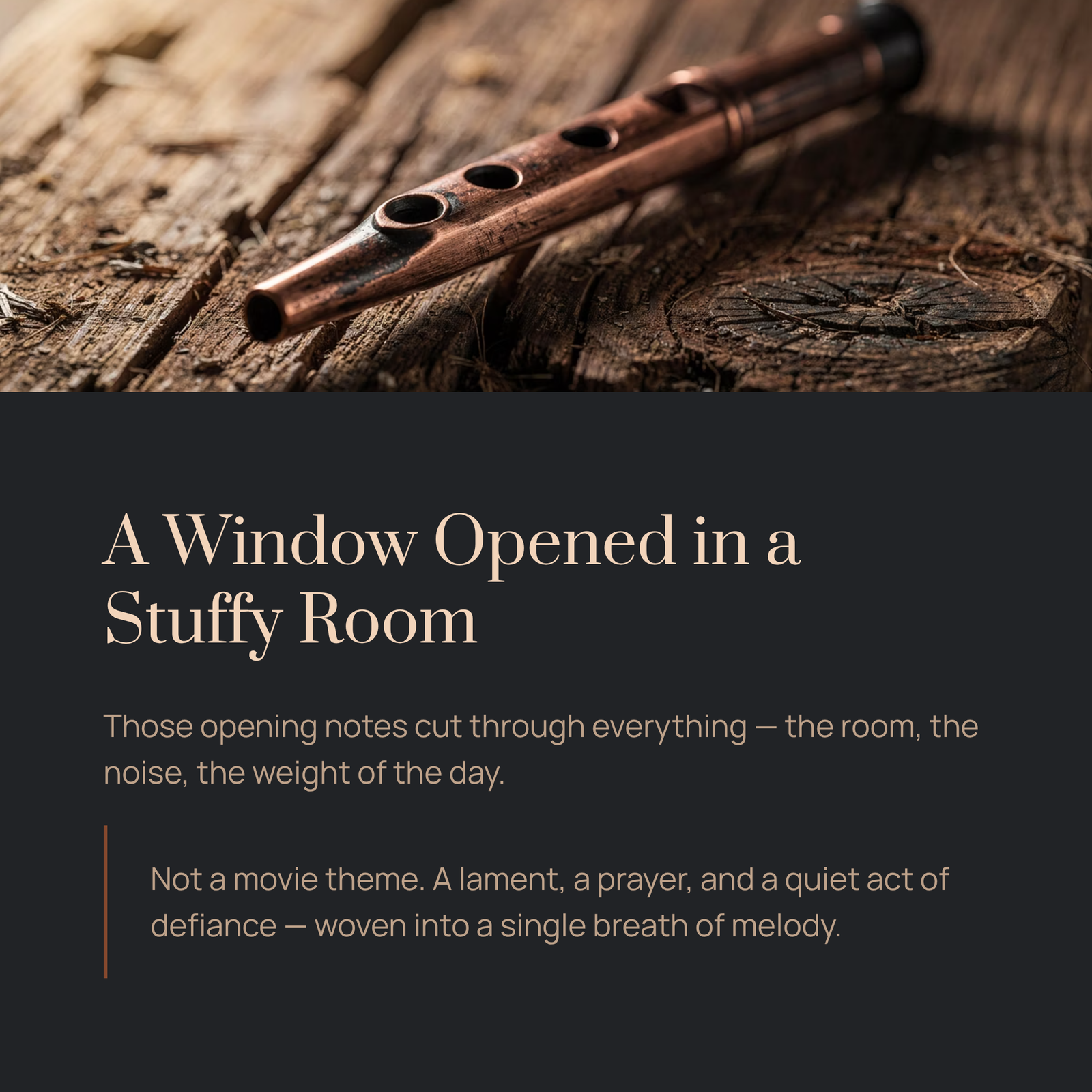
I first heard it years ago, not in a concert hall, not through expensive headphones, but through the tinny speakers of a laptop late at night. And yet, those opening notes of the penny whistle cut through everything. The room, the noise in my head, the weight of the day. It was as if someone had opened a window in a stuffy room and let the highland wind rush in.
If you have never listened to this piece on its own, separated from the film, I want you to try something. Close your eyes. Let the first thirty seconds wash over you without thinking about Mel Gibson or medieval Scotland. Just listen to the sound itself. What you will hear is not a movie theme. It is a lament, a prayer, and a quiet act of defiance, all woven into a single breath of melody.
The Quiet Genius Behind the Score
James Horner was not the kind of composer who courted the spotlight. Born in Los Angeles in 1953 but raised partly in London, he straddled two musical worlds from the very beginning. He studied at the Royal College of Music before earning his doctorate at UCLA, where he immersed himself in both contemporary classical composition and the emerging language of film scoring.
By the time Braveheart came along in 1995, Horner had already proven himself with scores for Star Trek II, Aliens, and Field of Dreams. But Hollywood had a complicated relationship with him. Some critics accused him of recycling melodic ideas. Others whispered that he leaned too heavily on temp tracks. What they missed, I think, was the emotional intelligence behind every choice he made. Horner did not write music to impress other composers. He wrote music to make ordinary people feel extraordinary things.
When director Mel Gibson approached him for Braveheart, something clicked. This was not a project that needed flashy orchestration or avant-garde experimentation. It needed honesty. It needed the sound of earth and sky and grief and stubborn, unbreakable hope. And Horner delivered something that transcended the film itself.
Listening to the Landscape: What Makes This Theme So Powerful
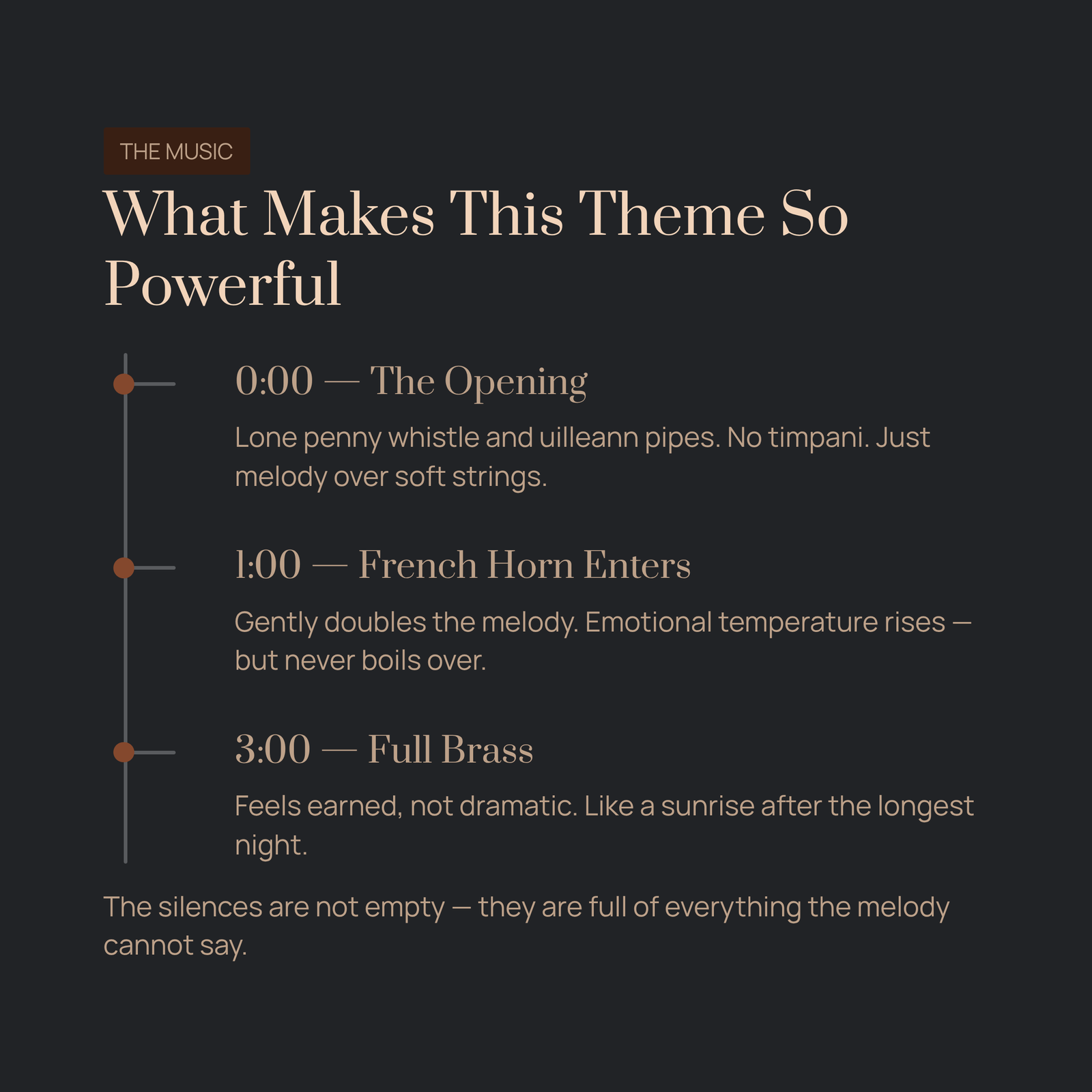
The genius of the Braveheart Main Theme lies in its restraint. It begins with the uilleann pipes and a lone penny whistle, instruments that carry centuries of Celtic sorrow in their very timbre. There is no grand orchestral entrance. No dramatic timpani roll. Just a single melodic line floating over a bed of soft strings, like mist drifting across a Scottish loch at dawn.
Pay attention to what happens around the one-minute mark. The French horn enters, gently doubling the melody, and the emotional temperature begins to rise. But Horner never lets it boil over. He understands something that many film composers forget: the space between the notes matters as much as the notes themselves. The silences in this piece are not empty. They are full of everything the melody cannot say.
As the theme develops, the full orchestra gradually joins, but always in service of that original whistle melody. The strings swell with a warmth that feels less like a Hollywood soundtrack and more like a hymn sung by people who have lost everything and still choose to stand. Around the three-minute mark, when the brass finally enters with full force, it does not feel like a dramatic reveal. It feels earned, like a sunrise after the longest night.
What strikes me most is the harmonic language Horner uses. The melody moves between major and minor modes with a fluidity that mirrors the Scottish folk tradition, where joy and sorrow have always been two sides of the same coin. There is a particular moment where the melody resolves on a major chord after lingering in minor territory, and every single time, it catches me off guard. It is the musical equivalent of finding light in a place where you expected only darkness.
Why This Music Still Matters, Thirty Years Later
I have a theory about why the Braveheart theme continues to resonate with people who have never set foot in Scotland and have no particular attachment to the film. It is because the piece speaks to something universal. Not freedom in the political sense, though the film certainly frames it that way. But freedom in the deeply personal sense. The freedom to feel something fully without apology.
We live in a world that often asks us to be efficient with our emotions. To process grief quickly, to contain our joy, to keep our longing private. Horner’s theme gives you permission to do the opposite. For seven minutes, you are allowed to ache. You are allowed to hope fiercely. You are allowed to sit with the bittersweet knowledge that the most beautiful things in life are also the most fragile.
I think this is why so many people tell me they listen to this piece during moments of transition. Before a difficult conversation. After a loss. On the morning of a new beginning. The music does not tell you what to feel. It simply creates a space vast enough for whatever you are carrying.
How to Listen: A Personal Guide
If you are coming to this piece for the first time, or if you want to hear it with fresh ears, here are a few suggestions that have deepened my own experience.
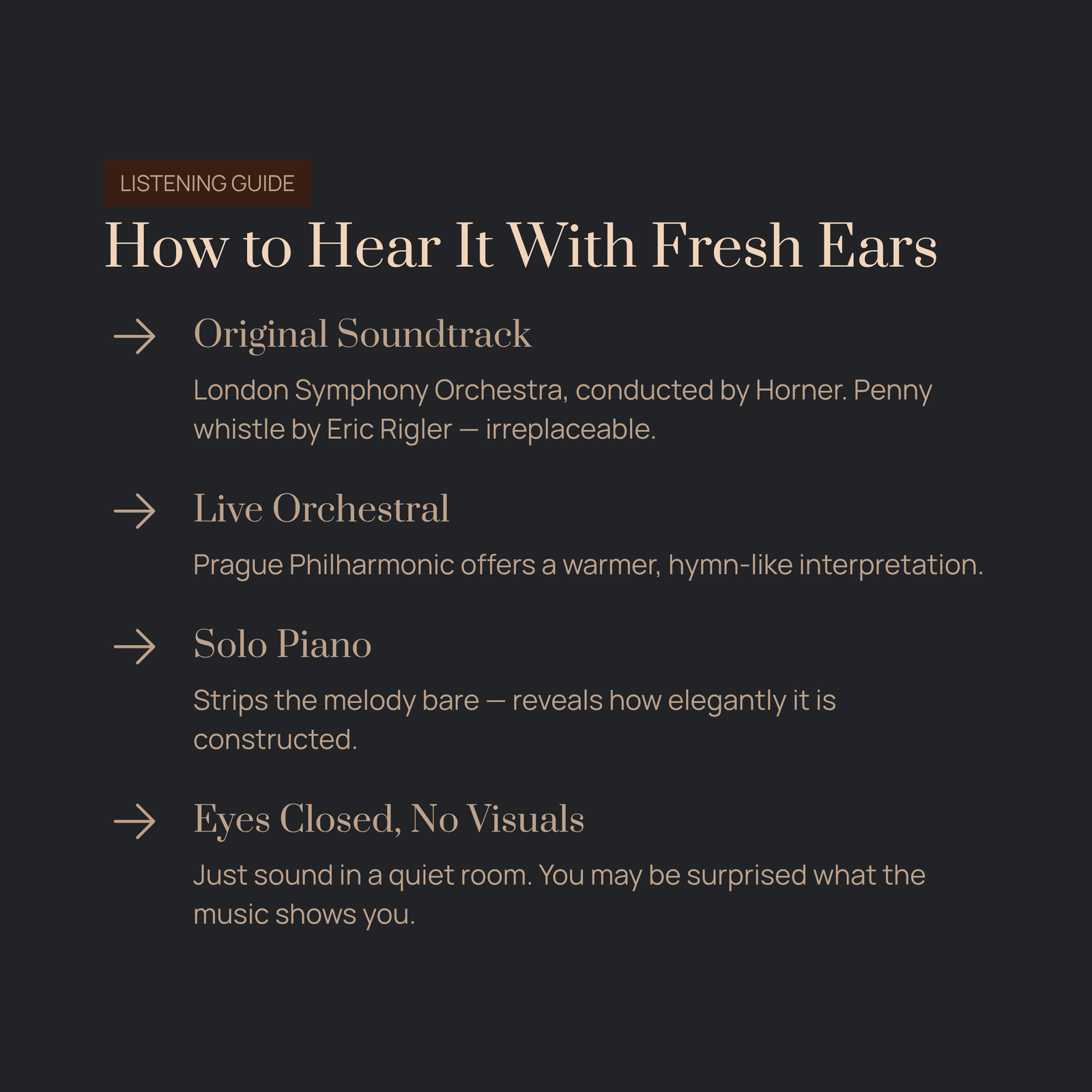
Start with the original soundtrack recording conducted by Horner himself. The London Symphony Orchestra performs with a restraint and sensitivity that perfectly matches the composer’s vision. There is a particular quality to the penny whistle playing by Eric Rigler that no subsequent cover has quite captured. His breath control, the slight roughness at the edges of certain notes, gives the melody a human vulnerability that a cleaner performance might lose.
For a different perspective, seek out the various live orchestral performances that have appeared over the years. The Prague Philharmonic recording offers a slightly warmer, more rounded interpretation that brings out the hymn-like quality of the piece. And if you want to experience the theme stripped down to its essence, search for solo piano arrangements. Without the orchestral coloring, the raw harmonic structure is exposed, and you can hear just how elegantly constructed the melody truly is.
I would also recommend listening at least once without any visual accompaniment at all. No film clips, no landscape videos, no visualizers. Just the sound in a quiet room. You might be surprised by what the music shows you when it has your full attention.
The Silence After the Last Note
James Horner died in a plane crash in 2015, at the age of sixty-one. He was flying his single-engine aircraft over the mountains north of Santa Barbara when something went wrong. The world lost a composer who, for all the criticism he sometimes received, understood something fundamental about music that many of his peers did not: that the purpose of a melody is not to demonstrate skill, but to help someone feel less alone.
Every time I reach the final bars of the Braveheart theme, when the whistle returns one last time over fading strings, I think about that. About how a simple sequence of notes, played on one of the humblest instruments ever made, can carry so much weight. About how music written for a Hollywood blockbuster can somehow become a private conversation between a listener and their own heart.
The piece ends quietly, as it began. No grand finale. No triumphant resolution. Just a melody dissolving into silence, like breath disappearing into cold highland air. And in that silence, something remains. Not the memory of a film, but something harder to name. A feeling that you have been somewhere true. That for a few minutes, you were allowed to be fully, unapologetically alive.
That, I think, is James Horner’s real legacy. Not the Academy Awards or the box office records. But this: a penny whistle melody that still makes strangers cry on trains, three decades after it was written. And if that is not a kind of immortality, I do not know what is.