📑 Table of Contents

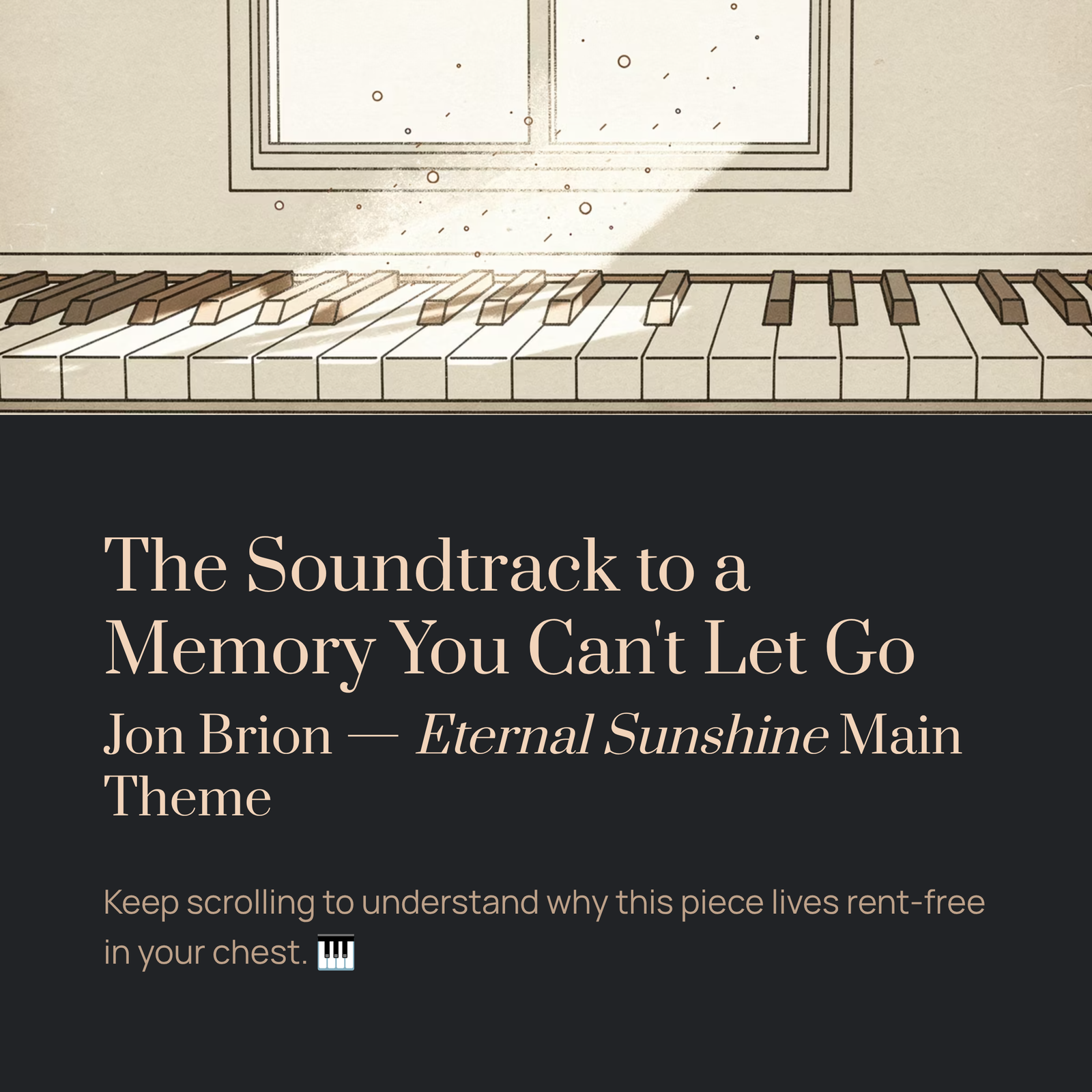
There is a particular kind of sadness that doesn’t arrive with tears. It comes instead as a quiet hum somewhere behind your ribs — the feeling of standing in a room where someone you loved used to be, knowing the air itself has changed. The first time I heard Jon Brion’s main theme from Eternal Sunshine of the Spotless Mind, I recognized that hum instantly. A handful of piano notes, unhurried and weightless, and suddenly I was not just listening to music. I was remembering something I couldn’t quite name.
This is the strange power of Jon Brion’s composition. It doesn’t demand your attention. It slips in through the side door and sits with you, the way an old photograph does when it falls out of a book you haven’t opened in years. If you’ve ever wondered whether instrumental music can tell a love story — a real one, with all its mess and tenderness — this piece is your answer.
Jon Brion: The Invisible Architect of Feeling
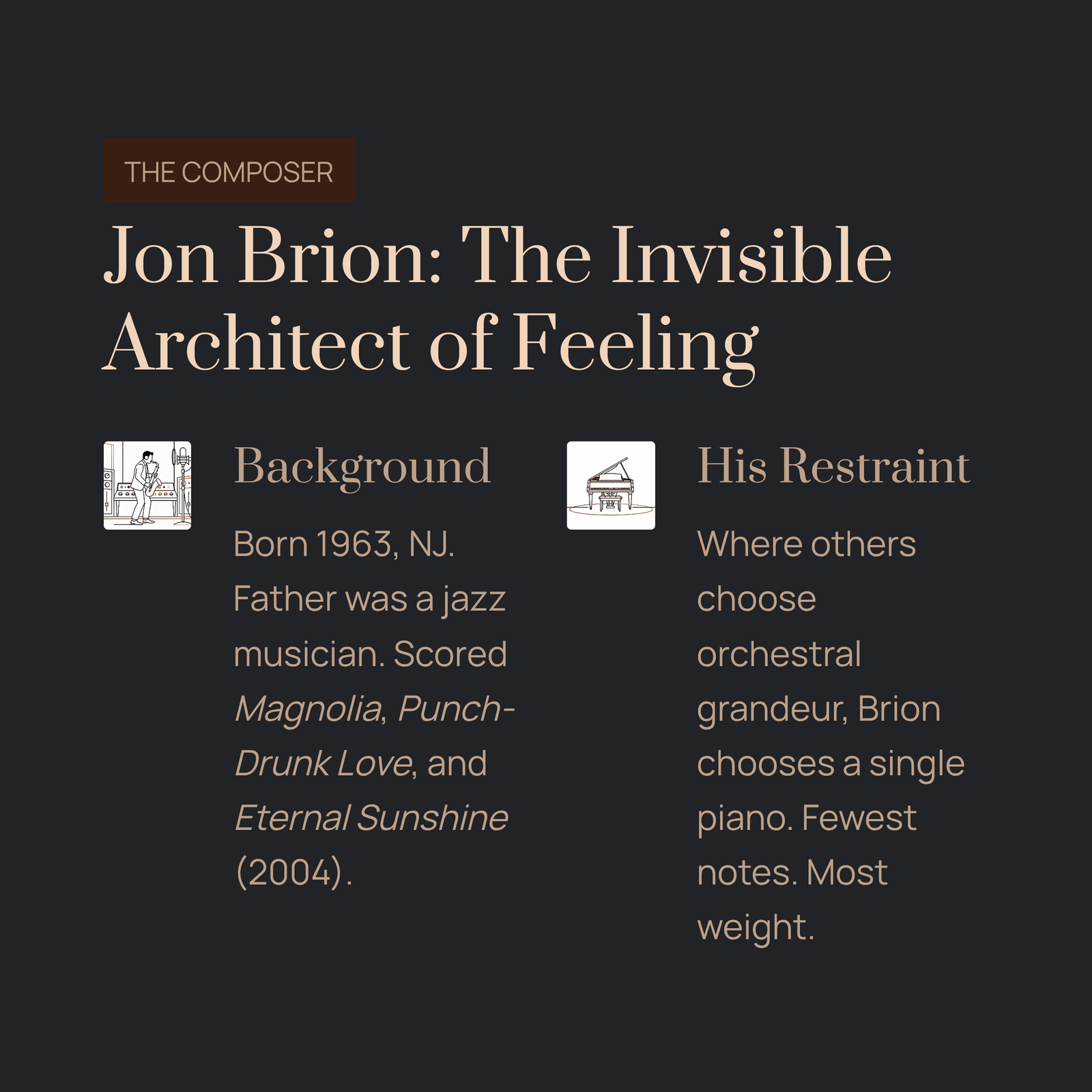
Jon Brion is not a household name in the way that Hans Zimmer or John Williams might be, but his fingerprints are all over some of the most emotionally precise moments in modern cinema. Born in 1963 in New Jersey, Brion grew up surrounded by music — his father was a jazz and folk musician — and he developed an almost alchemical ability to translate complex emotions into sound.
Before scoring Eternal Sunshine of the Spotless Mind in 2004, Brion had already built a reputation as a producer and multi-instrumentalist of remarkable range, working with artists like Fiona Apple and Aimee Mann. He was also the composer behind Paul Thomas Anderson’s Magnolia and Punch-Drunk Love, films that share a kinship with Eternal Sunshine in their willingness to sit inside uncomfortable emotional truths.
What makes Brion different from many film composers is his restraint. Where others might reach for orchestral grandeur, Brion often chooses a single piano, a music box, or a handful of plucked strings. He composes the way a poet writes — not by adding words, but by finding the fewest words that carry the most weight.
The Architecture of the Theme: What to Listen For
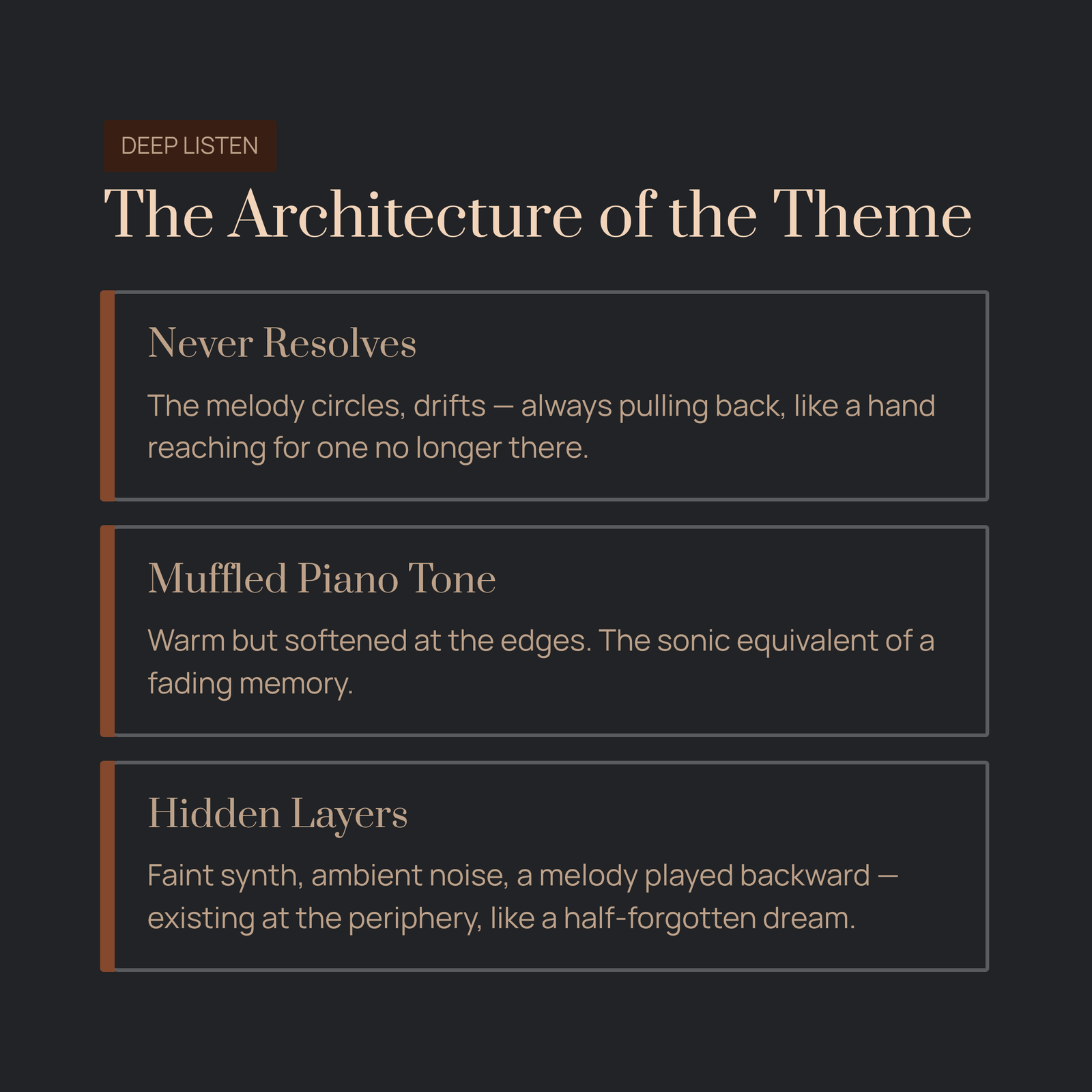
The main theme of Eternal Sunshine is built on a deceptively simple foundation. A piano melody moves in gentle, halting steps, as though it is trying to recall something just beyond its reach. The intervals between notes feel slightly wider than expected, creating a sense of space — or perhaps absence — that mirrors the film’s central premise of erased memories.
Listen for the way the melody never quite resolves. In traditional Western harmony, we expect musical phrases to arrive at a point of rest, a “home” chord that signals completion. Brion deliberately avoids this satisfaction. The theme circles and drifts, approaching resolution but always pulling back at the last moment, like a hand reaching for another hand that is no longer there.
There is also a textural quality worth noticing. The piano tone is warm but slightly muffled, as if heard through a wall or recalled from a distance. This is not accidental. Brion’s production choices create the sonic equivalent of a fading memory — present enough to feel real, but softened at the edges in a way that tells you it belongs to the past.
Underneath the piano, subtle layers appear and dissolve: a faint wash of synthesizer, a whisper of ambient noise, the ghost of a melody played backward. These elements don’t announce themselves. They exist in the periphery of your hearing, the same way half-forgotten details linger at the edges of a dream.
A Personal Listening: The Weight of Gentleness
I have returned to this theme more times than I can count, and each listening reveals something slightly different — not because the music changes, but because I do.
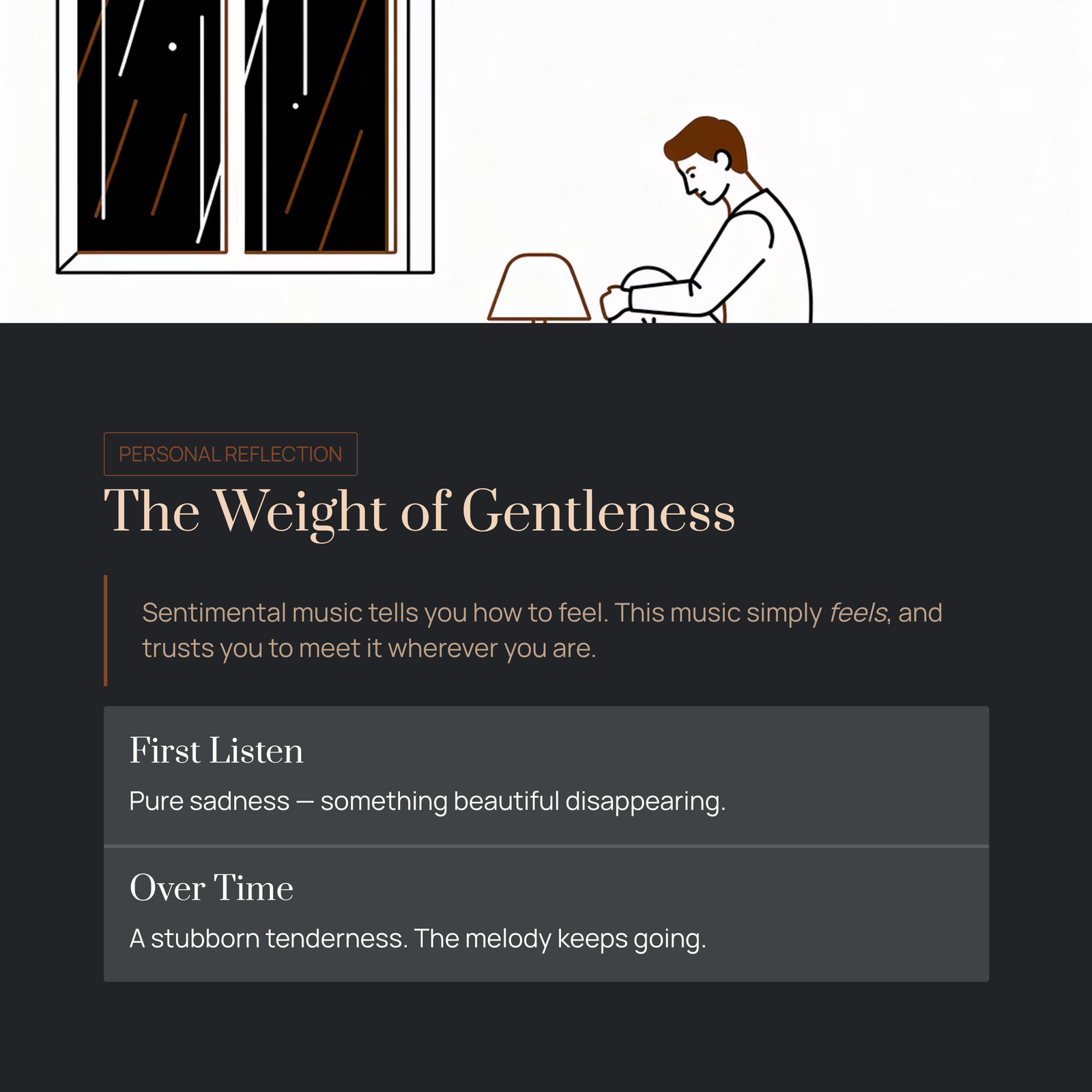
The first time, I heard sadness. Pure, uncomplicated sadness, the kind that comes from watching something beautiful disappear. But over time, I began to hear something else beneath the melancholy: a stubborn tenderness. The melody keeps going. It doesn’t collapse under the weight of its own grief. It moves forward, note by careful note, as though it believes that the act of remembering — even when remembering hurts — is itself a form of love.
This is what separates Brion’s theme from mere sentimentality. Sentimental music tells you how to feel. This music simply feels, and trusts you to meet it wherever you are. On a difficult evening, it sounds like consolation. On a quiet morning, it sounds like gratitude. It has the rare quality of being deeply personal without being specific — a mirror rather than a portrait.
I think this is why the piece works so powerfully even outside the context of the film. You don’t need to know the story of Joel and Clementine to understand what this music is saying. You only need to have loved someone and to have felt the particular ache of watching that love become memory.
How to Listen: Practical Suggestions
If this is your first encounter with the piece, I’d suggest the following approach.
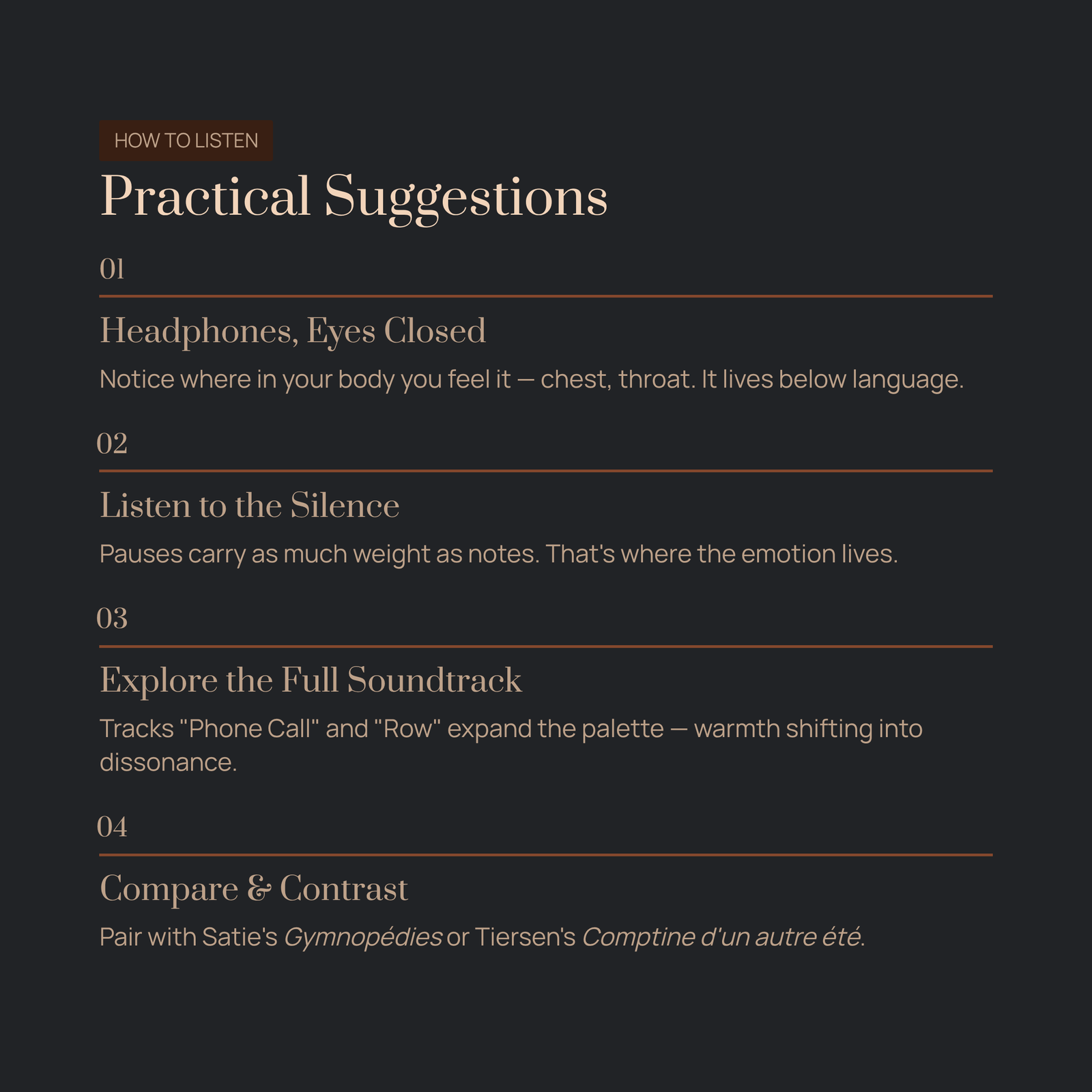
Start with the original soundtrack recording. Find a quiet space, ideally with headphones, and let the theme play without watching the film. Close your eyes. Notice where in your body you feel the music — chest, throat, the space behind your eyes. This is not a piece that lives in the head. It lives lower, in the places where emotion is stored before language can reach it.
On a second listen, pay attention to the silence between notes. Brion uses silence the way a painter uses negative space: not as emptiness but as structure. The pauses are as important as the notes themselves, and they’re where much of the emotional weight resides.
For those who want to explore further, I recommend listening to the full Eternal Sunshine of the Spotless Mind soundtrack in sequence. Tracks like “Phone Call” and “Row” expand on the main theme’s emotional palette, introducing variations that shift between warmth and dissonance. You’ll hear how Brion builds an entire emotional landscape from a few core musical ideas, the way a novelist might build a world from a single sentence.
For comparison, consider pairing this with Erik Satie’s Gymnopédies or Yann Tiersen’s Comptine d’un autre été. All three share a willingness to find profound emotion in simplicity, though each arrives there by a different path. Brion’s theme is arguably the most elusive of the three — the one that resists being pinned down, the one that changes color depending on the light you hold it up to.

What Memory Sounds Like
There is a question at the heart of Eternal Sunshine of the Spotless Mind that extends far beyond its science-fiction premise: if you could erase the pain of a lost love, would you also lose everything that made it beautiful?
Jon Brion’s main theme doesn’t answer this question. It inhabits it. Every note carries the dual weight of presence and absence, joy and its afterimage. The melody remembers even as it fades, and in doing so, it suggests that memory itself — imperfect, unreliable, aching — might be the most honest form of devotion we have.
This is music for anyone who has ever tried to hold onto something that was already leaving. Not dramatic, not grand, not asking for your sympathy. Just a few piano notes in a quiet room, saying what words have always struggled to say: that some things are worth remembering, even when — especially when — they hurt.