📑 Table of Contents
You know the moment. You’re at the starting line, or staring at a to-do list, or about to walk into a room where something matters. Your heart is already moving before your feet are. There’s a current running underneath you, and all you have to do is let it carry you forward.
That’s the feeling of the first movement of Vivaldi’s Concerto in A minor, RV 356. From the very first second, it doesn’t ask permission. The violins surge in together, restless and certain, like a small machine that has just switched on and intends to run. There’s no slow warm-up, no hesitant introduction—just immediate, propulsive energy.
If you’ve ever needed something to push you over the edge into focus, this is one of the most reliable three minutes ever written. And the wonderful part is that it’s been doing this exact job for over three hundred years.
Who Was Vivaldi, and Why “The Red Priest”?
Antonio Vivaldi (1678–1741) was a Venetian composer, violinist, and—improbably—an ordained Catholic priest. Because of his striking red hair, people around Venice called him il Prete Rosso, “the Red Priest.” He was ordained in 1703 but stopped saying Mass early on, citing health problems that were likely a form of asthma. Music, not the altar, was clearly where his life wanted to go.
For most of his career he worked at the Ospedale della Pietà, a Venetian institution for orphaned and abandoned girls. Vivaldi taught the residents music, and the ensemble he trained there became famous across Europe. Audiences traveled to Venice specifically to hear these young women perform—often hidden behind a screen—with a precision and fire that astonished visitors.
Vivaldi was staggeringly prolific. He wrote around 500 concertos, dozens of operas, and a mountain of sacred music. If a melody sounds like sunlight glinting off water, there’s a good chance Vivaldi wrote it. He had an instinct for energy and color that still feels modern today.
What “L’estro Armonico” Actually Means
In 1711, Vivaldi published a set of twelve concertos and gave the collection a title that’s tricky to translate: L’estro armonico. You’ll see it rendered as “harmonic inspiration,” “harmonic fancy,” or “harmonic whim.” The word estro suggests creative fire—a sudden burst of inspiration, almost a kind of divine madness. So you might think of it as “harmonic genius” in the old sense of the word.
Here’s why that collection matters: it wasn’t just a set of nice pieces. L’estro armonico was published in Amsterdam, the printing capital of Europe, and it spread across the continent like wildfire. It became Vivaldi’s calling card and arguably the most influential music publication of its era. A young German organist named Johann Sebastian Bach was so taken with these concertos that he transcribed several of them for keyboard, studying Vivaldi’s bright, clear sense of structure. In other words, this music helped shape Bach.
The piece we’re listening to, the Concerto No. 6 in A minor, RV 356, is one of the most beloved of the set—compact, fierce, and endlessly imitated.
A Quick Word on How a Baroque Concerto Works
If you’re new to classical music, one concept unlocks almost everything in this piece: the idea of a recurring “team theme” versus the “solo voice.”
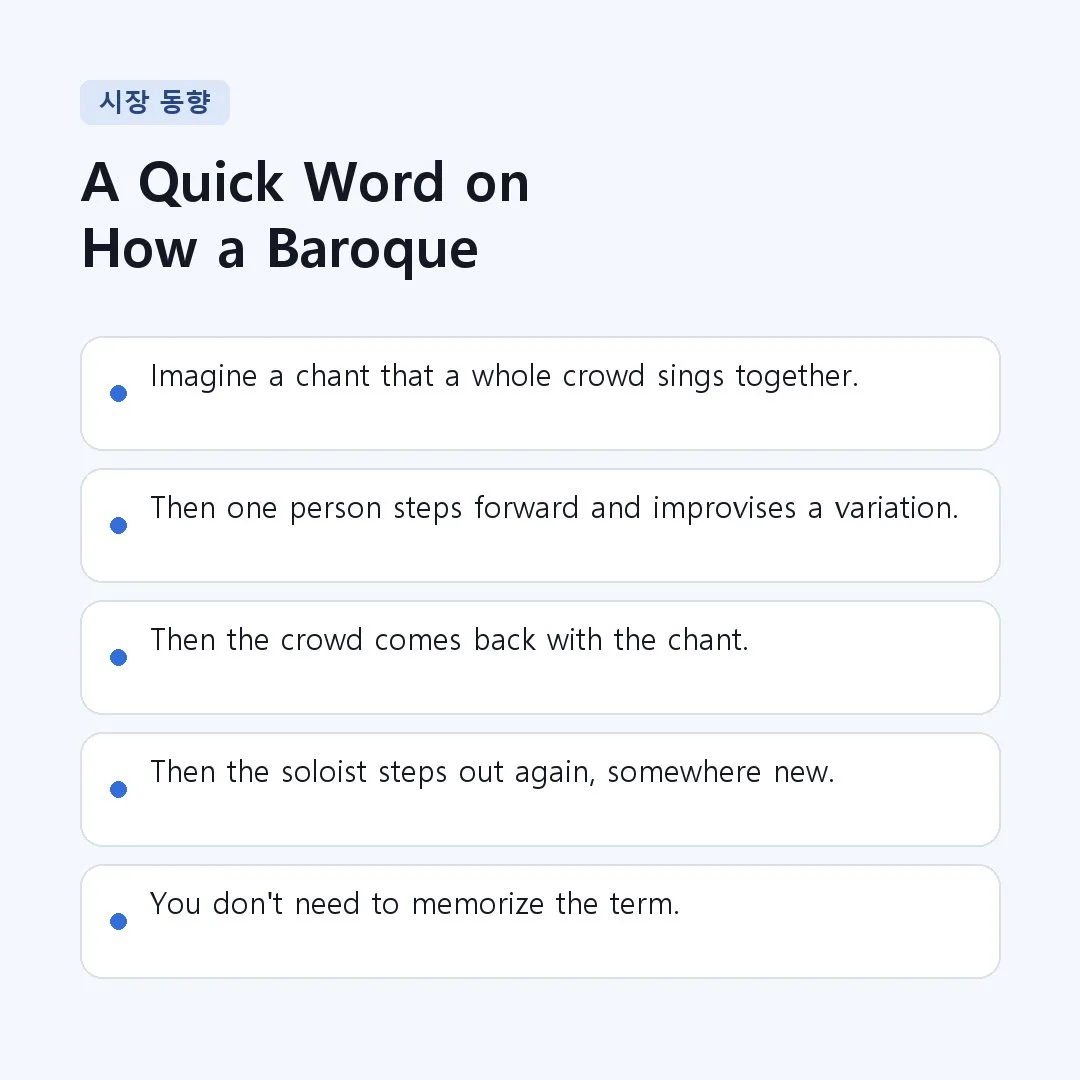
Imagine a chant that a whole crowd sings together. Then one person steps forward and improvises a variation. Then the crowd comes back with the chant. Then the soloist steps out again, somewhere new. That alternation—group, individual, group, individual—is the engine of the Baroque concerto. Musicians call the recurring group section the ritornello, which simply means “the little thing that returns.”
You don’t need to memorize the term. Just listen for the pattern: a strong, full-bodied passage everyone plays together, then a lighter moment where the solo violin darts ahead on its own. Once you hear that conversation, the whole movement clicks into place.
A Listening Guide for RV 356, First Movement
The movement is short—usually around three to three and a half minutes—so you can listen closely without losing focus. Here’s a rough map:
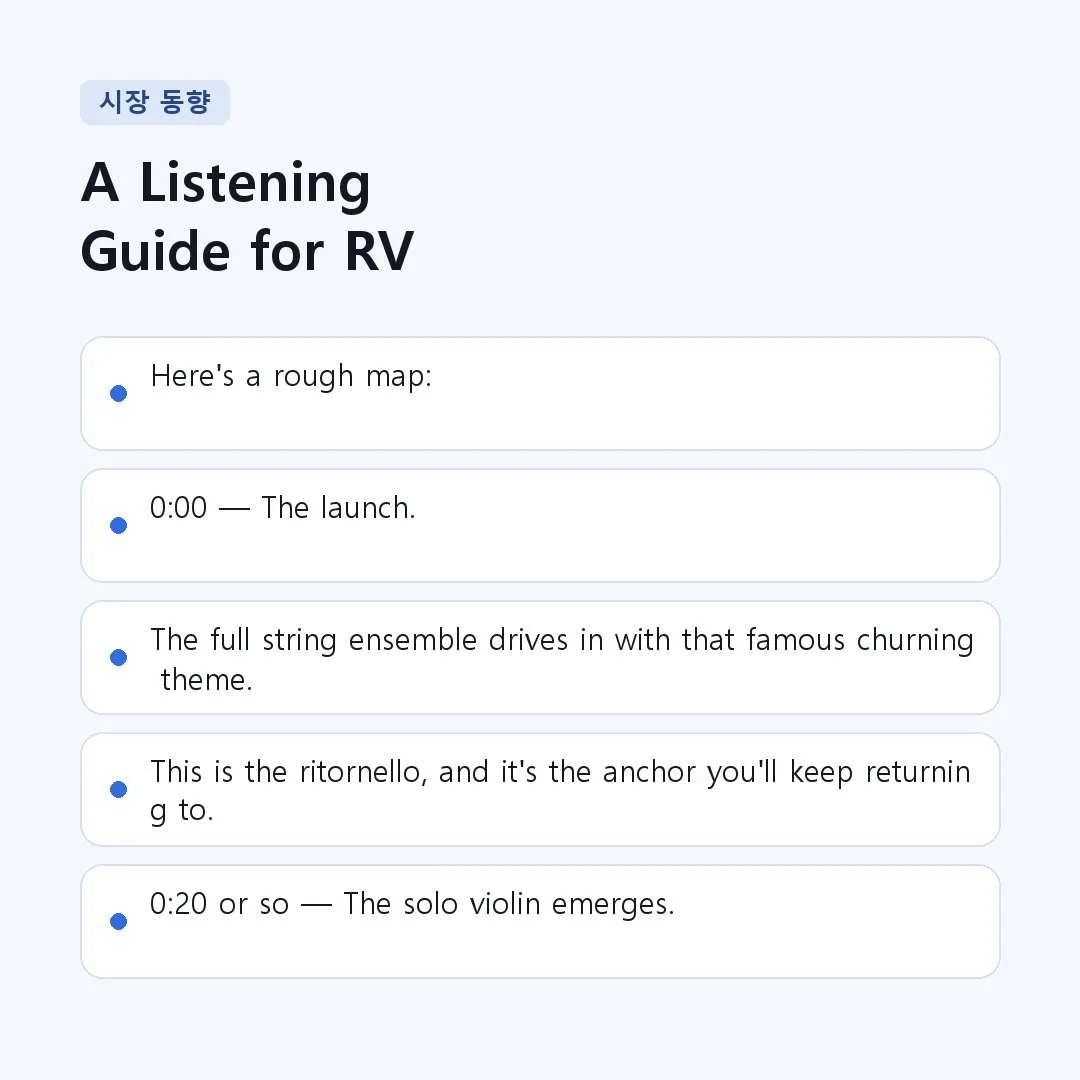
0:00 — The launch. The full string ensemble drives in with that famous churning theme. Notice how the music feels like it’s already in motion, like you caught it mid-sprint. This is the ritornello, and it’s the anchor you’ll keep returning to.
0:20 or so — The solo violin emerges. The texture thins out and a single violin steps forward, spinning faster, more agitated lines above the others. Listen for how the soloist sounds like it’s reaching, climbing, searching.
The middle — Tension and trading. The piece keeps alternating between the full group and the solo voice, shifting through different keys so it never feels static. There’s a restless, minor-key urgency throughout—not sad exactly, more like determined.
The close — The theme returns home. The opening material comes back to seal the movement, landing with the same confidence it started with. The whole thing feels less like a song that ends and more like a circuit that completes.
The magic is in that relentless rhythmic drive. There’s barely a moment of rest, which is exactly why this works so well as focus or momentum music—it pulls your attention forward and doesn’t let it drift.
Where to Start Listening
Because this concerto is so famous, you have wonderful options across very different styles.
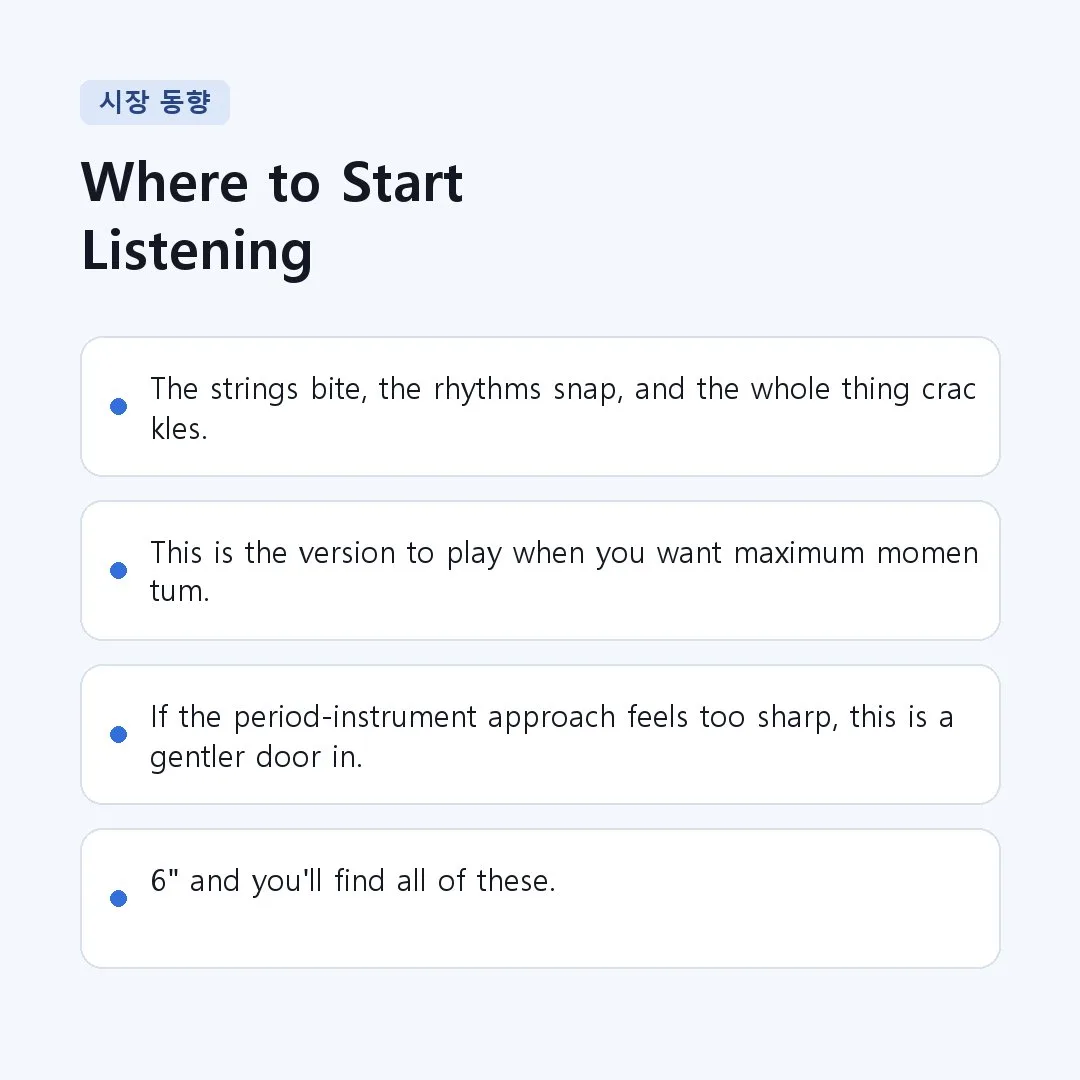
For crisp, energetic period-instrument fire: Look for recordings by Europa Galante under violinist Fabio Biondi, or Il Giardino Armonico. These ensembles use Baroque-era instruments and a punchy, almost rock-concert intensity. The strings bite, the rhythms snap, and the whole thing crackles. This is the version to play when you want maximum momentum.
For a warmer, more lyrical classic: I Musici, the legendary Italian chamber group, recorded L’estro armonico with a rounder, more golden sound. If the period-instrument approach feels too sharp, this is a gentler door in.
For the historical curiosity: Track down Bach’s keyboard transcription of a related Vivaldi concerto sometime. Hearing the same musical ideas reborn on a harpsichord or organ is a small revelation about how composers learned from one another.
On most streaming platforms, simply search “Vivaldi RV 356” or “L’estro armonico No. 6” and you’ll find all of these. Start with Biondi if you want the jolt of energy; start with I Musici if you want something easier on the ears.
Three Minutes That Still Run
What stays with me about this music is how willing it is. It never sulks, never stalls, never apologizes for taking up space. Three centuries after Vivaldi handed it to a room full of young musicians in Venice, it still does the one thing it was built to do: it moves, and it carries you with it.
So the next time you’re stuck at the starting line—of a workday, a project, a morning that refuses to begin—give it three minutes. Let the violins switch on. You might be surprised how much easier it is to move once something else is already moving for you.