Table of Contents
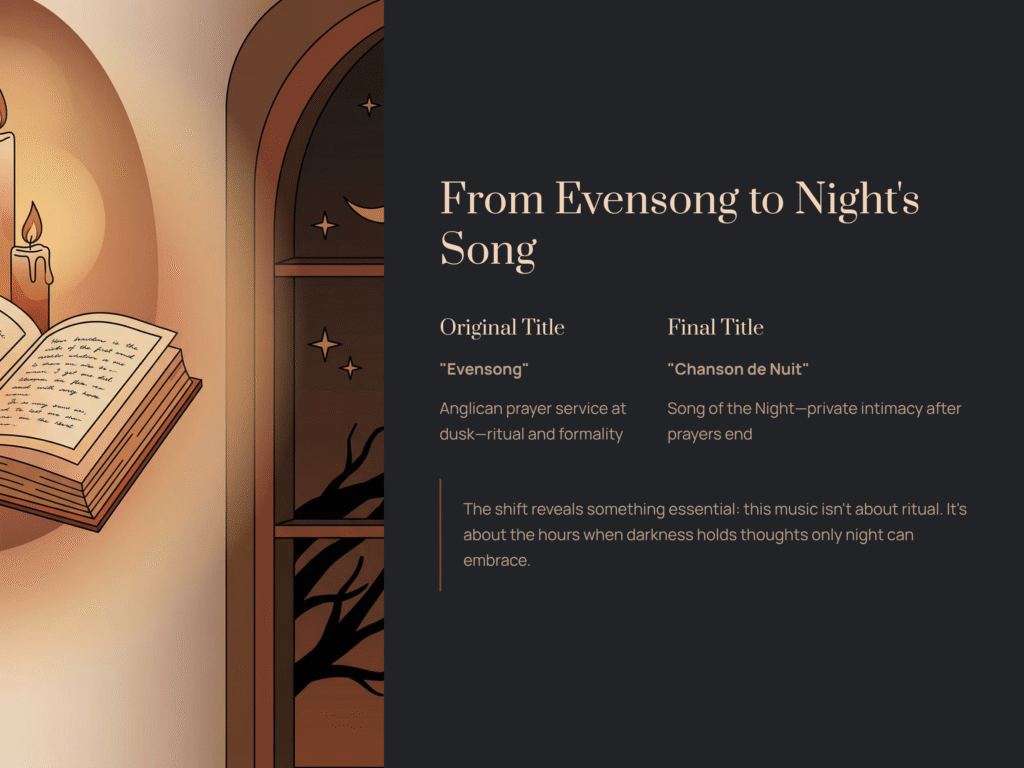
This piece almost had a different name. Before it became known as “Chanson de Nuit”—Song of the Night—Edward Elgar originally titled it “Evensong,” a word that carries the weight of Anglican prayer services at dusk. But somewhere between composition and publication, between the private sanctity of evening devotion and the public intimacy of night’s embrace, the name changed. And with it, the music took on a different life.
Why does this matter? Because in that shift from “Evensong” to “Chanson de Nuit,” we glimpse something essential about this music: it’s not about ritual or formality. It’s about the hours after prayers have ended, when the last light fades and you’re left alone with thoughts that only darkness can hold.
The Violinist Who Knew the Instrument’s Secrets
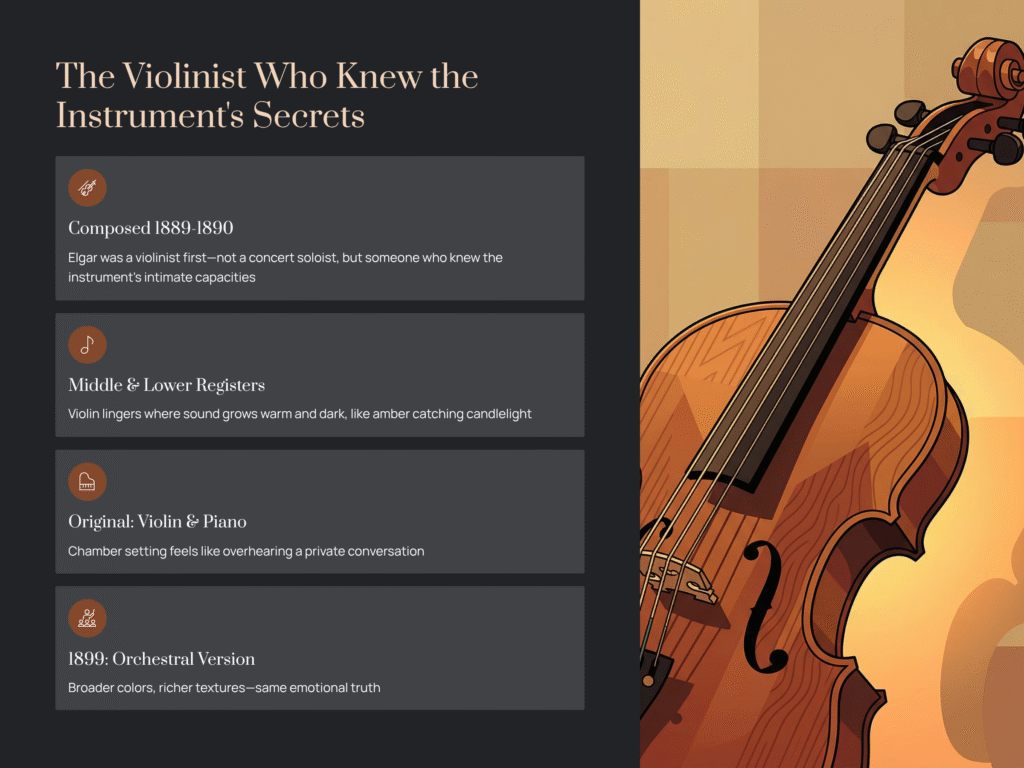
When Edward Elgar composed this piece in 1889 or 1890, he wasn’t yet the composer of grand oratorios or imperial marches. He was, first and foremost, a violinist. Not a concert soloist of international fame, but someone who knew the instrument from the inside—its capacities for intimacy, its ability to sing in a register that feels almost like a human voice confiding a secret.
You can hear this knowledge in every phrase of Chanson de Nuit. The violin doesn’t soar into virtuosic displays or brilliant high notes. Instead, it lingers in the middle and lower registers, where the sound grows warm and dark, like amber catching candlelight. This is music written by someone who has held a violin against their shoulder through countless hours, who knows exactly how to make it speak with the particular eloquence of twilight.
The original version was scored for violin and piano—a chamber setting that feels like overhearing a private conversation. Later, in 1899, Elgar arranged it for full orchestra, giving the melody broader colors and richer textures. Both versions reveal different facets of the same emotional truth: this is music of solitude made somehow companionable, loneliness transformed into something beautiful.
Night and Morning: The Twin Songs
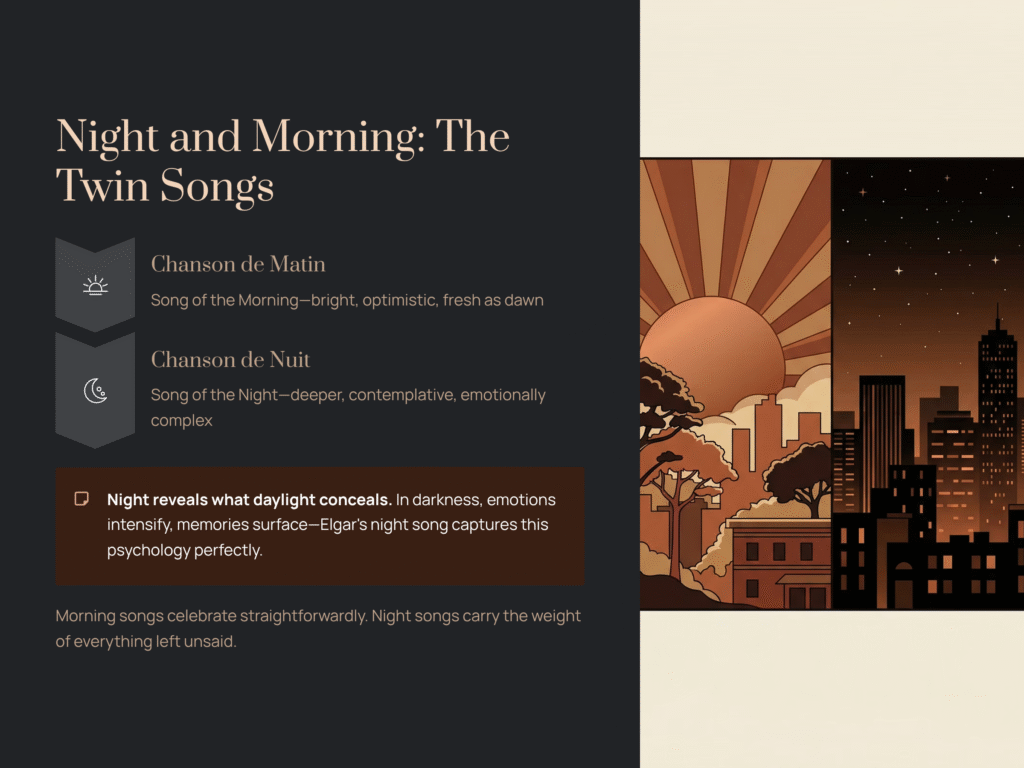
Elgar wrote a companion piece to this nocturne, called “Chanson de Matin”—Song of the Morning. Together, they form a diptych of day’s beginning and ending. But critics and listeners have long noted that the two pieces aren’t equal in depth. Chanson de Matin is lovely, certainly—bright and optimistic, with the freshness of dawn about it. But Chanson de Nuit goes deeper.
Perhaps it’s because night reveals what daylight conceals. In darkness, emotions intensify, memories surface, the mind wanders to places it avoids in sunlight. Elgar’s night song captures this psychology perfectly. It’s not melancholy exactly, but contemplative, tinged with a wistfulness that comes from looking back over the day that’s ending and forward into the uncertainty of what tomorrow will bring.
The contrast teaches us something about emotional maturity in music. Morning songs can be straightforward celebrations. Night songs must be more complex—they carry the weight of everything that’s happened, everything that’s been left unsaid.
A Journey Through Three Movements of Feeling
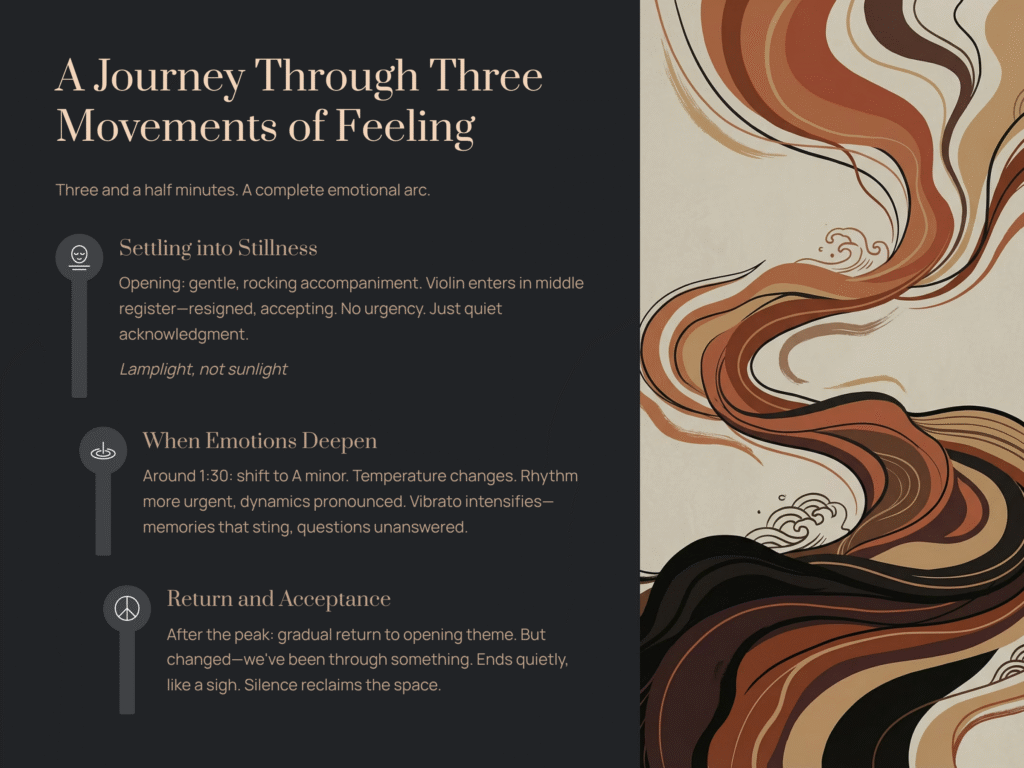
Though Chanson de Nuit lasts only about three and a half minutes, it takes us through a complete emotional arc. The structure is ternary form—A-B-A’—but thinking of it as three “movements of feeling” might help you connect with what’s actually happening in the music.
The First Movement of Feeling: Settling into Stillness
The opening is like the moment when you finally sit down after a long day. The piano (or strings, in the orchestral version) establishes a gentle, rocking accompaniment—not quite a lullaby, but something equally soothing. Then the violin enters with a melody that feels both resigned and accepting. There’s no urgency here, no striving. Just the acknowledgment that this is where we are now: in the quiet, in the dark, with our thoughts.
Notice how Elgar uses the violin’s middle register extensively. These aren’t the silvery high notes we often associate with the instrument’s most “classical” sound. These are deeper, mellower tones—the sonic equivalent of lamplight rather than sunlight. It’s an intimate timbre, and it draws you in close.
The Second Movement of Feeling: When Emotions Deepen
Around a minute and a half into the piece, something shifts. The music moves toward A minor, and the emotional temperature changes. It’s not dramatic—Elgar doesn’t deal in melodrama here—but you feel a subtle increase in tension, a darkening of mood. The rhythm becomes slightly more urgent, the dynamics more pronounced.
This is the section where, if this music were accompanying your thoughts, you’d move from gentle reflection to something more searching. Maybe a memory that still stings slightly. Maybe a question you can’t quite answer. The music doesn’t resolve these tensions, but it acknowledges them, gives them space to exist.
Listen for the way the violin’s vibrato intensifies here. Vibrato—that slight wavering of pitch that adds warmth and emotion to string playing—becomes a carrier of feeling. The violinist’s bow control, the subtle changes in pressure and speed, all contribute to this intensification of emotion without losing the piece’s essential gentleness.
The Third Movement of Feeling: Return and Acceptance
After reaching its emotional peak, the music gradually finds its way back to the opening theme. But it’s not exactly the same—we’re not simply repeating where we started. We’ve been through something, and the return feels different. It’s like coming home after a walk and seeing familiar rooms with slightly changed eyes.
The piece ends quietly, not with a grand statement but with a gentle settling, like a sigh. The final notes fade as if the music is simply letting go, allowing silence to reclaim the space. It’s a remarkably mature ending for such a short piece—Elgar resists the temptation to sum things up neatly or offer easy comfort.
What to Listen For: A Practical Guide
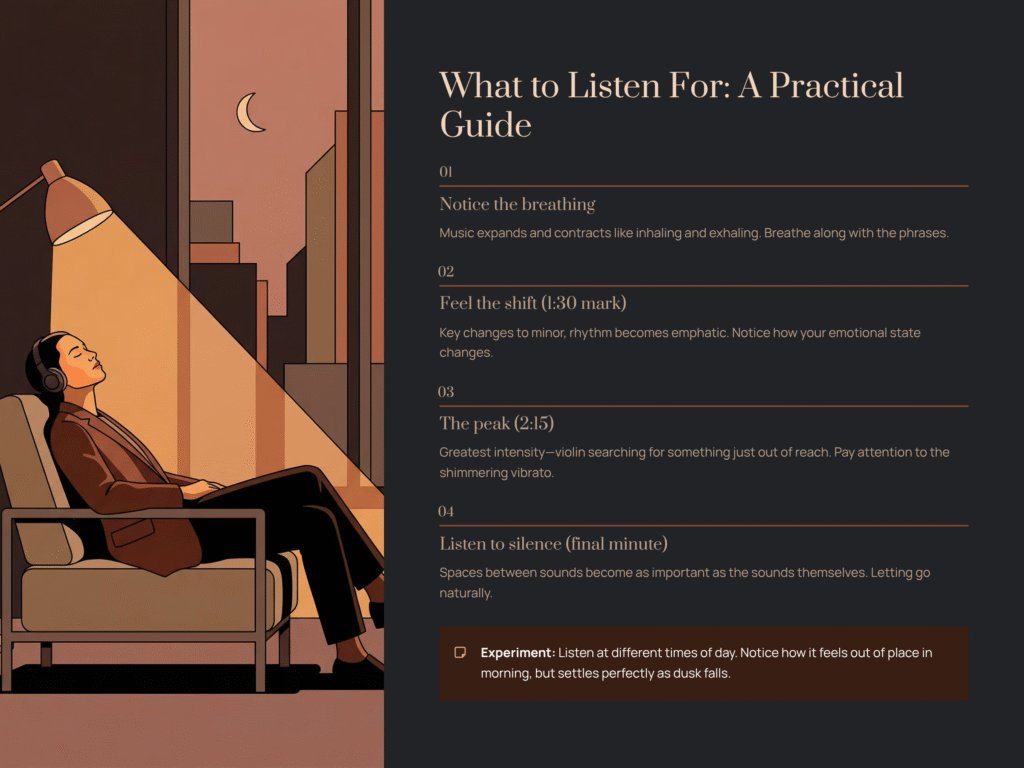
If you’re new to classical music, or new to this piece, here are some concrete things to do while listening:
First listening: Notice the breathing. Seriously. Listen to how the music seems to breathe, with phrases that expand and contract like inhaling and exhaling. This isn’t just a metaphor—it’s how the music is shaped. The violinist must breathe with the phrases to make them sing naturally, and you can breathe along with them.
Around the 1:30 mark: Feel the shift. This is where the music moves from contemplation to something more intense. You’ll hear the key change to minor, the rhythm become more emphatic. Don’t try to analyze it—just notice how your own emotional state changes in response.
At 2:15 or so: This is the peak. The moment of greatest intensity, where the violin seems to be searching for something just out of reach. Pay attention to the vibrato here, to how the sound seems to shimmer with feeling.
In the final minute: Listen to the silence between notes. As the music winds down, the spaces between sounds become as important as the sounds themselves. Elgar is teaching us something about letting go, about allowing things to come to rest naturally rather than forcing closure.
Try this experiment: Listen to the piece at different times of day. Play it in the morning and notice how it feels slightly out of place, like wearing evening clothes to breakfast. Then play it as dusk falls, or late at night, and feel how it settles into its proper emotional habitat.
Different Versions, Different Revelations
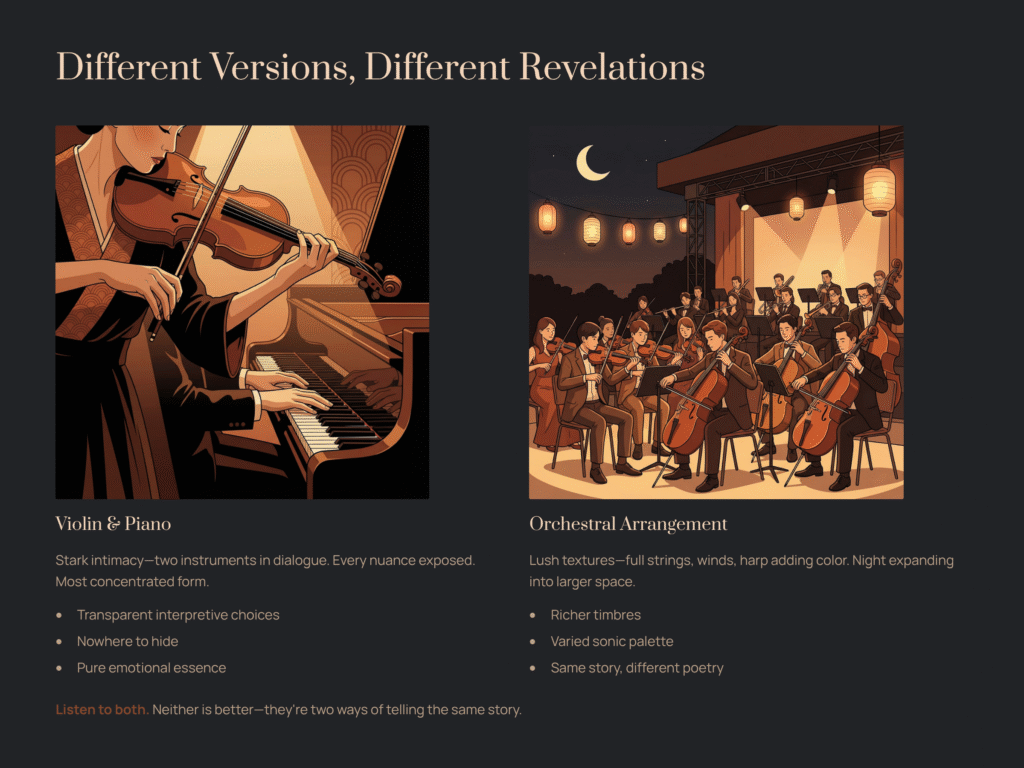
The original violin and piano version offers stark intimacy—two instruments in dialogue, with nowhere to hide. Every nuance of the violin’s tone, every subtlety of the piano’s support, is exposed and essential. This is the version to choose if you want to hear the piece in its most concentrated form, where the performer’s interpretive choices are most transparent.
The orchestral arrangement gives you a different experience. The melody now has the support of full strings, with winds and harp adding color at key moments. There’s a lushness here that the piano version can’t provide, a sense of the night expanding into a larger space. The same emotional journey unfolds, but with richer textures and more varied timbres painting the landscape.
If you can, listen to both. Notice how the same melody can feel different when it’s played by a solo violin versus when it’s carried by an entire string section. Neither is “better”—they’re simply two ways of telling the same story, each with its own poetry.
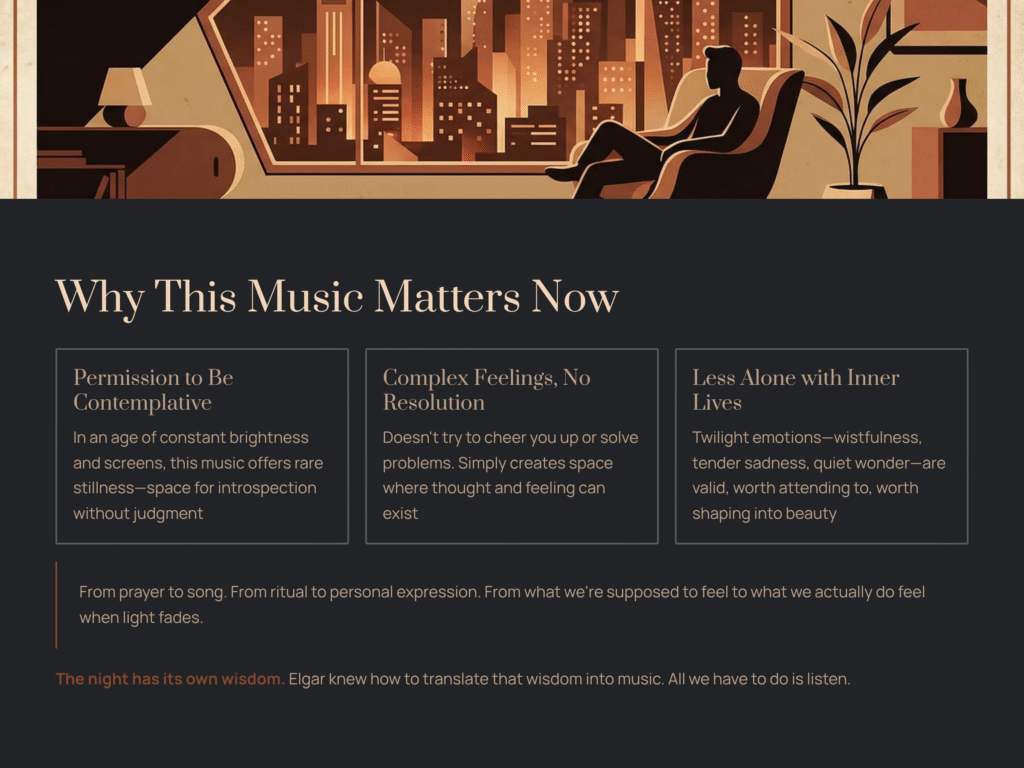
Why This Music Matters Now
We live in an age of constant brightness, both literal and metaphorical. Our nights are lit by screens, our emotional lives often performed in public spaces. We’ve become uncomfortable with genuine stillness, with the kind of quiet introspection that characterized earlier eras.
Elgar’s Chanson de Nuit offers us something increasingly rare: permission to be contemplative, to sit with complex feelings without immediately trying to resolve or broadcast them. It’s music that doesn’t demand anything from you except your attention. It doesn’t try to cheer you up or solve your problems. It simply creates a space where thought and feeling can exist without judgment.
In its brief three and a half minutes, this piece does what the best art always does: it makes us feel less alone with our inner lives. Elgar, through his violin writing, through his harmonic choices, through the very shape of his melody, tells us that these twilight emotions—these feelings of wistfulness and tender sadness and quiet wonder—are not only valid but worth attending to, worth shaping into something beautiful.
When you next find yourself in that particular state of mind that belongs to evening—not quite sad, not quite content, just thoughtful in a way that daylight doesn’t allow—consider spending a few minutes with this music. Let Elgar, who understood both violins and the human heart with equal depth, guide you through the night’s emotional landscape.
And remember: this was once called “Evensong,” but became “Chanson de Nuit.” From prayer to song, from ritual to personal expression. That transformation is itself a kind of journey, from what we’re supposed to feel to what we actually do feel when the light fades and we’re left with ourselves.
The night has its own wisdom. Elgar knew how to translate that wisdom into music. All we have to do is listen.