📑 Table of Contents

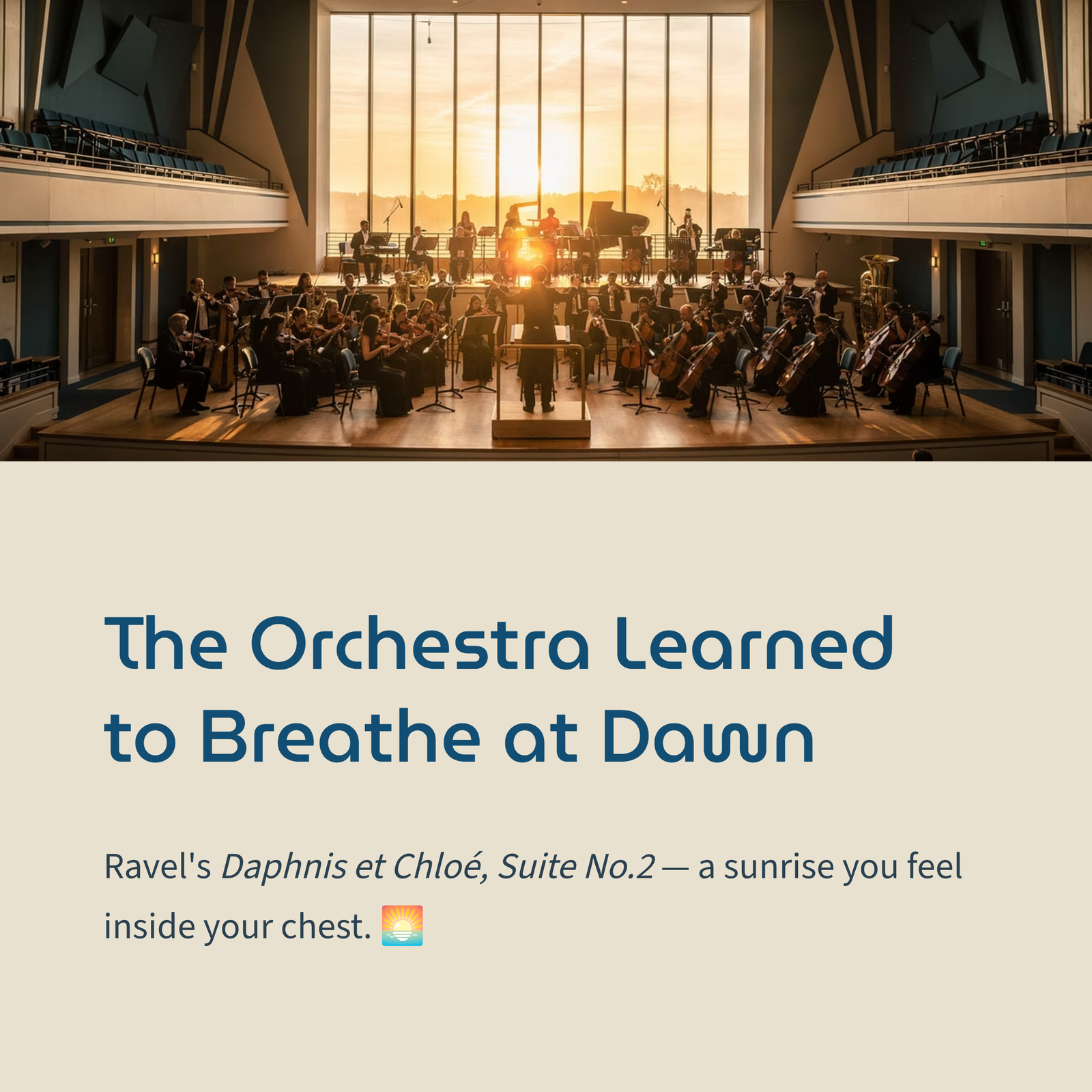
There are sunrises you watch, and then there are sunrises you feel rising inside your chest. Ravel’s “Daybreak” from Daphnis et Chloé, Suite No.2 belongs to the second kind. It doesn’t simply depict morning light — it becomes the light itself, spreading across the orchestra the way color slowly floods a still-dark sky.
I remember the first time I heard this piece with proper headphones on. About thirty seconds in, I realized I had stopped breathing. Not from shock, but because the music was breathing for me — slowly, gently, pulling air into the room as if the orchestra itself were waking up alongside the world it was painting. That feeling has never quite left me, and if you give this piece even five uninterrupted minutes, I suspect it won’t leave you either.
Ravel, the Perfectionist Who Painted with Sound
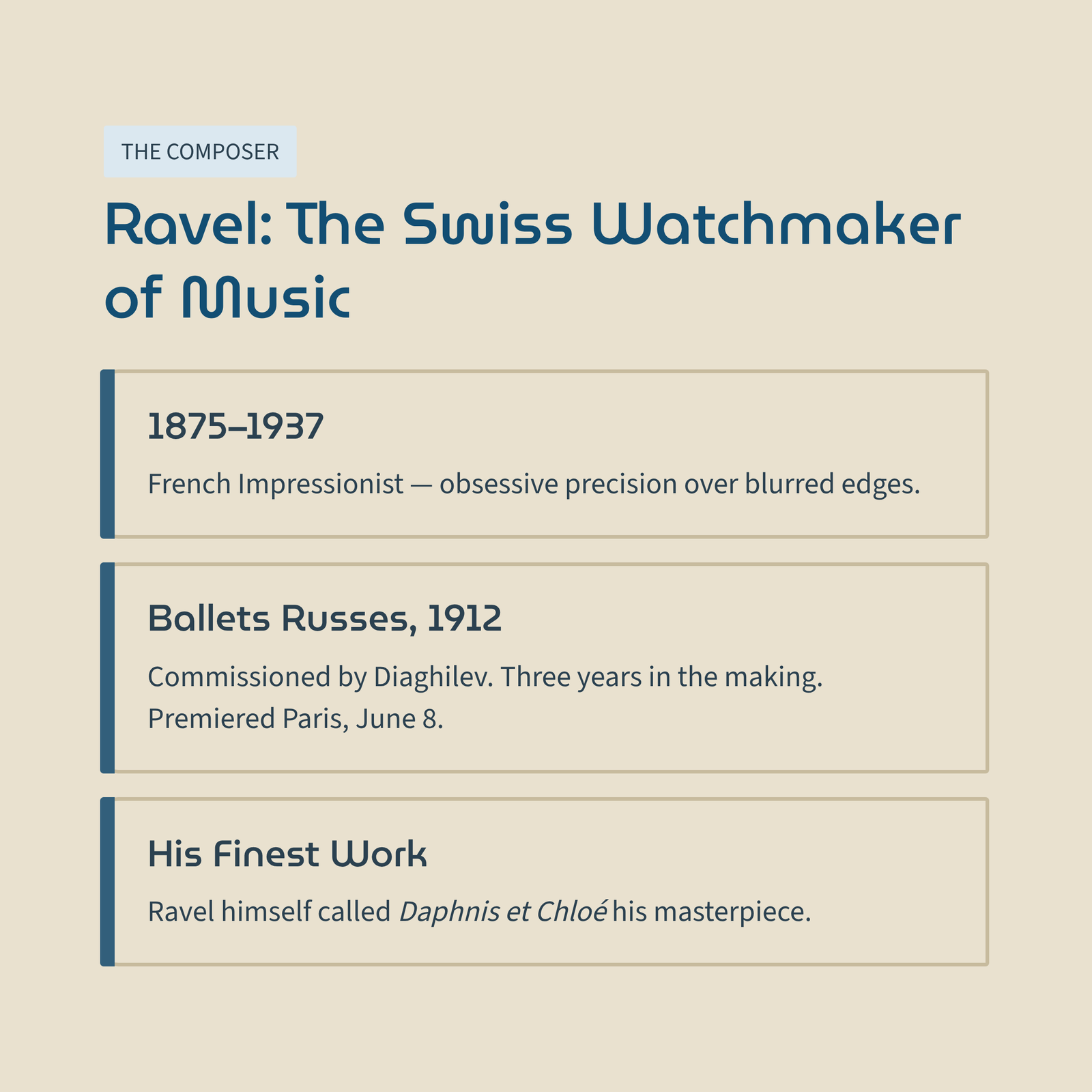
Maurice Ravel (1875–1937) is often mentioned in the same breath as Debussy, and while both composers are pillars of French Impressionism, Ravel carved out a distinctly different voice. Where Debussy dissolved boundaries and let music blur at the edges, Ravel was a craftsman of almost obsessive precision. He once described himself as a “Swiss watchmaker” of music — every note placed with surgical intent, every orchestral color chosen as deliberately as a painter mixing pigments on a palette.
Daphnis et Chloé was commissioned by Sergei Diaghilev for the legendary Ballets Russes and premiered in Paris on June 8, 1912. Ravel spent nearly three years on the score, and the result is widely considered the pinnacle of orchestral writing in the early twentieth century. The ballet tells a pastoral love story drawn from a second-century Greek romance by Longus: Daphnis, a shepherd, and Chloé, a shepherdess, are separated by pirates and divine intervention before being reunited at dawn.
That dawn — the “Lever du jour” — opens the Second Suite and has become one of the most celebrated passages in the entire orchestral repertoire. Ravel himself reportedly considered Daphnis et Chloé his finest work. When you hear the Daybreak section, you understand why.
Inside the Sound: How Daybreak Unfolds
What makes the Daybreak so extraordinary isn’t volume or drama — it’s patience. Ravel builds this sunrise from almost nothing, layering sound upon sound in a way that feels less like composition and more like watching nature itself unfold.
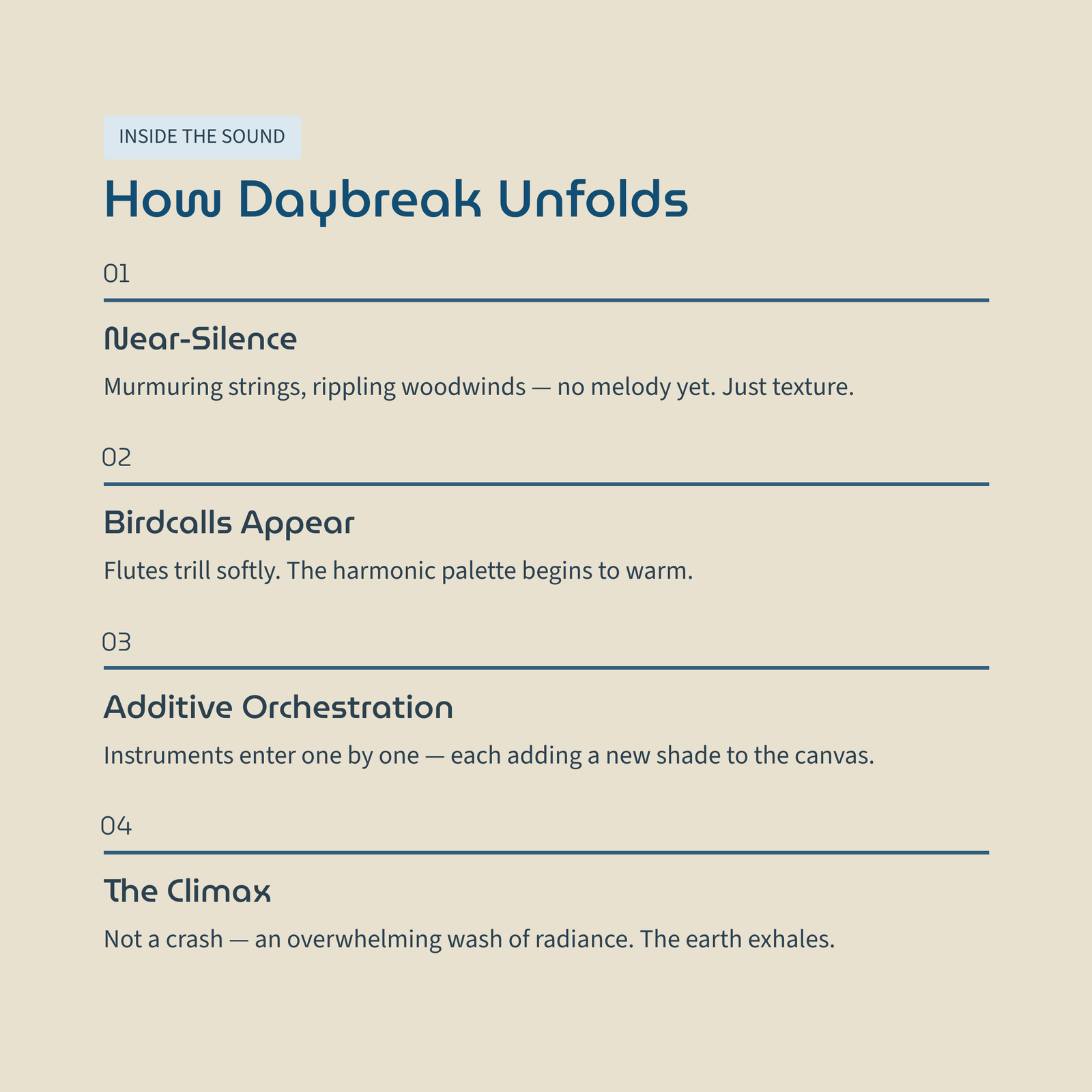
The piece begins in near-silence. Murmuring strings and gentle woodwind figures ripple outward like water stirring in a pond at first light. There’s no melody yet — just texture, atmosphere, a sense of the world slowly remembering itself. Birdcalls appear in the upper woodwinds, flutes trilling softly as if testing whether morning has truly arrived.
Then, gradually, the harmonic palette begins to warm. Low brass hums beneath the surface. The strings swell almost imperceptibly. It’s like watching the horizon shift from deep indigo to pale gold — you can’t quite point to the moment the color changes, but suddenly everything is different. Ravel uses a technique sometimes called “additive orchestration”: instruments enter one by one, each adding a new shade to the sonic canvas until the full orchestra blazes with light.
The climax arrives not with a crash but with an overwhelming wash of radiance. The entire orchestra surges upward in one of the most luminous crescendos ever written. Wordless chorus voices (in the full ballet version) float above the instruments, turning the music into something almost sacred. It’s not a fanfare — it’s an exhalation, as though the earth itself has been holding its breath through the night and finally lets go.
After the sunrise, the music transitions into the tender reunion of Daphnis and Chloé, and eventually into the ecstatic “Danse générale” that closes the suite. But it is the Daybreak that lingers longest in the memory — those first few minutes of impossible, gathering beauty.
Why This Piece Moves Us the Way It Does
I think the secret of “Daybreak” is that Ravel understood something fundamental about how humans experience wonder. Real awe doesn’t arrive suddenly — it accumulates. Think about the last time you stood somewhere beautiful as the sun came up. The magic wasn’t in any single moment; it was in the slow, irresistible building of light, the way your awareness expanded to take in more and more until you felt, briefly, like you were part of something much larger than yourself.
That is precisely what Ravel composed. The piece doesn’t tell you “this is beautiful” — it takes you through the process of beauty arriving. By the time the orchestra reaches its peak, you aren’t listening to a depiction of sunrise. You’re inside one. The emotional impact comes not from any single melody or harmony, but from the cumulative effect of patience, restraint, and then release.
There’s also something profoundly hopeful in it. After the darkness and turmoil of the ballet’s narrative — kidnapping, fear, separation — this dawn is a promise kept. The world renews itself. The lovers will find each other again. In our own lives, where nights can feel very long indeed, that kind of musical reassurance carries a weight that goes far beyond the concert hall.

How to Listen: A Practical Guide
If you’re approaching this piece for the first time, here’s what I’d suggest.
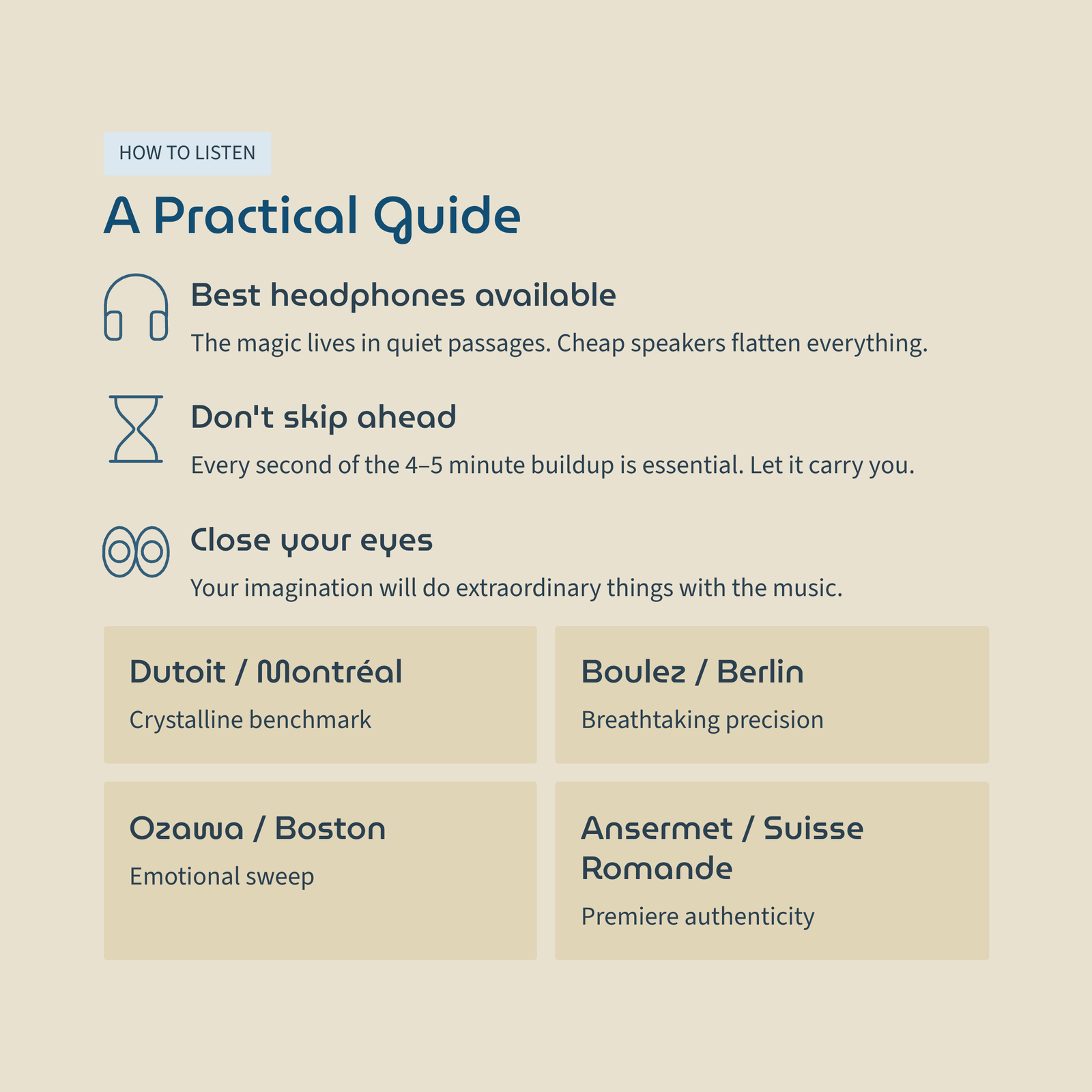
First, use the best headphones or speakers available to you. Ravel’s orchestration is extraordinarily detailed, and a good portion of the magic lives in the quiet passages — the rustling textures, the delicate overlapping of woodwind colors, the barely-there shimmer of harps and celesta. Cheap speakers will flatten all of this into mush.
Second, start the piece and resist the urge to skip ahead. The Daybreak section is roughly four to five minutes long before the main theme enters, and every second of that buildup is doing essential work. If you jump to the climax, you’ll hear a loud, pretty orchestral moment. If you let the piece carry you from the silence forward, you’ll experience something transformative.
Third, try closing your eyes. This is music that paints pictures, and your imagination will do extraordinary things with it if you let the visual cortex participate without competing input.
For recommended recordings, Charles Dutoit conducting the Orchestre Symphonique de Montréal on Decca remains a benchmark — crystalline, shimmering, perfectly balanced. Pierre Boulez with the Berlin Philharmonic on Deutsche Grammophon offers a more analytical but breathtakingly precise reading. For sheer emotional sweep, Seiji Ozawa with the Boston Symphony Orchestra delivers a Daybreak that feels like standing on a mountaintop. And if you want a historically informed perspective, Ernest Ansermet’s recording with the Orchestre de la Suisse Romande — the conductor who led the ballet’s premiere — carries an irreplaceable authenticity.
On YouTube, searching “Ravel Daphnis et Chloé Suite No.2” will bring up numerous excellent performances. I’d particularly recommend looking for live concert recordings, where the communal electricity of an audience holding its breath together adds another dimension to the experience entirely.
After the Dawn
There are pieces of music that impress you, pieces that entertain you, and then — rarely — pieces that change the way you perceive the world for a few minutes. Ravel’s “Daybreak” belongs to that last category. It doesn’t demand your attention with force or complexity. Instead, it simply opens a door and invites you to step through into a morning that has been waiting for over a century, still fresh, still luminous, still capable of making a room full of strangers forget to breathe at exactly the same moment.
Put your headphones on. Press play. And let the sun come up.