📑 Table of Contents
There’s a specific kind of energy that arrives before you’re ready for it.
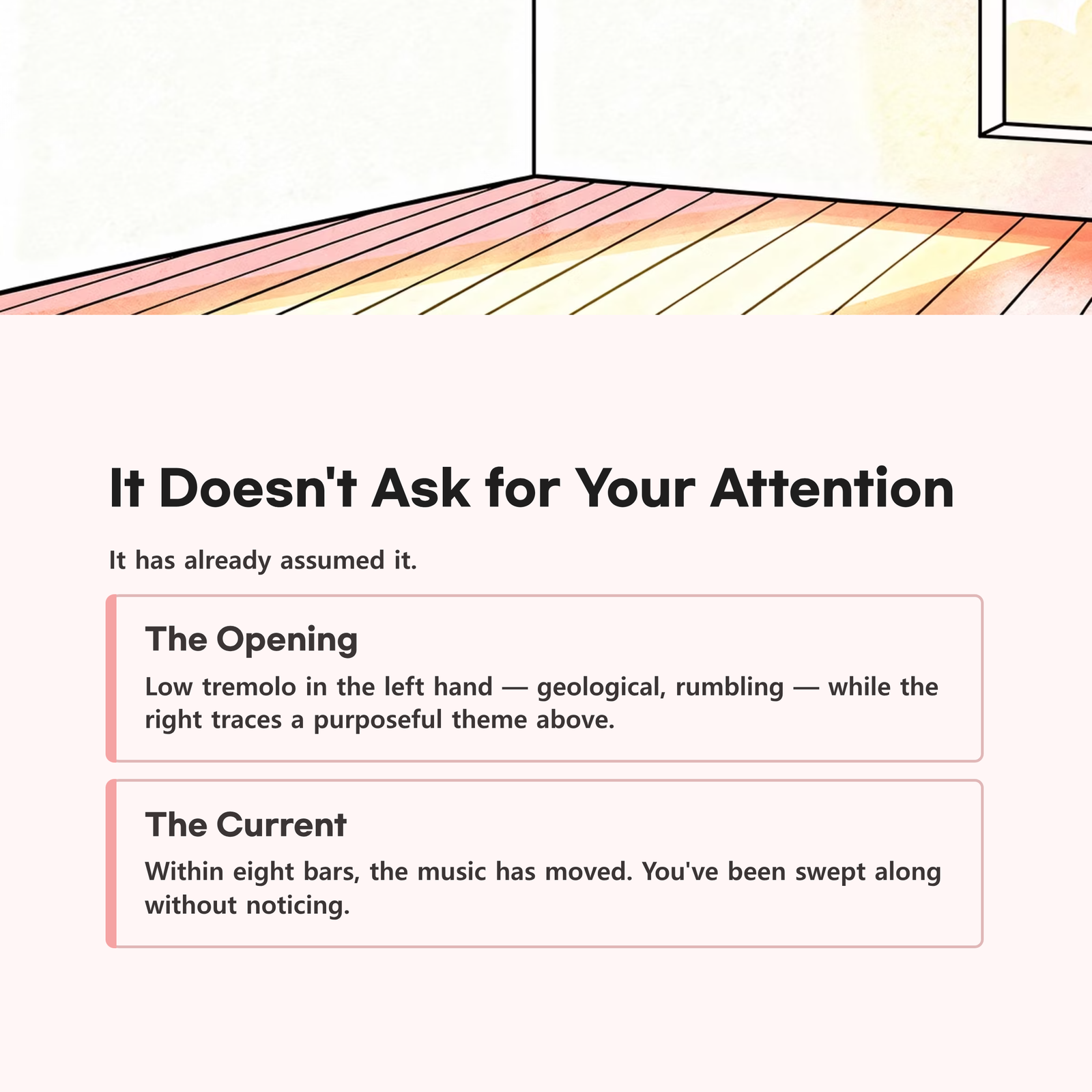
Not the slow, cinematic sunrise. Not the gentle alarm. Something more like the light that simply is when you open your eyes — already there, already insisting. That’s the first thing you notice when the Waldstein Sonata begins: it doesn’t ask for your attention. It has already assumed it.
Beethoven’s Piano Sonata No. 21 in C major, Op. 53 opens with a low, rapid tremolo in the left hand — a ground-level rumble, almost geological in feel — while the right hand traces a quiet but unmistakably purposeful theme above it. Within eight bars, the music has already moved somewhere. By the time the first great crescendo arrives, you realize you’ve been swept along without noticing the current.
The Man Behind the Thunder
To understand what this sonata is, you have to understand what 1803 was for Ludwig van Beethoven.
He was thirty-two years old. He had been hiding a secret for two years: his hearing was failing him. By 1802, the crisis had become so acute that he wrote what is now known as the Heiligenstadt Testament — a letter to his brothers, never sent, in which he confessed that he had considered suicide. “A little more of that,” he wrote, “and I would have ended my life. It was only my art that held me back.”
He didn’t end his life. Instead, he wrote some of the most forward-propulsive music of his career. The Waldstein Sonata, composed in 1803 and 1804, belongs to his so-called “heroic period” — a stretch of radical creative ambition that also produced the Eroica Symphony and the Appassionata Sonata. It’s as if, having stared into the void, he turned his back on it and ran.
The sonata’s nickname comes from Count Ferdinand von Waldstein, a close friend and patron who had supported Beethoven since his teenage years in Bonn. Waldstein reportedly told the young composer: “Through uninterrupted diligence you shall receive Mozart’s spirit through Haydn’s hands.” Whether or not Beethoven took that prophecy to heart, the Waldstein Sonata feels like its fulfillment — built on the Classical architecture Haydn gave him, animated by something no one had named yet.
What the First Movement Actually Does
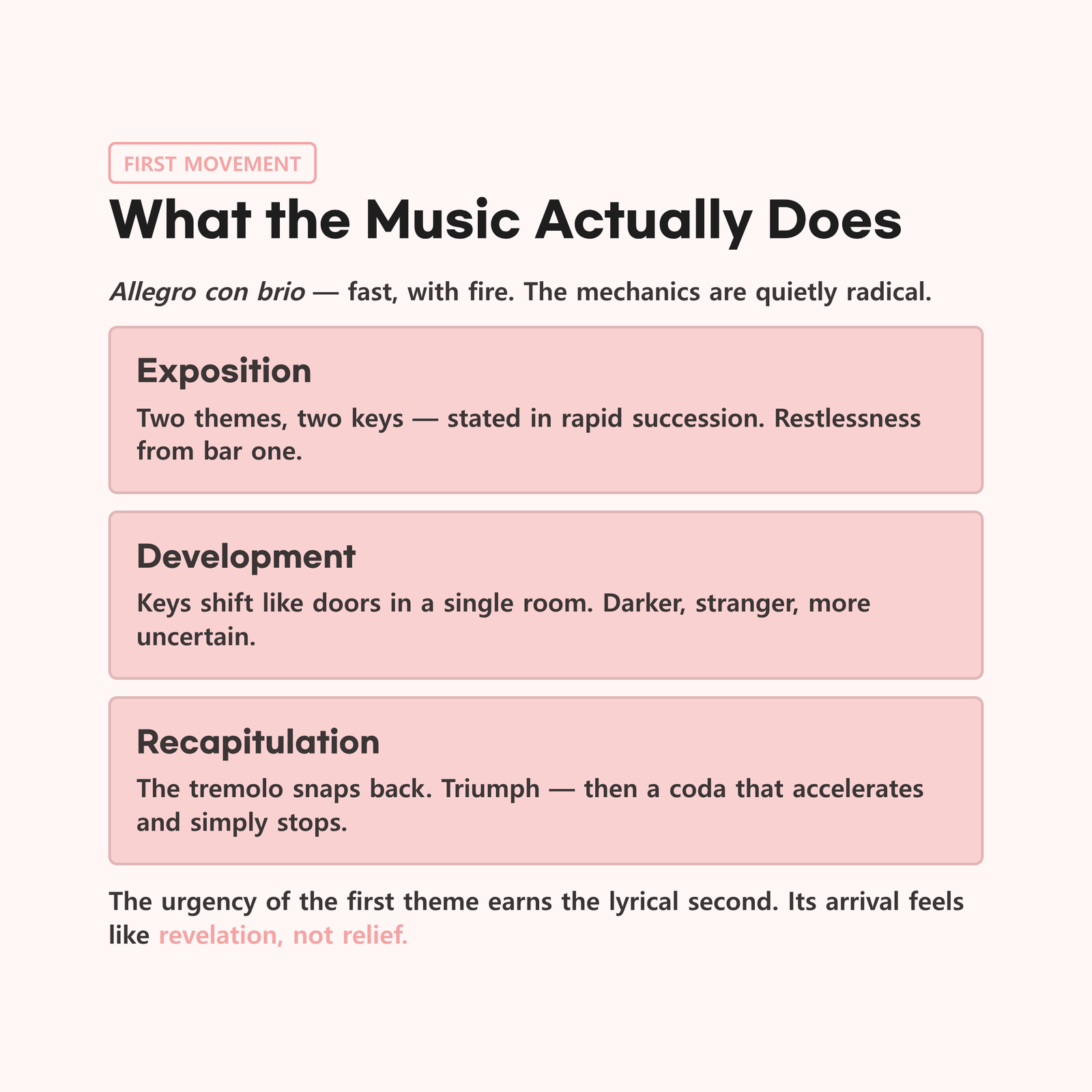
The formal label is Allegro con brio — fast, with fire. But the mechanics of how this movement works are worth slowing down to appreciate, even if you’ve never studied music theory.
The movement is in sonata form, which you can think of as a three-act drama: exposition (introducing the characters), development (putting them into conflict), and recapitulation (returning home, transformed). What Beethoven does within that framework here is quietly radical.
The opening theme — that trembling bass figure with the right-hand melody above — is stated twice in two different keys in quick succession. This is unusual. The harmonic shift happens so fast, so matter-of-factly, that it creates a sense of restlessness from the very first phrase. The music doesn’t seem to want to stand still long enough to establish where it is.
Then comes the second theme: a lyrical, almost operatic melody in the right hand, broad and singing. It’s a contrast so dramatic it feels like a different composer wrote it — except that Beethoven connects the two not just structurally but emotionally. The urgency of the first theme earns the arrival of the second. By the time the lyrical melody appears, it feels less like relief and more like revelation.
The development section — where the exposition’s material gets taken apart and pushed to extremes — is particularly intense. Beethoven moves through a chain of keys like a traveler who keeps finding new doors in what should be a single room. The harmonic language gets stranger, darker, more uncertain. And then, with very little warning, everything snaps back: the tremolo returns, the opening theme returns, and the whole structure reasserts itself with something close to triumph.
The movement closes not with grandeur but with speed — a coda that accelerates past what seems reasonable, then simply stops. No ceremonial ending. Just: done.
Why This Movement Feels the Way It Does
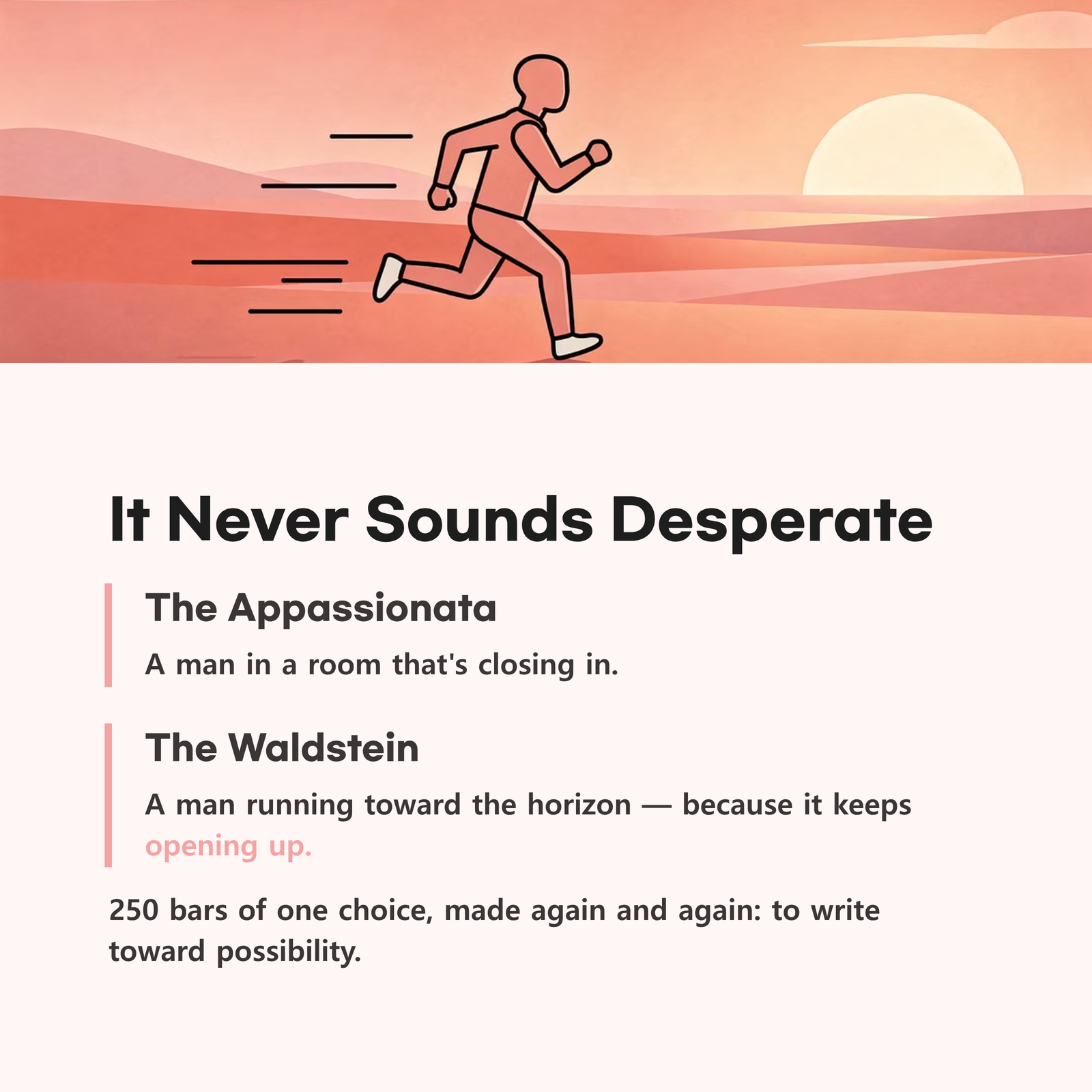
Here’s the thing about the Waldstein’s first movement that I keep returning to: it never sounds desperate, even though it was written by a desperate man.
Grief and urgency can sound very different. In some of Beethoven’s middle-period works — the Appassionata, the Op. 59 string quartets — you can feel the weight. The darkness is close to the surface. But the Waldstein moves differently. Its energy is outward, forward, locomotive. If the Appassionata sounds like a man in a room that’s closing in, the Waldstein sounds like a man running toward the horizon — not because he’s being chased, but because the horizon keeps opening up.
There’s a discipline to this that I find almost more moving than sorrow would be. Beethoven made a choice, somewhere in the composing of this, to write toward possibility. The first movement is 250 bars of that choice, made again and again.
How to Listen: A First-Timer’s Roadmap
If this is your first time sitting with this piece, here’s a practical guide to what to listen for:
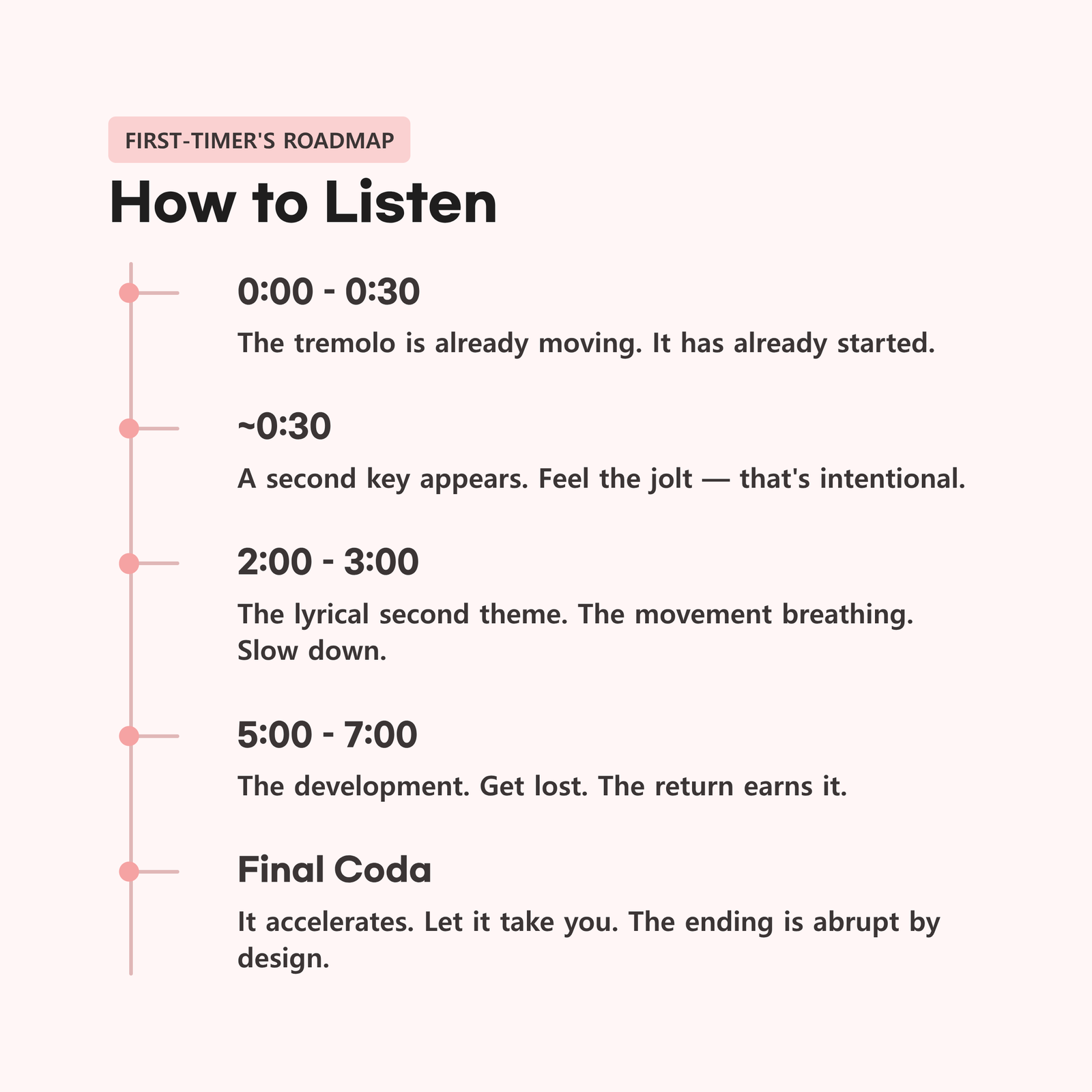
0:00 – 0:30 — Notice the opening tremolo. It’s quiet, but it’s already moving. Don’t wait for the music to start; it has already started.
Around 0:30 — The second key appears. If you feel a small jolt, a sense of “wait, where did that come from?” — that’s exactly what Beethoven wanted.
2:00 – 3:00 (approx.) — The lyrical second theme. Let yourself slow down here. This is the movement breathing.
5:00 – 7:00 (approx.) — The development. Things get darker and more disorienting. Don’t resist it. The return will feel earned in proportion to how lost you let yourself get.
Final coda — It accelerates. Let it take you. The ending is abrupt by design.
Recordings Worth Your Time
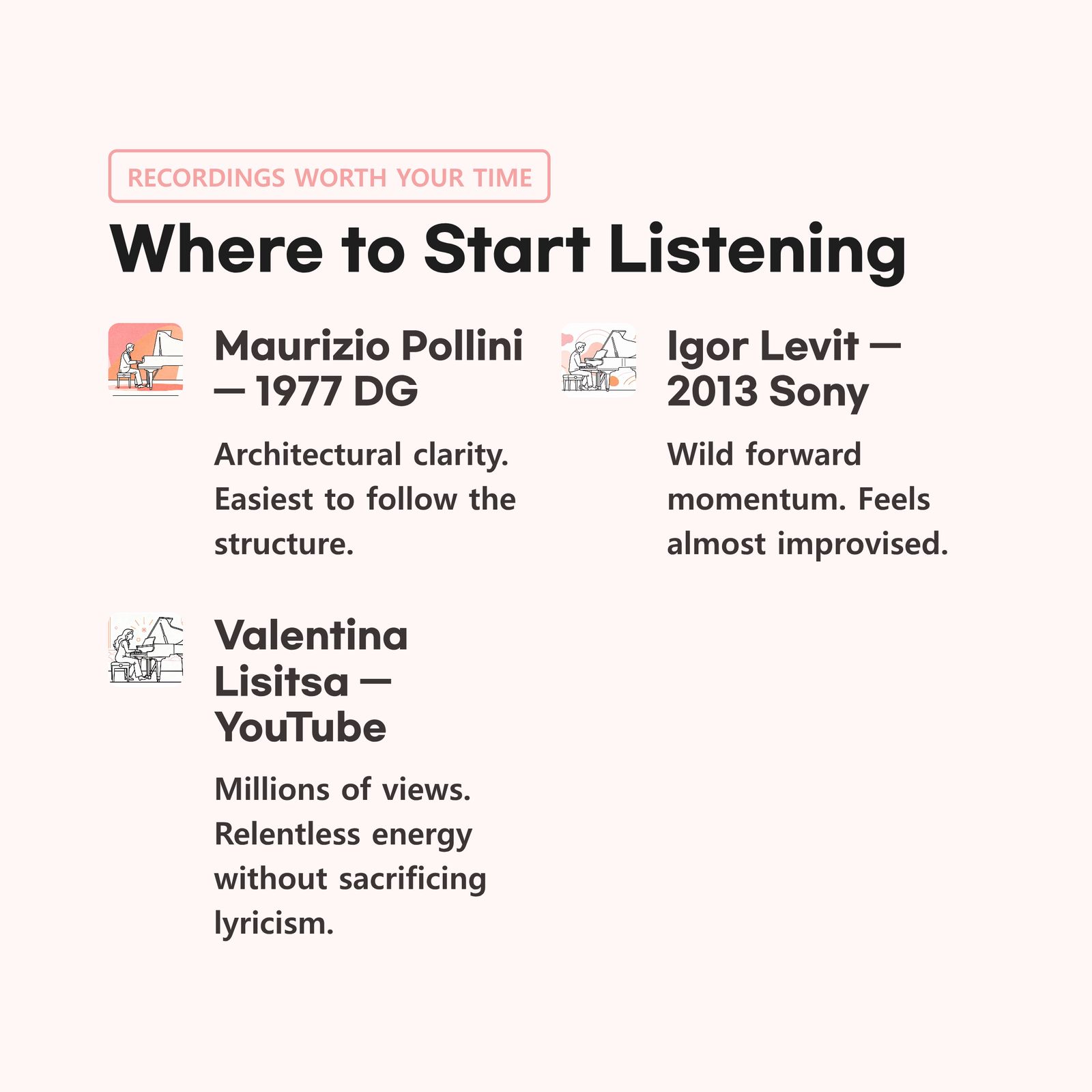
For a first listen, Maurizio Pollini’s 1977 Deutsche Grammophon recording remains a benchmark — its clarity is almost architectural, making the structure of the movement unusually easy to follow. If you prefer something more physical and risk-taking, Igor Levit’s 2013 Sony recording captures the wild forward momentum in a way that feels almost improvised.
On YouTube, Valentina Lisitsa’s live recording has garnered millions of views for good reason: she captures the first movement’s relentless energy without sacrificing the lyricism of the second theme.
What Gets Left When the Notes Stop
I’ve spent a lot of time with this movement. I’ve listened to it early in the morning, in transit, in the middle of nights when sleep wasn’t coming. What I keep taking from it isn’t the technical ambition, extraordinary as that is. It’s the tempo of it — the insistence that forward is a direction worth choosing.
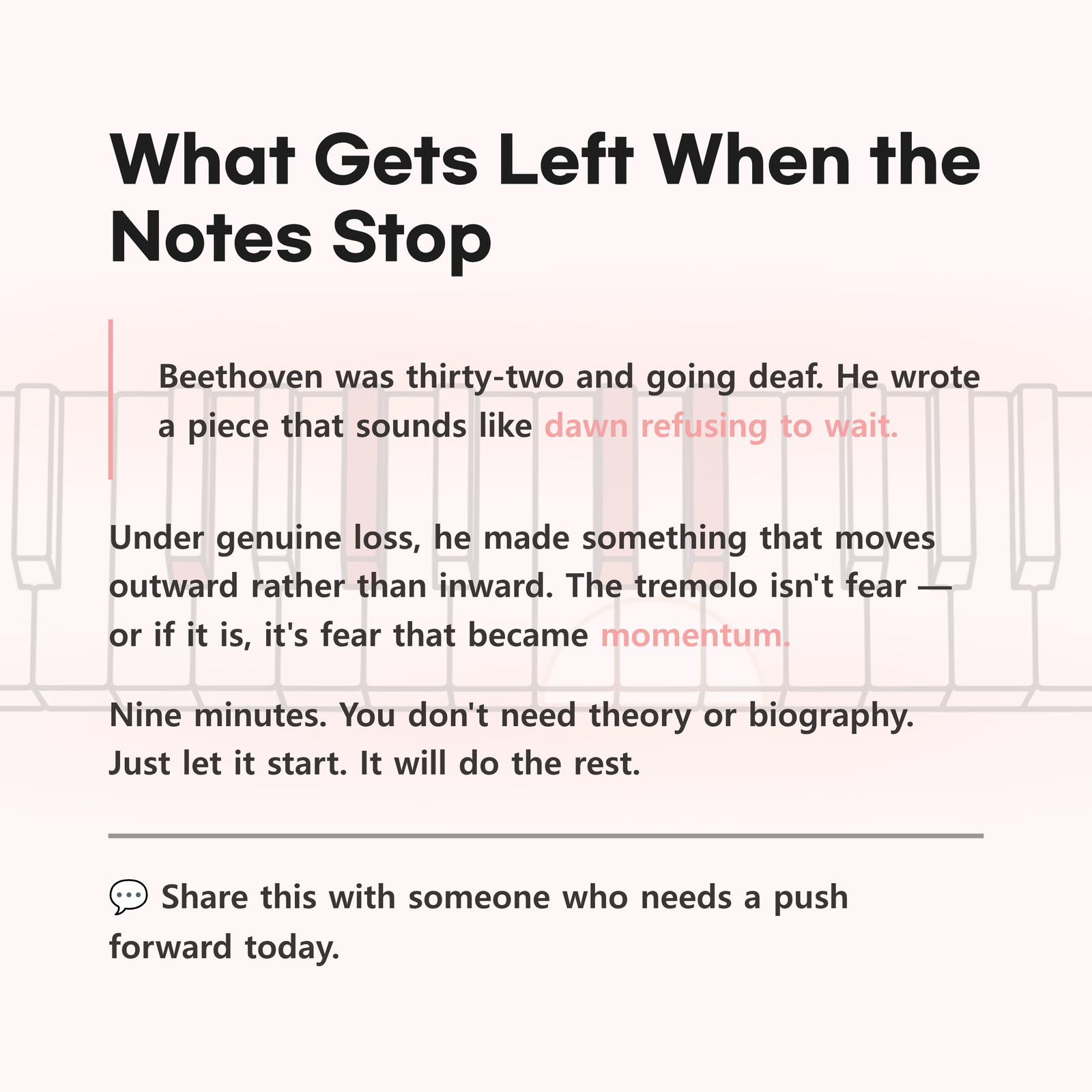
Beethoven was thirty-two and going deaf. He wrote a piece that sounds like dawn refusing to wait.
There’s something instructive in that. Not a lesson, exactly. More like a demonstration. That it’s possible, under conditions of genuine loss, to make something that moves outward rather than inward. That the tremolo at the beginning isn’t fear — or if it is, it’s fear that has decided to become momentum.
The first movement of the Waldstein Sonata lasts roughly nine minutes. In nine minutes, it makes its case completely. You don’t need to understand anything about sonata form or Beethoven’s biography or the key of C major to feel what it’s arguing. You just have to let it start.
It will do the rest.