📑 Table of Contents
There is a moment in music — rare, electric, almost unreasonably satisfying — when everything that has been building suddenly locks into place. Two melodies that seemed to exist in entirely separate worlds collide, intertwine, and surge forward together as though they were always meant to end this way. Bizet’s Farandole from L’Arlésienne Suite No. 2 lives in that moment. It doesn’t approach it. It is that moment, sustained for four relentless, glorious minutes.
If you have never heard it before, you are about to understand why conductors smile before they raise their baton.
Who Was Bizet, and Why Doesn’t Everyone Know This Story?
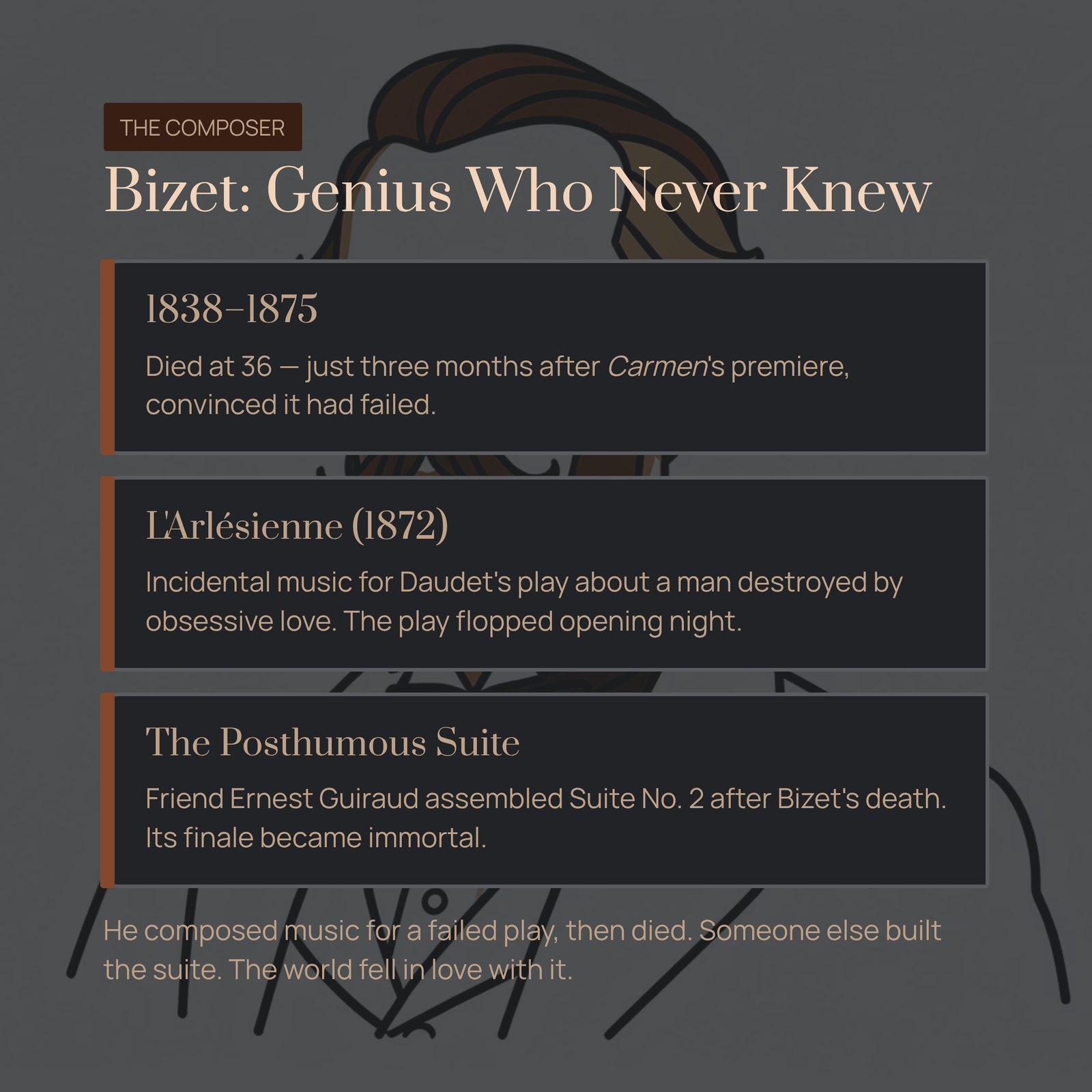
Georges Bizet (1838–1875) is one of classical music’s most quietly heartbreaking figures. He is best known today for Carmen, one of the most performed operas in history — yet he died at 36, just three months after its premiere, reportedly convinced it had been a failure. He never knew. He never got to stand in the ovation his own genius had earned.
Before Carmen, however, there was L’Arlésienne.
In 1872, Bizet was commissioned to compose incidental music for a play by Alphonse Daudet — a tragic love story set in Provence in the south of France. The play tells of a young man destroyed by his obsessive love for a woman from Arles (the Arlésienne of the title), a woman who never once appears onstage. The music Bizet wrote for it was inventive and atmospheric, but the play itself flopped on opening night.
Bizet salvaged what he could. He rearranged four of his incidental pieces into a concert suite — Suite No. 1 — which found an audience. After his death, his friend and fellow composer Ernest Guiraud assembled four more movements into Suite No. 2, and it is the finale of that posthumous suite that became immortal: the Farandole.
Bizet composed music for a play that failed. Then he died. Then someone else assembled the suite. And then the world fell in love with it. Even in death, this man couldn’t catch a simple break — but the music refused to be quiet.
What Exactly Is a Farandole?
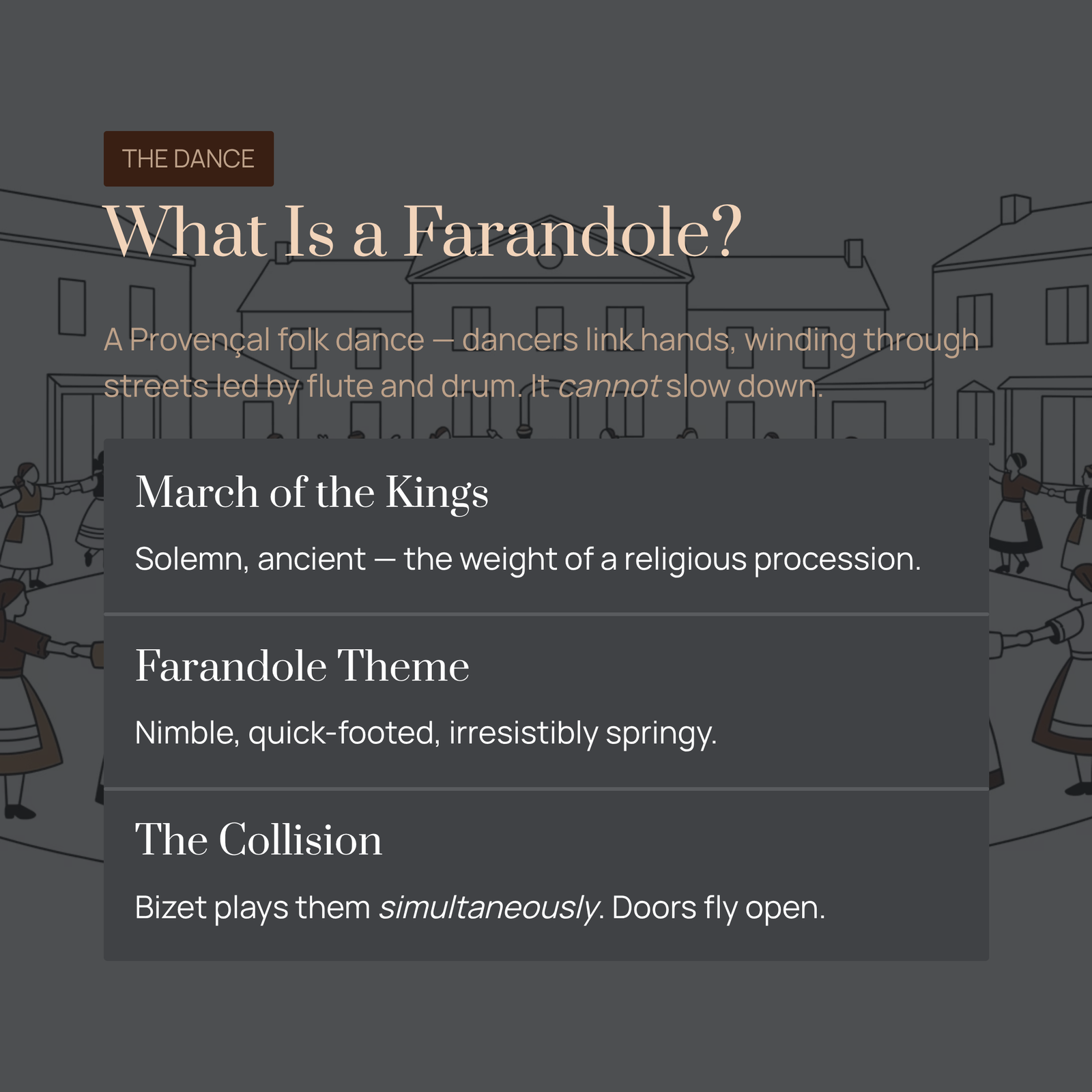
A farandole is a traditional folk dance from Provence, typically performed outdoors in a long, serpentine chain: dancers link hands or hold handkerchiefs and wind through streets and town squares, led by a musician playing a galoubet (a small three-holed flute) and a tambourin (a long, narrow drum). The dance has deep roots in the region — some historians trace it back to ancient Greek colonizers who settled the area around Marseille.
The farandole is festive, communal, and physically driven. It moves forward without stopping. That energy — the sense of a crowd that cannot slow down — is precisely what Bizet captures.
In his Farandole, he uses two authentic Provençal folk melodies as his raw material. The first is the March of the Kings (La Marche des Rois), a solemn, ancient-sounding melody with the weight of a religious procession. The second is the farandole dance theme itself: nimble, quick-footed, irresistibly springy.
For most of the piece, these two themes are kept apart, as though they belong to different stories. Then Bizet does something that still feels almost mischievous in its confidence: he plays them simultaneously. The grave march and the dancing folk tune lock into each other in perfect counterpoint, and instead of colliding, they lift. The effect is not complicated to explain. It simply feels like doors flying open.
A Listener’s Map: What to Hear as It Unfolds
The Farandole runs approximately four minutes and follows a clear dramatic arc. Here is what to listen for:
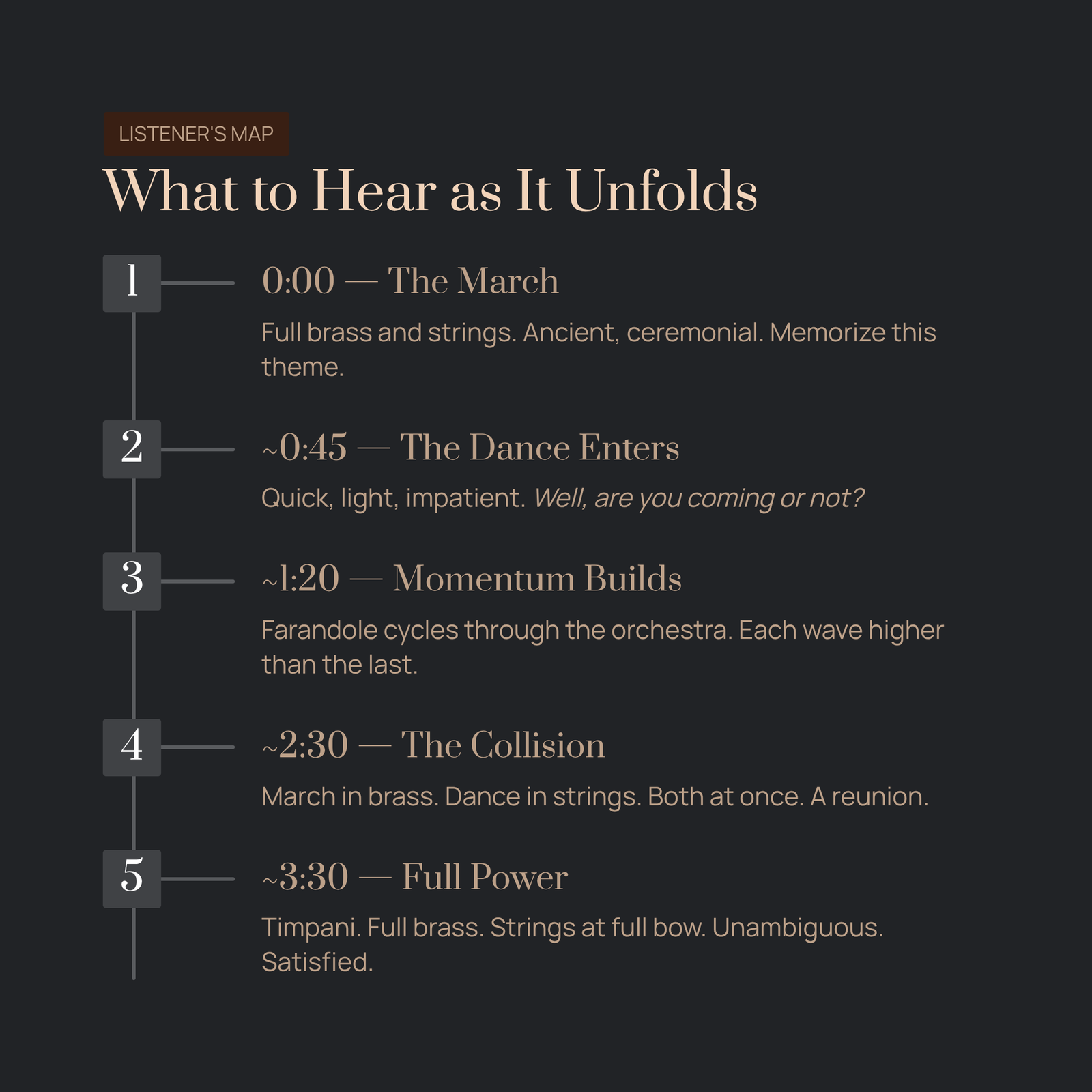
0:00 — The March Announces Itself
The piece opens with the orchestra in full ceremonial voice. The March of the Kings is stated grandly — brass forward, strings underlining. It has the quality of something ancient being called back to life. Take a moment to memorize this theme. You’ll need it later.
~0:45 — The Dance Enters
Without warning, the mood pivots. Strings and woodwinds introduce the farandole theme: quick, light, rhythmically bouncy. It has the character of someone appearing in a doorway and saying, well, are you coming or not? Notice how the tempo feels almost impatient — there’s no time to stand still.
~1:20 — The Dance Takes Over
The farandole theme cycles through the orchestra, building momentum with each pass. The full string section drives forward. Percussion sharpens the beat. The dynamic level rises in waves, each one a little higher than the last.
~2:30 — The Collision (The Moment)
Here it is. The march theme re-enters in the brass while the strings continue the dancing farandole below. Both themes run simultaneously. This is called counterpoint — the technique of combining independent melodic lines — but in this context it functions less like a technical device and more like a reunion. These two melodies discover they were always compatible. The effect is massive and warm at the same time.
~3:30 — The Final Push
The combined themes build to the finale with total orchestral force. Timpani. Full brass. Strings at full bow. There is no resolution that eases you gently out — it simply arrives at full power and ends there, unambiguous, satisfied with itself.
The Hidden Emotional Logic
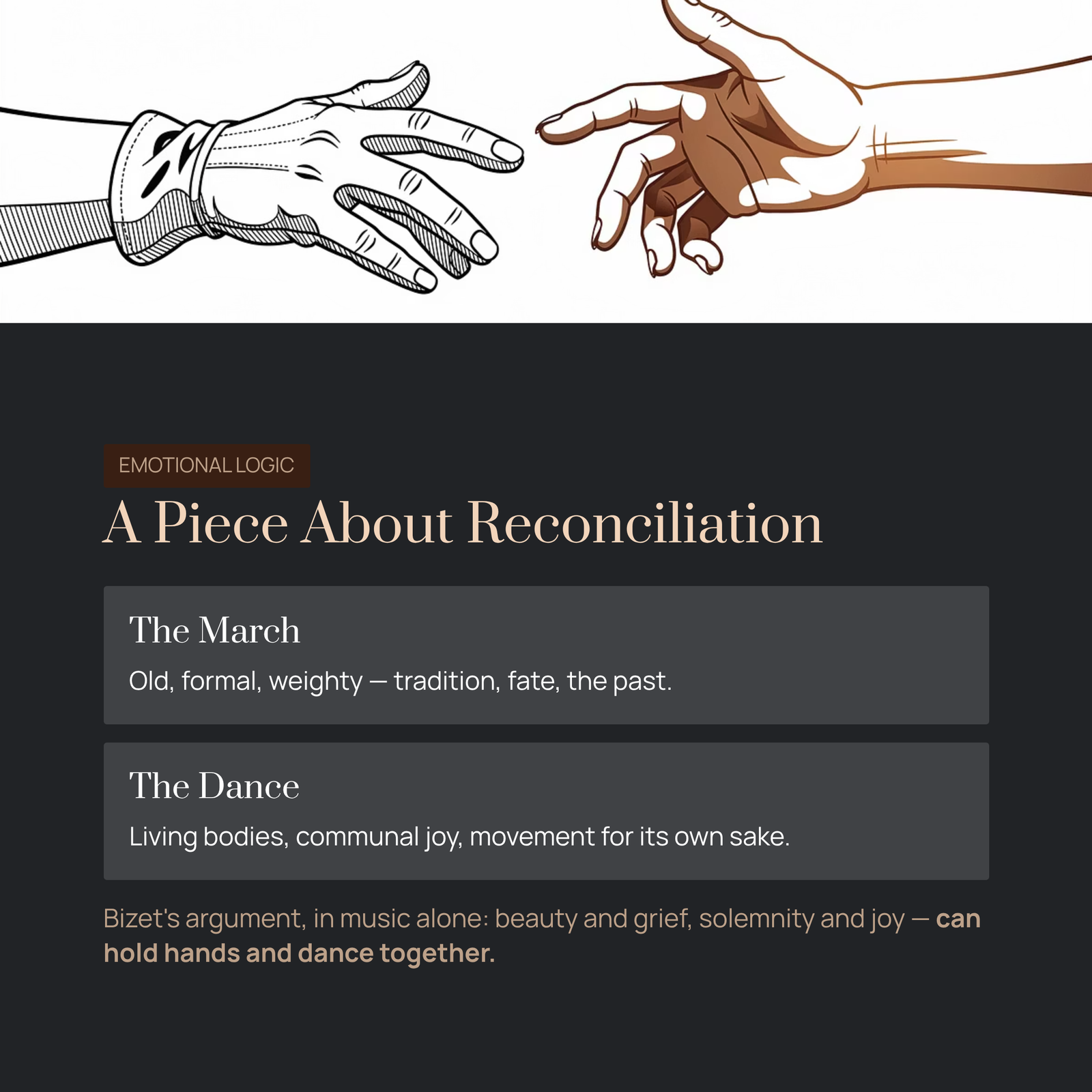
What makes the Farandole structurally interesting is also what makes it emotionally satisfying: it is a piece about reconciliation.
The March of the Kings represents something old, formal, weighty — tradition, perhaps, or fate, or the past. The farandole dance represents the present: living bodies, communal joy, movement for its own sake. These two forces feel opposed in the opening minutes. But Bizet’s argument — delivered entirely in music, without words — is that they are not opposites. They belong to the same world.
In the context of the original Daudet play, this has a bittersweet edge. The story ends in tragedy. Bizet knew that. But in the Farandole, he chose to let the music say something the story could not: that beauty and grief, solemnity and joy, the ancient and the immediate, can sometimes hold hands and dance together.
Given what we know of Bizet’s own short life — the failed premieres, the early death, the recognition that came too late — it is difficult not to hear something personal in that finale. A man composing, at full speed, refusing to let the serious and the joyful cancel each other out.
Recommended Recordings
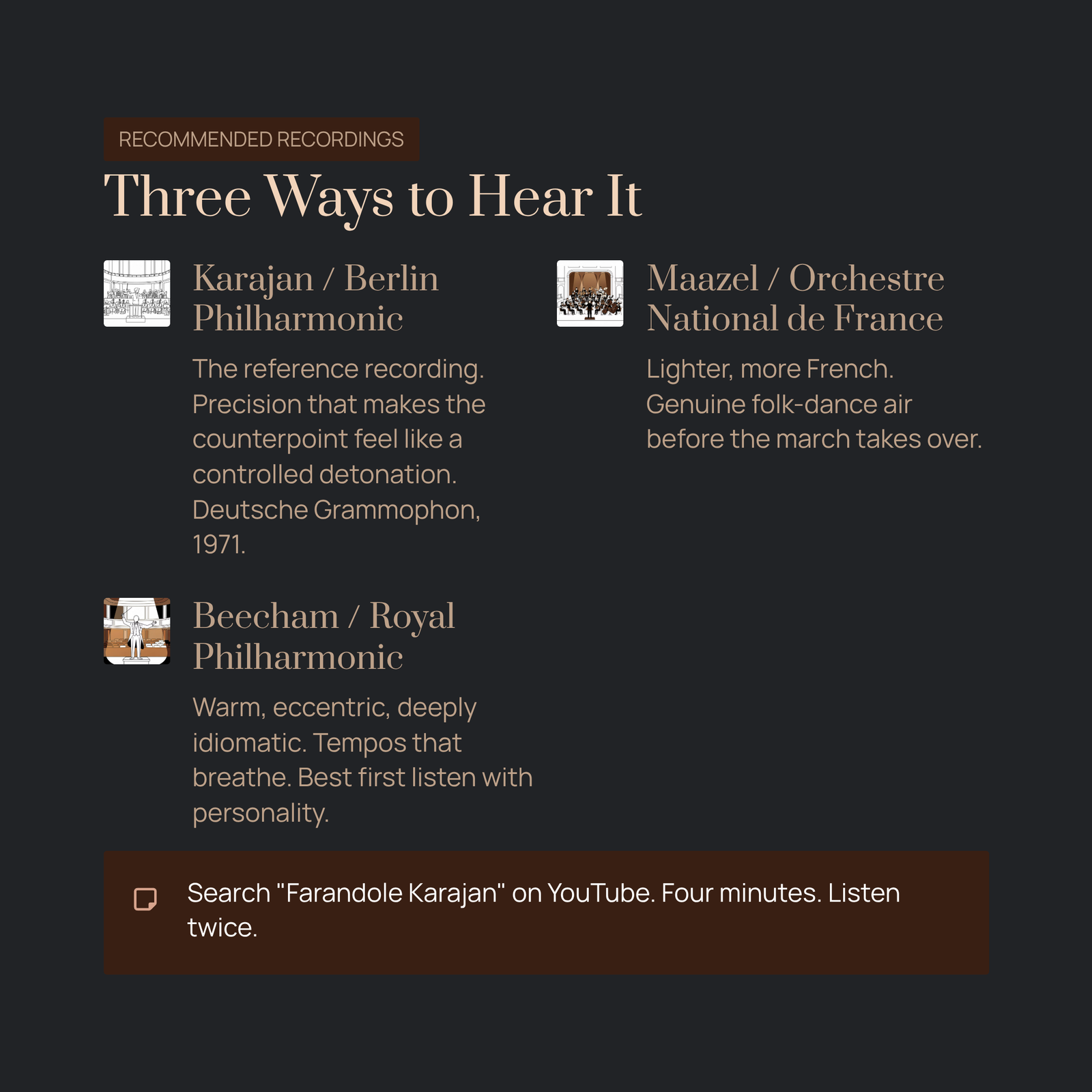
Herbert von Karajan / Berlin Philharmonic
The reference recording for sheer orchestral power. Karajan drives the Farandole with a precision that makes the counterpoint moment feel like a controlled detonation. The Berlin Philharmonic’s brass section in 1971 has never been equaled for this repertoire. Look for the Deutsche Grammophon release of the complete Bizet suites.
Lorin Maazel / Orchestre National de France
A more overtly French interpretation — lighter in the dance sections, with more air in the strings. The farandole theme here has a genuine folk-dance lightness before the march takes over. It reminds you that this music was written about real people in a real landscape.
Sir Thomas Beecham / Royal Philharmonic Orchestra
Beecham was legendary for his affinity with French music, and his recording of the L’Arlésienne suites is warm, slightly eccentric, and deeply idiomatic. The tempos breathe in ways that modern recordings sometimes don’t allow. For a first listen with personality, this is worth seeking out.
For a quick introduction, searching “Farandole Karajan” on YouTube will surface the Berlin Philharmonic version almost immediately — and at three to four minutes long, there is no reason not to listen twice.
Why This Piece, Right Now?
There is a category of music that functions as a reminder. Not a reminder of anything specific — not a childhood, not a place, not a person — but a reminder that your nervous system is capable of responding to something with full presence. The Farandole is that kind of music.
You can play it in a kitchen while cooking. You can play it before a difficult phone call. You can play it at the end of a week when nothing went the way you planned, and it will not sympathize or console. It will simply play — march, then dance, then both at once — and your body will respond before your mind has finished deciding whether it wants to.
Bizet wrote this music for a play that no one remembers. He died before knowing anyone would love it. The Farandole has been playing ever since.
That’s the deal music makes with time. And in this case, the deal was extraordinarily well-negotiated.