📑 Table of Contents
There is a certain kind of beauty that survives being forgotten.
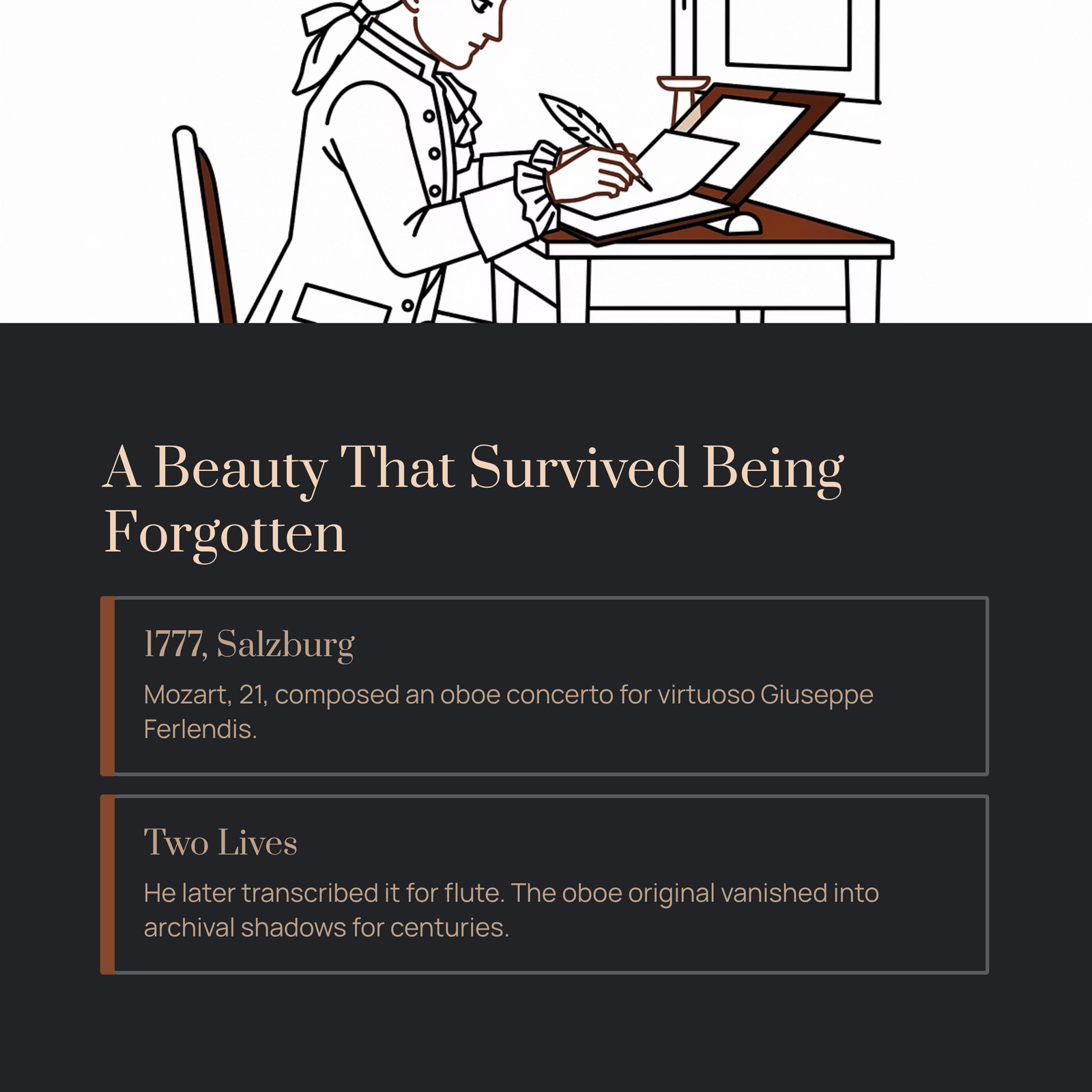
Mozart was twenty-one years old and restless. It was 1777, and he was stuck in Salzburg—a city he famously despised, under the thumb of an archbishop he despised even more. He had already written symphonies, operas, and piano concertos. And yet he felt, as many young geniuses do, perpetually underestimated.
That year, he composed a concerto for oboe—a gift, essentially, for a virtuoso named Giuseppe Ferlendis. It was elegant, warm, and precise in the way only Mozart could be at twenty-one. Then, almost as an afterthought, he transcribed it for flute. The oboe original slipped into the archival shadows for centuries.
What we’re left with, when we listen to the second movement today, is a small miracle: a melody that needed to survive two lives before we could fully hear it.
Who Was Mozart, Really?
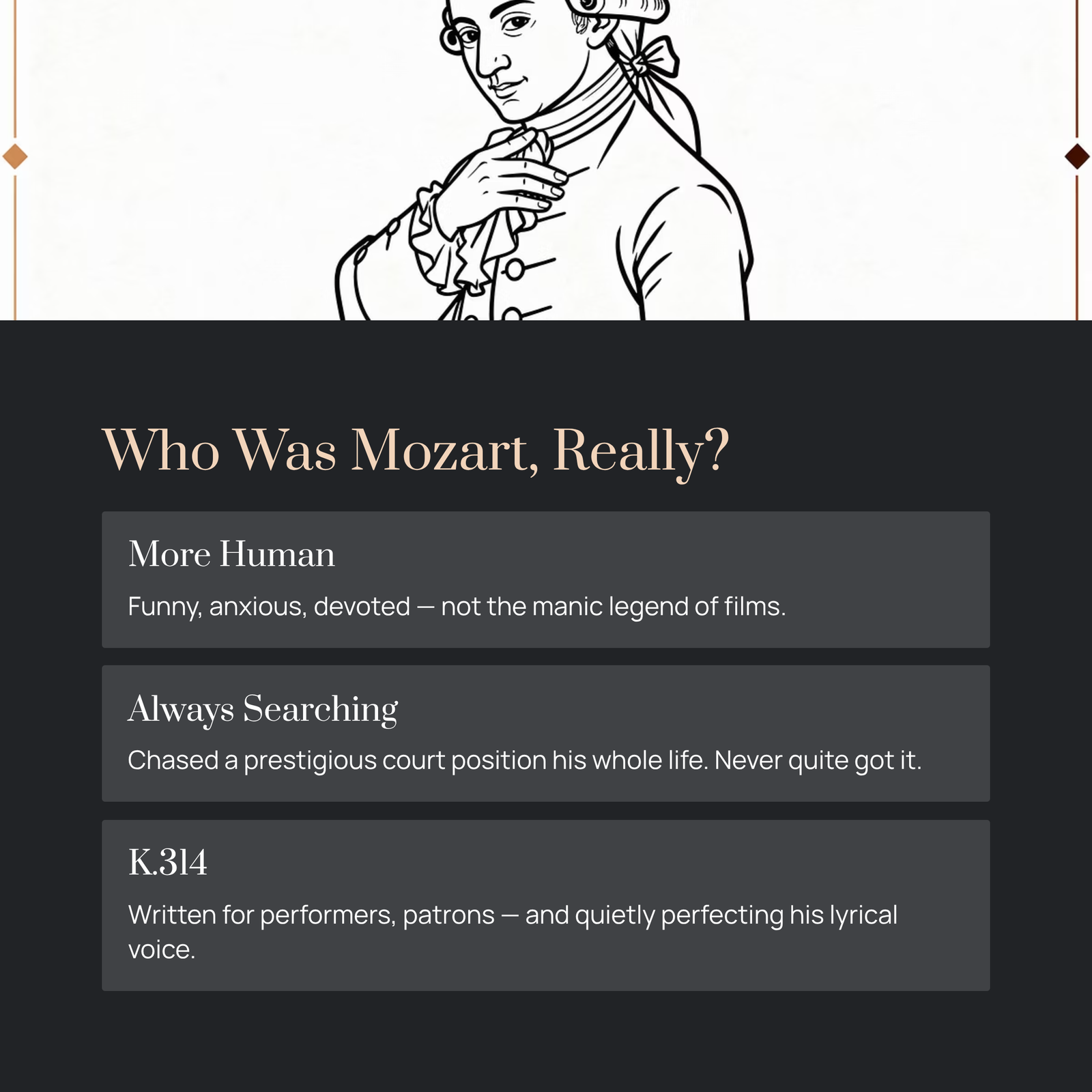
Most people know Mozart as a legend—the child prodigy, the man who died broke at thirty-five, the genius depicted in films with wild laughter and a manic grin. The real Mozart was more interesting and more ordinary than that.
He was funny. He wrote letters full of wordplay and bodily humor that would make a teenager blush. He was anxious, devoted to his family, and deeply sensitive to rejection. He spent much of his life searching for a prestigious court position that would never quite come, composing masterworks along the way as if they were a side project.
The Oboe Concerto in C major, K.314 belongs to this searching period—a time when Mozart was writing for specific performers, trying to impress patrons, and quietly developing the lyrical voice that would define his greatest slow movements.
What Makes This Adagio Different
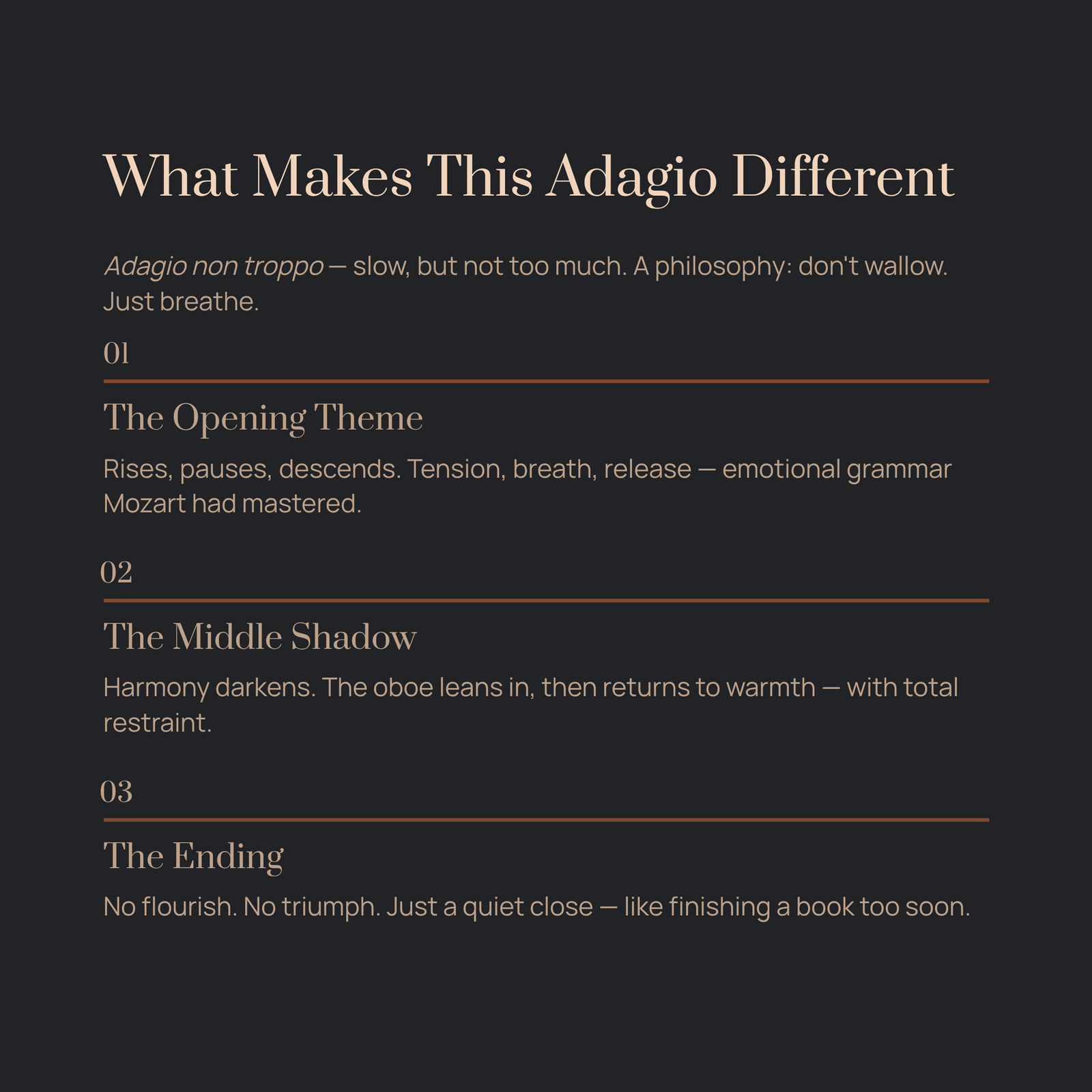
The second movement is marked Adagio non troppo—”slow, but not too much.” It’s a small instruction that contains a philosophy: don’t wallow. Don’t overdo the sentiment. Just breathe, and let the melody speak.
And speak it does.
The oboe enters almost immediately, carrying a long, unadorned line that feels less composed than remembered—as if it were something you’ve always known but couldn’t name. Mozart gives the soloist space to sing without cluttering the texture. The strings beneath are hushed, mostly supportive, occasionally offering a gentle countermelody that makes the whole thing feel like a quiet conversation.
A few things to listen for:
The opening theme’s shape. It rises, pauses, then gently descends. That arc—tension, breath, release—is repeated in different forms throughout the movement. It’s a kind of emotional grammar Mozart had already mastered.
The oboe’s tone in the middle section. Around the midpoint, the harmony shifts slightly darker. The oboe doesn’t panic—it leans into the shadow, explores it for a moment, then finds its way back to warmth. This restraint is everything. Lesser composers would have dramatized that moment. Mozart just lets it pass, the way real sadness often does.
The way the movement ends. Not with a flourish. Not with triumph. Just a quiet return, a rounding off, like closing a book you weren’t quite ready to finish.
Why the Oboe Changes Everything
When Mozart later transcribed this concerto for flute, he transposed it up a whole step into D major. The flute version is lovely. But something shifts.
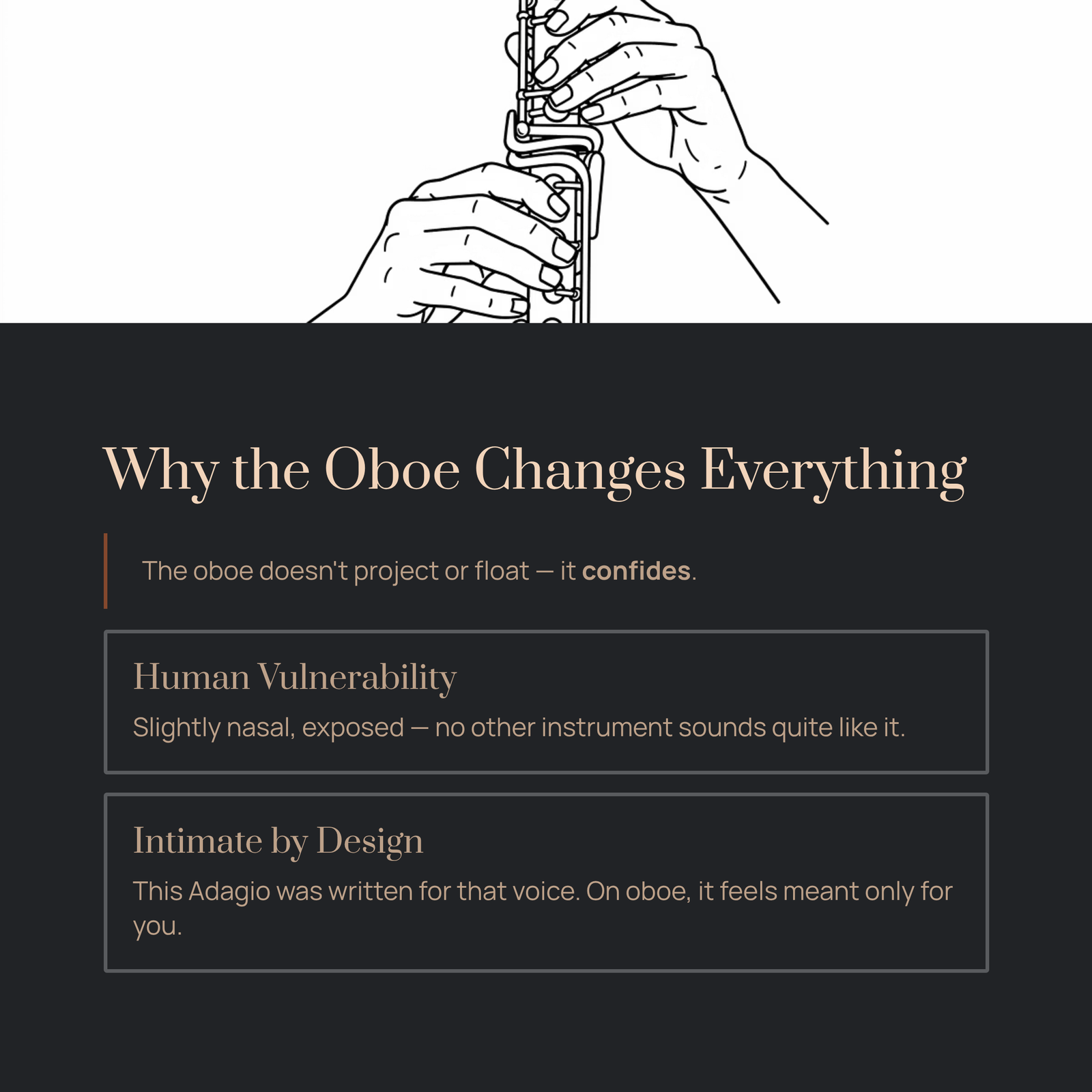
The oboe has a quality no other instrument quite replicates: a slightly nasal, almost human vulnerability. It doesn’t project like a trumpet or float like a flute. It confides. When an oboe plays a long, exposed melody, it sounds less like a performance and more like someone telling you something true.
This Adagio was written with that voice in mind. Heard on oboe, it has a particular quality of intimacy—the sense that the music is happening close to your face, meant only for you.
How to Listen (Especially If You’re New to Classical Music)
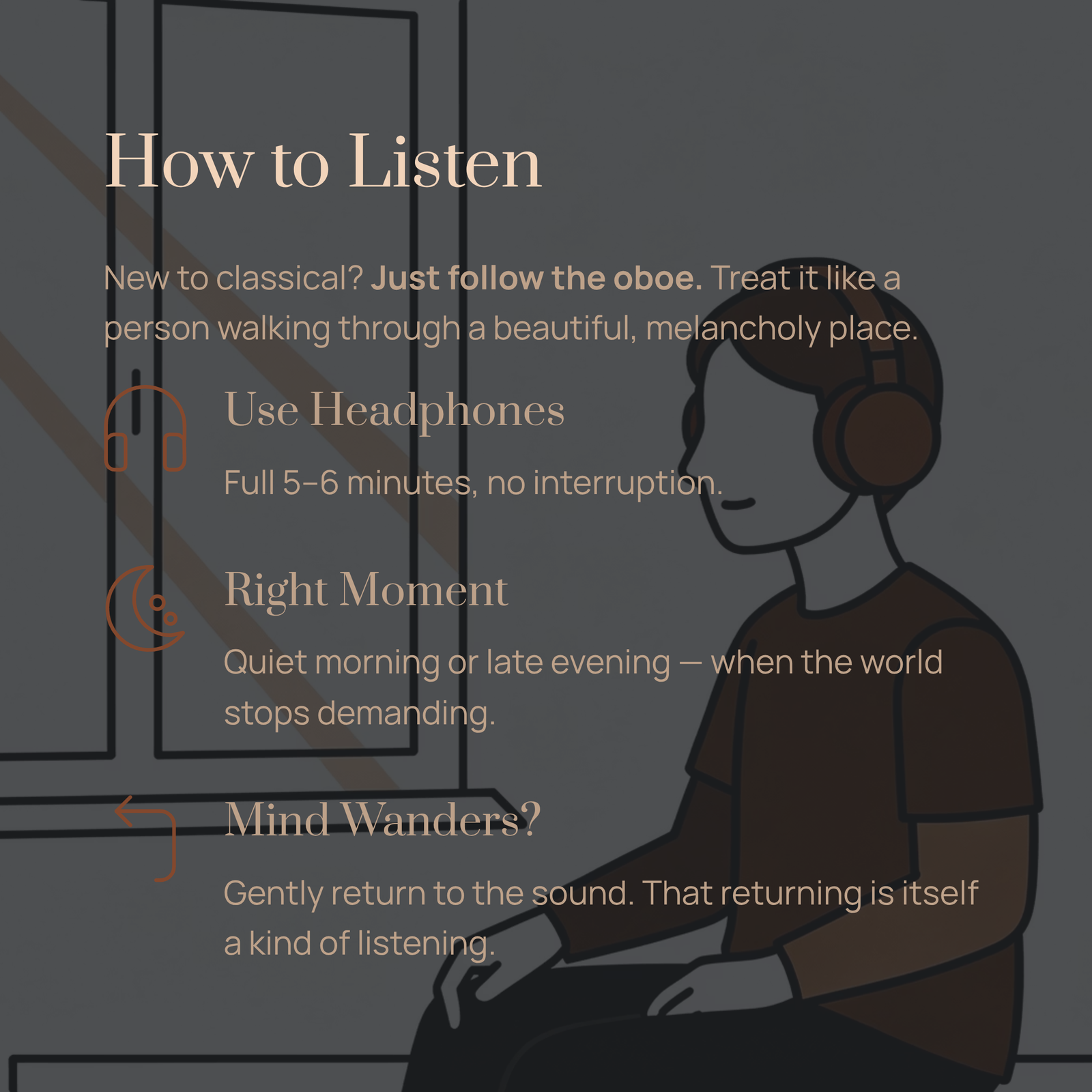
If you’ve never sat with a Mozart concerto before, here’s a simple way in: don’t try to analyze. Just follow the oboe.
Forget about structure, form, or historical context for now. Treat the oboe line like a person walking slowly through a beautiful, slightly melancholy place. Follow them. Notice when they speed up, when they hesitate, when the path opens up into something unexpected.
Ideally, listen with headphones. Give it the full five to six minutes without interruption. If your mind wanders—and it will, because that’s what minds do—just bring it gently back to the sound. That returning is itself a kind of listening.
A quiet morning, a late evening, or any moment when the world has briefly stopped demanding things of you: this is the right time.
Recommended Recordings
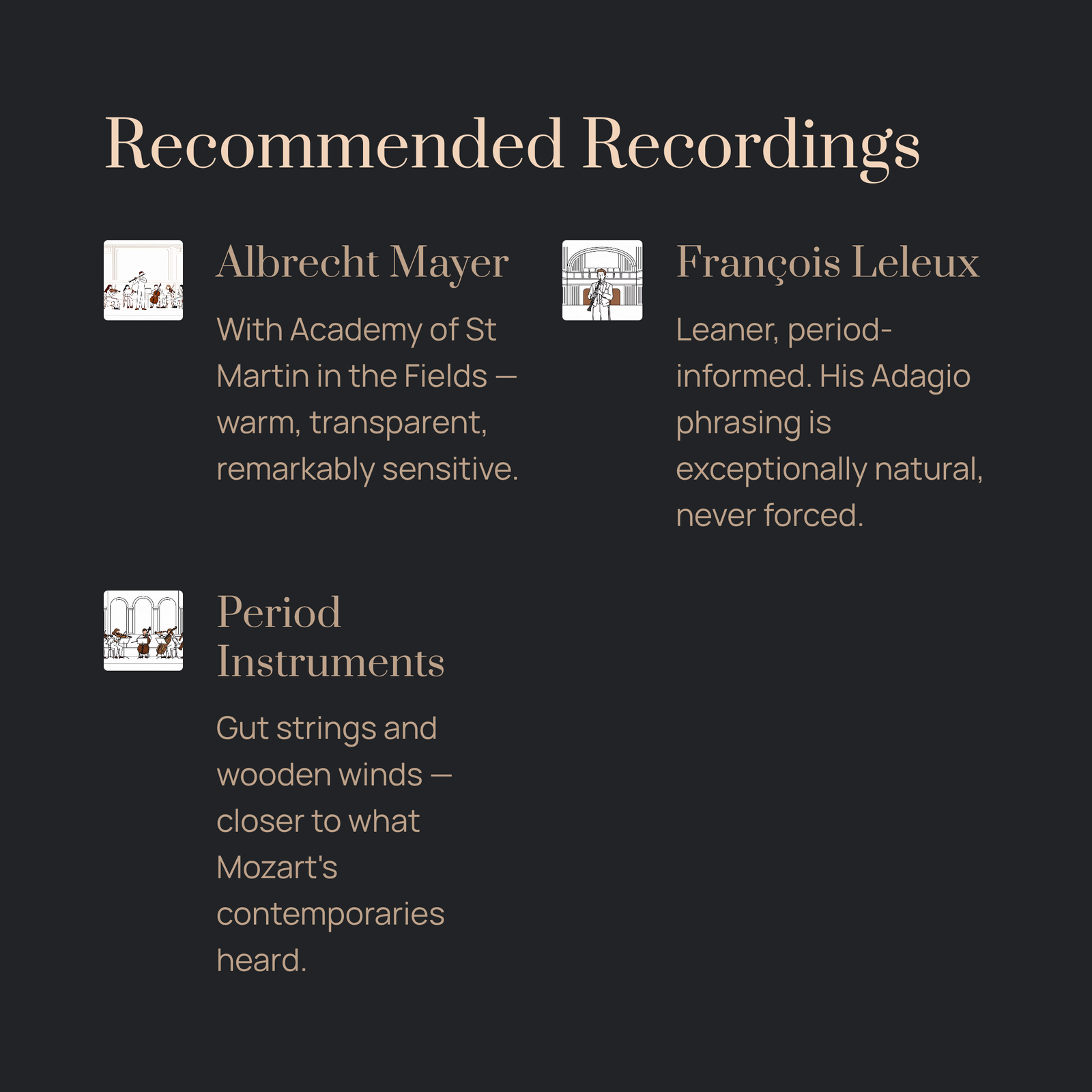
For a first listen, Albrecht Mayer with the Academy of St Martin in the Fields offers one of the warmest and most transparent accounts available. Mayer’s tone is rich without being heavy, and the ensemble responds to him with remarkable sensitivity.
François Leleux is another outstanding choice if you prefer a slightly leaner, more period-informed sound—his phrasing in the Adagio is exceptionally natural, never forced.
For something more historically grounded, look for recordings with period instruments—gut strings and wooden winds produce a texture that feels closer to what Mozart’s contemporaries would have heard, with less vibrato and more air in the sound.
A Note on the Music That Almost Wasn’t
There’s something worth sitting with in the story of this concerto’s double life.
Mozart wrote it for one instrument, handed it off to another, and the original version spent years in relative obscurity. Had circumstances been slightly different—had no one bothered to preserve the oboe version, had the manuscript been lost in a Salzburg archive—we might never have heard it in the voice it was born for.
That thought makes the listening feel a little different. Not heavier, exactly. But more precious.
Some things survive by luck as much as merit. And when we do encounter them, in the right moment, with the right kind of attention—they feel less like entertainment and more like recovery. Like finding something you didn’t know you’d lost.
That is what this Adagio does, at its best. It returns something to you quietly, without announcement, and asks only that you notice.