📑 Table of Contents

Most marches are built to make you stand up straight and step in time. This one starts by asking you to bow your head.
The opening of Tchaikovsky’s Slavonic March moves at the pace of a funeral procession — slow, heavy brass, a melody that sounds like grief being carried on shoulders. If you came expecting a triumphant parade, the first few minutes will surprise you. And that surprise is the whole point. By the time the piece ends, roughly ten minutes later, that same music has transformed into one of the most blazing, full-orchestra celebrations in the repertoire. The journey from mourning to triumph isn’t an accident. Tchaikovsky designed it to tell a true story.
Who Was Tchaikovsky?
Pyotr Ilyich Tchaikovsky (1840–1893) is the Russian composer behind some of the most-loved music ever written — Swan Lake, The Nutcracker, the 1812 Overture, and a string of symphonies and concertos that still fill concert halls today. He had a rare gift: writing melodies so direct and emotional that you don’t need any musical training to feel them.
He’s sometimes described as caught between two worlds. A group of Russian composers in his time wanted music built strictly on native folk traditions, while Tchaikovsky absorbed European techniques just as eagerly. The result is music that feels deeply Russian in spirit but speaks a language anyone can understand. The Slavonic March, written when he was 36, is a perfect snapshot of that balance — folk tunes and patriotic feeling poured into a polished orchestral form.

The War That Sparked the Music
To understand this piece, you have to understand the headline that inspired it. In 1876, Serbia and the Ottoman Empire were at war, and Russia openly supported Serbia. Many Russians felt a strong kinship with the Serbs as fellow Slavs and fellow Orthodox Christians, and they sent volunteer soldiers and aid to help.
In that atmosphere, the Russian Musical Society commissioned an orchestral piece from Tchaikovsky for a charity concert to benefit wounded Serbian soldiers. He composed and orchestrated it in late September and early October of 1876 in Moscow. Tchaikovsky himself thought of it in very specific terms — the title page of his manuscript calls it a “Serbo-Russian March on Slavonic folk themes.”
The work was an immediate hit. It premiered on 17 November 1876 in Moscow, conducted by Nikolay Rubinstein, and was such a success that it had to be repeated by popular demand. Picture that first audience — a room full of people who were reading about this war in their newspapers, hearing it dramatized in sound for the first time.
What to Listen For
Here’s the secret that makes the Slavonic March so satisfying: it’s not just a piece of music, it’s a story told in four chapters. Knowing the plot turns ten minutes of orchestral sound into something you can actually follow.
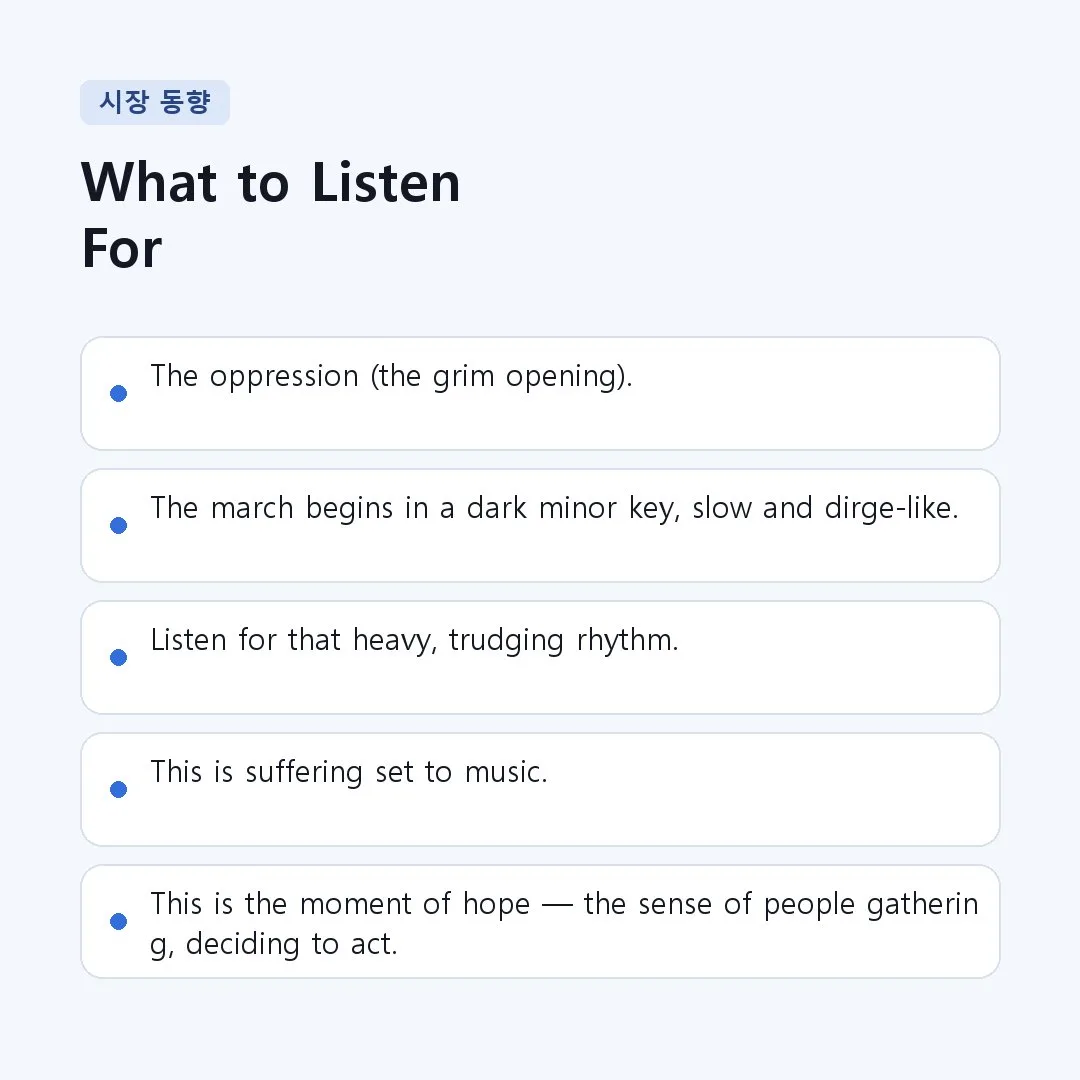
The oppression (the grim opening). The march begins in a dark minor key, slow and dirge-like. This first section depicts the oppression of the Serbs, and Tchaikovsky builds it on two genuine Serbian folk songs — real melodies people would have sung, woven into the orchestra. Listen for that heavy, trudging rhythm. This is suffering set to music.
The rallying cry. The mood shifts. A simpler, dance-like melody appears and gets passed around the orchestra, like word spreading from section to section. This is the moment of hope — the sense of people gathering, deciding to act.
The hidden anthem. Now comes the detail that classical fans love to point out. That rallying section finally gives way to a solemn statement of the Russian national anthem, “God Save the Tsar.” If the melody sounds familiar, there’s a reason — Tchaikovsky uses the very same anthem prominently in his famous 1812 Overture. Once you can pick it out, you’ll hear Russia “entering” the story.
The triumph. The finale describes the Russian volunteers marching to help, building through another blazing rendition of “God Save the Tsar” and finishing with a virtuoso coda for the full orchestra. Everything that felt mournful at the start now roars. The transformation is complete.
One more thing to enjoy: at several moments, different sections of the orchestra carry their own melodies at the same time, creating a rich, layered effect. On a second listen, try to follow just the brass, or just the strings, and you’ll hear how much is happening at once.
A quick, honest note for context: the piece is unmistakably a patriotic work of its era, written to stir national feeling. You can appreciate its drama and craft while also hearing it as a document of how 1876 Russia saw itself. The music doesn’t hide its agenda — it announces it in capital letters — and that openness is part of what makes it such a vivid listen.
Recordings Worth Your Time
The Slavonic March lives or dies on contrast — the gloom has to feel genuinely heavy so the triumph can feel earned. A few directions depending on what you want:
- Herbert von Karajan with the Berlin Philharmonic — the classic choice for sheer polish and power. If you want the big, glossy, overwhelming version where the final pages truly blaze, start here.
- Valery Gergiev with a Russian orchestra (such as the Mariinsky or London Symphony) — for an interpretation with extra weight in the dark opening and a more visceral sense of the underlying drama.
- Any pairing with the 1812 Overture — many albums program these two together, which is ideal for a first encounter. Hearing “God Save the Tsar” in both back-to-back makes the shared musical language click instantly.
If you’re streaming, simply search the work’s name and sample the opening minute of two or three recordings; you’ll quickly feel which conductor’s sense of pacing pulls you in.
Why This Ten-Minute Piece Sticks With You
The Slavonic March works because it gives you the full arc of a story in the time it takes to drink a cup of coffee. It starts in darkness, finds hope, and ends in blazing daylight — and it does all of that without a single word. You don’t need to know the history to feel that journey, but once you do, the grief at the beginning lands harder and the triumph at the end feels truly won.
Put it on, give it your full attention once, and let the funeral march at the start lull you in. When the brass finally erupts, you’ll understand exactly why a Moscow audience in 1876 demanded to hear it twice.