📑 Table of Contents
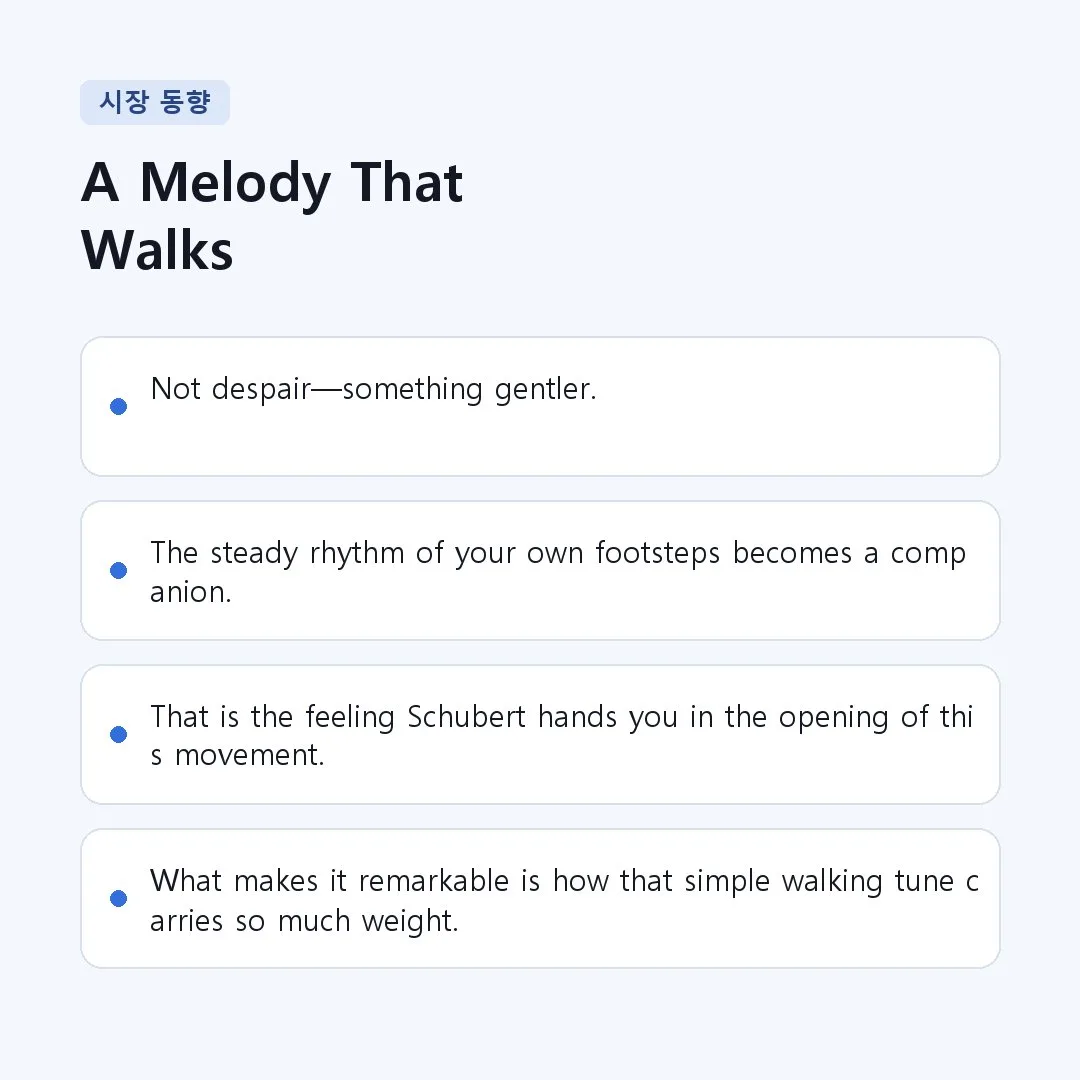
There is a particular kind of loneliness in walking somewhere with no one waiting at the other end. Not despair—something gentler. The steady rhythm of your own footsteps becomes a companion. The light shifts. You keep going.
That is the feeling Schubert hands you in the opening of this movement. A solo oboe steps forward over plucked strings, and immediately you sense motion: a tune that doesn’t sit still but travels, like someone setting out on a long road with their hands in their pockets. The tempo marking says it all—Andante con moto, “at a walking pace, with motion.” This is not music that lingers in a room. It goes outside.
What makes it remarkable is how that simple walking tune carries so much weight. Within a few minutes it has swelled into something enormous, then collapsed into stillness, then risen again. You are following one melody, but it takes you through an entire emotional landscape without ever announcing where you’re headed.
The Man Who Never Heard It
Franz Schubert (1797–1828) wrote songs the way other people breathe—over six hundred of them, plus symphonies, sonatas, and chamber works—and yet he died at thirty-one, poor, largely unknown beyond a circle of devoted friends in Vienna.
Here is the detail that stops you cold: Schubert almost certainly never heard this symphony played by an orchestra. He composed it in the final years of his short life, but it was considered too long and too difficult by the musicians of his day. The manuscript was set aside.
It might have vanished entirely if not for Robert Schumann. More than a decade after Schubert’s death, Schumann visited Vienna, met the composer’s brother, and discovered a pile of forgotten manuscripts gathering dust. Among them was this symphony. Schumann recognized its greatness instantly and famously described its “heavenly length”—a phrase that has followed the piece ever since. He arranged for Felix Mendelssohn to conduct the premiere in Leipzig in 1839. Schubert had been dead for eleven years.
So when you listen to this movement, you are hearing music that outlived the silence imposed on it—a work that waited patiently in a drawer for someone to believe in it.
What to Listen For
You don’t need to know any musical theory to follow this movement. Just keep your ears on a few signposts.
The walking theme (the opening). That oboe melody over short, plucked string notes is your main character. Notice how it has a slight limp in its step—a little catch in the rhythm that makes it sound human, almost like someone trudging through tiredness but refusing to stop.
The great swell (around the middle). Schubert lets the orchestra build and build until it reaches a peak of brightness, the strings soaring. It feels like the sun breaking through after a long gray morning. Then, dramatically, everything stops.
The silence. After that climax comes one of the most extraordinary moments in all of symphonic music: a long, held silence, broken only by quiet horn calls echoing as if from very far away. Composers rarely dare to do nothing for this long. Schubert does, and it’s devastating in its calm. Listen for those distant horns—they sound like a memory of someone calling your name across a valley.
The return. The walking theme comes back, but it feels changed, the way a familiar street looks different on the way home. The movement closes not with triumph but with acceptance.
The whole thing runs roughly twelve to fifteen minutes depending on the conductor—long for a single movement, but that’s the “heavenly length” Schumann meant. It isn’t long to show off. It’s long because some journeys can’t be rushed.

Where to Begin Listening
If you want warmth and old-world glow, Karl Böhm with the Berlin Philharmonic offers a reading that breathes naturally, never hurried, letting that walking pace feel like a genuine stroll. It’s a fine first encounter.
For something with more edge and forward drive, Nikolaus Harnoncourt with the Concertgebouw brings out the rhythmic snap in the strings, making the movement feel more urgent and alive—rewarding once you know the piece.
And Sir Georg Solti with the Vienna Philharmonic sits beautifully in between: clear, grand, and emotionally direct, with that distinctive Viennese string sound that suits Schubert’s own city.
Any recording works as a doorway. Put it on while you’re walking somewhere yourself, and you may find that Schubert’s footsteps and yours fall into the same rhythm.
The Gift of Heavenly Length
What moves me most about this Andante is that it was written by a man who had every reason to feel that his music didn’t matter—unheard, unpublished, running out of time. And yet there is no bitterness in it. There is loneliness, yes, and that long ache of the silence in the middle. But there is also that radiant swell, that stubborn walking tune that keeps moving forward no matter what.
Schubert never knew this music would reach us. He wrote it anyway, sealed his hope inside it, and trusted the road to lead somewhere. Nearly two centuries later, it has—straight to you, on whatever ordinary day you press play.
Sometimes the most honest thing music can say is simply: keep walking. This movement says it for fifteen unhurried minutes, and you come out the other side feeling, somehow, a little less alone.