📑 Table of Contents
There’s a particular kind of tiredness that doesn’t go away when you lie down. Your body stops, but your mind keeps running through the day. If you’ve ever felt that, I want you to try something: press play on Bach’s Air from Orchestral Suite No. 3, and just breathe.
You’ll notice it almost immediately. The strings don’t rush. The melody floats in long, sustained lines, rising slowly and then settling, the way your shoulders drop when you finally let go of a held breath. Nothing in this music is in a hurry, and within a few seconds, neither are you.
This piece is roughly three hundred years old, written for a small Baroque orchestra in Germany. And yet it does something almost no modern relaxation track manages to do: it doesn’t try to relax you. It simply is calm, and invites you to join it.
Who Was Bach, and Why Does This Sound So Effortless?
Johann Sebastian Bach (1685–1750) is often described as the foundation of Western classical music, the composer other composers studied to learn their craft. But that reputation can make him sound intimidating, like a textbook rather than a person.
Here’s the more human version. Bach spent most of his career as a working musician, churning out music on deadline for churches and courts. He had twenty children, an enormous appetite for coffee, and a reputation for being stubborn with his employers. He wasn’t writing for posterity; he was writing because Sunday was coming and the choir needed something to sing.
What makes his music feel so right is his command of counterpoint, the art of weaving several independent melodies together so they support each other without clashing. In the Air, you don’t hear this as complexity. You hear it as warmth. Underneath the main violin melody, the lower strings walk steadily downward, like a hand resting on your back. That quiet support is the whole secret of why the piece feels so safe.
The Story Behind the Suite (and Its Famous Nickname)
Bach composed his four Orchestral Suites during his most productive years, likely around 1730, when he was working in Leipzig. A suite, in Baroque terms, is simply a collection of dance-inspired movements bundled together. Suite No. 3 opens with a grand, ceremonial overture full of trumpets and timpani, and then, in its second movement, everything suddenly softens. That second movement is the Air.
“Air” here doesn’t mean the thing you breathe. In Baroque music, an aria or air meant a song-like, lyrical movement, something meant to sing rather than dance. Bach wrote it for strings alone, leaving out the trumpets and drums, which is why it feels like stepping from a crowded hall into a quiet garden.
You may also know this piece by a different name: “Air on the G String.” That nickname comes much later. In the 19th century, a violinist named August Wilhelmj rearranged the melody so it could be played entirely on the violin’s lowest string, the G string, which gives it a darker, richer tone. The arrangement became so popular that the nickname stuck, even though Bach never called it that himself.
How to Listen: What to Notice
You don’t need any training to enjoy this piece, but here are a few anchors that make it even more rewarding.
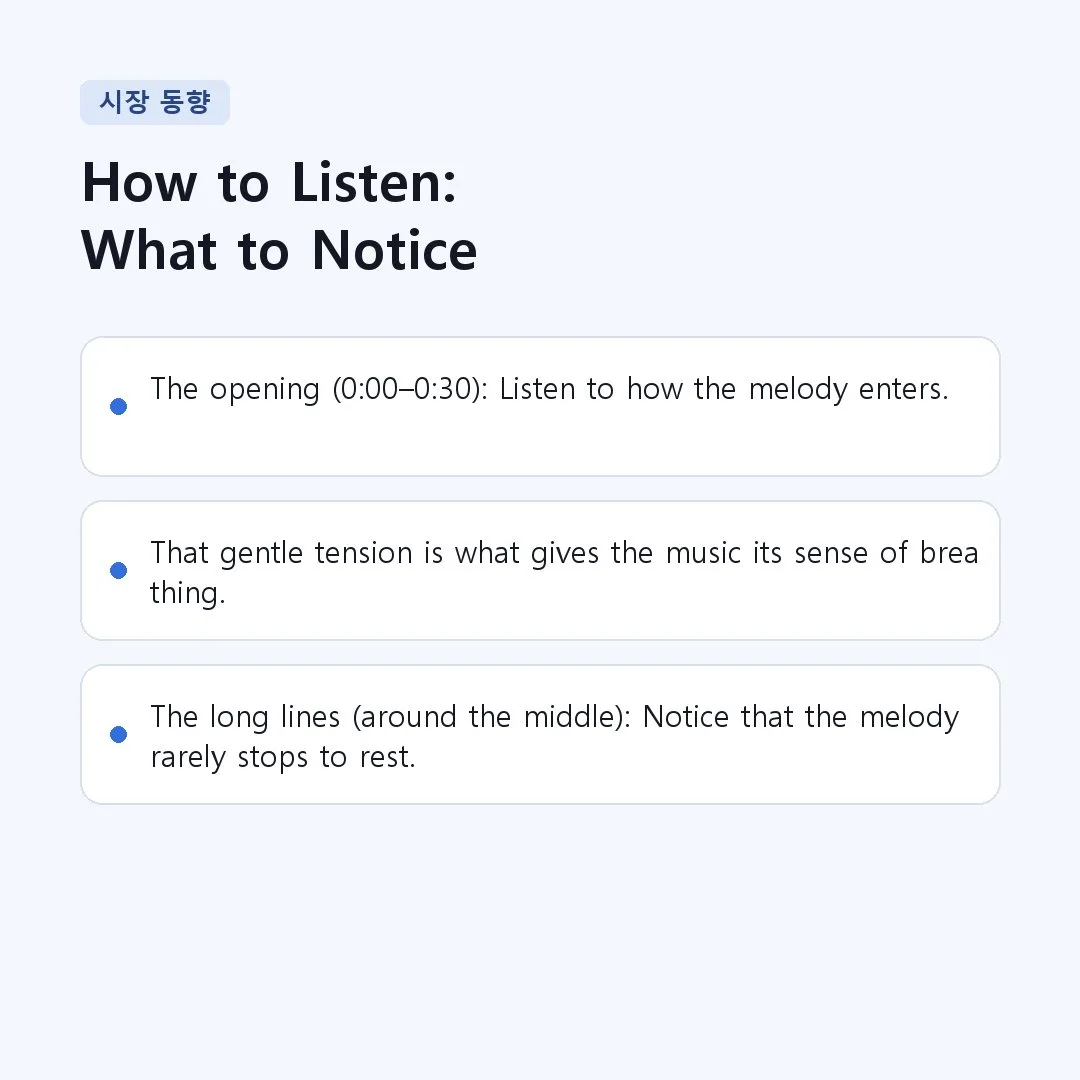
The opening (0:00–0:30): Listen to how the melody enters. The first violins reach upward and hold, while below them the bass line begins its slow, steady descent. Try to hear those two layers at once: the melody floating up, the foundation sinking down. That gentle tension is what gives the music its sense of breathing.
The long lines (around the middle): Notice that the melody rarely stops to rest. Phrases stretch and overlap, so just as one seems to finish, another has already begun. This is why the piece feels seamless, like a single continuous exhale rather than a series of separate notes.
The suspensions (throughout): Every so often you’ll hear a note that sounds slightly unresolved, a small ache, before it slides into place and settles. Those moments are called suspensions, and they’re the emotional heart of the piece. The brief tension, then the release, is exactly the feeling of relief, written into music.
The whole movement lasts only four to five minutes, which makes it perfect for a single deliberate pause in a long day.
Recordings Worth Your Time
There are two broad ways to hear this piece, and which you prefer says a lot about your mood.
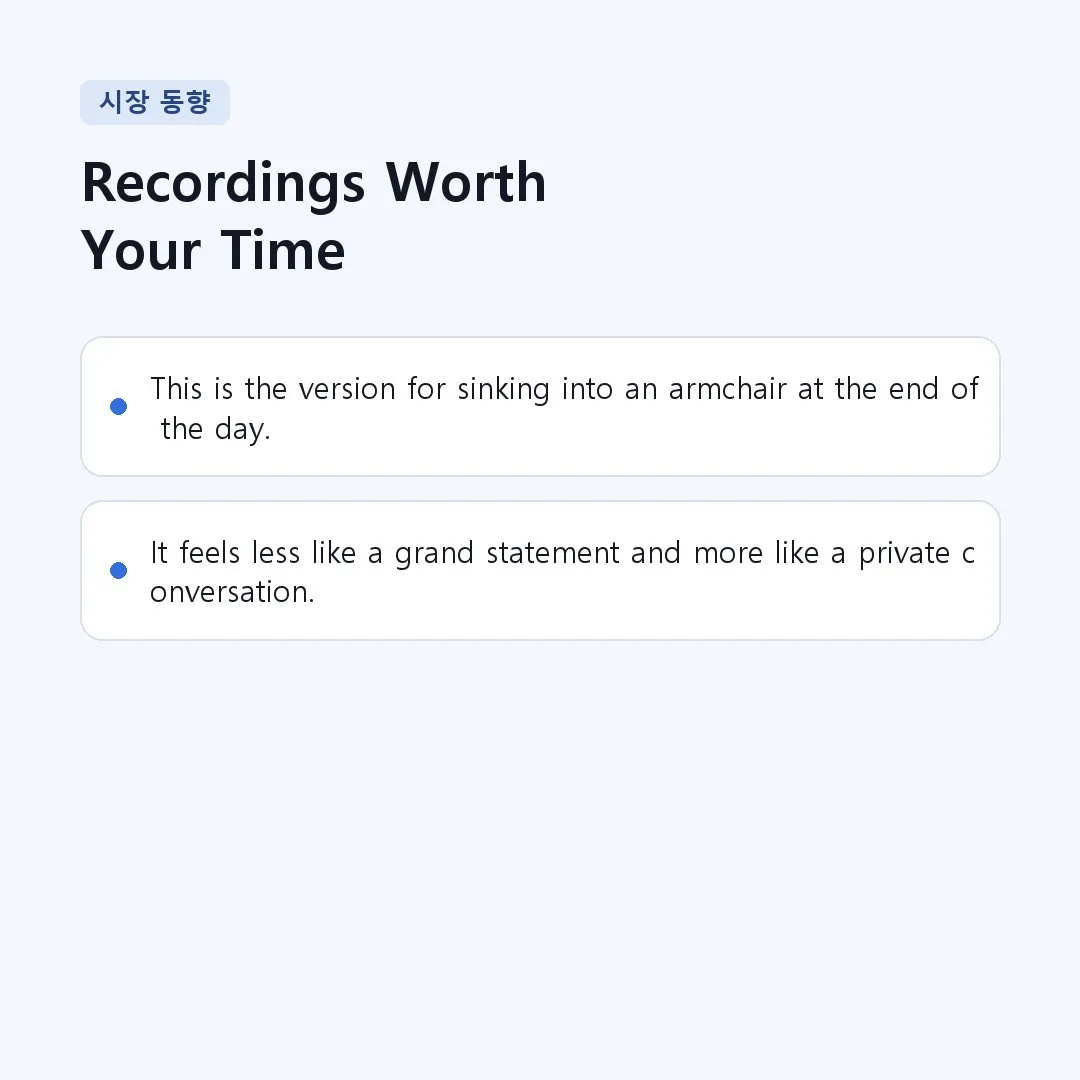
For a warm, romantic reading, try the Berliner Philharmoniker under Herbert von Karajan. The strings are lush and full, the tempo unhurried, the whole thing bathed in a golden glow. This is the version for sinking into an armchair at the end of the day.
For a lighter, more transparent sound, seek out a period-instrument ensemble such as the English Concert under Trevor Pinnock or Café Zimmermann. These groups use gut strings and historical bowing, producing a leaner, more intimate texture closer to what Bach’s own listeners would have heard. It feels less like a grand statement and more like a private conversation.
And if you want the famous “Air on the G String” arrangement specifically, almost any solo violinist’s recording of the Wilhelmj version will give you that deeper, single-string richness.

Why This Piece Stays With Us
Some music impresses you. This music takes care of you. That’s a rarer thing, and it’s why the Air has survived three centuries of changing tastes to become one of the few classical pieces almost everyone recognizes, even if they can’t name it.
Part of it is the structure, that steady descending bass holding everything up. Part of it is the lyricism, those long unbroken lines that mirror the rhythm of calm breathing. But mostly, I think, it’s the generosity of the thing. Bach wasn’t trying to dazzle anyone here. He was writing a moment of stillness into the middle of a grand, noisy suite, a small clearing of quiet.
So the next time the day feels like too much, you have somewhere to go. Four minutes, a pair of headphones, and a melody that has been quietly calming people since before your great-great-grandparents were born. Press play, and let it exhale for you.