📑 Table of Contents
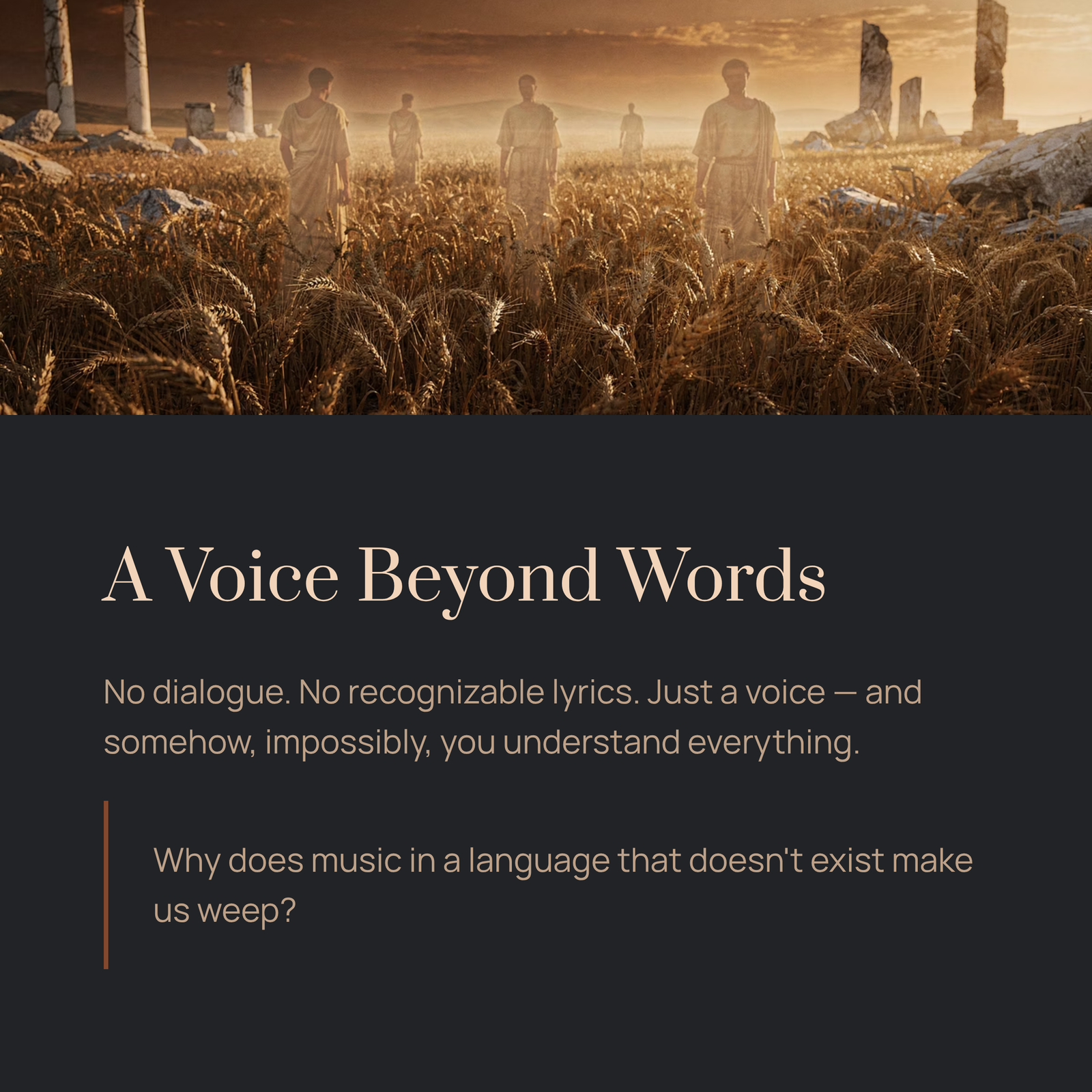
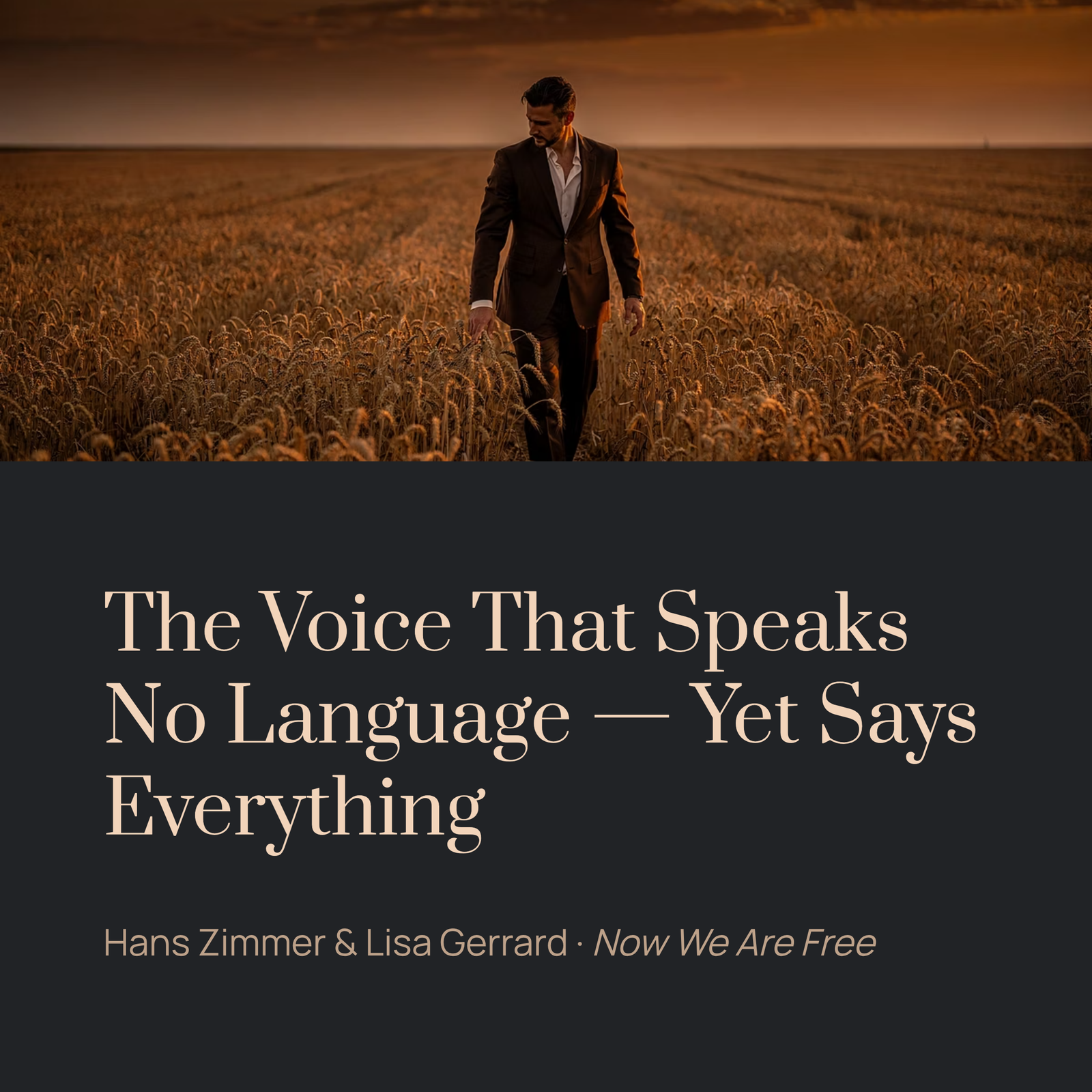
Close your eyes for a moment. Picture a man walking through an endless wheat field, his fingers trailing across the golden tops of grain swaying in warm wind. There is no dialogue. No exposition. Just a voice—otherworldly, ancient, neither singing words you recognize nor needing to. And somehow, impossibly, you understand everything.
This is the final scene of Ridley Scott’s Gladiator (2000), and the piece accompanying it is “Now We Are Free.” It is, without exaggeration, one of the most emotionally devastating pieces of music ever composed for film. Not because it tries to manipulate you, but because it does something far rarer—it releases you.
If you have ever listened to this track and felt tears arrive without warning, without any clear reason, you are not alone. And that mystery—why does music in a language that doesn’t even exist make us weep?—is exactly what makes this piece worth exploring.
Hans Zimmer and the Architecture of Emotion
Hans Zimmer needs little introduction to anyone who has watched a movie in the last three decades. Born in Frankfurt, Germany in 1957, he has become arguably the most influential film composer of his generation. His résumé reads like a tour through modern cinema’s greatest moments: The Lion King, Inception, Interstellar, The Dark Knight, Dune.
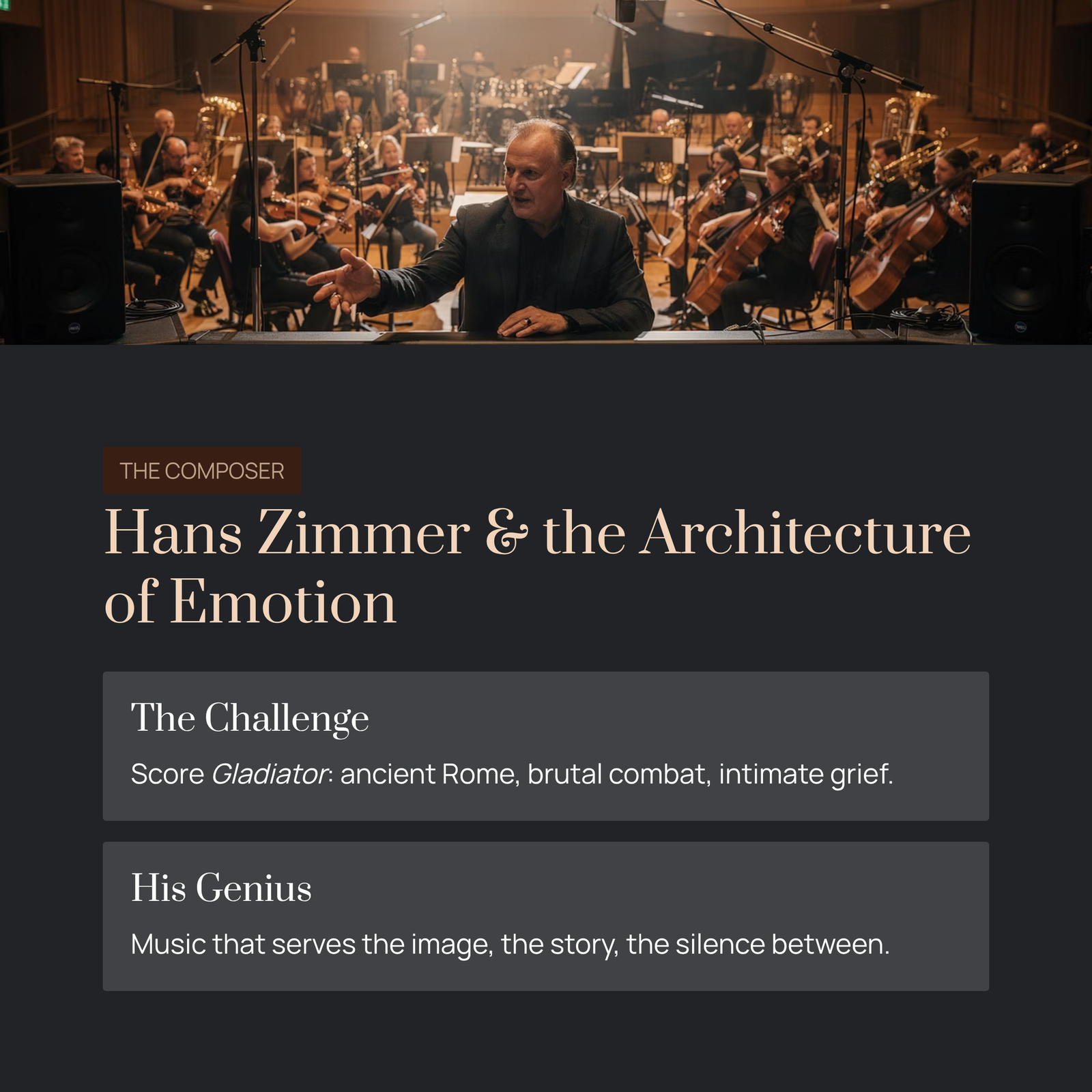
But Zimmer’s genius has never been about complexity for its own sake. Where classical composers might build elaborate fugues or dense counterpoint, Zimmer works with something more primal. He understands that film music exists in a fundamentally different space than concert music. It must serve the image, the story, the breath of a character—and sometimes, the silence between all of those things.
For Gladiator, Zimmer faced a particular challenge. The film tells the story of Maximus Decimus Meridius, a Roman general betrayed and enslaved, who fights his way through the gladiatorial arena seeking justice—and, ultimately, peace. The score needed to carry the weight of ancient Rome, the brutality of combat, and the intimate grief of a man who has lost everything he loved.
Zimmer knew he couldn’t do it alone. He needed a voice that sounded like it came from before recorded history.
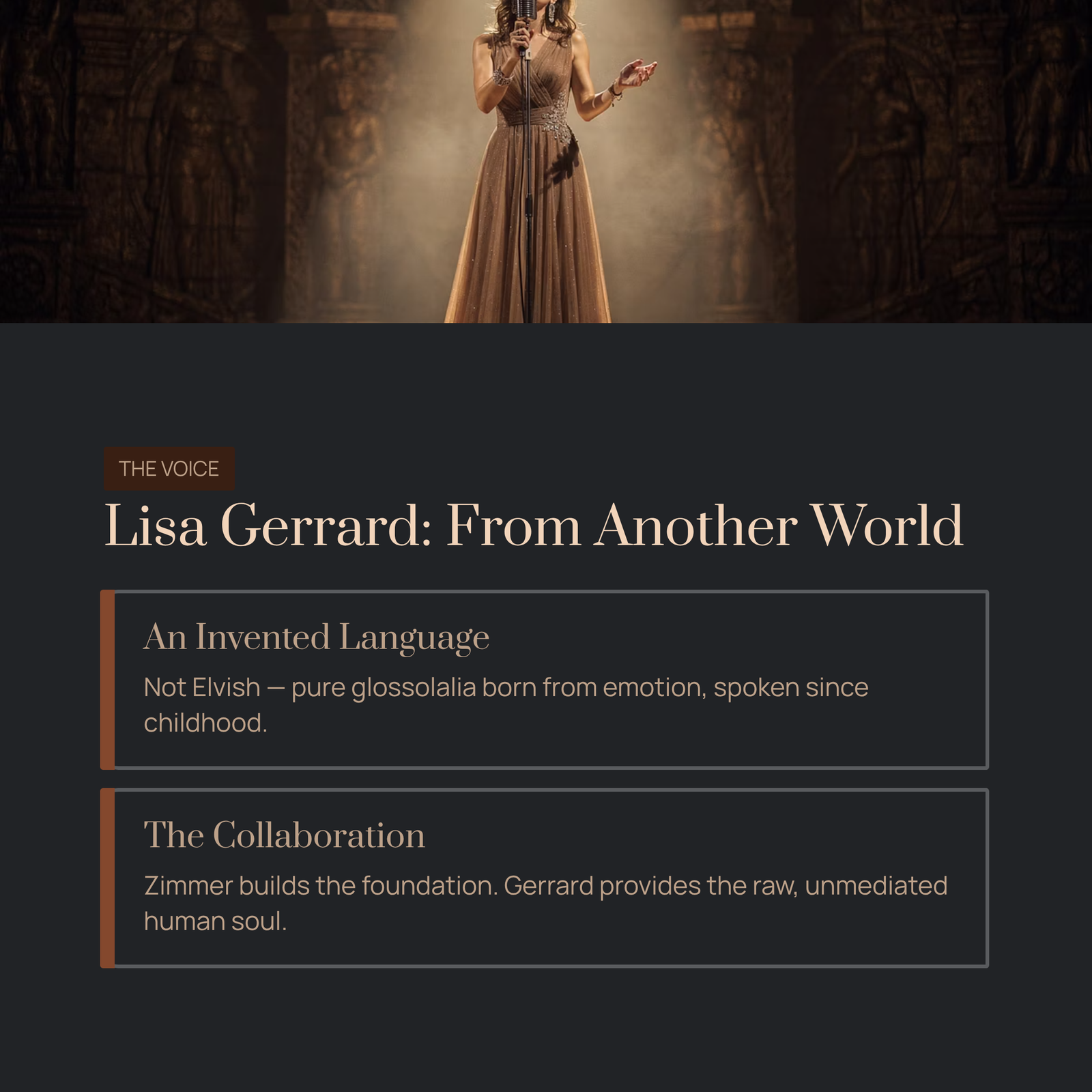
Lisa Gerrard: The Voice from Another World
Enter Lisa Gerrard—Australian musician, co-founder of the band Dead Can Dance, and the owner of one of the most extraordinary vocal instruments on the planet.
Gerrard does something that almost no other vocalist does: she sings in a language she invented herself. Not a constructed language with grammar and vocabulary like Tolkien’s Elvish, but something more intuitive—a glossolalia born from pure emotion. She has described it as a language she has spoken since childhood, a way of expressing feelings that sit beyond the reach of any existing words.
When Gerrard’s voice enters “Now We Are Free,” it transforms the piece from a beautiful film cue into something that feels sacred. The melody she carries is simple, almost folk-like, rising and falling with the gentle inevitability of breathing. You cannot translate what she is singing because there is nothing to translate. The meaning is the sound itself. The meaning is what happens inside your chest when you hear it.
This is what makes the collaboration between Zimmer and Gerrard so extraordinary. Zimmer builds the harmonic foundation—warm strings, gentle percussion, a bed of synthesized texture that feels both ancient and timeless. Gerrard provides the human element, the raw, unmediated expression of something words would only diminish.
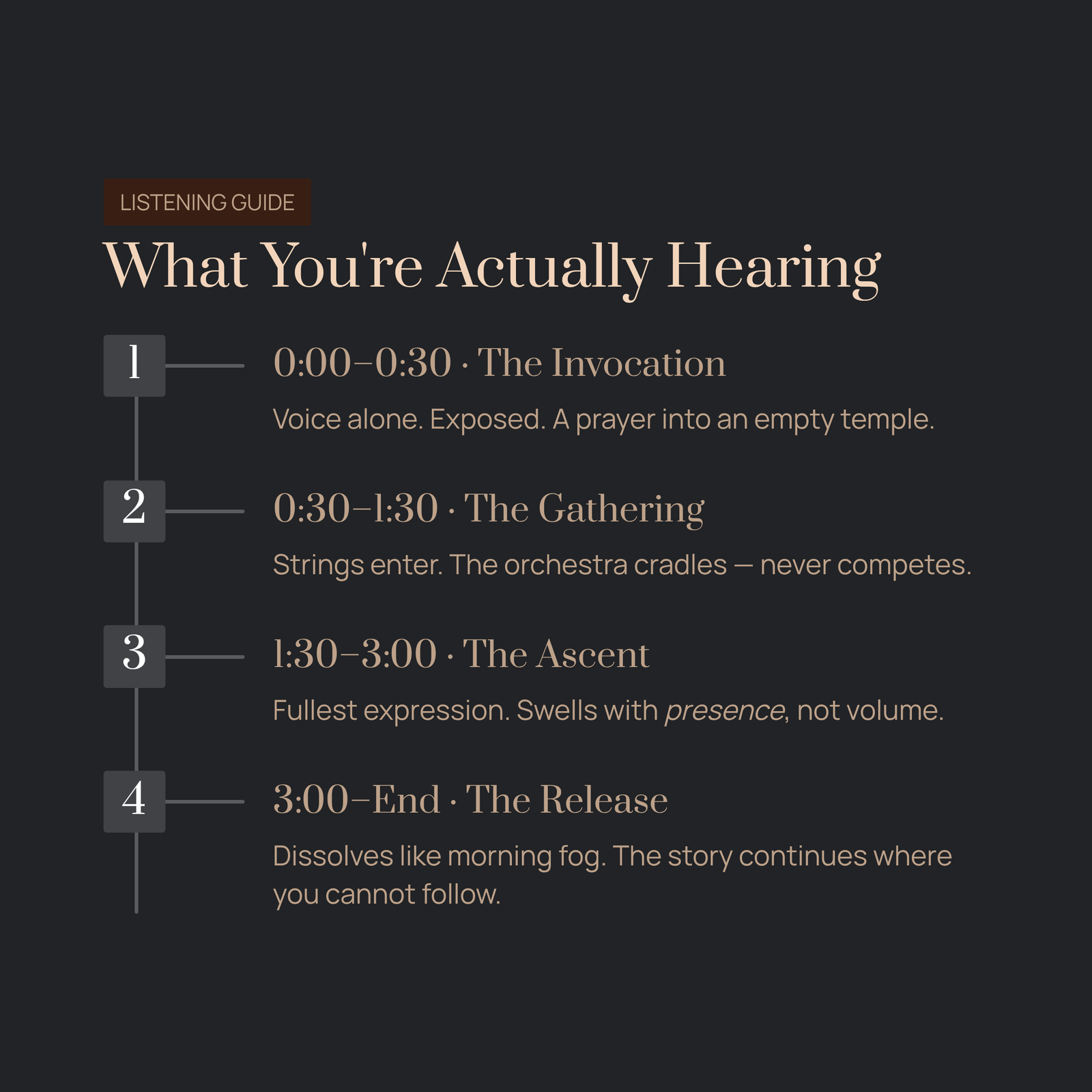
What You’re Actually Hearing: A Listening Guide
If you’re new to paying close attention to film scores, “Now We Are Free” is an ideal place to start. Here’s what to listen for:
0:00–0:30 — The Invocation.
The piece opens with Gerrard’s voice alone, unaccompanied, like a prayer spoken into an empty temple. Notice how exposed and vulnerable this feels. There is no orchestra to hide behind, no rhythm to lean on. Just a human voice and silence.
0:30–1:30 — The Gathering.
Strings and a subtle rhythmic pulse enter. The world begins to form around the voice. This is Zimmer’s craft at work—the orchestration doesn’t compete with Gerrard; it cradles her. Listen to how the low strings provide warmth without weight.
1:30–3:00 — The Ascent.
The melody reaches its fullest expression. Percussion deepens, the harmonic texture grows richer. And yet the piece never becomes loud in the way you might expect. It swells with presence rather than volume. This is the emotional core—the moment in the film where Maximus finally walks through that wheat field, finally touches the door of his home, finally reaches what was taken from him.
3:00–End — The Release.
The instrumentation gradually thins. Gerrard’s voice softens, the strings recede. The piece doesn’t end with a dramatic conclusion—it dissolves, like morning fog lifting from a valley. This is deliberate. The music doesn’t tell you the story is over. It tells you the story continues somewhere you cannot follow.
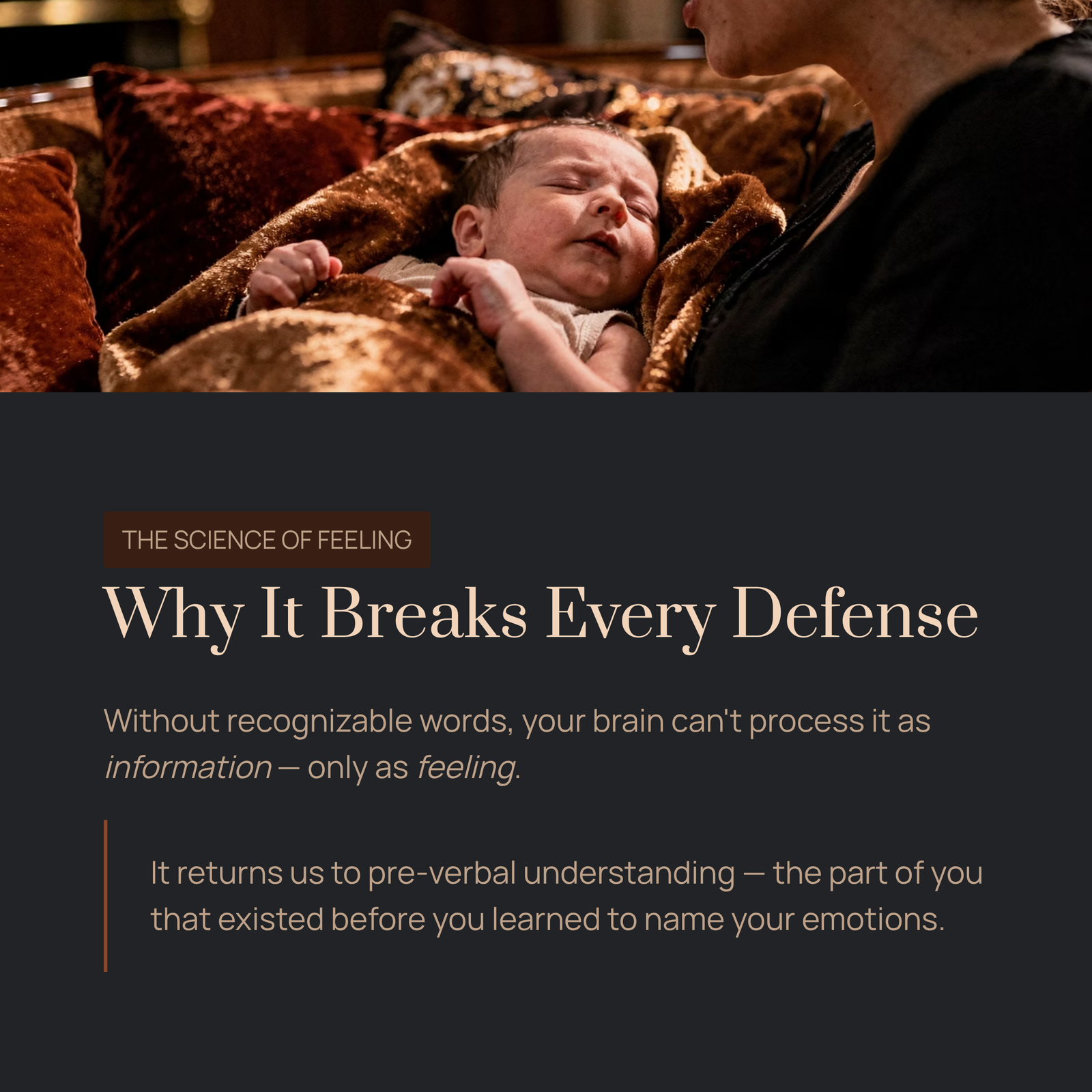
Why This Piece Breaks Through Every Defense
There is a reason “Now We Are Free” continues to appear on playlists for meditation, grief processing, and emotional healing, twenty-five years after its release. It operates on a level that bypasses our intellectual defenses entirely.
Most music communicates through a combination of melody, harmony, rhythm, and—crucially—lyrics. Words give us something to hold onto, something to analyze and agree or disagree with. But Gerrard’s invented language removes that handle completely. Without recognizable words, your brain cannot process the vocal as information. It can only process it as feeling.
This is remarkably similar to how we experience music as very young children, before language has fully formed. A lullaby works on an infant not because of its words but because of its contour, its warmth, its rhythm against a heartbeat. “Now We Are Free” returns us, briefly, to that state of pre-verbal understanding. It is music that speaks to the part of you that existed before you learned to name your emotions.
And in the context of the film, this choice is devastating. Maximus dies. He returns to his family in the afterlife. And the music that accompanies this reunion is not in Latin, not in English, not in any tongue of the living. It is in a language that belongs to no nation, no era, no empire. It is the language of pure release—the sound of someone finally, after unbearable suffering, coming home.
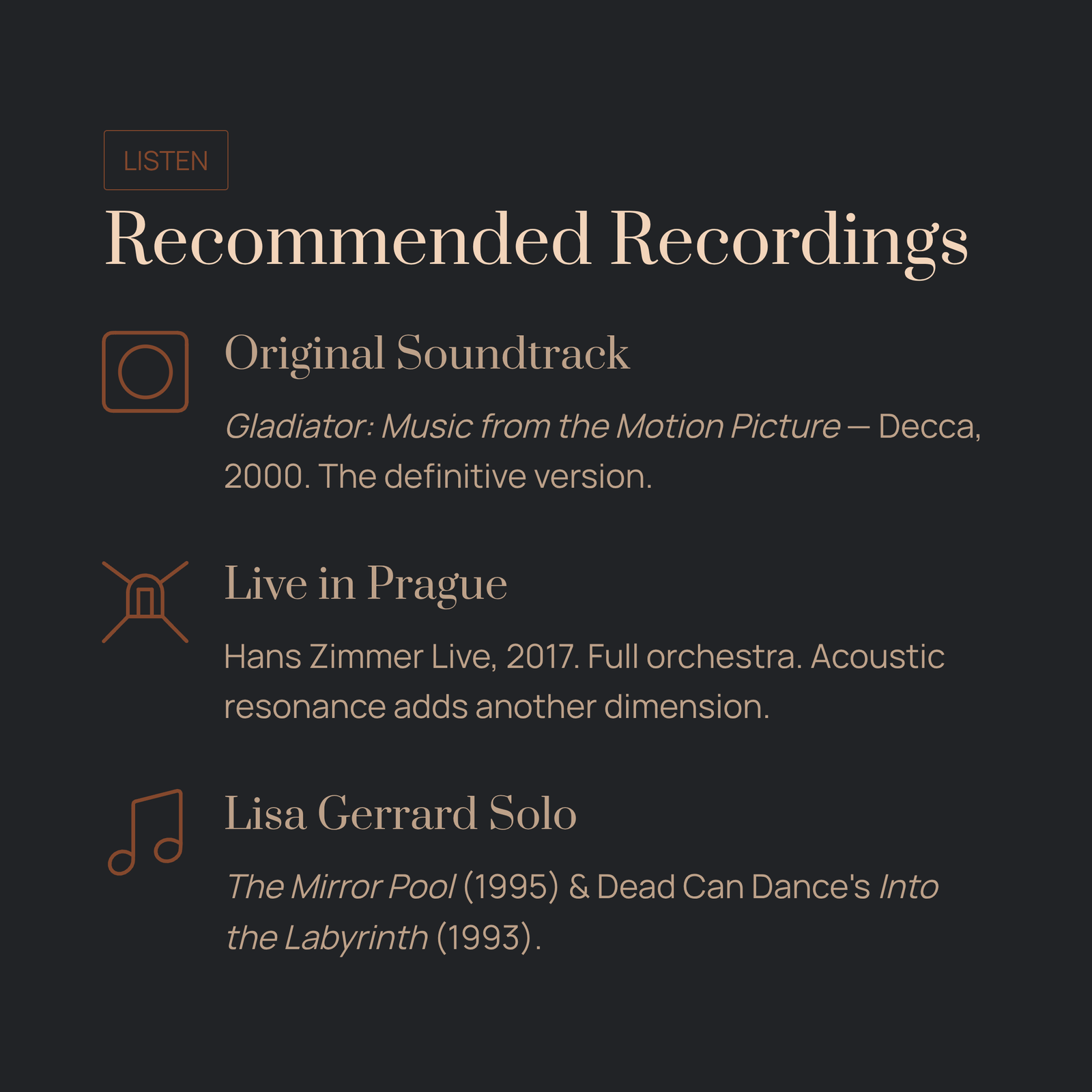
Recommended Recordings and Performances
The original soundtrack recording remains the definitive version. The Gladiator: Music from the Motion Picture album (Decca, 2000) captures the full richness of the studio production, with Gerrard’s voice balanced perfectly against Zimmer’s orchestration.
For a live experience, seek out Hans Zimmer’s concert tours—particularly the Hans Zimmer Live recordings, where “Now We Are Free” is often performed with full orchestra and a guest vocalist. The 2017 Prague concert and the Hans Zimmer Live in Prague recording offer particularly powerful renditions. There is something about hearing this piece performed live, with the acoustic resonance of a real hall, that adds yet another dimension to its emotional impact.
Lisa Gerrard’s solo work and her recordings with Dead Can Dance are also essential listening for anyone moved by her voice. Albums like The Mirror Pool (1995) and Dead Can Dance’s Into the Labyrinth (1993) explore similar territory—music that exists at the boundary between the ancient and the eternal.

The Wheat Field Inside You
Here is what I believe makes “Now We Are Free” more than a great film cue. It is more than a beautiful piece of music. It is an experience of permission.
So much of our daily life is spent holding things together—managing, performing, enduring. We carry grief we haven’t processed, longing we haven’t named, exhaustion we haven’t acknowledged. And then this piece arrives, in its invented language that asks nothing of your intellect, and it simply says: you can put it down now.
You don’t need to understand the words. You don’t need to know anything about Roman history or Hans Zimmer’s compositional technique or Lisa Gerrard’s musical philosophy. You just need to press play, close your eyes, and let the wheat field find you.
Some music teaches you something. Some music entertains you. And some music, very rarely, frees you.
This is that music.