📑 Table of Contents
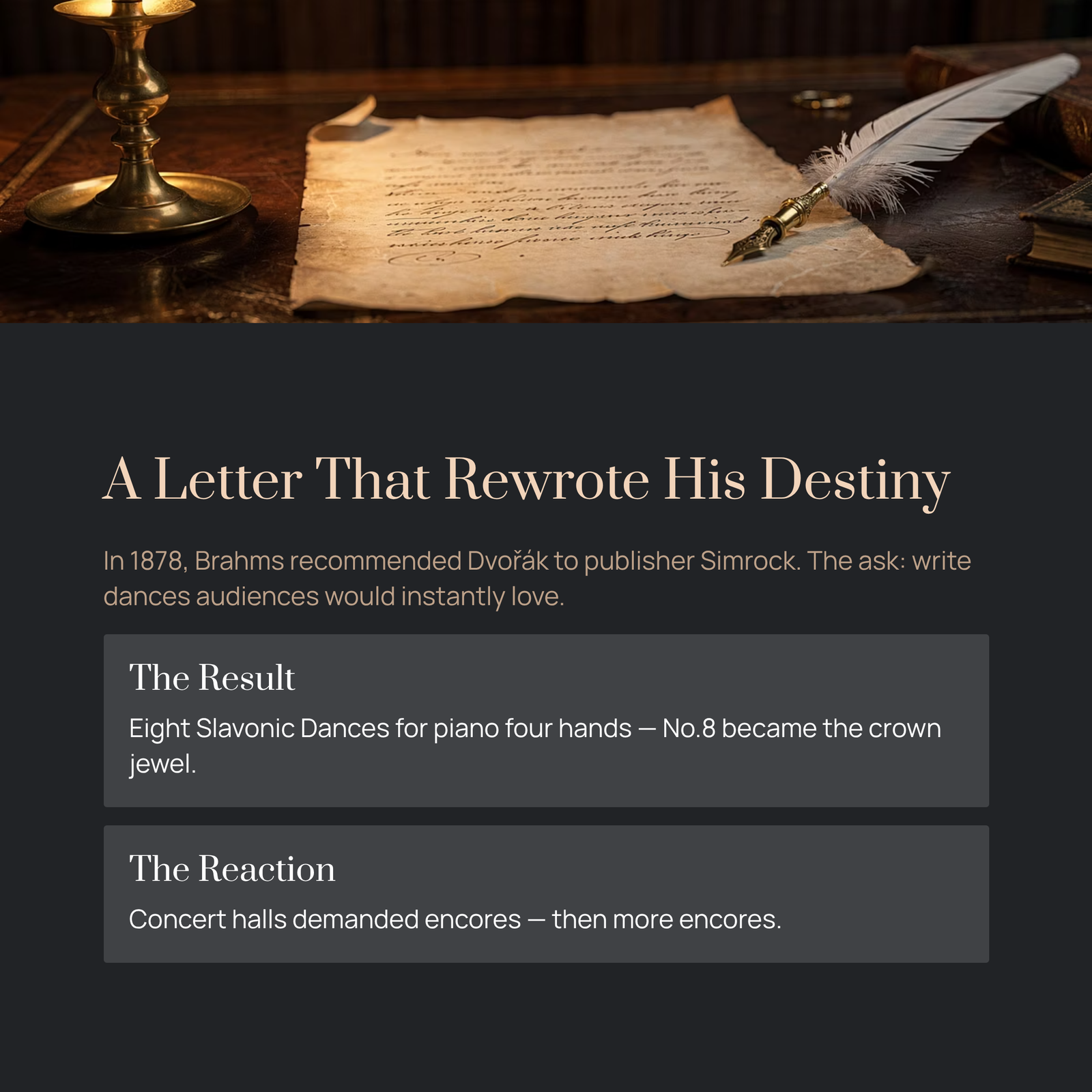
In 1878, a struggling Prague organist named Antonín Dvořák opened a letter that would rewrite his destiny. Johannes Brahms — the most powerful name in German music — had recommended him to his own publisher, Fritz Simrock. The catch? Simrock wanted something marketable, something audiences could immediately fall in love with. He wanted dances.
Dvořák didn’t hesitate. He sat down and poured every ounce of his Bohemian soul into a set of eight Slavonic Dances for piano four hands. The eighth and final piece — in G minor — became the crown jewel. When the orchestral version hit concert halls across Europe, audiences didn’t just applaud. They demanded encores. Then they demanded more encores.
This is the story of Op.46 No.8, a piece that sounds like the earth itself is spinning faster than it should.
A Composer Who Never Forgot Where He Came From
Dvořák (pronounced roughly “DVOR-zhahk”) grew up in a tiny village north of Prague. His father was a butcher and innkeeper. There was no grand piano in the parlor, no aristocratic patron writing checks. What there was, however, was music — folk music, everywhere, all the time. Village dances, pub songs, church hymns. It seeped into young Antonín’s bones before he could read a single note on paper.
Even after he’d become one of the most celebrated composers in Europe, Dvořák never tried to scrub away those roots. He didn’t imitate Beethoven’s heroism or Wagner’s mythology. Instead, he distilled the rhythms and melodies of Czech village life into something that could stand beside any German symphony. The Slavonic Dances are his most direct love letter to that heritage — and No.8 is the one where he stops writing politely and starts writing with fire.
What You’re Actually Hearing
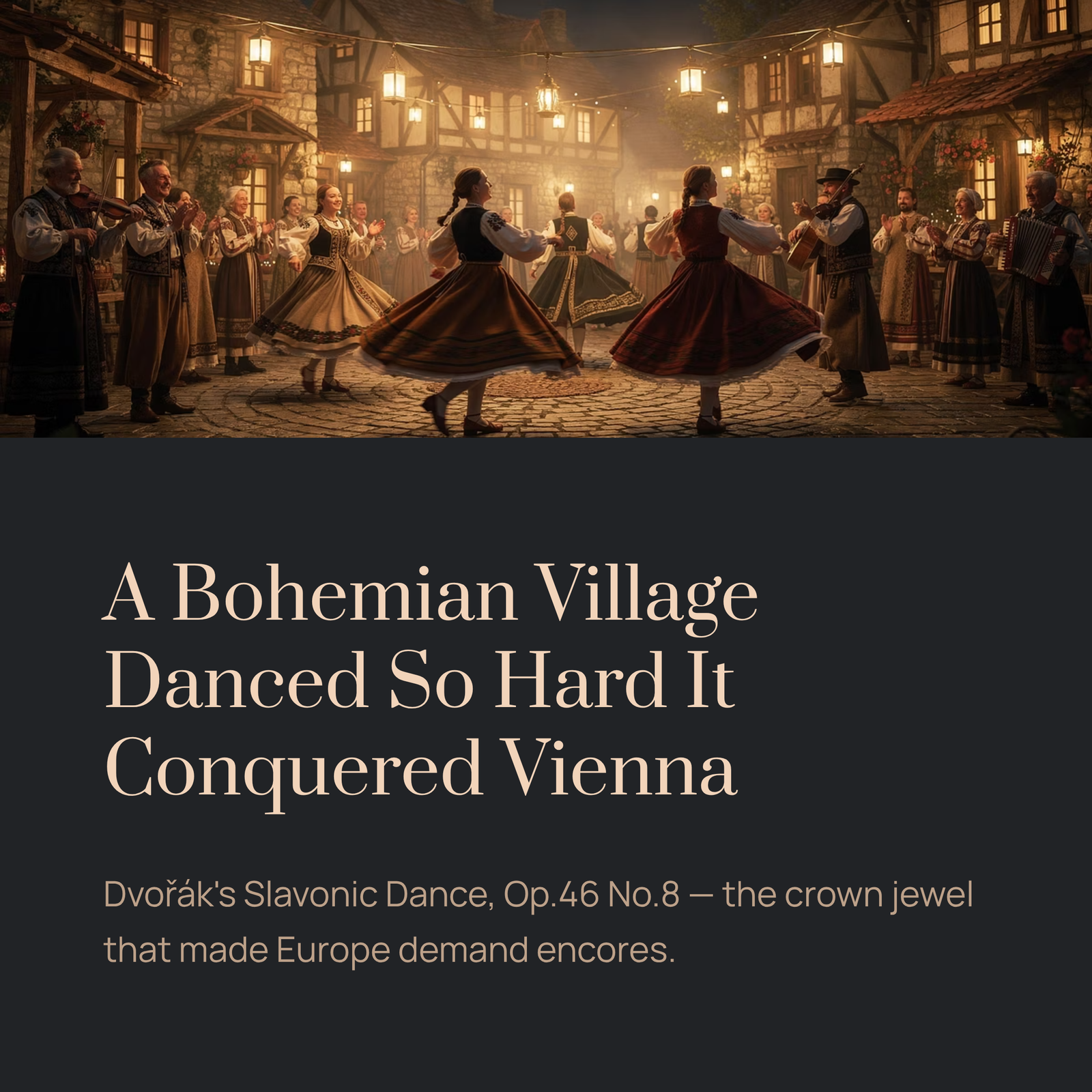
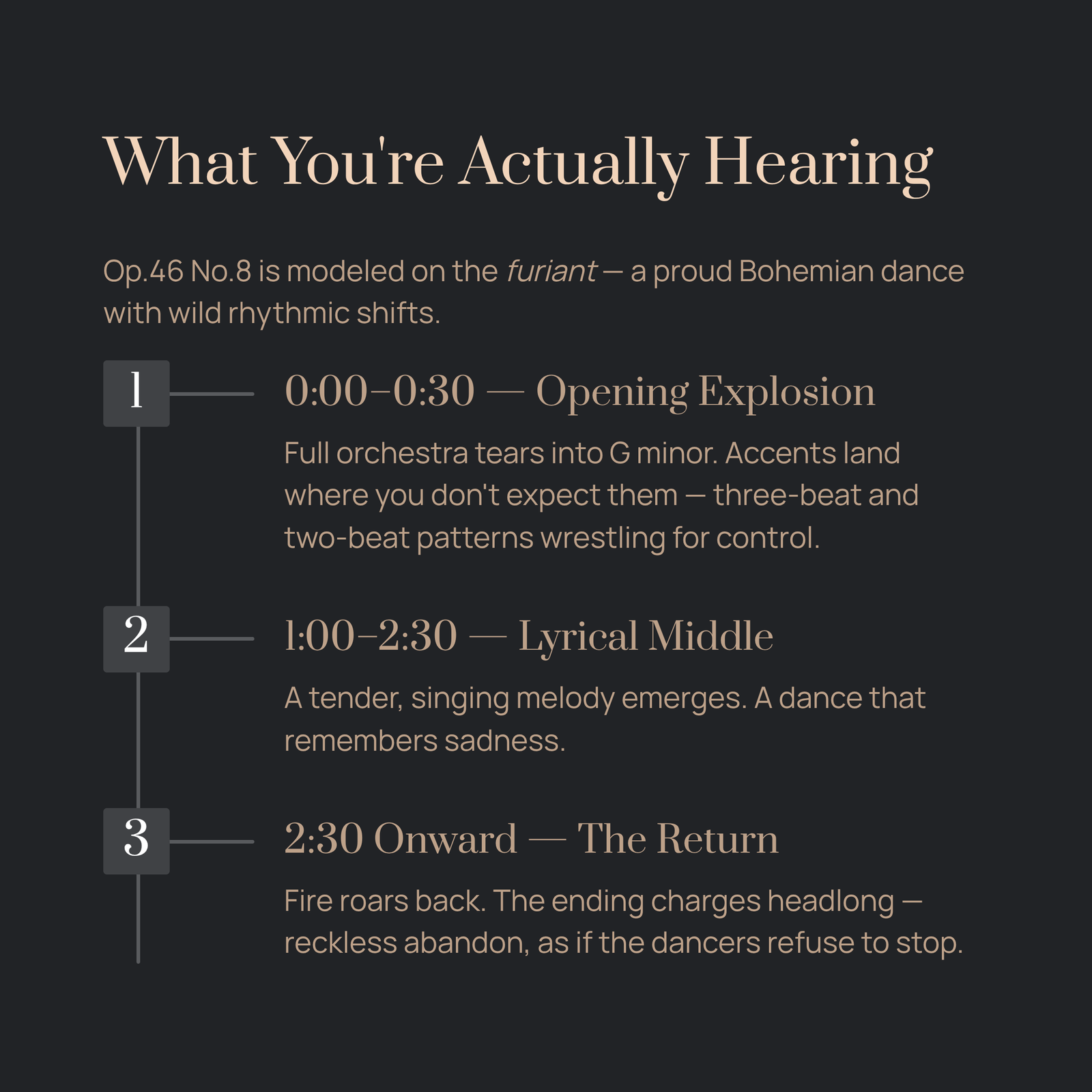
The Slavonic Dance No.8 in G minor is modeled on the furiant, a proud Bohemian dance characterized by wild rhythmic shifts. Imagine a village celebration where the dancers are so caught up in the music that the ground shakes. That’s the energy here.
The opening explosion (0:00–0:30): The piece launches without warning. The full orchestra tears into a G minor theme that’s equal parts fury and exhilaration. Pay attention to how the rhythm keeps tripping over itself — accents landing where you don’t expect them, three-beat and two-beat patterns wrestling for control. This rhythmic tug-of-war is the heartbeat of the furiant.
The lyrical middle (around 1:00–2:30): Just when the intensity feels almost unbearable, Dvořák pulls back the curtain on something achingly tender. A warm, singing melody emerges — often carried by strings or woodwinds — that feels like a memory of something gentle in the middle of all that wildness. This contrast is what elevates the piece from exciting to deeply moving. It’s not just a dance; it’s a dance that remembers sadness.
The return and finale (2:30 onward): The fire comes roaring back, but now it carries the weight of that lyrical interlude. The ending doesn’t fade; it charges headlong into its final bars with an almost reckless abandon, as if the dancers refuse to stop even as the night ends.
Why This Piece Still Hits So Hard
There’s a reason this particular Slavonic Dance has been an audience favorite for nearly 150 years, and it’s not just the infectious energy. It’s the emotional honesty. Dvořák doesn’t manipulate you with clever compositional tricks. He doesn’t need to. The joy is real joy. The melancholy is real melancholy. And the pride — that fierce, unapologetic pride in where he came from — radiates from every measure.
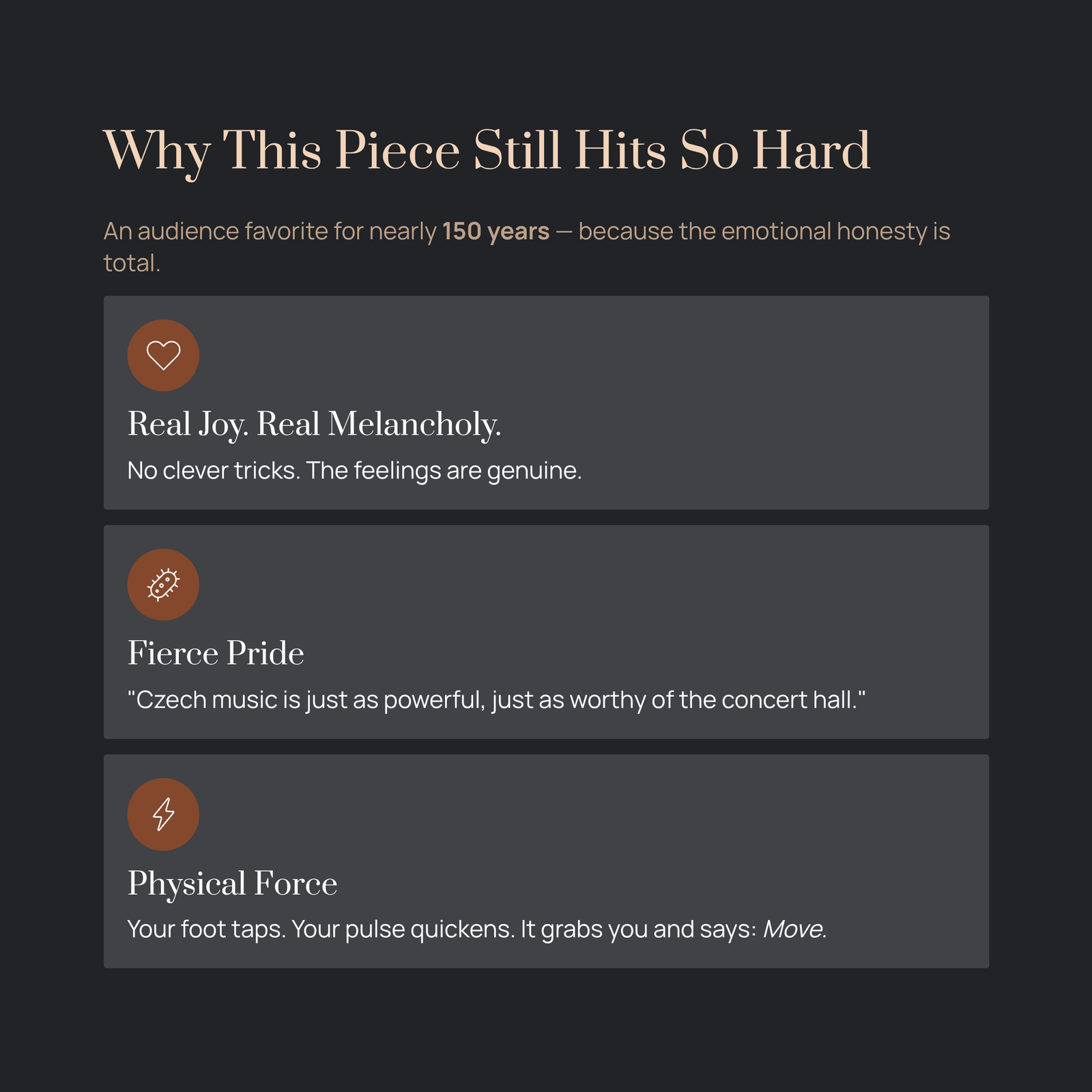
In a classical music world that often rewarded composers for sounding German, Dvořák stood up and said: Czech music is just as powerful, just as sophisticated, just as worthy of the concert hall. This piece is the proof.
There’s also something wonderfully physical about it. You feel it in your body. Your foot taps. Your pulse quickens. In an era where classical music can sometimes feel like it asks you to sit still and be reverent, Op.46 No.8 grabs you by the collar and says: Move.
How to Listen: Three Ways In
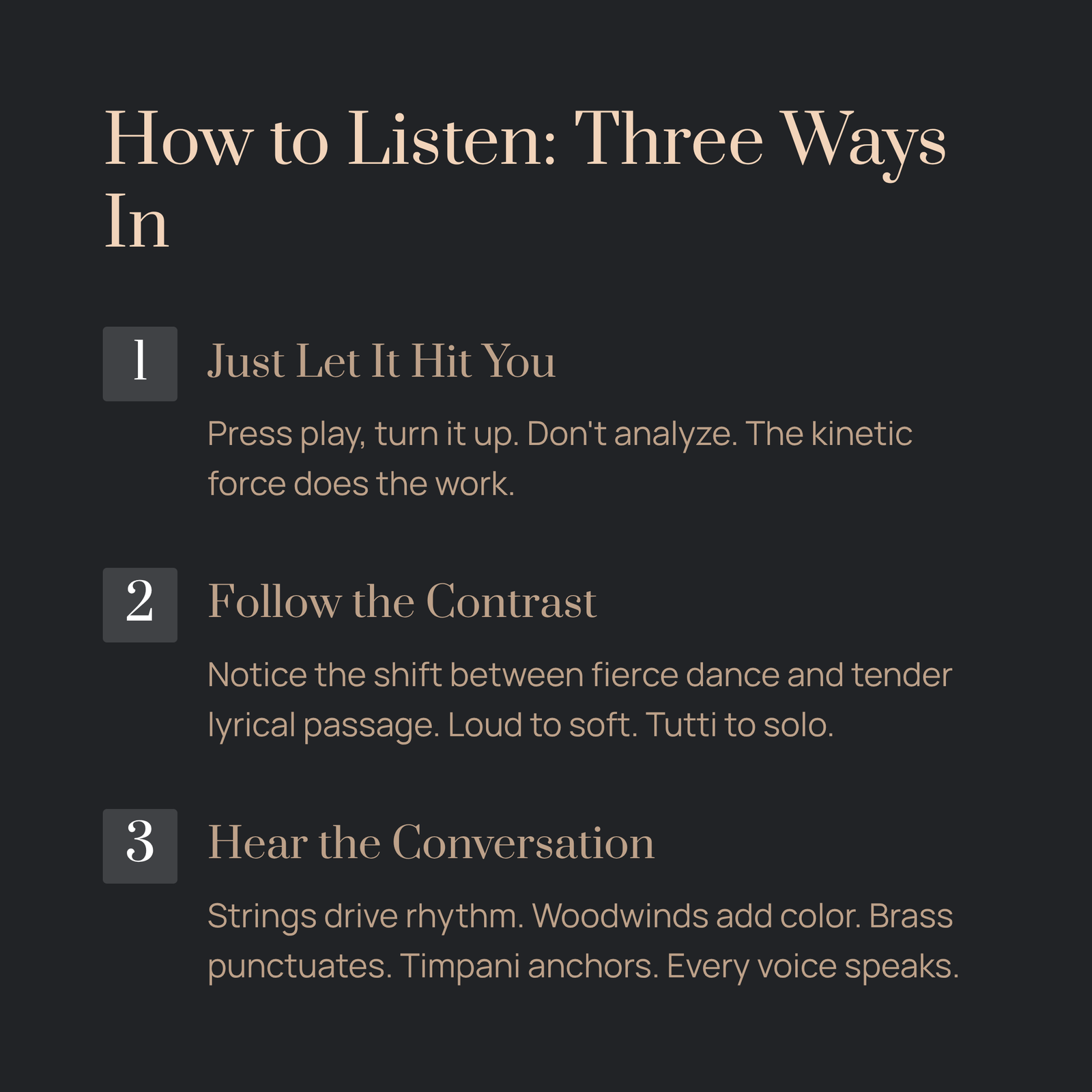
First listen — just let it hit you. Don’t analyze. Don’t count beats. Press play, turn it up, and let the sheer kinetic force of the music do its work. You’ll know within thirty seconds whether this piece speaks to you (spoiler: it will).
Second listen — follow the contrast. This time, pay attention to the shift between the fierce dance sections and the tender lyrical passage in the middle. Notice how Dvořák uses dynamics — loud to soft, tutti to solo — to create dramatic tension. The architecture is deceptively simple but emotionally precise.
Third listen — hear the conversation. Focus on individual instruments. The strings drive the rhythm, but listen for the woodwinds adding color, the brass punctuating climactic moments, and the timpani anchoring the pulse. Dvořák was a master orchestrator, and every instrumental voice has something specific to say.
Recordings Worth Your Time
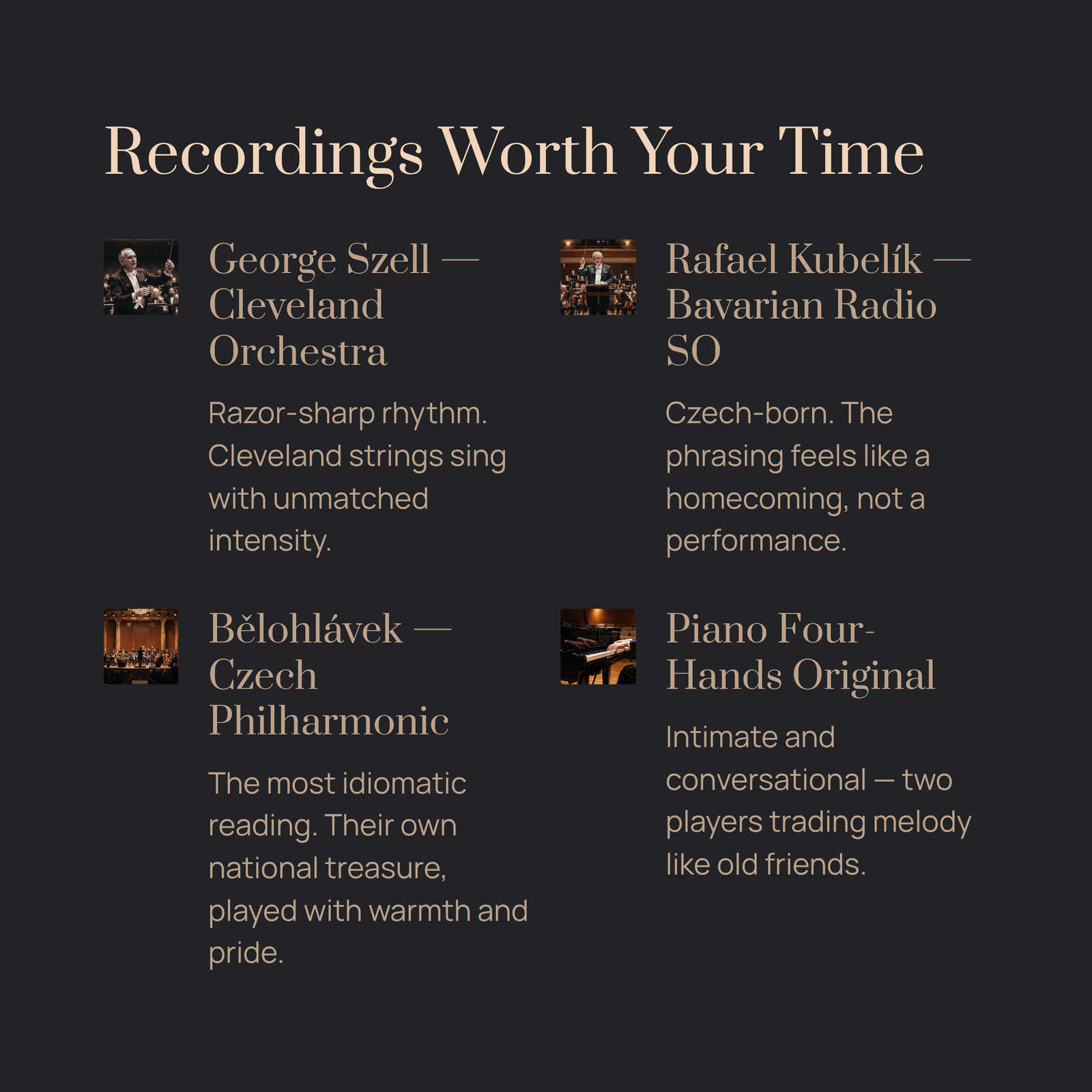
George Szell with the Cleveland Orchestra — A legendary reading that balances precision with raw excitement. Szell’s sense of rhythm is razor-sharp, and the Cleveland strings sing with an intensity that’s hard to match.
Rafael Kubelík with the Bavarian Radio Symphony Orchestra — Kubelík was Czech himself, and you can hear it. There’s an authenticity to the phrasing, a natural swing in the rhythms that feels less like a performance and more like a homecoming.
Jiří Bělohlávek with the Czech Philharmonic — For the most idiomatic interpretation, it’s hard to beat the Czech Phil playing their own national treasure. Bělohlávek brings warmth and pride in equal measure.
For a different texture, seek out the original piano four-hands version. It’s more intimate, almost conversational — two players sharing a single keyboard, trading the melody back and forth like old friends finishing each other’s sentences.
A Small Piece That Carries a Whole World
Dvořák’s Slavonic Dance No.8 runs barely five minutes. It doesn’t demand the commitment of a symphony or the patience of an opera. But within those five minutes, an entire world unfolds — village squares and starlit skies, stamping feet and whispered prayers, fierce pride and quiet longing.
This is what the best classical music does. It doesn’t just represent emotions. It becomes them. And when the final chord rings out with that almost defiant G major resolution, you’re left with something that feels less like the end of a piece and more like the beginning of an obsession.
Press play. Let the Bohemian fire do the rest.