📑 Table of Contents
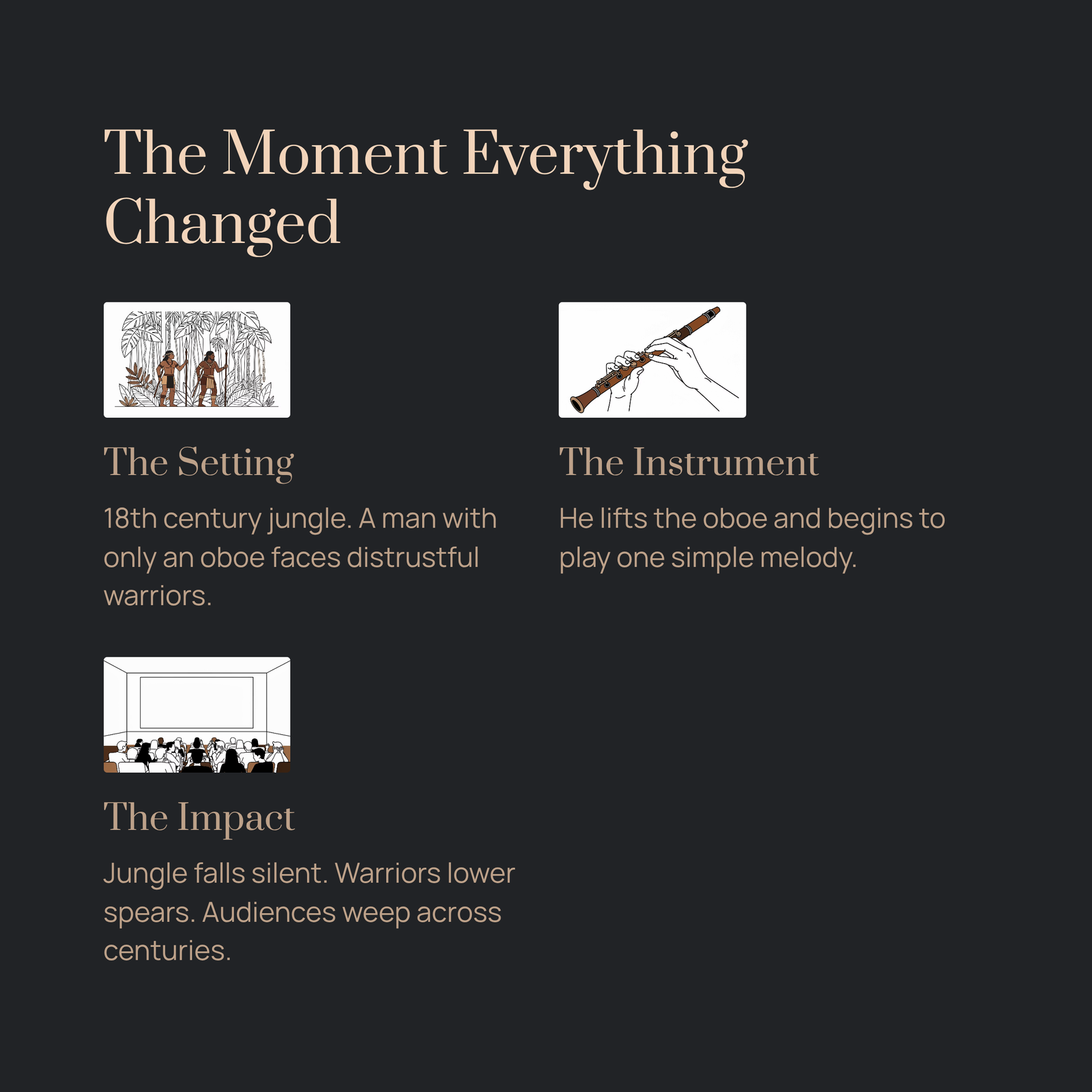
Imagine a dense South American jungle in the 18th century. A man stands on a cliff’s edge, alone, surrounded by indigenous people who have every reason to distrust him. He has no weapon, no shield, no words they would understand. All he has is a wooden oboe — and one melody.
He lifts the instrument to his lips and begins to play.
The jungle falls silent. The birds pause. The warriors lower their spears. And somewhere across centuries, sitting in a darkened movie theater in 1986, audiences held their breath and wept.
That melody is Gabriel’s Oboe, and the man who composed it — Ennio Morricone — understood something profound about music: sometimes a single, unadorned line of notes can reach deeper into the human soul than any symphony ever could.
Who Was Ennio Morricone?
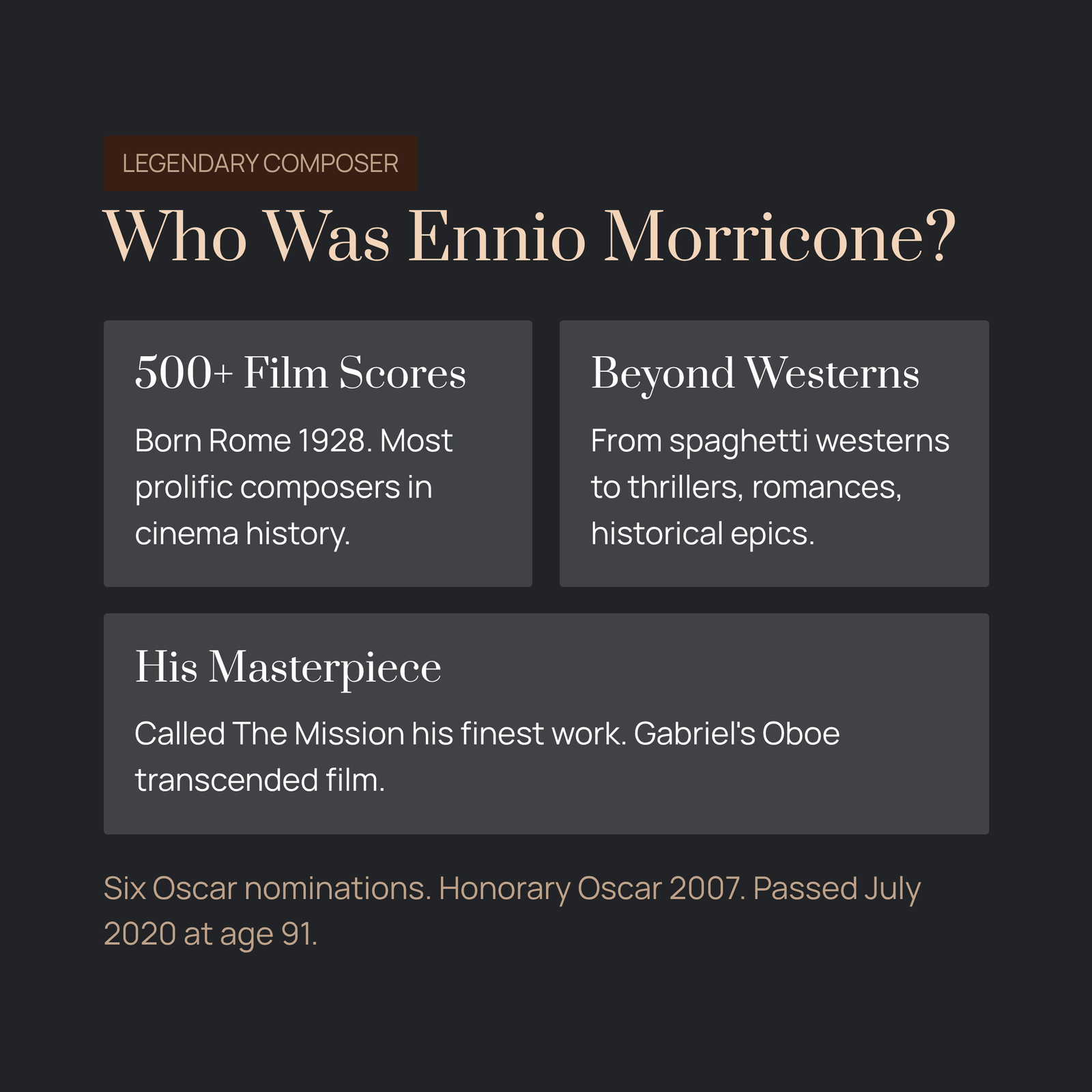
If you’ve watched a movie in the last sixty years, you’ve almost certainly heard Ennio Morricone’s music — even if you didn’t know his name. Born in Rome in 1928, Morricone composed over 500 film scores throughout his legendary career, making him one of the most prolific and influential composers in cinema history.
Most people associate him with Sergio Leone’s spaghetti westerns — those iconic, whistling themes from The Good, the Bad and the Ugly that practically invented a genre. But Morricone was never a one-trick composer. He moved fluidly between genres, from thrillers to romances, from horror to historical epics. He had an uncanny ability to find the exact emotional frequency a story needed and translate it into sound.
Yet for all his hundreds of scores, Morricone himself often pointed to The Mission as his finest work. And at the heart of that score lies Gabriel’s Oboe — a piece so achingly beautiful that it transcended its origins as film music and entered the repertoire of concert halls worldwide.
He was nominated for six Academy Awards before finally receiving an honorary Oscar in 2007. When he passed away in July 2020 at the age of 91, the world lost not just a film composer, but a musical architect who reshaped how we experience stories.
The Story Behind the Music
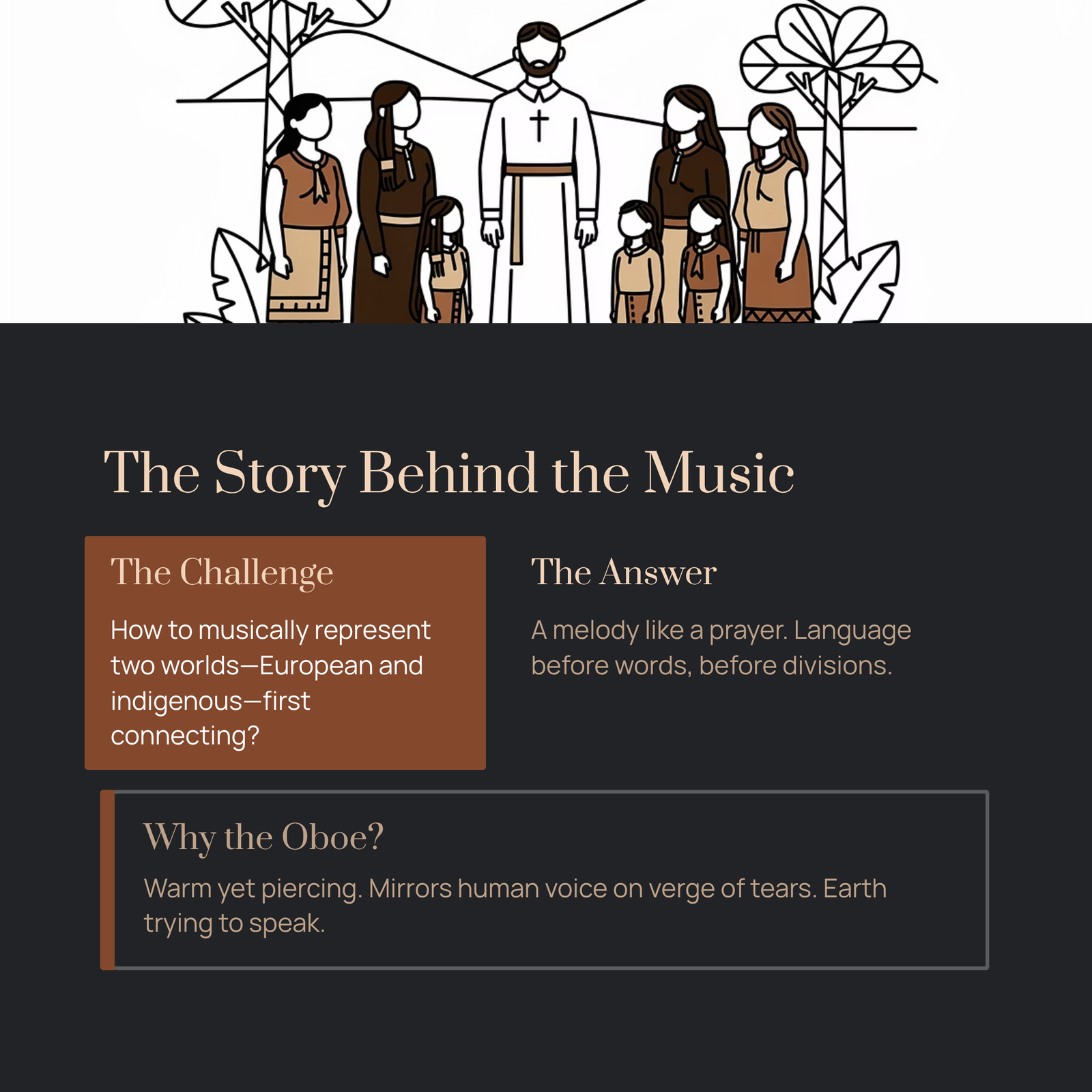
The Mission, directed by Roland Joffé, tells the story of Father Gabriel, a Jesuit missionary who ventures into the South American wilderness in the 1750s to build a mission among the Guaraní people. The film explores themes of faith, colonialism, redemption, and the collision between the spiritual and the political.
Morricone faced a fascinating challenge: how do you musically represent the moment when two completely different worlds — European and indigenous — first connect? His answer was breathtakingly simple. Rather than composing something grand or complex, he wrote a melody that sounds almost like a prayer. It’s as if the oboe is speaking a language that exists before words, before culture, before the divisions that separate people from one another.
There’s a reason Morricone chose the oboe for this theme. The oboe has a quality unlike any other instrument — warm yet piercing, human yet otherworldly. Its tone sits in a register that closely mirrors the human voice, particularly a voice on the verge of tears. When you hear Gabriel’s Oboe, you’re not just listening to music. You’re hearing something that sounds like the earth itself is trying to speak.

How to Listen: Finding the Layers
Gabriel’s Oboe rewards repeated listening. Each time you return to it, something new reveals itself. Here are a few ways to deepen your experience with this piece.
First listen — just breathe. Don’t analyze anything. Don’t read along. Just close your eyes and let the melody wash over you. Notice where it makes your chest tighten, where your breath changes. The piece is only about three minutes long, but those three minutes can feel like an entire lifetime compressed into sound.
Second listen — follow the oboe’s breath. The melody has a quality of breathing — it rises and falls in phrases that mirror human respiration. Pay attention to the pauses between phrases. Morricone understood that silence is as much a part of music as sound. Those brief moments of quiet between notes are where the emotion lives.
Third listen — notice the accompaniment. Beneath the oboe, strings provide a gentle, almost hymn-like harmonic foundation. They don’t compete with the melody; they cradle it. Listen to how the harmony subtly shifts, creating moments of tension and release that mirror the emotional arc of longing, hope, and quiet sorrow.
The key moment comes near the middle of the piece, where the melody reaches its highest point. It’s not a dramatic climax — there are no crashing cymbals or thundering drums. Instead, the oboe simply reaches upward, as if stretching toward something just beyond its grasp, and then gently descends. That single gesture contains more emotional truth than many composers achieve in an entire symphony.
A Personal Reflection
There are pieces of music that you admire and pieces that you carry with you. Gabriel’s Oboe belongs to the second category for countless listeners around the world. What makes it so universally moving? I think it’s because Morricone stripped away everything unnecessary. There’s no virtuosic display, no complex counterpoint, no orchestral fireworks. There’s just a melody — honest, vulnerable, and completely exposed.
In a world that often rewards complexity and volume, Gabriel’s Oboe reminds us that the most powerful things are often the simplest. It’s the musical equivalent of a hand extended in peace, a whispered confession, a wordless understanding between strangers.
Morricone once said that he wanted this melody to represent “the possibility of communication between different peoples.” Listening to it decades later, it’s clear he achieved something even greater. He composed a piece that communicates across time itself — reaching listeners who were not yet born when he first set pen to paper, moving them just as deeply as it moved those first audiences in 1986.
Recommended Recordings and Performances
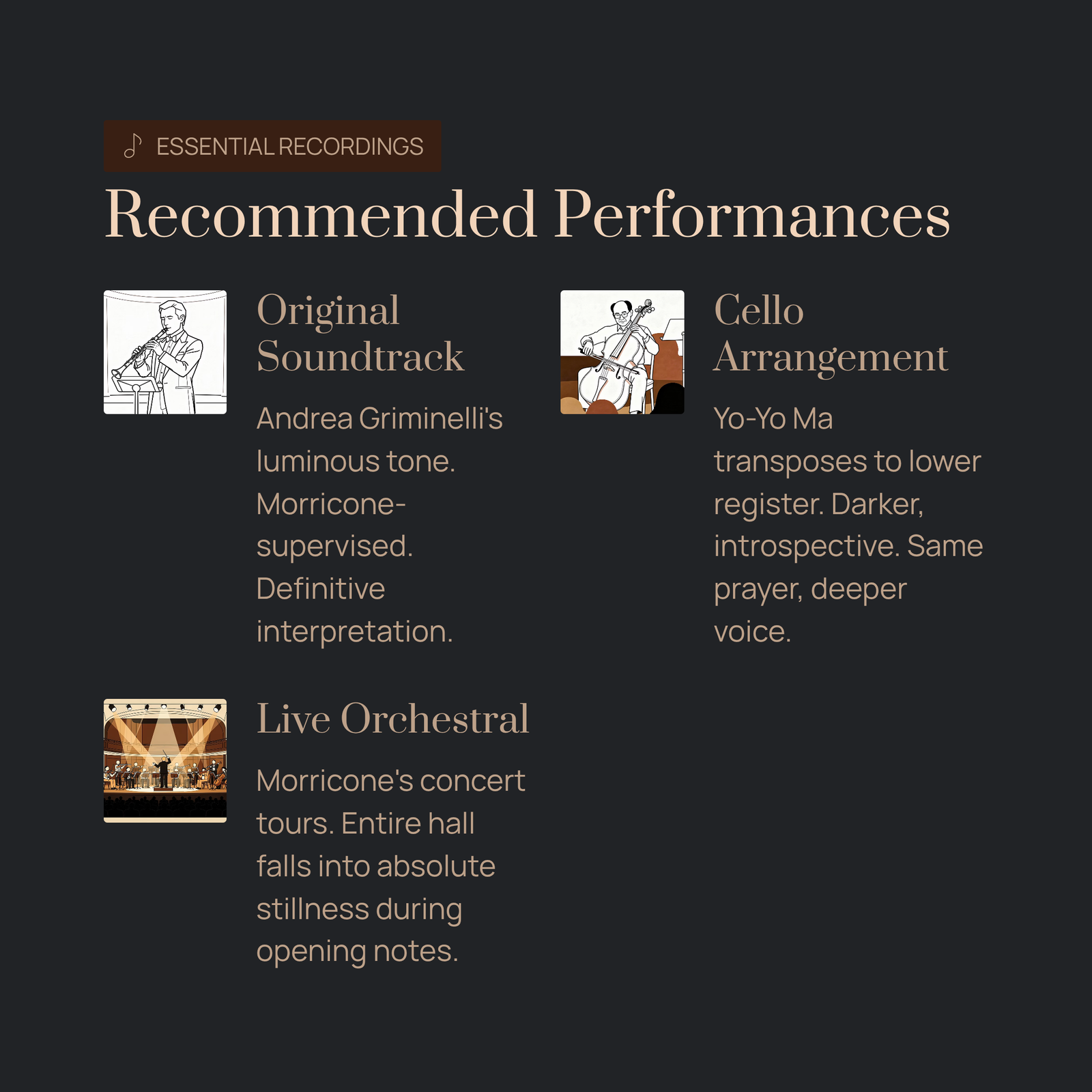
For your first encounter, seek out the original film soundtrack performed by the oboist Andrea Griminelli, whose tone is luminous and deeply expressive. This is the version Morricone personally supervised, and it remains the definitive interpretation.
For a different perspective, Yo-Yo Ma’s arrangement for cello (from his album Yo-Yo Ma Plays Ennio Morricone) transposes the melody into a lower register, giving it a darker, more introspective quality — like hearing the same prayer spoken in a deeper voice.
If you want to experience the piece in a live orchestral context, search for recordings from Morricone’s concert tours, where he often performed it as the emotional centerpiece of the program. Watching an entire concert hall fall into absolute stillness during those opening notes is something that recordings alone can’t fully capture — but they come remarkably close.
The Silence After the Last Note
There’s an old saying among musicians: the most important part of any performance is the silence after the last note fades. Gabriel’s Oboe embodies this truth completely. When the final phrase dissolves into stillness, you’ll find yourself sitting in that silence, unwilling to break it — as though the music has opened a door to some quiet, sacred place inside you that you’d forgotten existed.
That, perhaps, is Morricone’s greatest gift. Not just the melody itself, but the space it creates within you. A space for reflection, for feeling, for remembering what it means to be genuinely moved by something as simple and as profound as a single voice singing without words.