📑 Table of Contents
We tend to imagine Franz Liszt as a thunderstorm in a tailcoat: the original rock star of the nineteenth century, scattering snapped piano strings and swooning admirers across Europe. So here is the surprise. The piece I want to share with you contains almost none of that. No fireworks, no roaring octaves, no chest-beating drama.
Instead, picture sunlight breaking on moving water. Tiny droplets catching the light, scattering, falling, and catching it again. That is the world of Les jeux d’eau à la Villa d’Este — “The Fountains of the Villa d’Este.” And the strangest thing about it is when it was written: in 1877, by a man in his mid-sixties who had every reason to coast on past glory, and instead chose to invent something the musical world had never quite heard before.
If you have ever needed music that holds your attention without demanding it — something to think to, work to, or simply breathe to — let me introduce you to one of the most quietly radical pieces ever written for the piano.

The Showman Who Became a Mystic
To understand why this piece matters, you have to know how far Liszt had traveled to write it.
In his twenties and thirties, Liszt was the most famous performer alive. Audiences fainted. Women fought over his discarded gloves. He earned and gave away fortunes. He more or less invented the solo piano recital as we know it. If you wanted spectacle, Liszt was the spectacle.
But the second half of his life took a turn almost no one expected. He stepped back from the concert circuit, settled for long stretches in Rome, and in 1865 took minor orders in the Catholic Church, becoming known as the Abbé Liszt. The man who had once electrified ballrooms now spent his days closer to prayer than to applause.
The music followed him inward. His late works grew stranger, sparer, and more searching — harmonically adventurous in ways that wouldn’t be fully understood until composers decades later caught up with him. Les jeux d’eau belongs to this final chapter. It is the work of someone who no longer needed to prove anything, and so was free to listen for something subtler.
A Renaissance Garden, Captured in Sound
The Villa d’Este is a sixteenth-century estate in Tivoli, just outside Rome, famous above all for its terraced hillside gardens and their astonishing fountains — hundreds of jets, pools, and cascades engineered to make water dance. Liszt was a frequent and welcome guest there, staying at the invitation of Cardinal Gustav von Hohenlohe.
He clearly fell in love with the place. And in 1877 he translated what he saw into music, making Les jeux d’eau the fourth piece of the third and final book of his lifelong piano cycle Années de pèlerinage, or “Years of Pilgrimage” — a musical travel diary he assembled across four decades of his life.
But here is the detail that turns a pretty picture into something deeper. Into the score, above the music, Liszt wrote a line of Latin from the Gospel of John: “Sed aqua quam ego dabo ei, fiet in eo fons aquae salientis in vitam aeternam” — “But the water that I shall give him shall become in him a well of water springing up into eternal life.” Suddenly the fountains are not only fountains. The sparkling water is also a quiet emblem of the spiritual, the eternal welling up through the everyday. For the devout, aging Liszt, the gardens were a place where beauty and faith met in mid-air.

How to Listen: Finding the Light on the Water
You do not need to read music or know any theory to fall into this piece. Here is a simple way in.
From the very first bars, listen for a fast, shimmering, almost weightless texture high in the piano — rapid little figures that seem to glitter rather than march. That is Liszt painting the spray and movement of water. Notice how the music has no obvious “tune” to hum at first; instead it sets a mood, a surface of light. Many listeners find this is exactly what makes it so good for focus: there is something to follow, but nothing that grabs you by the collar.
About midway through, listen for a warmer, more singing melody to rise out of the shimmer — this is often understood as the spiritual heart of the piece, the moment the Latin inscription seems to “speak.” Then notice how the music swells gently toward a luminous high point before settling back into stillness, the fountains quieting at the end of the day.
If you want the single most important thing to listen for, it is this: color over volume. Liszt is not building to a loud climax so much as to a glow. Let your ear chase the brightness, not the force.
And if it sounds startlingly modern to you — almost like film music, or like something French and dreamy — your instinct is correct. This piece directly inspired the great water-music of Maurice Ravel and helped open the door to the entire Impressionist movement in music, with composers like Debussy turning shimmer and color into a whole new language. Liszt got there first, decades early.
Where to Begin: Recordings Worth Your Time
A few interpretations make wonderful entry points, each with a slightly different personality:
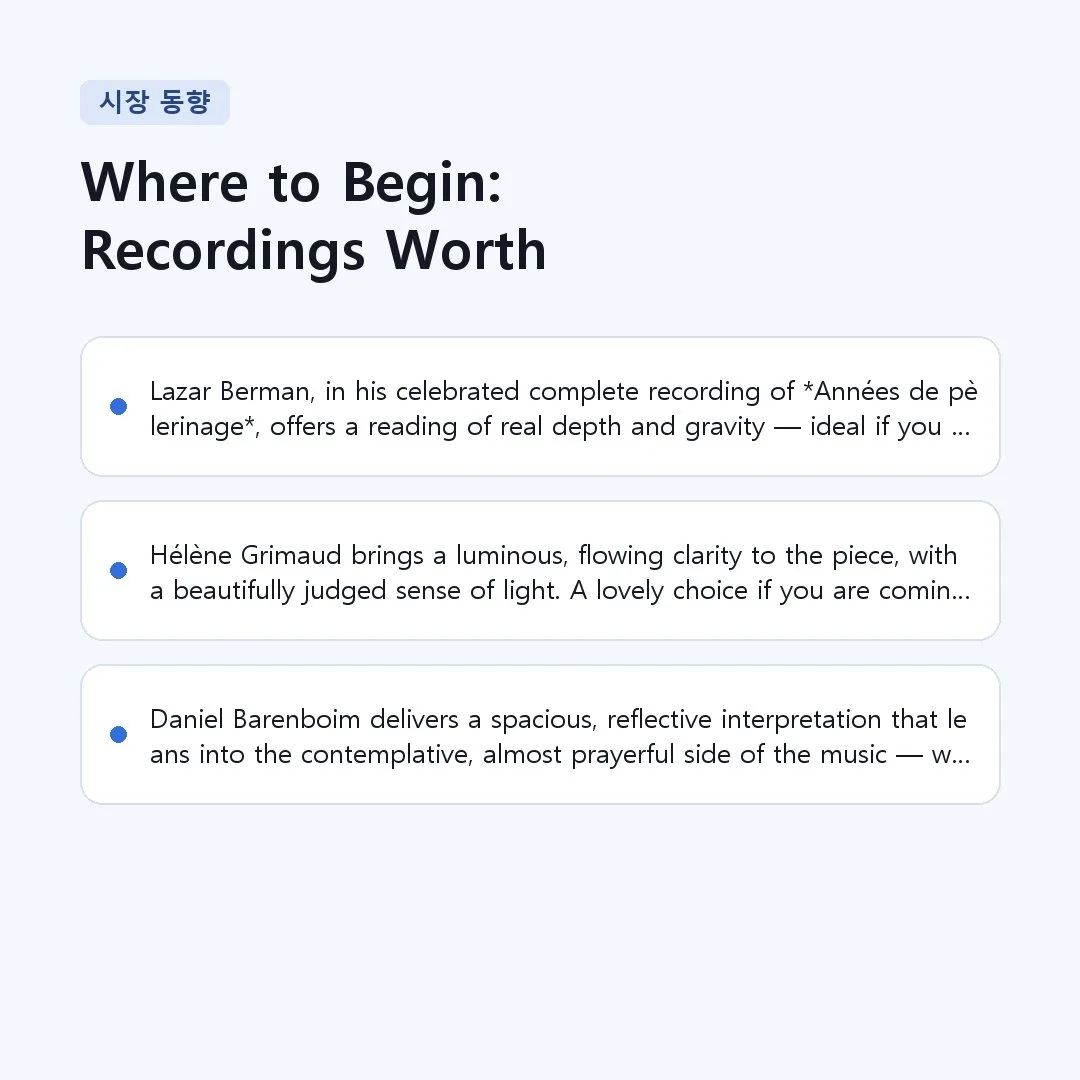
- Lazar Berman, in his celebrated complete recording of Années de pèlerinage, offers a reading of real depth and gravity — ideal if you want to feel the spiritual weight beneath the sparkle. A favorite of many longtime Liszt listeners.
- Hélène Grimaud brings a luminous, flowing clarity to the piece, with a beautifully judged sense of light. A lovely choice if you are coming to Liszt for the first time and want immediate beauty.
- Daniel Barenboim delivers a spacious, reflective interpretation that leans into the contemplative, almost prayerful side of the music — wonderful for deep, quiet listening.
Any of these is easy to find on the major streaming platforms; searching the piece title alongside the pianist’s name will bring it up quickly. I would suggest starting with whichever recording is simplest for you to play right now, and letting the water do the rest.
The Quiet Power of Late Beauty
What moves me most about Les jeux d’eau à la Villa d’Este is what it represents. Here was a man who had conquered every stage, tasted every kind of acclaim, and could have spent his final years simply being a legend. Instead he sat in a garden, watched the light play on falling water, and tried to capture something fleeting and luminous — and in doing so, quietly pointed the way to the music of the next century.
There is a lesson hidden in the spray. The grandest gesture is not always the loudest one. Sometimes the most radical thing a person can do is grow quieter, look more closely, and find eternity in the way light catches a fountain on an ordinary afternoon.
Put it on, let the shimmer fill the room, and see what it does to the next hour of your day.