📑 Table of Contents
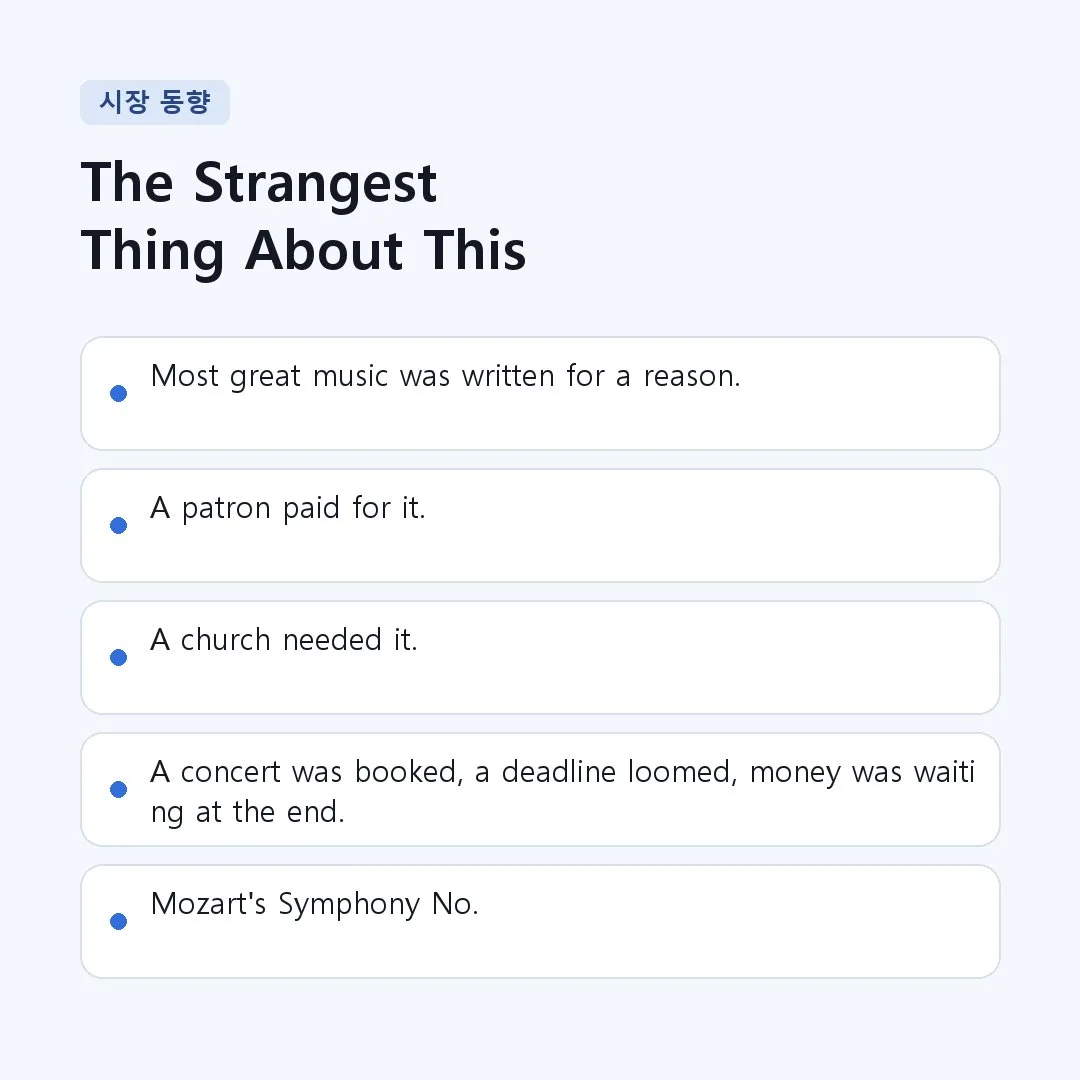
Most great music was written for a reason. A patron paid for it. A church needed it. A concert was booked, a deadline loomed, money was waiting at the end.
Mozart’s Symphony No. 39 has none of that behind it.
In the summer of 1788, in the space of about six weeks, he wrote three symphonies — Nos. 39, 40, and 41 — and as far as anyone can tell, no one had commissioned them. There was no concert scheduled. No payment promised. He was deep in debt, writing begging letters to a friend, and one of his infant daughters had just died. By every practical measure, this was the worst possible time to sit down and write some of the most luminous orchestral music ever composed.
And yet that’s exactly what he did. The first movement of No. 39 begins in shadow and then, almost stubbornly, walks toward the light. Knowing the circumstances, it’s hard not to hear that as a choice.
Who Was Mozart, Really, by This Point
If you only know Mozart as the powdered-wig child prodigy from the movies, the man who wrote this symphony was someone quite different.
By 1788 he was thirty-two, living in Vienna, and no longer the dazzling novelty he’d once been. The aristocrats who had clamored for him a few years earlier had drifted toward newer fashions. His income was unstable. He was a working composer hustling to stay afloat, not a celebrity.
What hadn’t changed was his ear. Wolfgang Amadeus Mozart could hold an entire piece in his head and write it down nearly complete, and he had an almost supernatural sense for how instruments sounded together. Symphony No. 39 is where that gift gets quietly experimental: he leaves out the bright, piercing oboes entirely and uses clarinets instead — a then-unusual choice that gives the whole work a warmer, rounder, more velvety glow. It’s a small decision that changes everything about how the music feels.
A Slow Door, Then a Sudden Room
Here’s the shape of the first movement, in plain terms.
It opens with a slow introduction marked Adagio — grand, weighty, almost ceremonial. Think of standing outside a tall closed door at night. There are big, dotted chords, like formal knocks, and then long descending scales that pour downward like rain running off a roof. The mood is serious, even a little ominous. The music seems to be searching for something.
Then the door opens. The tempo shifts to Allegro (fast), and we step into a completely different space: bright, flowing, three-beats-to-a-bar, the melody rising and dancing. The heaviness lifts. This sudden turn from darkness to daylight is the emotional engine of the whole movement, and it’s the single thing to listen for if you listen for nothing else.
For a beginner, this slow-introduction-then-fast-main-section design is worth knowing, because Mozart’s audiences would have recognized it as a marker of seriousness and ambition. Starting a symphony this way was his way of saying: this matters, pay attention.
How to Actually Listen to It
You don’t need to read music to follow this. Try anchoring yourself to these moments (timings are approximate and vary by performance):
The opening (0:00–roughly 2:00): Let the slow introduction work on you. Notice the contrast between the loud, stately chords and the soft, falling string lines that answer them. It feels unresolved on purpose — like a question with no answer yet.
The shift into the Allegro (around 2:00): This is the payoff. The music breaks into a lighter, faster pulse. Feel how your own breathing wants to settle into it. The tension hasn’t been explained away; it’s been transformed.
The clarinet color (throughout the fast section): Once you know the oboes are absent, you’ll start to hear how soft-edged everything sounds. The clarinets blend into the strings instead of cutting through them. It’s the difference between sunlight and a spotlight.
The way themes return: Mozart introduces a tune, wanders off into other keys and moods, and then brings the opening ideas back home. You don’t need to track the mechanics — just notice the small relief you feel when something familiar comes around again. That return is built into the design, and your ear catches it even if your mind doesn’t name it.
If you put this on while working or reading, the fast section makes excellent focus music: propulsive enough to keep you moving, warm enough that it never jangles your nerves.
Recordings Worth Your Time
A few interpretations that suit different listeners:
Karl Böhm with the Berlin Philharmonic — the warm, spacious, old-school approach. If you want the music to feel grand and reassuring, with rich strings and unhurried phrasing, start here. Ideal for first-time listeners.
Sir Charles Mackerras with the Scottish Chamber Orchestra — lighter, quicker, and more transparent, closer to how the music might have sounded in Mozart’s own time. You’ll hear inner details and the clarinet color more clearly. Great once the piece is familiar.
Nikolaus Harnoncourt with the Concentus Musicus Wien — the boldest, most dramatic reading, leaning hard into the contrasts. Choose this if you want the darkness-to-light journey thrown into sharp relief.
For a free starting point, searching the symphony’s name on YouTube will surface several full performances by major orchestras; look for one with a visible timer so you can find the Adagio-to-Allegro shift and listen for that moment specifically.
What He Couldn’t Have Known
Mozart almost certainly never heard this symphony performed. There’s no clear record of it being played in his lifetime, and he died a little over three years later, in December 1791, at thirty-five.
So this is music written into uncertainty — no audience, no applause, no guarantee anyone would ever listen. And what he chose to write, in the middle of debt and grief, was a piece that opens in the dark and insists on walking into the light anyway.
That’s the thing worth carrying away from the first movement. It isn’t cheerful in a shallow way. It earns its brightness by starting somewhere heavier and choosing, in real time, to move. More than two centuries later, that choice is still audible — and on a hard day, it can feel less like history and more like company.