📑 Table of Contents
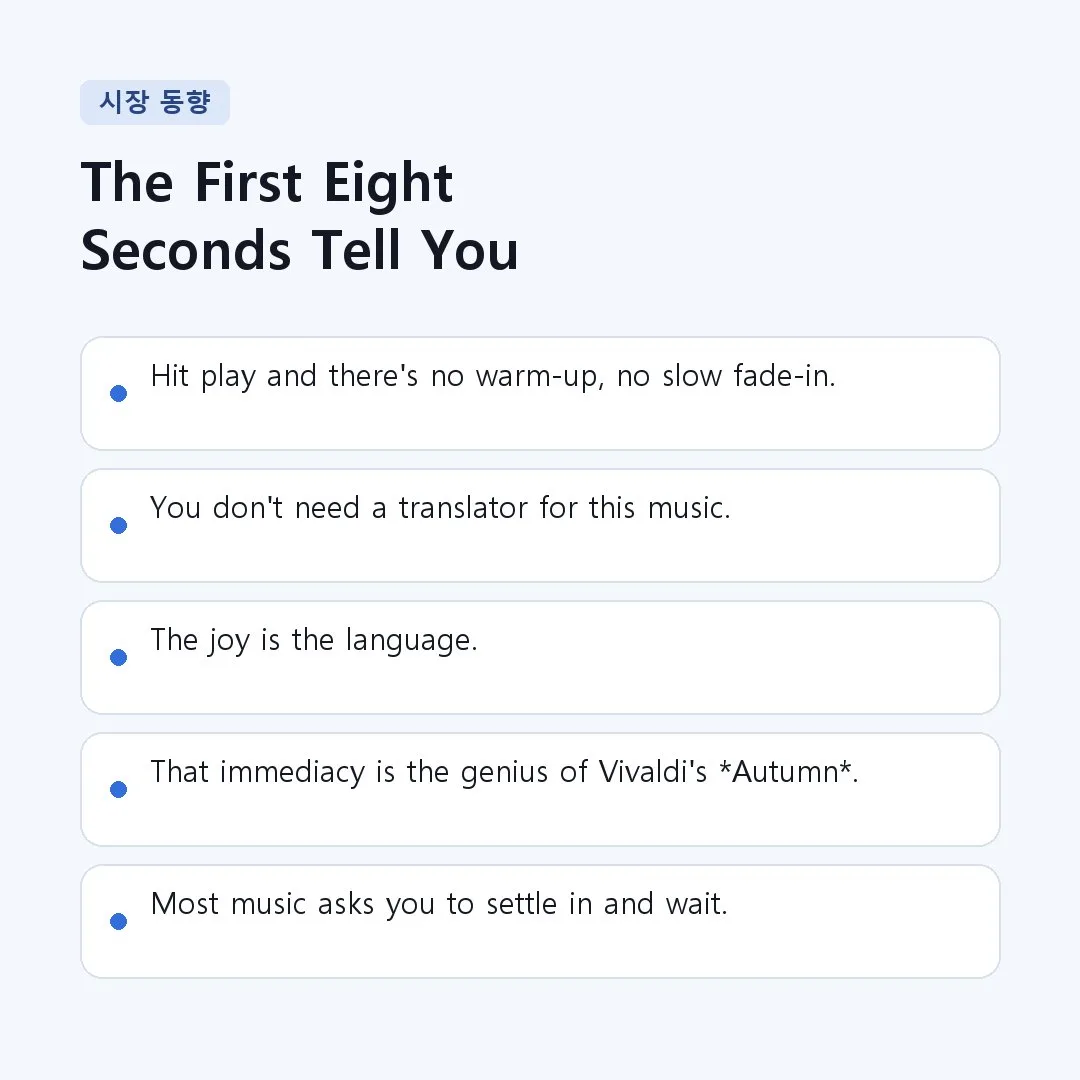
Hit play and there’s no warm-up, no slow fade-in. The whole orchestra leaps in at once with a bright, bounding melody, and within seconds you understand exactly where you are: a village square, the harvest is in, and everyone is dancing. You don’t need a translator for this music. The joy is the language.
That immediacy is the genius of Vivaldi’s Autumn. Most music asks you to settle in and wait. This asks nothing. It simply arrives, already in full swing, and pulls you onto the dance floor before you’ve decided whether you wanted to dance.
The Composer Who Wrote with a Fever
Antonio Vivaldi (1678–1741) was a red-haired priest from Venice, nicknamed il Prete Rosso, “the Red Priest.” He was ordained but rarely said Mass, often citing a chest condition that left him short of breath. What he did instead was write music at a ferocious pace, much of it for the young women of the Ospedale della Pietà, a Venetian institution for orphaned and abandoned girls where Vivaldi taught violin for decades.
These students became one of the most admired ensembles in Europe, and Vivaldi fed them a constant stream of concertos. He composed so fast that he once bragged he could write a concerto quicker than a copyist could copy it. The Four Seasons, published in 1725, came out of this whirlwind of productivity, and it remains the most famous thing he ever wrote.
A Poem You Can Hear
Here’s what makes The Four Seasons unusual, even today: each concerto comes with its own poem, a sonnet that the music illustrates line by line. We don’t know for certain who wrote the verses, but many believe Vivaldi wrote them himself. Either way, he printed them in the score and then composed the music to match.
The sonnet for Autumn opens with peasants celebrating a successful harvest with dancing and song. This first movement, marked Allegro (lively, quick), is that celebration set to sound. As the poem describes, the wine flows freely, and one by one the dancers grow tipsy until they drift off into a contented sleep. Vivaldi doesn’t just suggest this scene; he stages it, characters and all.
What to Listen For
Knowing the story turns this from pretty background music into a film you watch with your ears. A few moments to catch:
The dancing refrain (0:00). That opening tune comes back again and again throughout the movement. In Baroque music this recurring section is called the ritornello, Italian for “little return.” Think of it as the chorus of a pop song: every time the soloists wander off to do their own thing, the full group swings back to this familiar dance. Once you recognize it, the whole movement becomes easy to follow.
The solo violin steals the spotlight (around 1:00). A single violin breaks away from the crowd with brilliant, showy runs. This is your reveler, the life of the party, spinning and showing off while everyone watches.
The drunken stumble (around 2:00). This is the most delightful detail. The solo violin begins to slip and slur, playing wobbling, off-balance figures that musically depict a dancer who has had a little too much wine. Listen for the line that seems to lurch and trip. Vivaldi is doing comedy with notes.
The slowing down toward sleep. As the movement winds toward its close, the energy softens. The wine has done its work, and the revelers are nodding off, before the dance bursts back one final time.
Recordings Worth Your Time
If you want fire and drama, Fabio Biondi with Europa Galante plays on period instruments with a raw, almost wild energy that makes the dance feel genuinely rowdy. Their reading leans into every theatrical detail.
For something polished and warm, Anne-Sophie Mutter with the Trondheim Soloists offers a richer, more modern violin sound that emphasizes the music’s elegance over its grit.
And for a famous, irresistibly energetic benchmark, Nigel Kennedy’s recording with the English Chamber Orchestra became a global bestseller for good reason; it’s vivid, propulsive, and approachable for first-time listeners.
A good rule for beginners: pick a period-instrument version (like Biondi’s) and a modern one (like Mutter’s), play the same passage in each, and notice how different the same notes can feel. That comparison teaches you more about interpretation than any explanation could.
Why It Still Works
Three centuries later, Autumn hasn’t aged because it isn’t really about a season at all. It’s about the universal human moment after hard work is finished, when the harvest is in and the only thing left to do is celebrate. Vivaldi captured that feeling so precisely, with such humor and warmth, that you don’t need to know a single thing about Baroque music to feel invited.
So put it on. The square is full, the wine is poured, and the dancing has already started without you. All you have to do is join in.