📑 Table of Contents
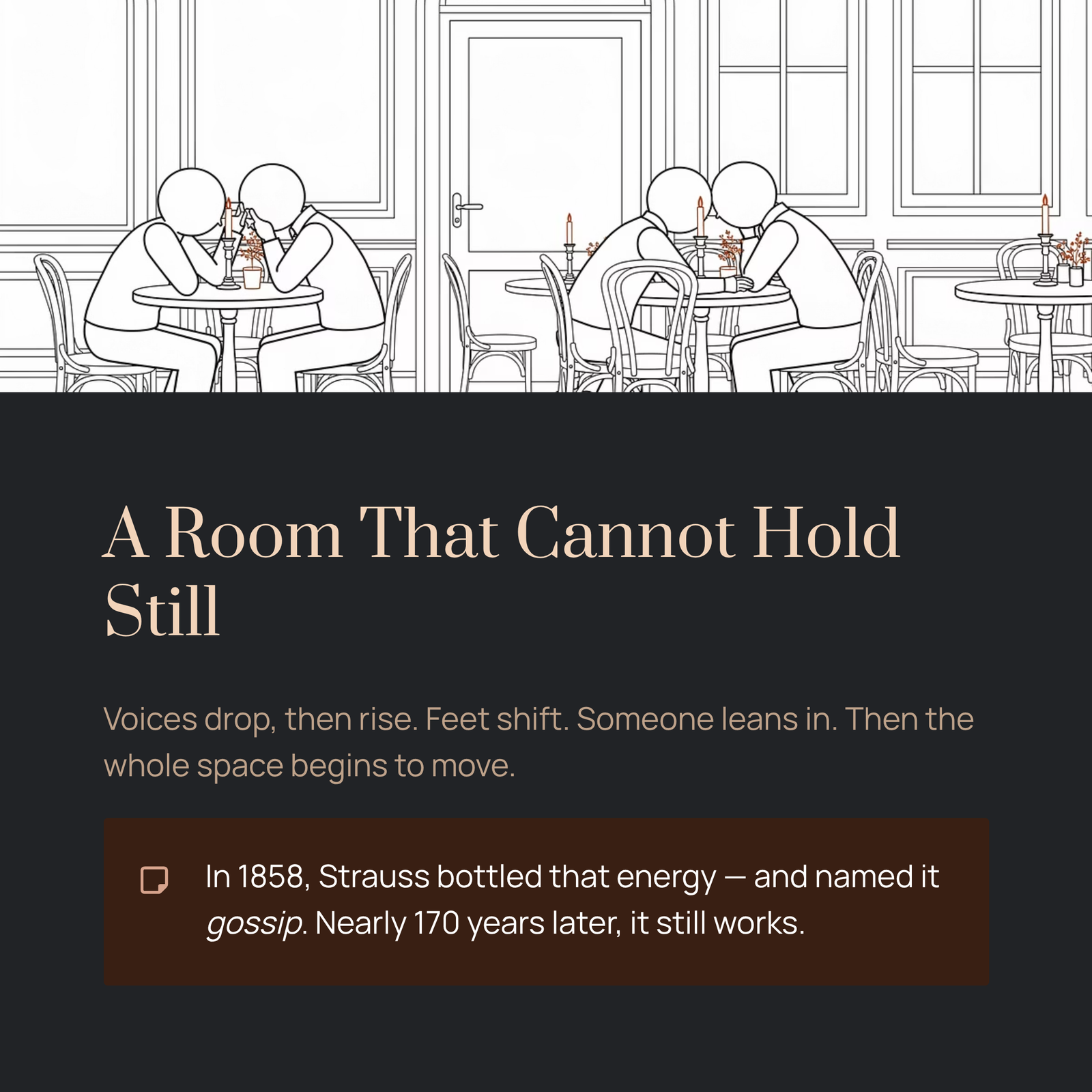
There is a particular kind of energy that lives in a room full of people who have just heard something scandalous.
Voices drop, then rise. Laughter cuts through the air before it’s finished being polite. Feet shift. Someone leans in. Then, almost as if the room itself can no longer hold still, the whole space begins to move.
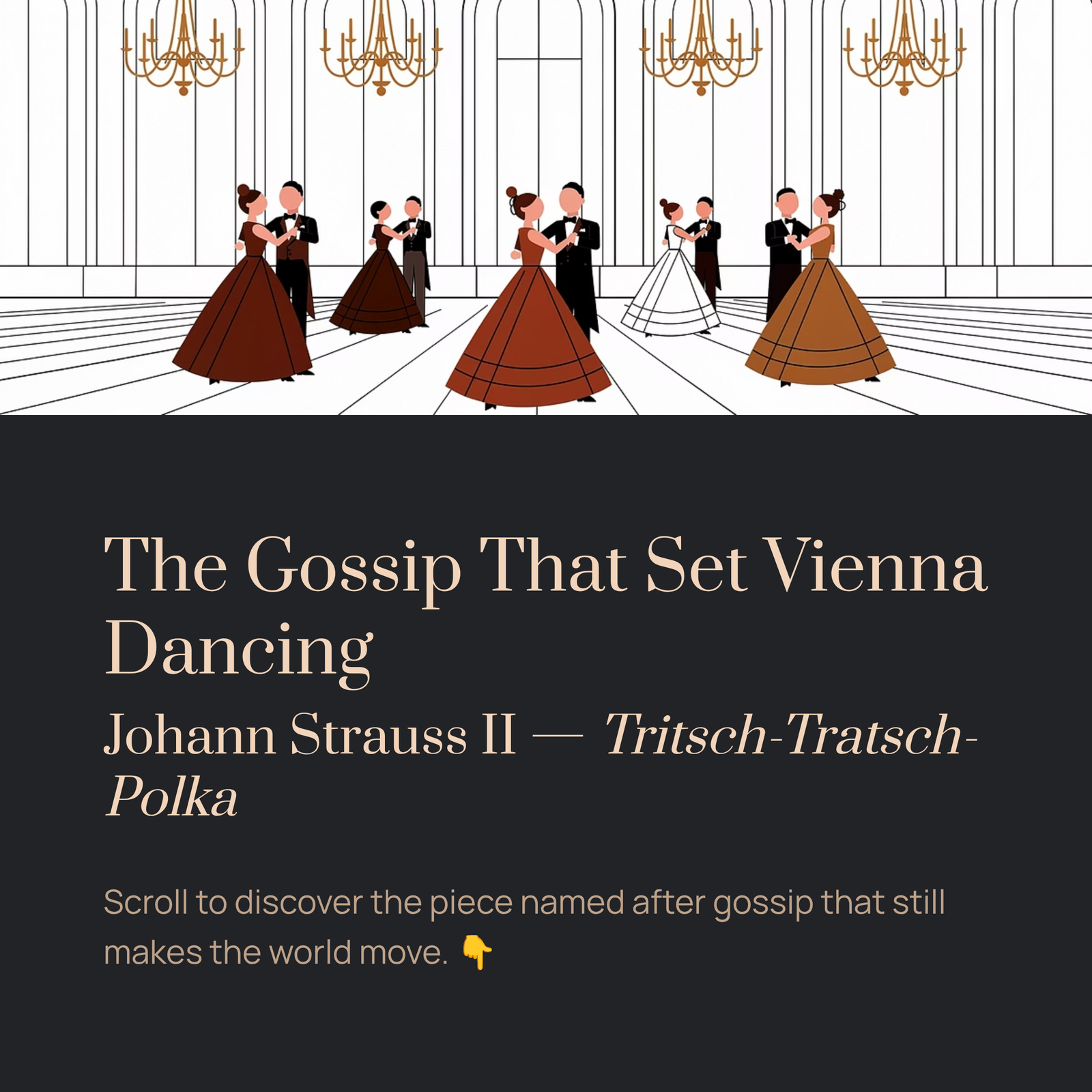
That is exactly what Johann Strauss II bottled in 1858 when he wrote the Tritsch-Tratsch-Polka, Op. 214 — a piece named, quite literally, after gossip. Not rumor. Not news. Gossip. The kind that makes your cheeks hurt from smiling too hard.
And nearly 170 years later, it still works.
Who Was Johann Strauss II?
Before we dive into the music, a quick introduction is in order — because Johann Strauss II is a name that deserves more than a passing mention.
Born in Vienna in 1825, Strauss was the eldest son of the celebrated composer Johann Strauss I, who was already known across Europe for his rousing dance music. The elder Strauss, in a move that reads almost like a plot from a 19th-century novel, forbade his son from pursuing music professionally. He wanted the boy to become a banker.
The son ignored him.
By his mid-twenties, Johann Strauss II had not only launched a successful conducting career, but had surpassed his father in popularity. He would go on to compose over 500 works — waltzes, polkas, quadrilles, operettas — and earn the title that still follows his name today: the Waltz King. His The Blue Danube (1866) and Tales from the Vienna Woods (1868) remain among the most recognizable pieces of orchestral music ever written.
But before those masterworks, before the grand waltzes that would define an era, there was Tritsch-Tratsch — fizzy, irreverent, and utterly alive.
What Does “Tritsch-Tratsch” Actually Mean?
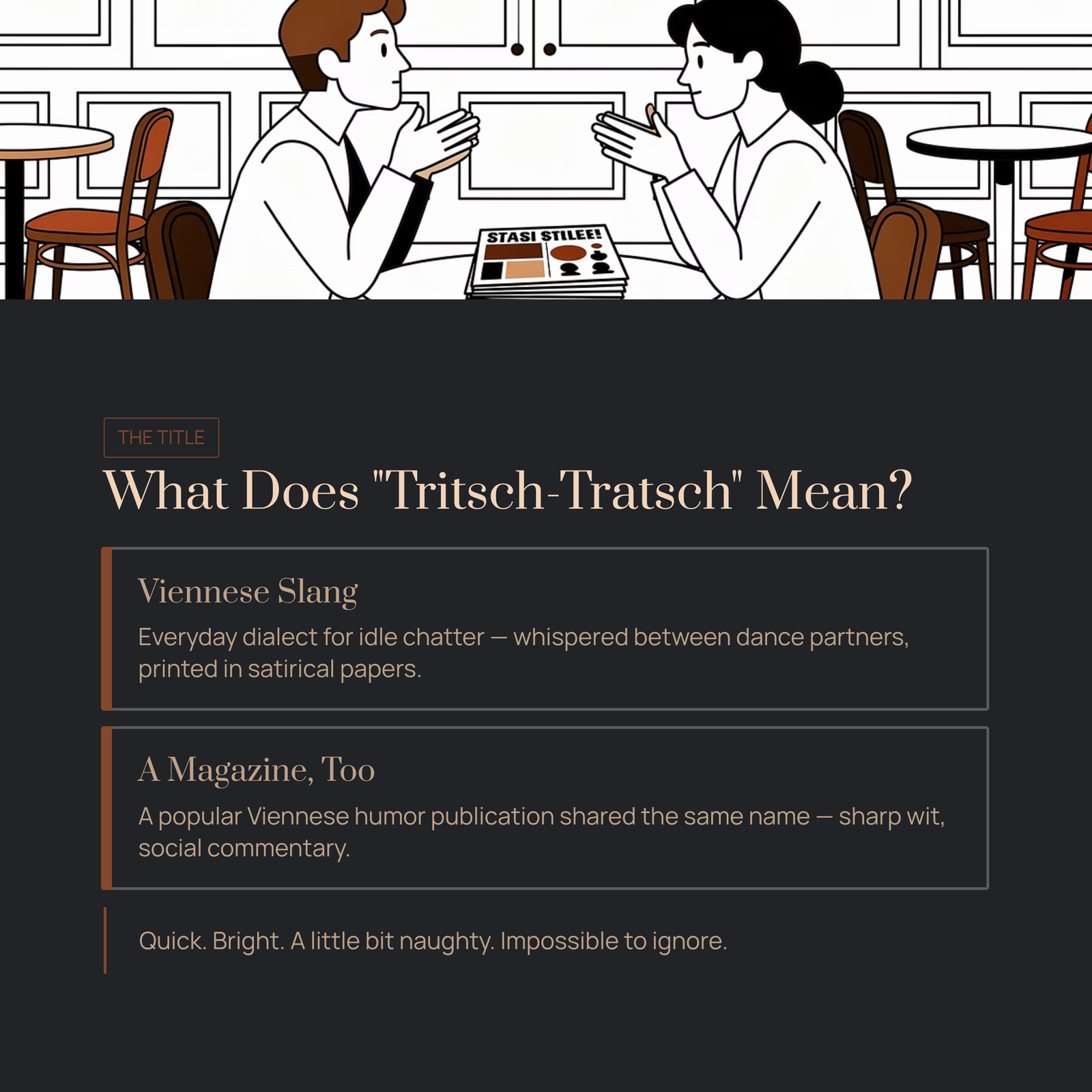
The title is not a random sound. In the Viennese dialect of the mid-19th century, Tritsch-Tratsch (sometimes spelled Trisch-Trasch) was everyday slang for idle chatter — the kind exchanged over coffee, whispered between dance partners, or printed in the satirical papers that flourished in the city’s lively café culture.
In fact, at the time Strauss composed this piece, there was a popular Viennese humor magazine also called Tritsch-Tratsch, known for its sharp wit and social commentary. Whether Strauss was tipping his hat to the publication, to the phrase itself, or simply to the spirit of Viennese small talk, the result is the same: a piece that sounds like gossip feels.
Quick. Bright. A little bit naughty. Impossible to ignore.
What Makes This Polka So Special?
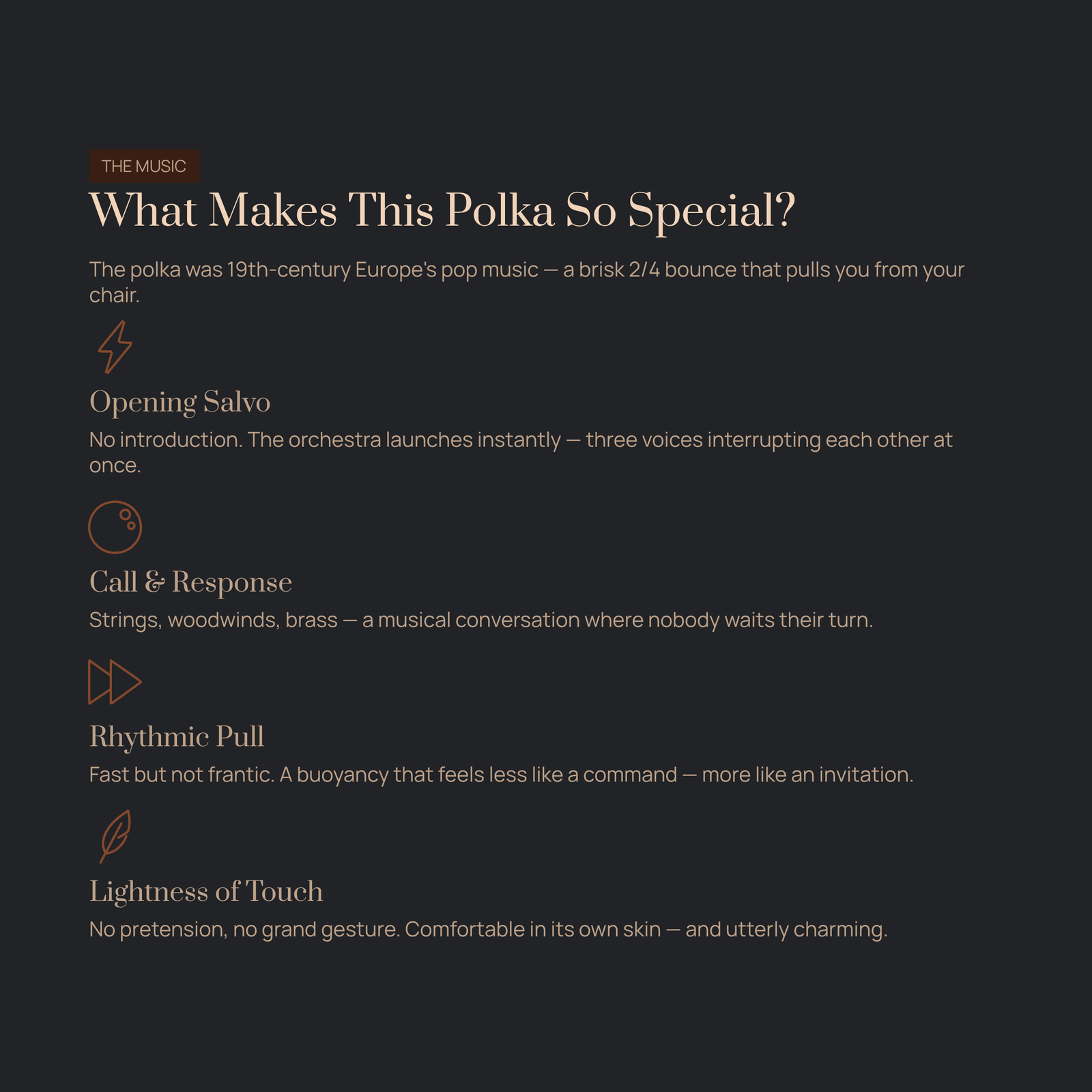
The polka was the pop music of 19th-century Europe. Originating in Bohemia (modern-day Czech Republic) in the 1830s, it swept across the continent like a craze, arriving in Vienna’s ballrooms around 1840 and never quite leaving. Its hallmark is a brisk 2/4 time signature — think a bouncing, two-step rhythm that practically pulls you out of your chair.
Strauss had a gift for writing polkas that felt tailor-made for the dance floor, and Tritsch-Tratsch is among the most exhilarating examples. Here is what to listen for:
The opening salvo. The piece wastes no time. From the very first bars, the orchestra launches into a melody that sounds like three people interrupting each other at once — which, if you’ve ever tried to follow gossip at a party, is exactly right. There is no long introduction, no throat-clearing. The music simply begins, in medias res, the way a good story always does.
The call-and-response structure. As the piece unfolds, different sections of the orchestra seem to carry on a conversation. A phrase in the strings gets picked up by the woodwinds. The brass add a comment. Nobody waits their turn. It is musical chatter of the highest order, and Strauss orchestrates it with the precision of a comedy writer who knows exactly when to land the punchline.
The rhythmic momentum. What makes polkas so irresistible — and what Strauss understood better than almost anyone — is the way the rhythm creates a kind of forward compulsion. You cannot listen to Tritsch-Tratsch and stay perfectly still. The tempo is fast but not frantic, and the beat has a buoyancy to it that feels less like a command to dance and more like an irresistible invitation.
The lightness of touch. Where Strauss’s waltzes can sometimes reach for the sublime, Tritsch-Tratsch is content to be delightful. There is no pretension here, no grand gesture. The piece is comfortable in its own skin, and that self-assurance is part of what makes it so charming.
Listening for the First Time: What to Expect
If you have never heard Tritsch-Tratsch-Polka before, here is a simple roadmap for your first listen:
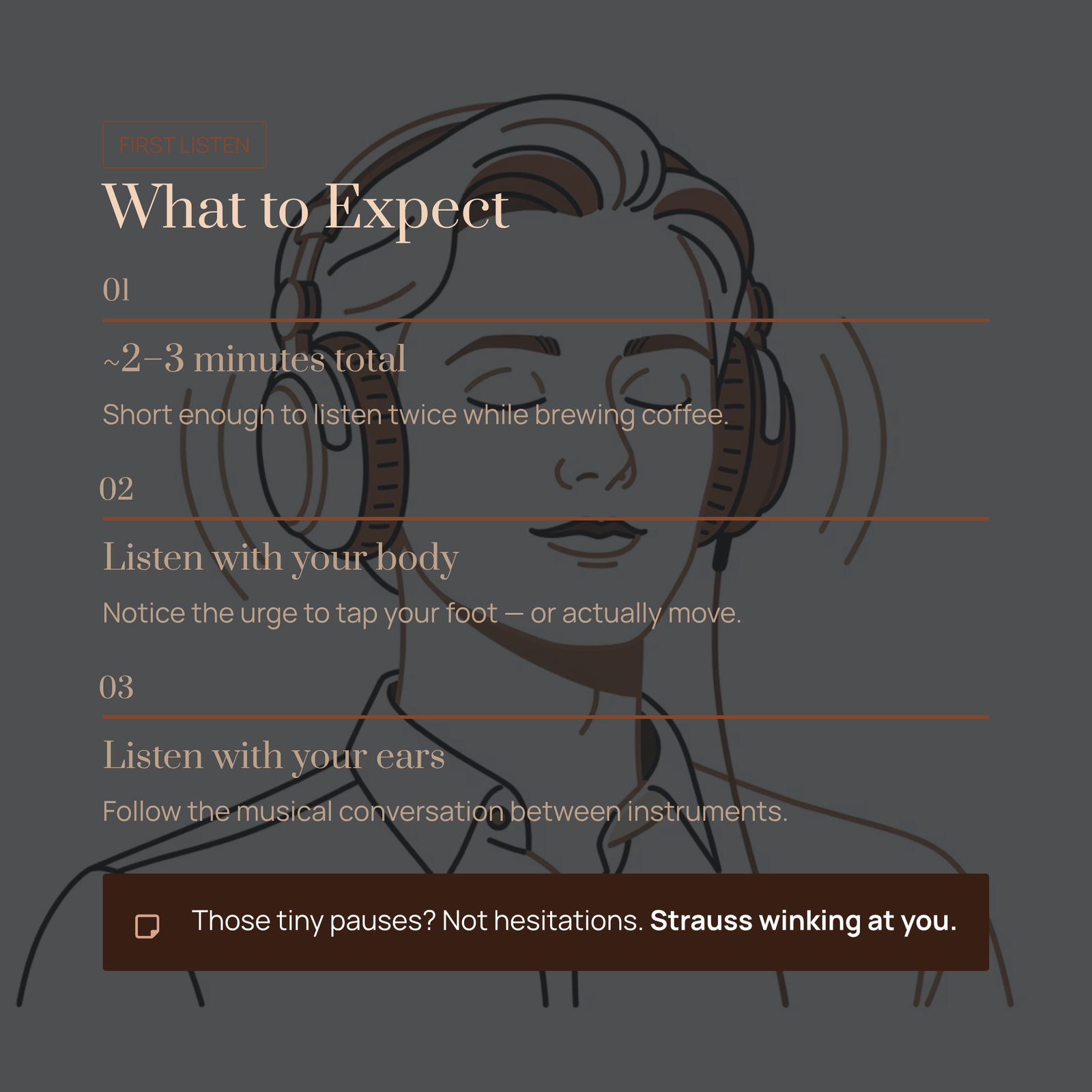
The piece runs approximately two to three minutes, depending on the conductor and any observance of repeats — which means you can listen to it twice in the time it takes to brew a cup of coffee. Do that. Listen once with your body (notice the impulse to tap your foot, shift your weight, or — if no one is watching — actually move). Then listen again with your ears, paying attention to the musical conversation happening between the instruments.
Notice how the melody never outstays its welcome. Each phrase is short, crisp, and slightly cheeky — like a well-timed quip rather than a speech. Notice, too, the moments where the music seems to catch its breath before charging forward again. Those tiny pauses are not hesitations; they are Strauss winking at you.
Recommended Recordings
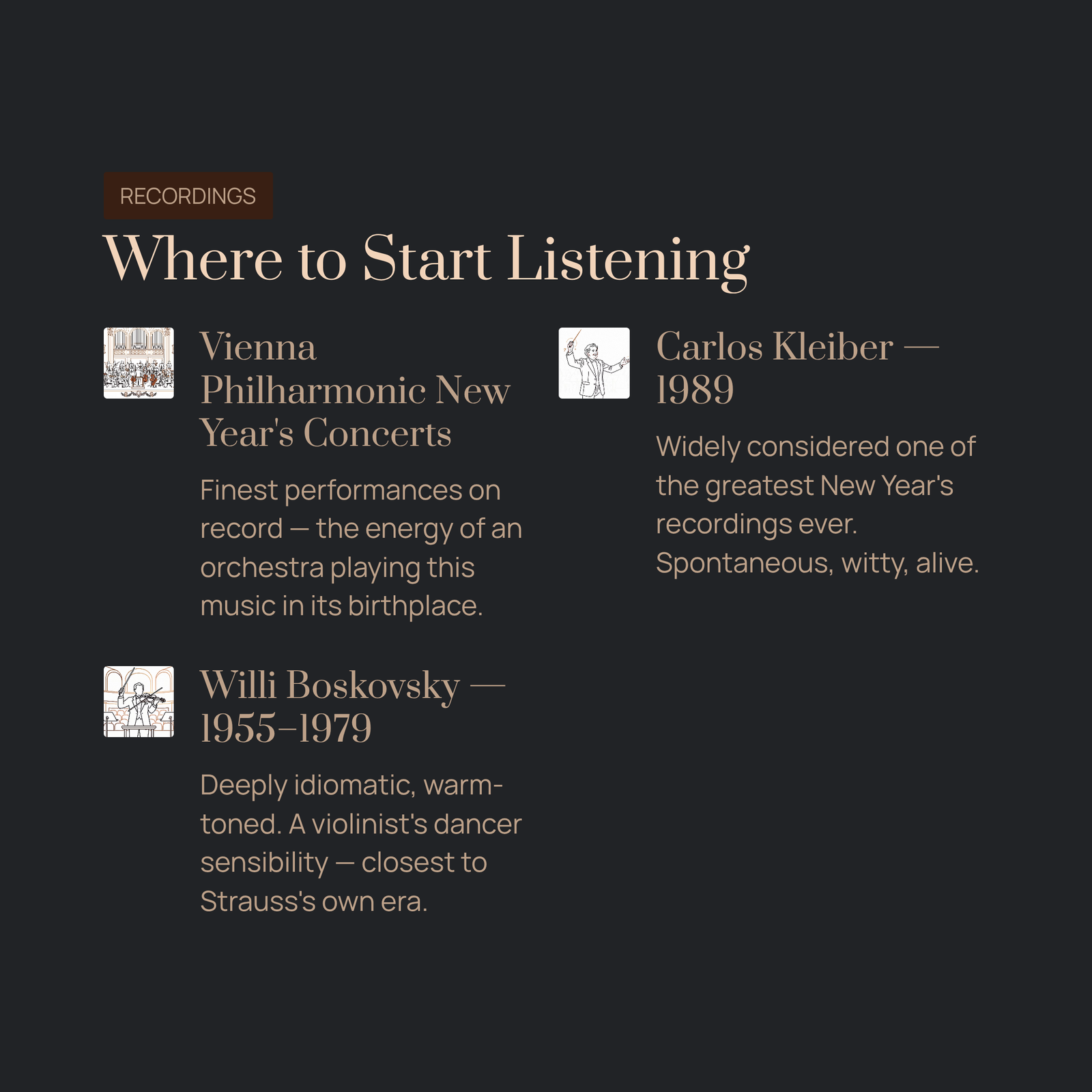
For a first encounter, the Vienna Philharmonic New Year’s Concerts offer some of the finest performances on record. Tritsch-Tratsch has appeared on the New Year’s program multiple times over the decades, and the recordings capture something irreplaceable: the particular energy of an orchestra playing this music in the city where it was born.
Among the most celebrated interpretations is the 1989 New Year’s Concert conducted by Carlos Kleiber — a recording widely considered one of the greatest in the history of the event. Kleiber’s approach to Strauss is extraordinarily alive, full of spontaneity and wit, and his handling of Tritsch-Tratsch in that concert captures the gossip of the title better than almost anyone before or since.
For a more relaxed discovery, the recordings made by Willi Boskovsky during his long tenure conducting the New Year’s concerts (1955–1979) offer a deeply idiomatic, warm-toned approach that feels as close as possible to how this music might have sounded in Strauss’s own time. Boskovsky himself was a violinist, and there is a dancer’s sensibility in the way he shapes these rhythms.
Why a Two-Minute Polka Still Matters
It would be easy to dismiss Tritsch-Tratsch-Polka as a trifle — a charming appetizer before the main course of Strauss’s great waltzes. But that dismissal misunderstands what the piece actually is.
Tritsch-Tratsch is a document of joy. Not the ponderous, hard-won joy of a Beethoven symphony, but the lighter, more immediate joy of a Friday evening when the work is done and the room is full of people you like. It is the musical equivalent of a joke that lands exactly right — the kind where you laugh before you’ve even finished hearing it.
In a 19th century that was not without its sorrows — revolution, displacement, the grinding social tensions of an empire in slow decline — Strauss gave Vienna music that insisted on pleasure. Music that said: for three minutes, at least, this is what life can feel like.
That is not a small thing. That has never been a small thing.
And here, in the twenty-first century, with its own considerable weight of trouble, Tritsch-Tratsch still does exactly what it was always meant to do.
It makes you want to move.
A Final Note for New Listeners
If you are new to classical music and wondering where to start, pieces like Tritsch-Tratsch-Polka are among the most honest possible entry points — because they ask nothing of you except your attention, and they give you something immediate and physical in return. You do not need to understand music theory. You do not need historical context. You just need to press play.
The rest takes care of itself.