📑 Table of Contents
There is a moment, near the end of Steven Spielberg’s Lincoln, where the music does something extraordinary. It stops trying to impress you.
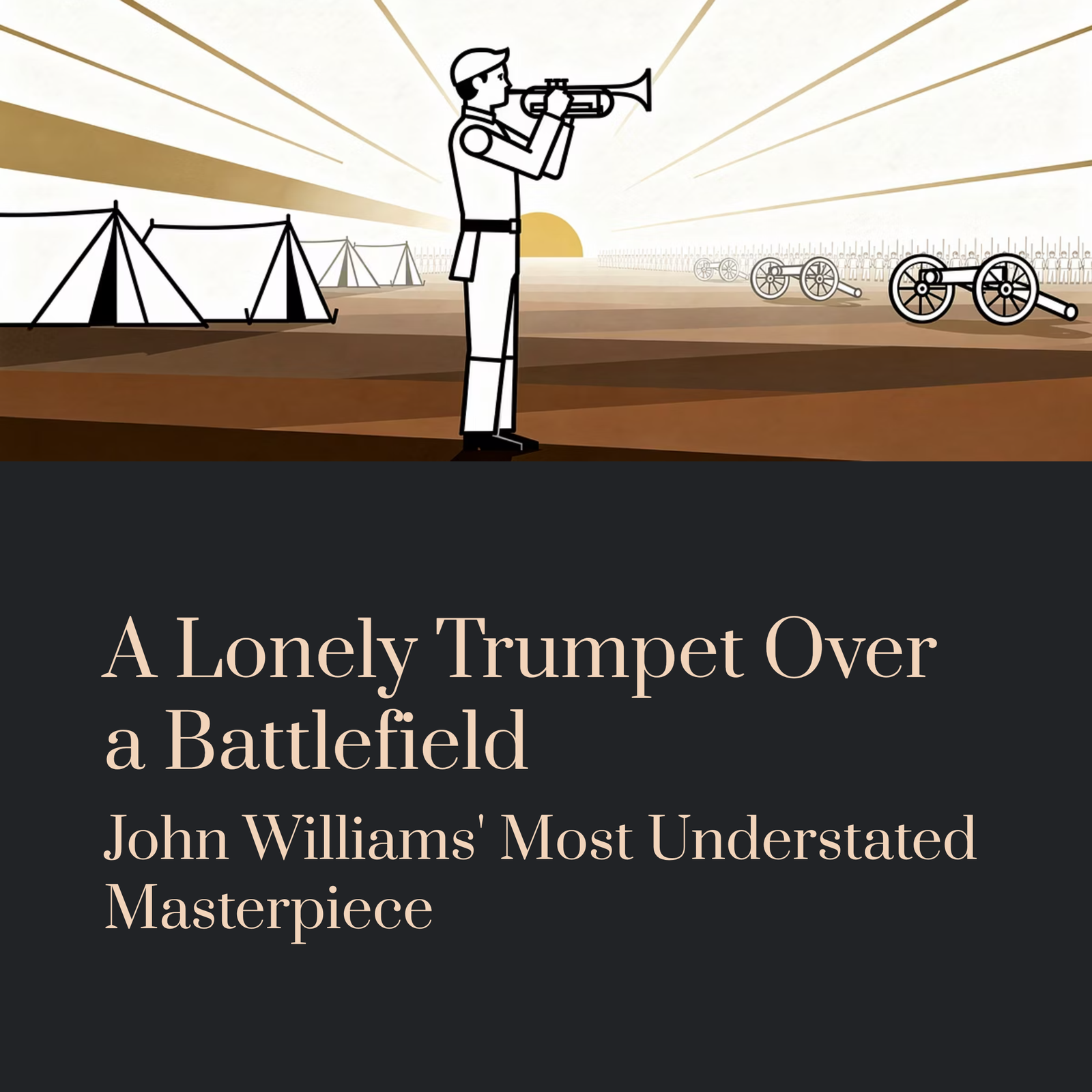
No sweeping orchestral fanfare. No triumphant brass procession. Just a single trumpet, floating above the softest bed of piano chords, singing a melody so plain and unadorned it could be a lullaby. Or a hymn sung in an empty country church. Or the last thing a dying soldier hears before he closes his eyes.
That melody is “With Malice Toward None,” and if you have never heard it, I envy you — because you still get to experience, for the first time, what it feels like when a piece of music reaches into your chest and gently, almost apologetically, breaks your heart.
This is John Williams at his most restrained, his most human, and — many would argue — his most profound.
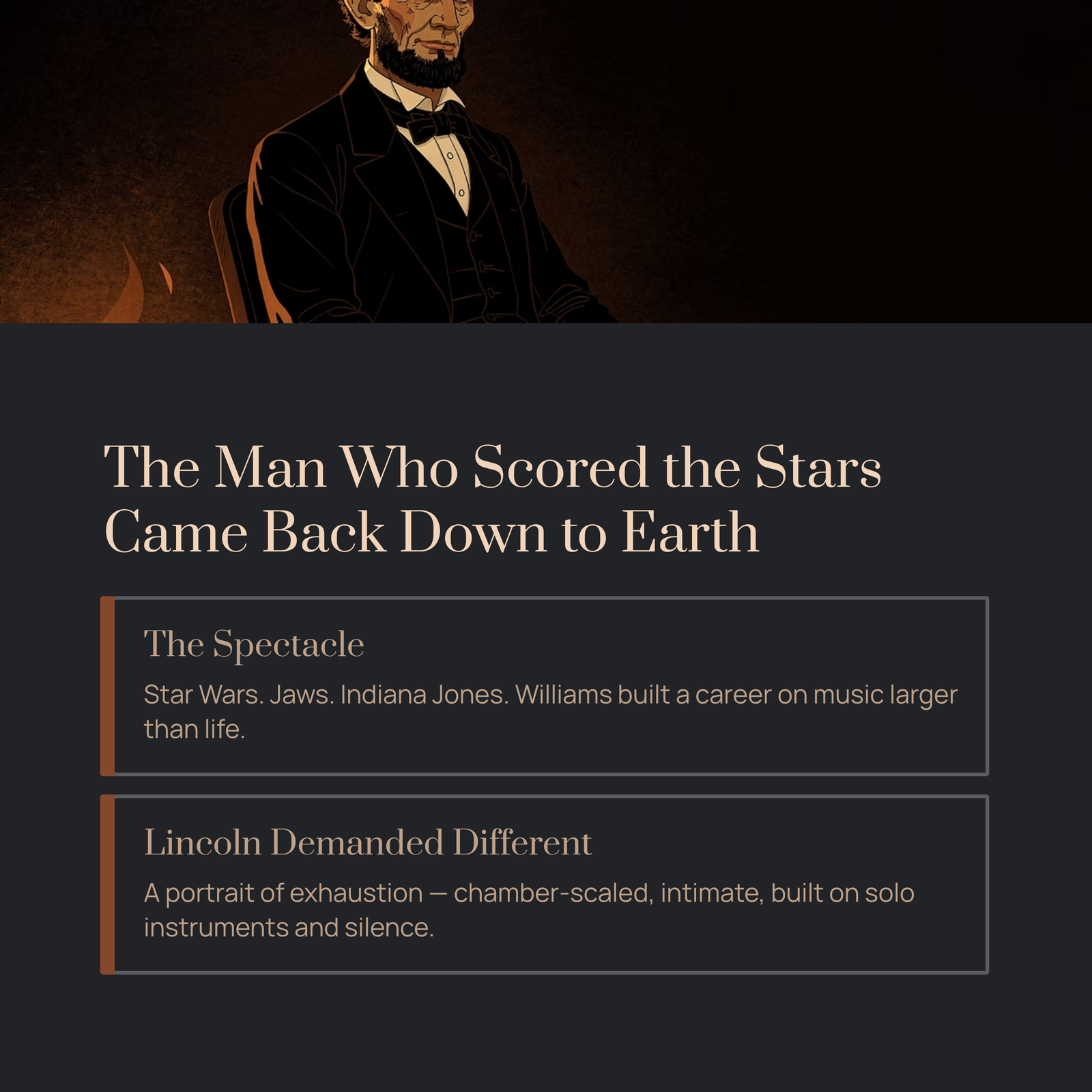
The Man Who Scored the Stars Came Back Down to Earth
When most people think of John Williams, they think of spectacle. The blazing horns of Star Wars. The thundering adventure of Indiana Jones. The terror lurking beneath the two-note motif of Jaws. Over more than five decades, Williams built a career on music that is larger than life — melodies so grand they seem to belong to the sky itself.
But Lincoln demanded something entirely different.
Spielberg’s 2012 film was not an action epic. It was a portrait of exhaustion — of a man carrying the impossible weight of a nation tearing itself apart, trying to hold the pieces together with nothing but words and willpower. Daniel Day-Lewis portrayed Abraham Lincoln not as a marble monument but as a tired, funny, deeply human father and politician navigating the final months of the Civil War and the passage of the Thirteenth Amendment.
For this story, Williams understood that grandeur would be a lie. The music needed to breathe like a man who has been awake for too long and has finally sat down by the fire. It needed to feel like the worn wood of a prairie farmhouse, like ink on parchment, like the slow turning of a page in a history book that still has the power to make you weep.
So he composed a score unlike anything in his filmography — chamber-scaled, intimate, built on solo instruments and silence. And at the very heart of it, he placed this melody: “With Malice Toward None.”
What Those Words Really Mean
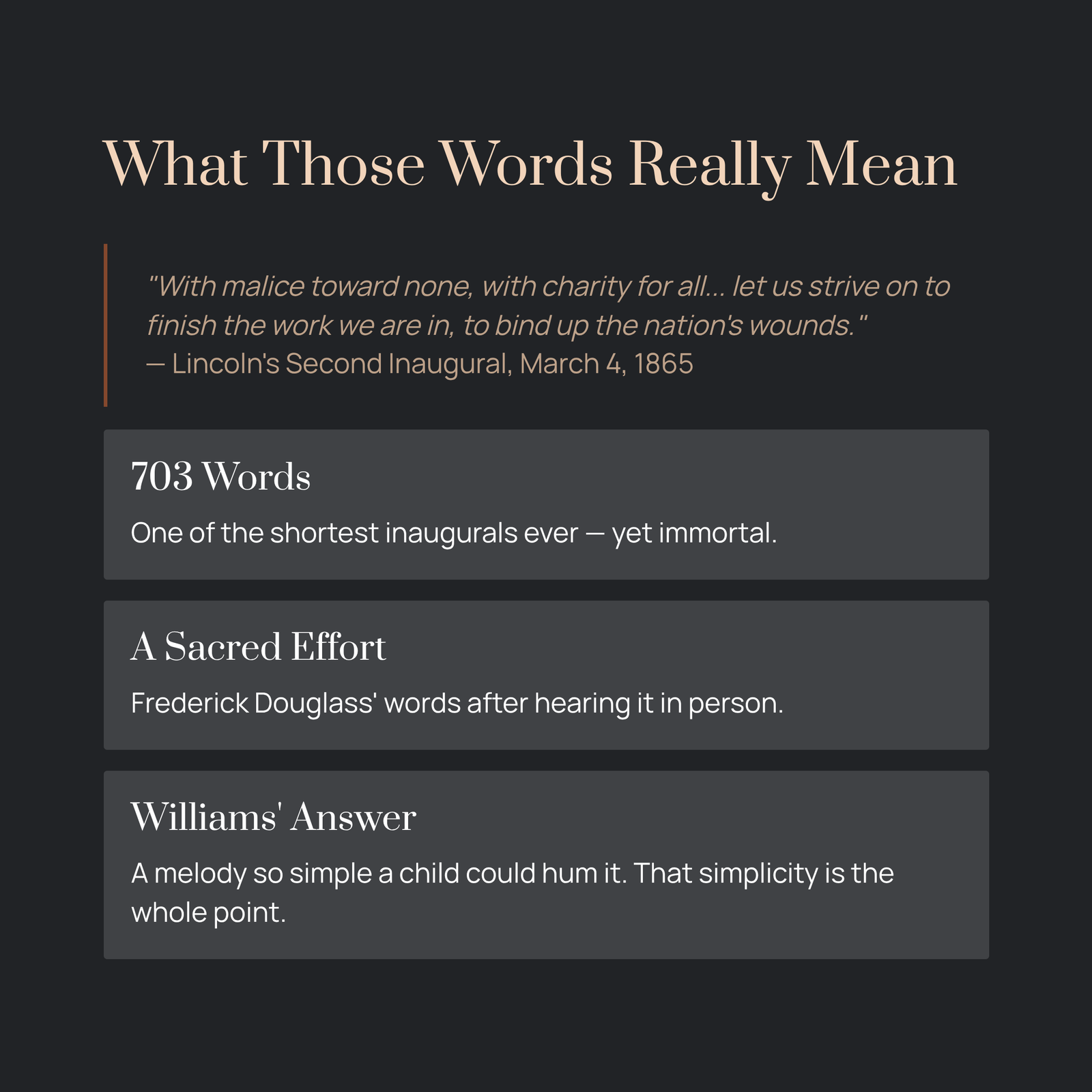
The title is borrowed from one of the most famous sentences in American history. On March 4, 1865, just weeks before the Civil War’s end and barely a month before his assassination, Abraham Lincoln delivered his Second Inaugural Address. At only 703 words, it was among the shortest inaugurals ever given — but its closing passage became immortal:
“With malice toward none, with charity for all, with firmness in the right as God gives us to see the right, let us strive on to finish the work we are in, to bind up the nation’s wounds…”
Lincoln was not celebrating victory. He was asking a broken nation to forgive. In a speech filled with biblical gravity, he refused to cast the South as a defeated enemy. Instead, he spoke of shared guilt, shared suffering, and the terrifying possibility that the war itself was divine punishment visited upon both sides for the sin of slavery.
It was, as Frederick Douglass said after hearing it in person, “a sacred effort.”
John Williams took those words — that impossible plea for mercy in the middle of unimaginable grief — and translated them into sound. Not a grand choral setting, not a patriotic anthem, but a melody so simple a child could hum it on the way home from school. That simplicity is the whole point. Lincoln’s genius was in speaking plainly. Williams’ genius was in composing the same way.
How the Music Speaks — A Listener’s Guide
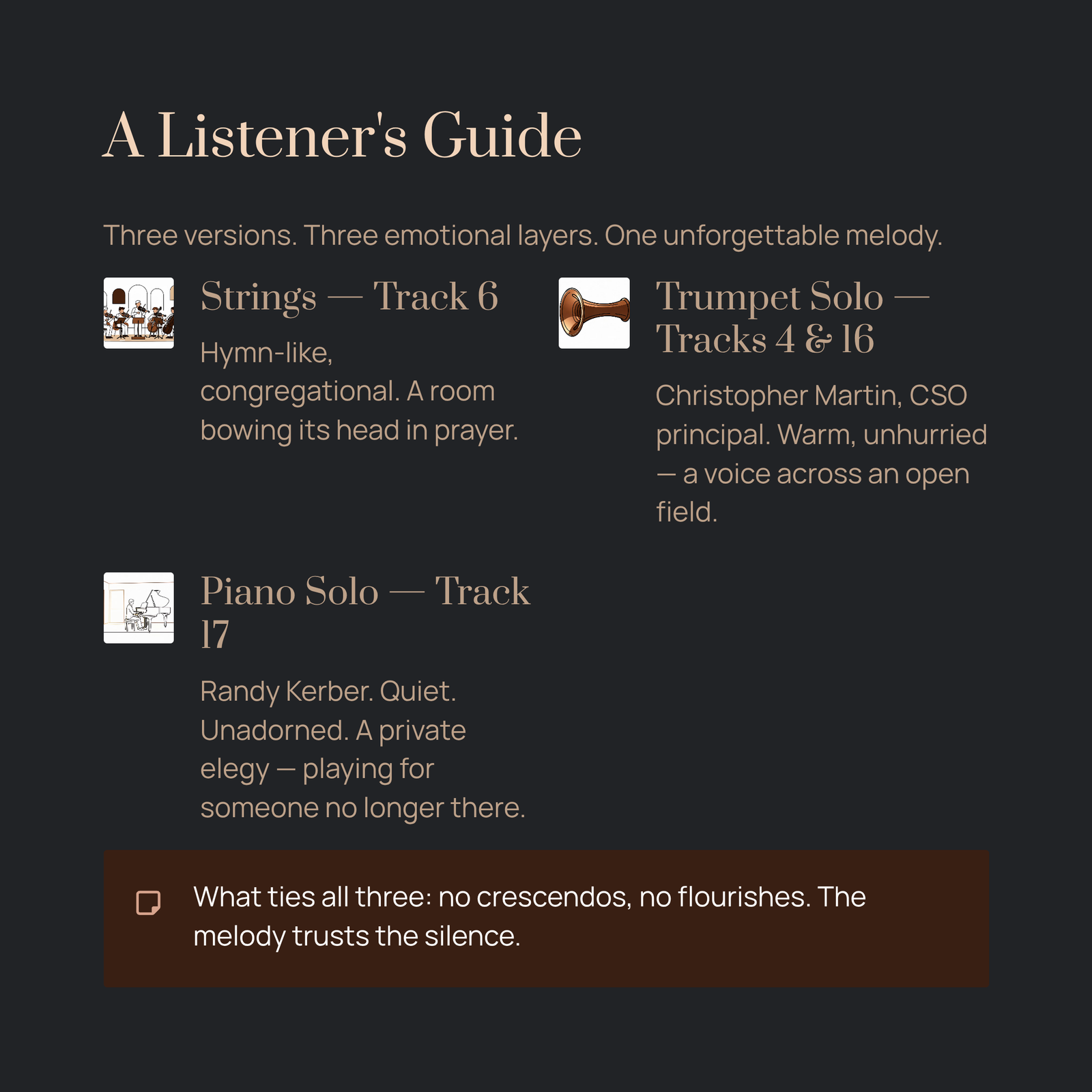
“With Malice Toward None” appears in several forms throughout the Lincoln soundtrack, each version revealing a different emotional layer. Here is what to listen for:
The String Orchestra Version (Track 6, ~1:50)
This is the purest, most hymn-like statement of the theme. The strings play with such tenderness that the melody seems to hover just above silence. There is something congregational about it — as though a room full of people have bowed their heads and the music is doing the praying they cannot put into words. Notice how the melody gently rises and falls in a lilting rhythm, almost like a folk song. Williams was deliberately evoking the musical language of 19th-century Americana — the same tradition that produced “Simple Gifts” and “Shenandoah.” It sounds like something Lincoln himself might have known.
The Trumpet Solo (within Track 4, “The American Process,” and Track 16, “The Peterson House and Finale”)
This is where the melody becomes unforgettable. Christopher Martin, then the principal trumpet of the Chicago Symphony Orchestra, performs the theme with a tone so warm and clear it feels less like an instrument and more like a human voice calling out across an open field. Williams wrote this solo knowing exactly what a lone trumpet signifies in the American imagination — bugle calls at dawn, taps played over a soldier’s grave, a single voice cutting through the vastness of a nation at war with itself. Martin’s performance is extraordinary: unhurried, deeply felt, with a stillness that dares you to breathe.
The Piano Solo (Track 17, the album’s closing)
Randy Kerber, the only non-CSO soloist on the soundtrack, performs a gentle piano variation that serves as the album’s final word. It is quiet. It is unadorned. It sounds like someone sitting alone at a piano in an empty room, playing not for an audience but for themselves — or perhaps for someone who is no longer there. The melody here takes on the quality of a memory, something recalled from a great distance. If the trumpet version is a public elegy, the piano version is a private one.
What ties all three versions together is Williams’ commitment to restraint. There are no dramatic crescendos, no virtuosic flourishes, no harmonic tricks. The melody breathes. It pauses. It trusts the silence between the notes as much as the notes themselves.
Why This Piece Still Matters
I want to be honest about something. When I first listened to the Lincoln soundtrack, I almost skipped past “With Malice Toward None.” It is so quiet, so unassuming, that it barely registers on first hearing. It does not grab you the way Williams’ iconic themes do. It does not announce itself.
But that is exactly why it works.
There is a particular kind of grief that is too large for loud music. The grief of a nation that has spent four years killing its own sons. The grief of a leader who knows the war is ending but who senses, perhaps, that he will not live to see the peace he fought for. That grief does not scream. It sits in a chair by the window. It looks out at the rain. And if it finds a melody, that melody is small, and simple, and almost unbearably tender.
What Williams captured in this theme is something rare in film music: genuine humility. The score for Lincoln earned an Academy Award nomination, and many critics noted that its power came not from what Williams wrote but from what he chose not to write. He gave the actors room. He gave the silences room. And when the music did speak, it spoke in the voice of a folk hymn — the kind of music that belongs to everyone and no one.
Spielberg himself reportedly requested the Chicago Symphony Orchestra specifically because Lincoln was from Illinois. The choice gave the score a sense of place, of rootedness, as though the music itself had grown up in the same prairie soil as the man it was honoring. And when Christopher Martin’s trumpet sings the main theme, there is a quality to the sound that cannot be faked — the resonance of a great orchestra playing music they feel in their bones.
How to Listen — A Few Suggestions
If you are new to this piece, here is how I would recommend approaching it:
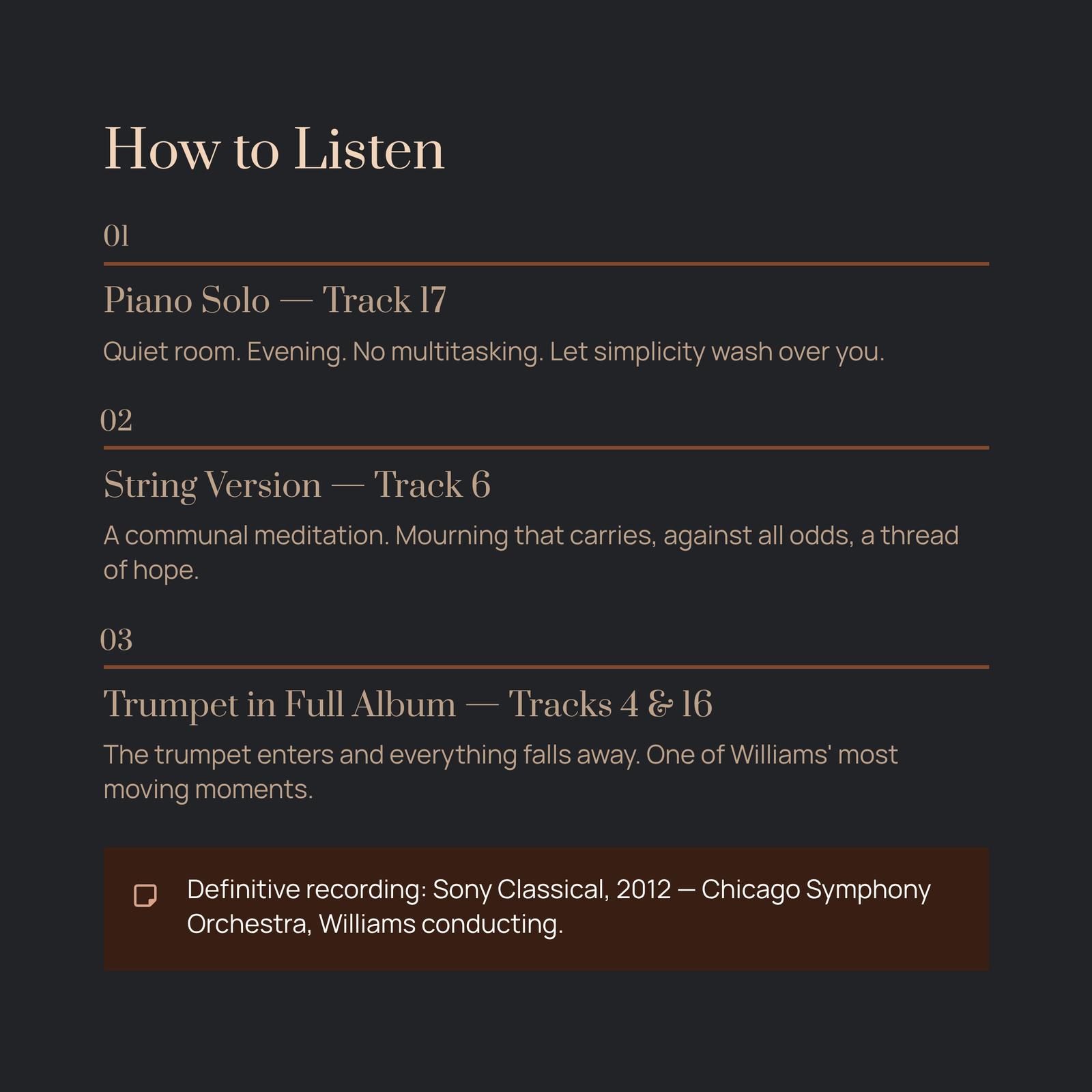
Start with the piano solo version (Track 17). Listen to it in a quiet room, preferably in the evening. Do not multitask. Just sit with it. Let the simplicity wash over you. You may find yourself thinking not about Lincoln or the Civil War but about your own losses, your own quiet griefs. That is the melody doing its work.
Next, try the string version (Track 6). Pay attention to how the strings breathe together, how the phrasing rises and falls like a slow tide. If the piano version is a private meditation, the string version is a communal one — a shared moment of mourning that somehow, against all odds, carries a thread of hope.
Finally, listen to the trumpet solo in the context of the full album — particularly within “The American Process” (Track 4) and “The Peterson House and Finale” (Track 16). Hearing the theme emerge from the surrounding score, rising out of woodwind conversations and orchestral textures, gives it a dramatic weight that the standalone versions cannot achieve. The trumpet enters, and everything else falls away. It is one of the most moving moments in all of Williams’ work.
For recordings, the original soundtrack album (Sony Classical, 2012) is the definitive version, performed by the Chicago Symphony Orchestra under Williams’ own baton. Christopher Martin has also performed the trumpet arrangement in concert settings — his live performance at “A Capitol Fourth” on the National Mall in Washington, D.C., with the National Symphony Orchestra, is particularly worth seeking out, a moment where the music returned to the city where Lincoln spoke those words 150 years earlier.
The Quietest Thing He Ever Wrote
John Williams once said that he tried to approach the Lincoln score with the same restraint that Lincoln himself brought to language — saying more with less, trusting the listener, resisting the urge to embellish.
In “With Malice Toward None,” he succeeded beyond what any film score is normally asked to do. He wrote a melody that is not just about Abraham Lincoln or the Civil War or the end of slavery. It is about the possibility that human beings, after inflicting terrible suffering on one another, might still find a way back to tenderness. That forgiveness is not weakness. That the quietest voice in the room might be the one most worth hearing.
The next time the world feels too loud — too angry, too fractured, too far gone — try sitting with this melody for a few minutes. A trumpet. A piano. A handful of strings. And the radical, almost impossible suggestion that we might yet learn to bind up each other’s wounds.
That is what Lincoln asked for in 1865. That is what Williams put into music in 2012. And that is why, more than a decade later, the melody still has the power to stop you mid-breath and remind you of something you forgot you believed.