📑 Table of Contents
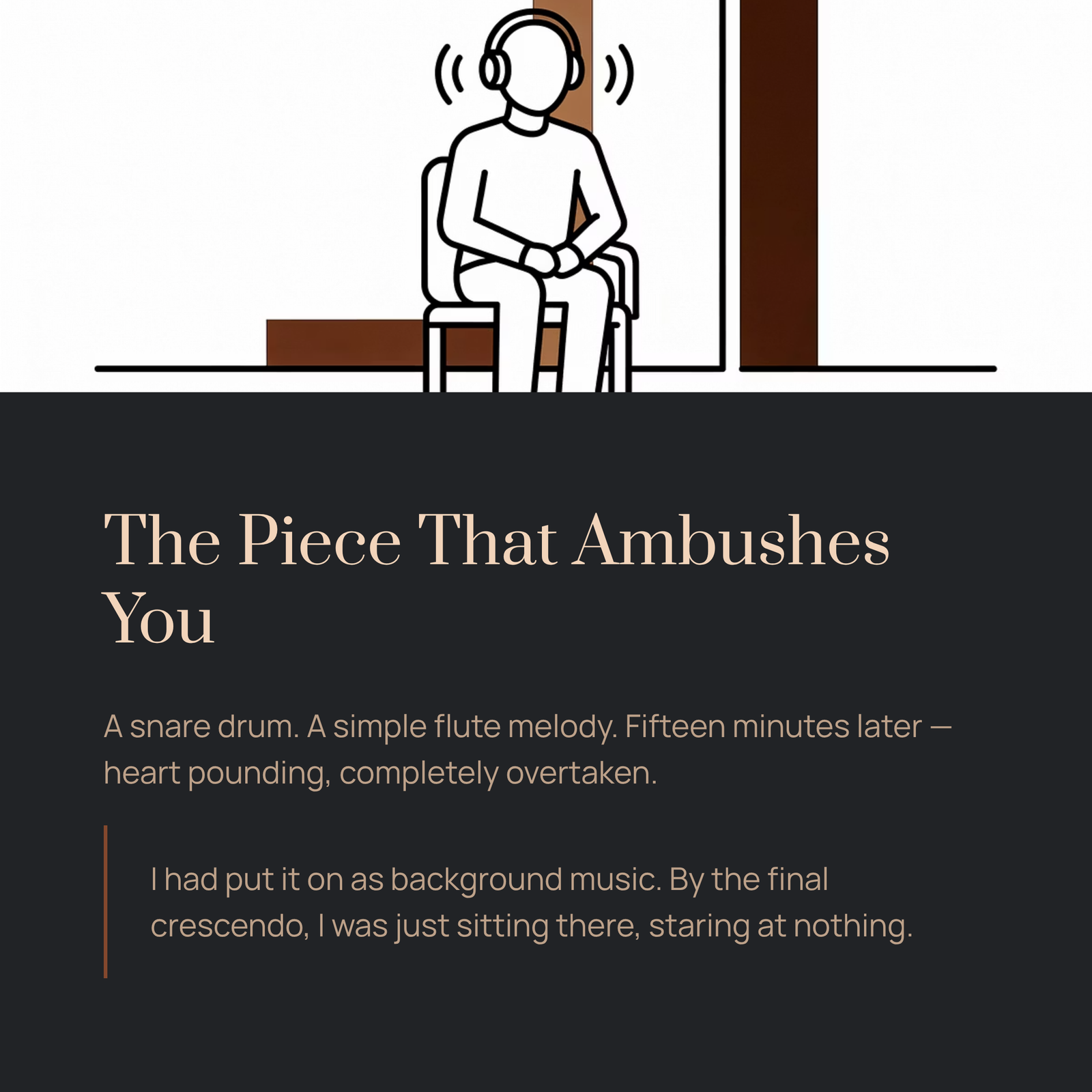
Imagine sitting in a dimly lit room. From somewhere far away, a single snare drum begins tapping — soft, mechanical, almost forgettable. Then a flute enters with a melody so plain you might mistake it for a children’s tune. You think, “That’s it?” And yet, fifteen minutes later, you find yourself gripping the armrest of your chair, heart pounding, as an entire orchestra crashes into the same melody you once dismissed. You never noticed the moment it took hold of you. That’s the genius of Ravel’s Bolero — it doesn’t grab your attention. It steals it, one layer at a time.
I still remember the first time I heard it all the way through. I had put it on as background music while working. By the halfway mark, I had stopped typing entirely. By the final crescendo, I was just sitting there, staring at nothing, completely overtaken. No piece has ever ambushed me quite like that.
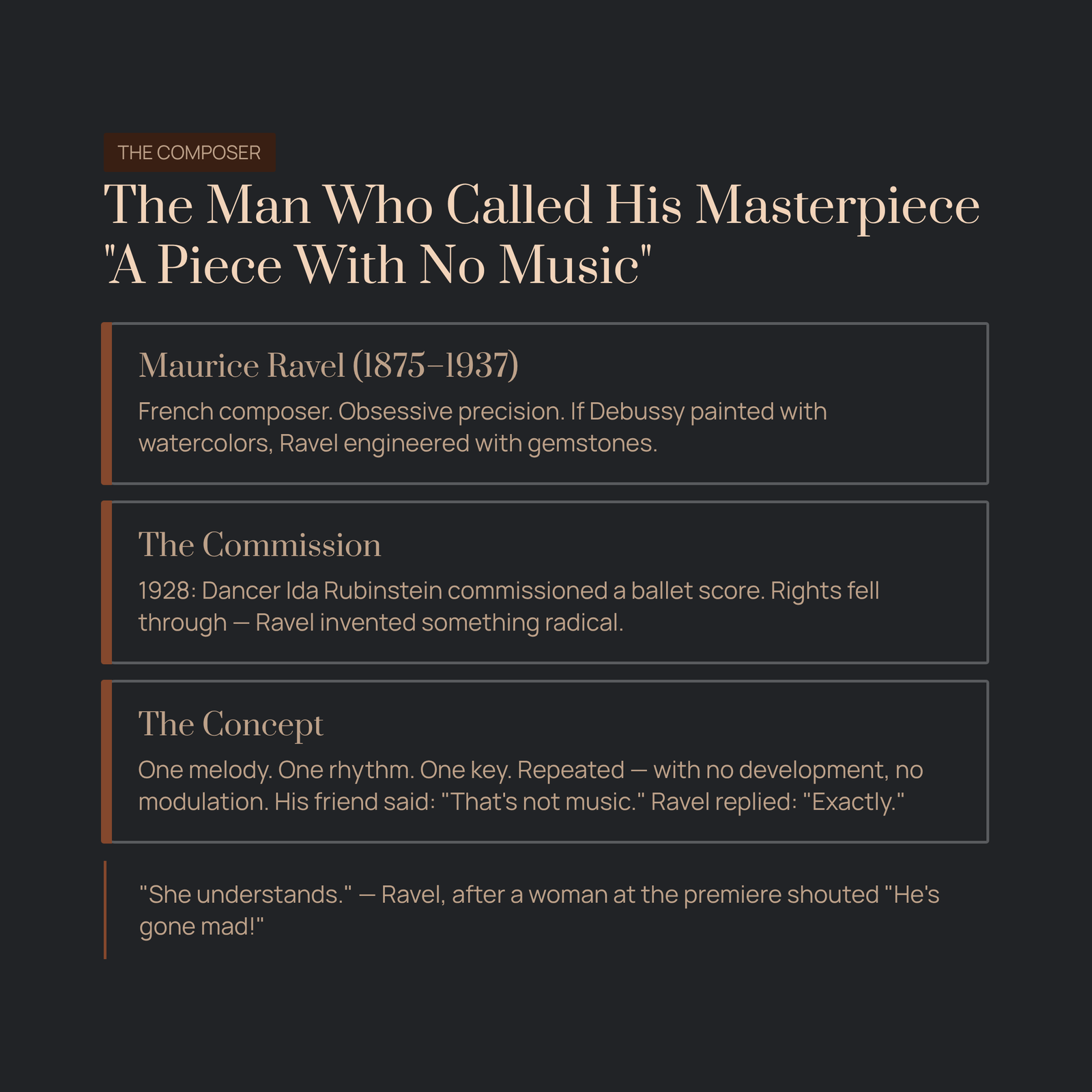
The Composer Who Called His Own Masterpiece “A Piece With No Music”
Maurice Ravel (1875–1937) was a French composer known for his obsessive attention to detail and dazzling orchestration. He was the kind of person who could spend weeks perfecting a single chord voicing. Among his peers — Debussy, Stravinsky, Satie — Ravel stood apart for his precision. If Debussy painted with watercolors, Ravel engineered with gemstones.
And yet, Bolero was born almost as an experiment. In 1928, the Russian ballet dancer Ida Rubinstein commissioned Ravel to write a ballet score. Ravel initially planned to orchestrate some piano pieces by Albéniz, but when the rights fell through, he decided to compose something entirely new — something radical in its simplicity.
His concept was audacious: take one melody, one rhythm, and one key, then repeat them over and over while gradually adding instruments. No development. No modulation (until the very end). No drama in the traditional sense. When Ravel played the theme on piano for a friend, the friend reportedly said, “But Maurice, that’s not really music, is it?” Ravel smiled and replied, “Exactly.”
He later described Bolero as “a piece for orchestra without music.” He seemed genuinely baffled when it became a sensation. At the premiere, a woman in the audience was heard shouting, “He’s gone mad!” Ravel, upon hearing this, reportedly said, “She understands.”
How a Single Thread Weaves an Entire Universe
So what exactly happens in Bolero? On paper, almost nothing. In practice, everything.
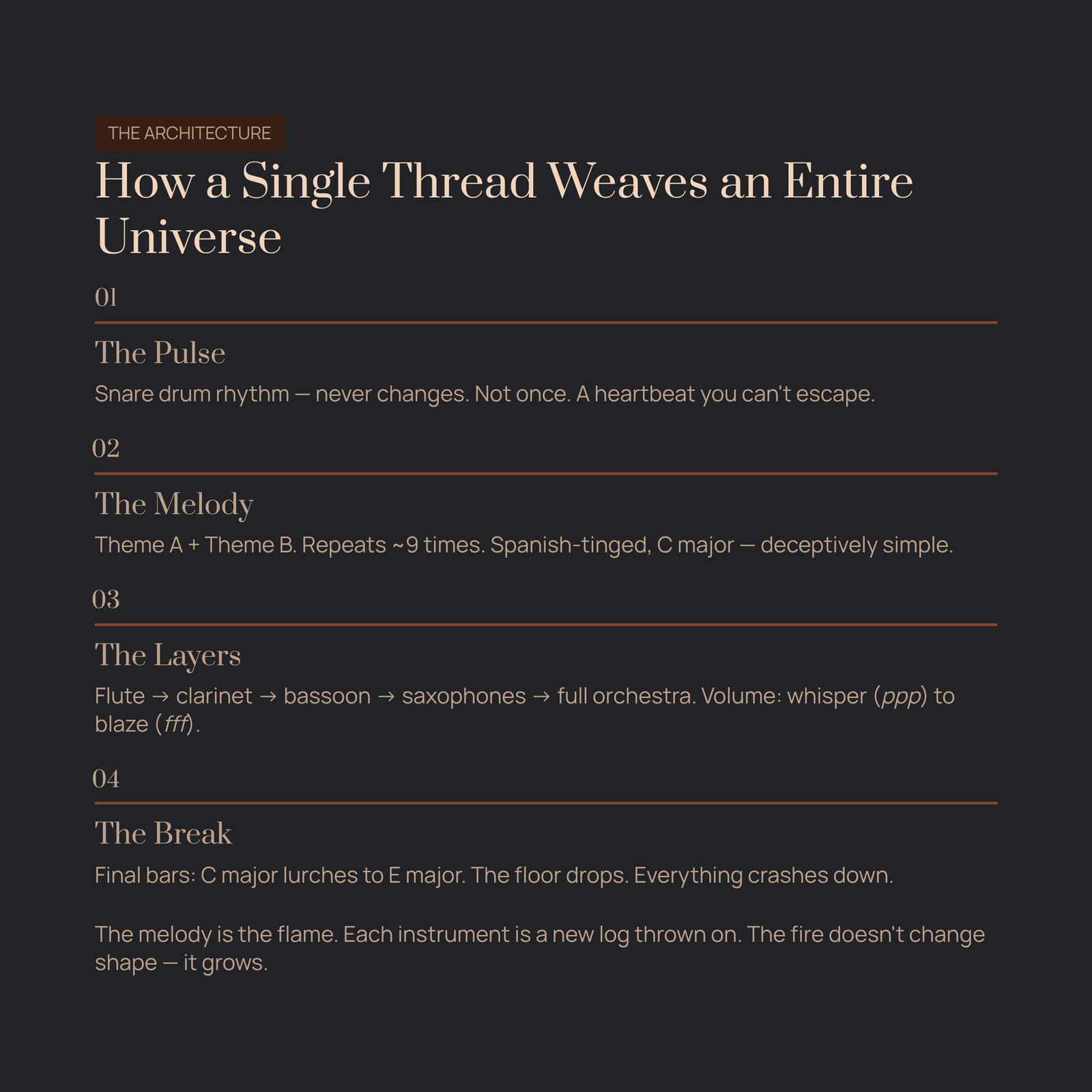
The piece opens with that iconic snare drum rhythm — a steady, hypnotic ta-da-da-da-da-da-da-da-da pattern in 3/4 time. This rhythm never changes. Not once. For the entire duration, the snare drum marches on like a heartbeat you can’t escape.
Over this pulse, the melody enters. It’s built in two halves — Theme A and Theme B — each about sixteen bars long. Together they form a complete cycle, and this cycle repeats roughly nine times throughout the piece. The melody itself is deceptively simple: rooted in C major with a Spanish-tinged flavor, it feels almost folk-like, something you could hum after hearing it once.
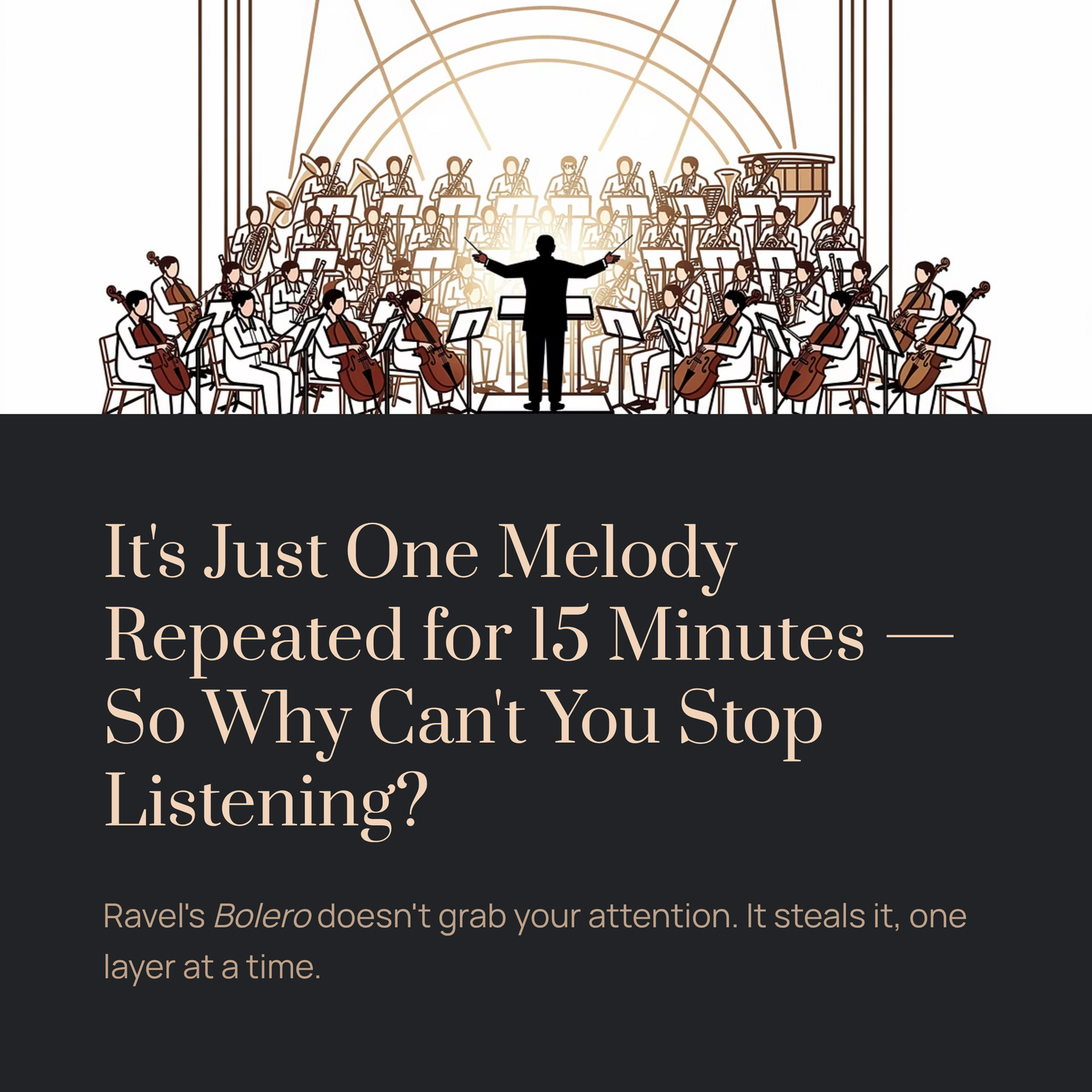
But here is where the magic unfolds. Each repetition introduces new instruments. The flute whispers the melody first, alone. Then the clarinet picks it up. Then the bassoon in an unusually high register — a stroke of genius that gives the melody an eerie, nasal quality. Gradually, oboes, trumpets, saxophones (yes, saxophones in an orchestral piece — rare and wonderful), and trombones join the conversation.
Think of it like a bonfire. The melody is the flame. Each instrument is a new log thrown on. The fire doesn’t change shape — but it grows brighter, hotter, more consuming. By the time the full orchestra roars together in the final minutes, the volume has swelled from a whisper (ppp) to an almost unbearable blaze (fff). The effect is not intellectual — it’s physical. You feel it in your chest.
And then, in the final bars, something extraordinary happens. After fifteen minutes of stubbornly staying in C major, the harmony suddenly lurches into E major — a tonal shift that feels like the floor dropping out from under you. It lasts only a few seconds before everything comes crashing down in a violent, almost chaotic conclusion. It’s as if the spell finally breaks, and the piece collapses under its own accumulated weight.
The Obsession Underneath the Surface
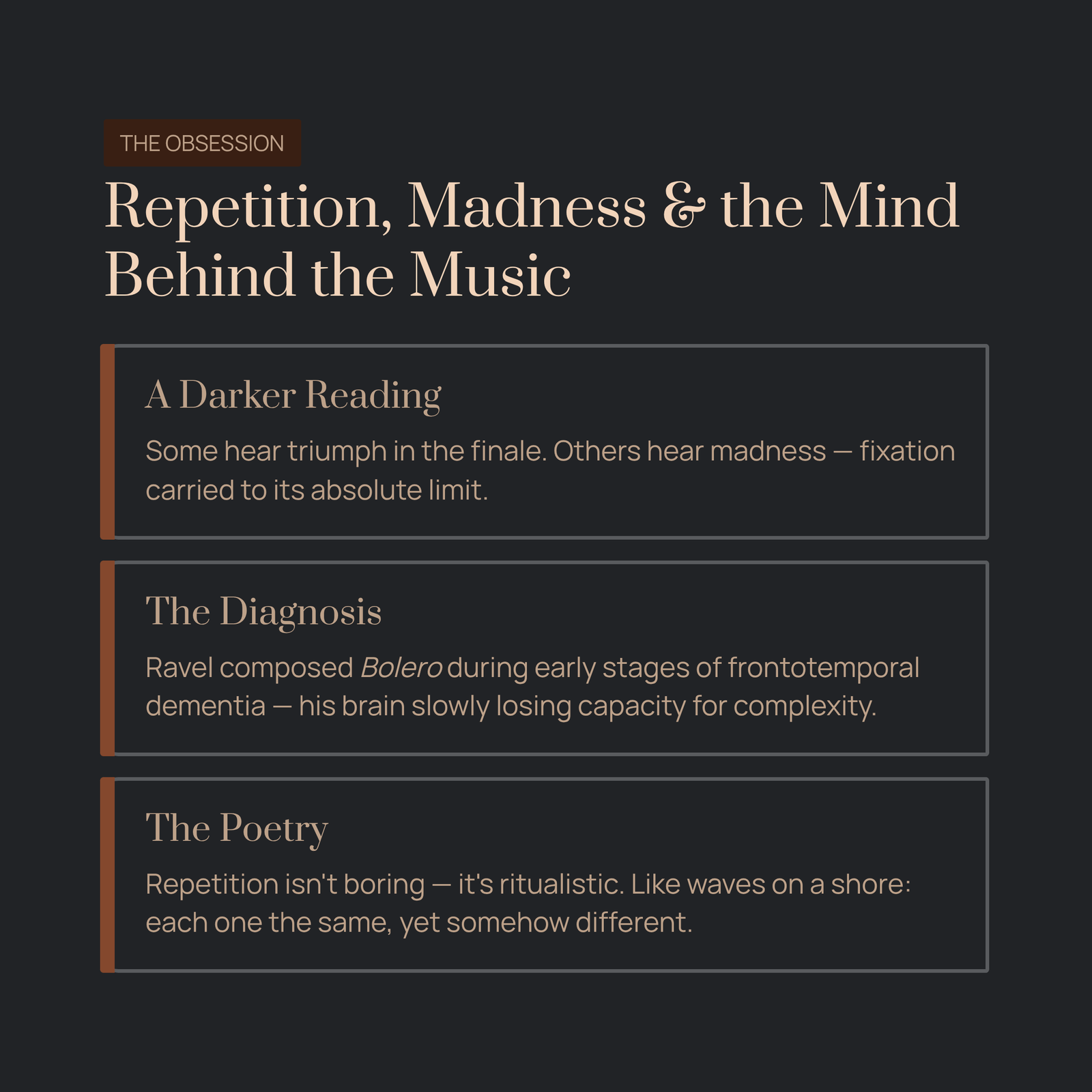
There’s something unsettling about Bolero if you think about it long enough. A single idea, repeated without escape, growing louder and louder until it either consumes you or destroys itself. Some listeners hear triumph in the finale. I hear something closer to madness — the beautiful, terrifying consequence of fixation carried to its absolute limit.
Ravel composed Bolero during the early stages of what would later be identified as a degenerative brain condition — likely frontotemporal dementia or Pick’s disease. Some scholars have drawn a connection between the piece’s obsessive repetition and the neurological changes already affecting his mind. Whether or not that’s true, there’s an uncomfortable poetry in it: a composer whose brain was slowly losing its capacity for complexity, creating a masterpiece from the radical act of repeating one idea until it becomes transcendent.
I don’t think you need to know any of that to feel it, though. Bolero works on a primal level. The repetition isn’t boring — it’s ritualistic. Like watching waves crash on a shore, each one the same and yet somehow different. It teaches you a strange kind of patience: the willingness to stay still while something slowly, inevitably, overtakes you.
Your First Listen — And How to Make It Count
If you’ve never sat down and listened to Bolero from start to finish with intention, here’s how I’d suggest approaching it.
Choose a version first. Not all Boleros are created equal. Here are three distinct approaches worth exploring:
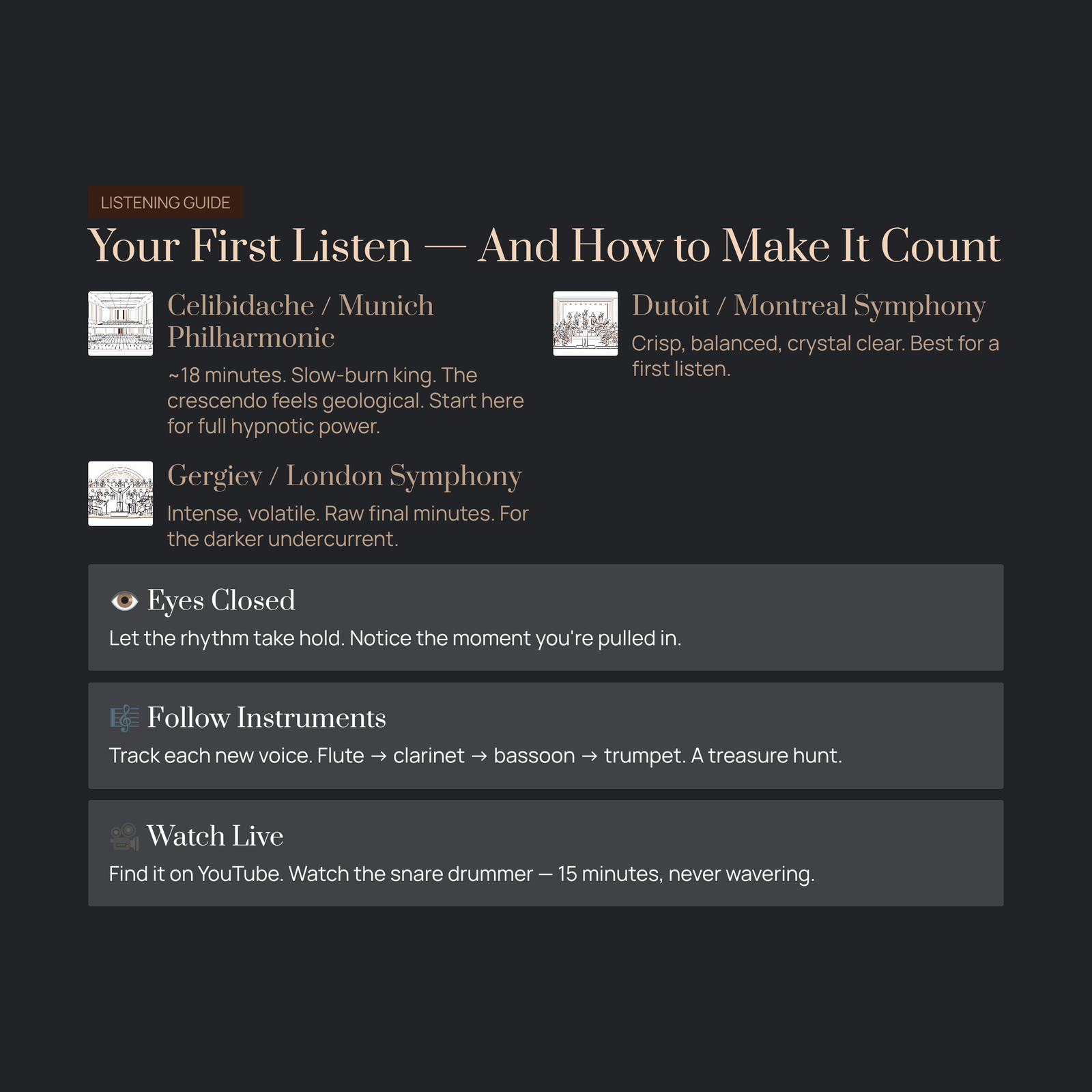
- Sergiu Celibidache with the Munich Philharmonic — This is the slow-burn king. Celibidache stretches the piece to nearly 18 minutes, and the patience pays off. The crescendo feels geological, like watching a mountain form. If you want to feel the full hypnotic power, start here.
- Charles Dutoit with the Montreal Symphony — Crisp, elegant, and perfectly balanced. This is the version I’d recommend for a first listen. Every instrument is crystal clear, and the pacing feels natural.
- Valery Gergiev with the London Symphony Orchestra — More intense, more volatile. The final minutes have a raw, almost aggressive energy. If you want to feel the piece’s darker undercurrent, this is your pick.
Now, try these three ways to listen:
First listen — eyes closed, no distractions. Just let the rhythm take hold. Don’t analyze. Don’t think. Notice the moment you realize you’ve been pulled in — that’s the moment Bolero starts working on you.
Second listen — follow the instruments. Try to identify each new voice as it enters. The flute, then the clarinet, then the bassoon’s strange high note, then the oboe d’amore (a rare guest in orchestral music), then the trumpet with its ghostly mute. Tracking the orchestration turns the piece into a treasure hunt.
Third listen — watch a live performance on video. Search for a full orchestral performance on YouTube. There’s something mesmerizing about watching the musicians — particularly the snare drummer, who must maintain that identical rhythm for fifteen minutes straight without wavering. Their concentration alone is a performance within the performance.
When Repetition Becomes Revelation
We live in a world that worships novelty. New content, new ideas, new stimulation — every second, something fresh competes for our attention. Bolero refuses all of that. It offers you one idea and dares you to stay with it. And in doing so, it reveals something we rarely allow ourselves to experience: the depth hidden inside simplicity, the transformation that happens not when things change, but when we finally learn to listen.
Ravel thought he had written a curiosity, a technical exercise, perhaps even a joke. Instead, he created one of the most viscerally powerful pieces of music ever written — proof that repetition, handled with enough craft and courage, isn’t monotony. It’s a slow-burning act of revelation.
The drum is still playing. The melody hasn’t changed. But you have.