📑 Table of Contents
There are pieces of music you listen to, and then there are pieces that listen to you. Samuel Barber’s Adagio for Strings belongs to the second category. It doesn’t ask for your attention — it seizes it, quietly, the way sorrow enters a room before anyone has spoken a word.
You might have first encountered it without knowing its name. Perhaps it was in Oliver Stone’s 1986 film Platoon, scoring the final devastation of young soldiers who had already lost everything worth losing. Perhaps it was during a news broadcast on September 11, 2001, when radio stations across America replaced their programming with this single piece. Or perhaps someone you loved died, and this melody found you in a way nothing else could.
Whatever brought you here, you’re not alone. This is the piece the world reaches for when language fails.
The 26-Year-Old Who Wrote America’s Requiem
Samuel Barber was not a tortured, starving artist. Born in 1910 in West Chester, Pennsylvania, he grew up in a musical household — his aunt was the celebrated contralto Louise Homer, and his uncle was a composer. Barber began writing music at seven and entered the Curtis Institute of Music at fourteen. By all accounts, he was gifted, disciplined, and remarkably self-assured.
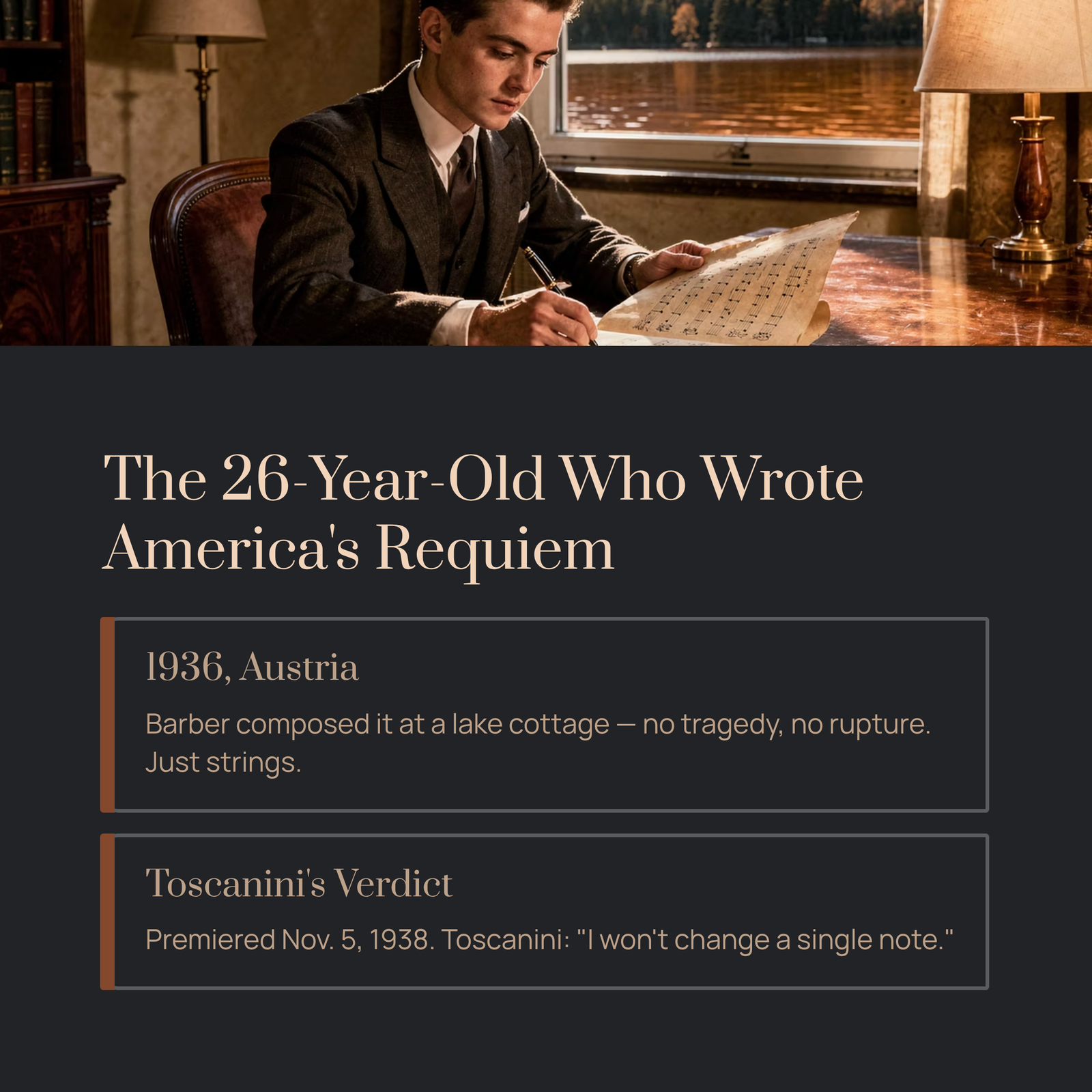
In the summer of 1936, at just twenty-six, Barber traveled to Europe with his lifelong companion Gian Carlo Menotti. While staying at a lake cottage in Austria, he composed his String Quartet in B minor, Op. 11. The second movement of that quartet — a slow, aching meditation for strings — would become the Adagio for Strings once Barber arranged it for full string orchestra.
What’s remarkable is that nothing catastrophic had happened. There was no death, no betrayal, no dramatic rupture behind the composition. Barber simply sat down and wrote something that sounds like the collective grief of an entire century. The legendary conductor Arturo Toscanini, who famously rejected most American compositions, agreed to premiere the orchestral arrangement with the NBC Symphony Orchestra on November 5, 1938. He reportedly told Barber he would play it — and that he wouldn’t change a single note. From Toscanini, there was no higher praise.
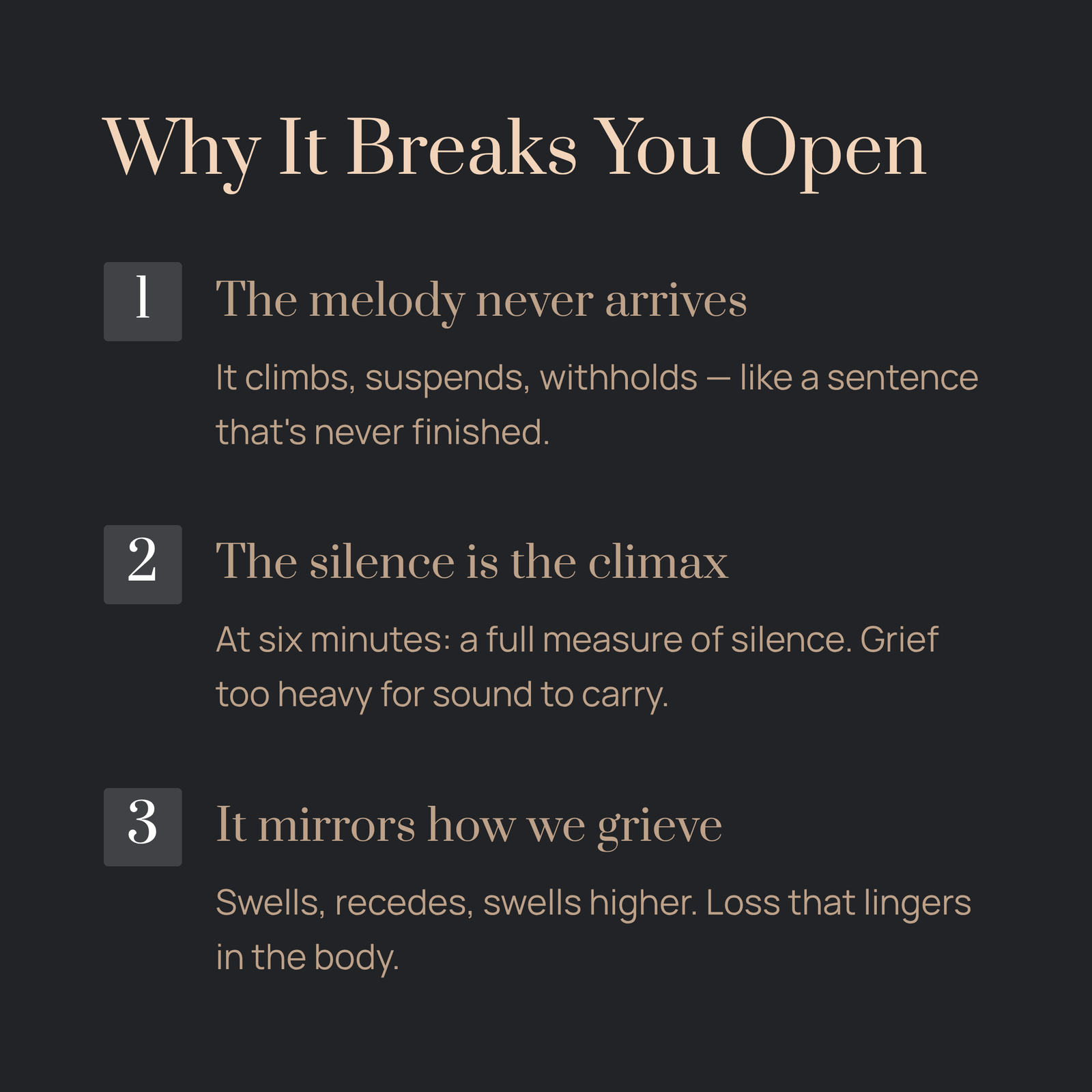
Why This Piece Breaks You Open — Even When You’re Fine
The Adagio for Strings runs roughly seven to ten minutes depending on the performance. That’s all. No grand orchestral explosions, no percussion, no brass. Just strings — violins, violas, cellos, and double basses — weaving a single melodic line that rises, falls, and rises again with unbearable patience.
Here’s what makes it so devastating, even if you know nothing about music theory.
The melody never quite arrives. It climbs upward in long, arching phrases, each one reaching a little higher than the last. You feel yourself leaning forward, waiting for resolution. But Barber keeps suspending you. The harmonic tension builds not through speed or volume, but through withholding — like a conversation where the most important sentence is never finished.
The silence is the climax. Around the six-minute mark in most performances, the entire orchestra builds to a searing fortissimo — the strings crying out in unison at their highest register. And then: nothing. A full measure of silence. That pause is not an absence of music. It is the music. It’s the moment when grief becomes too heavy for sound to carry, and all that’s left is the weight of what you’ve just felt. When the melody returns after that silence, quieter than before, it feels like breathing again after forgetting how.
It mirrors how we actually grieve. Grief doesn’t crash in like a wave and leave cleanly. It swells, recedes, swells higher, and recedes again. The Adagio‘s structure follows this same organic rhythm — building tension through overlapping phrases that never quite resolve, creating a sense of emotional suspension that mirrors the way real loss lingers in the body.
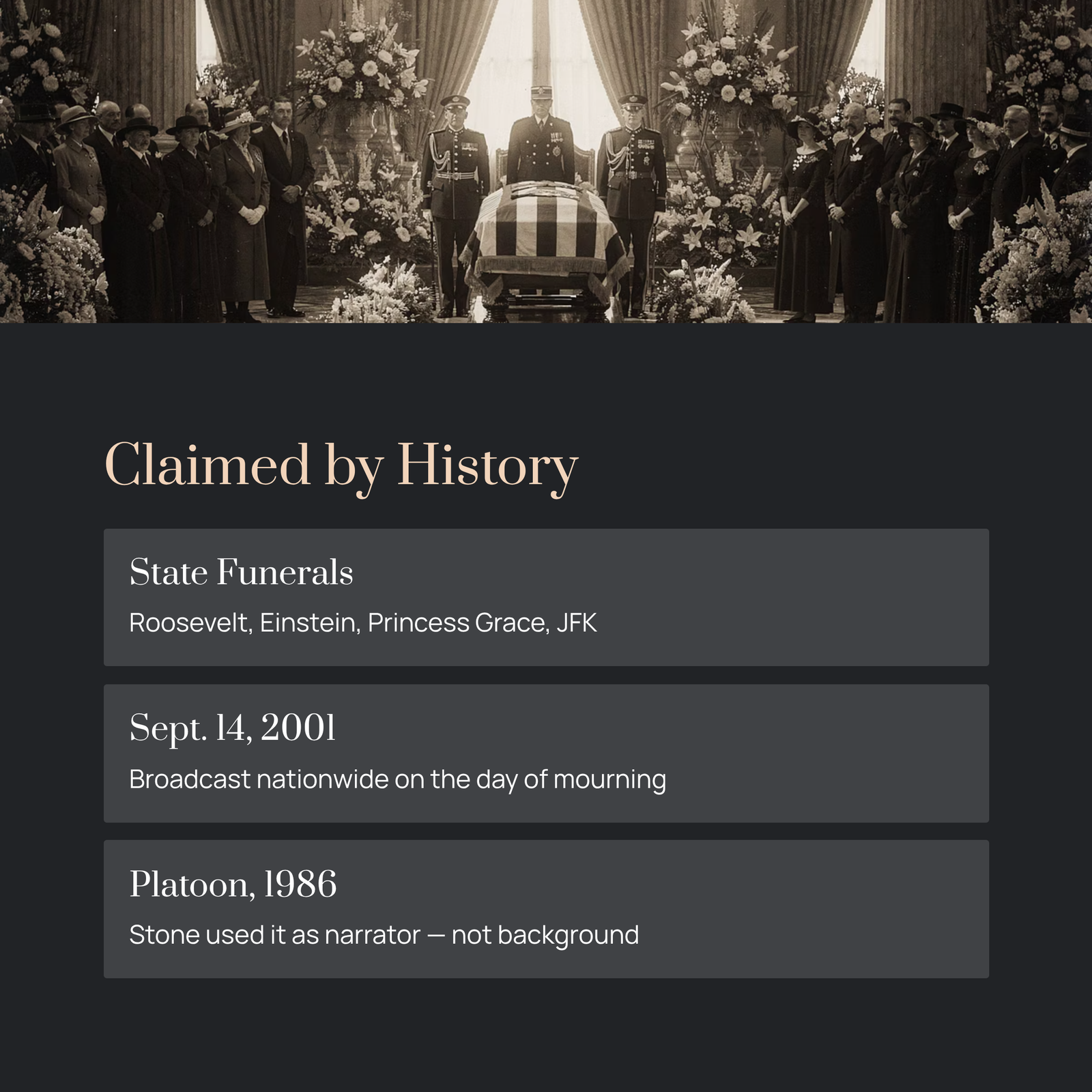
From Concert Hall to Battlefield — A Piece Claimed by History
Few works of classical music have embedded themselves so deeply into public consciousness. The Adagio for Strings has been played at the funerals of Franklin D. Roosevelt, Albert Einstein, Princess Grace of Monaco, and John F. Kennedy. It was broadcast across American airwaves on September 14, 2001, during the national day of mourning.
But for many listeners, its most powerful association remains Oliver Stone’s Platoon. In the film, the Adagio accompanies the final scenes of carnage — bodies falling in slow motion, faces frozen between terror and resignation. Stone didn’t use the piece as background music. He used it as a narrator, telling the truth the characters could no longer speak: that war destroys not just bodies, but the possibility of ever being whole again.
The pairing was so effective that the Adagio for Strings essentially became synonymous with cinematic grief. But this association is worth gently pushing against. The piece existed for fifty years before Platoon, and its emotional power doesn’t depend on images of warfare. It speaks just as clearly in an empty room at midnight.
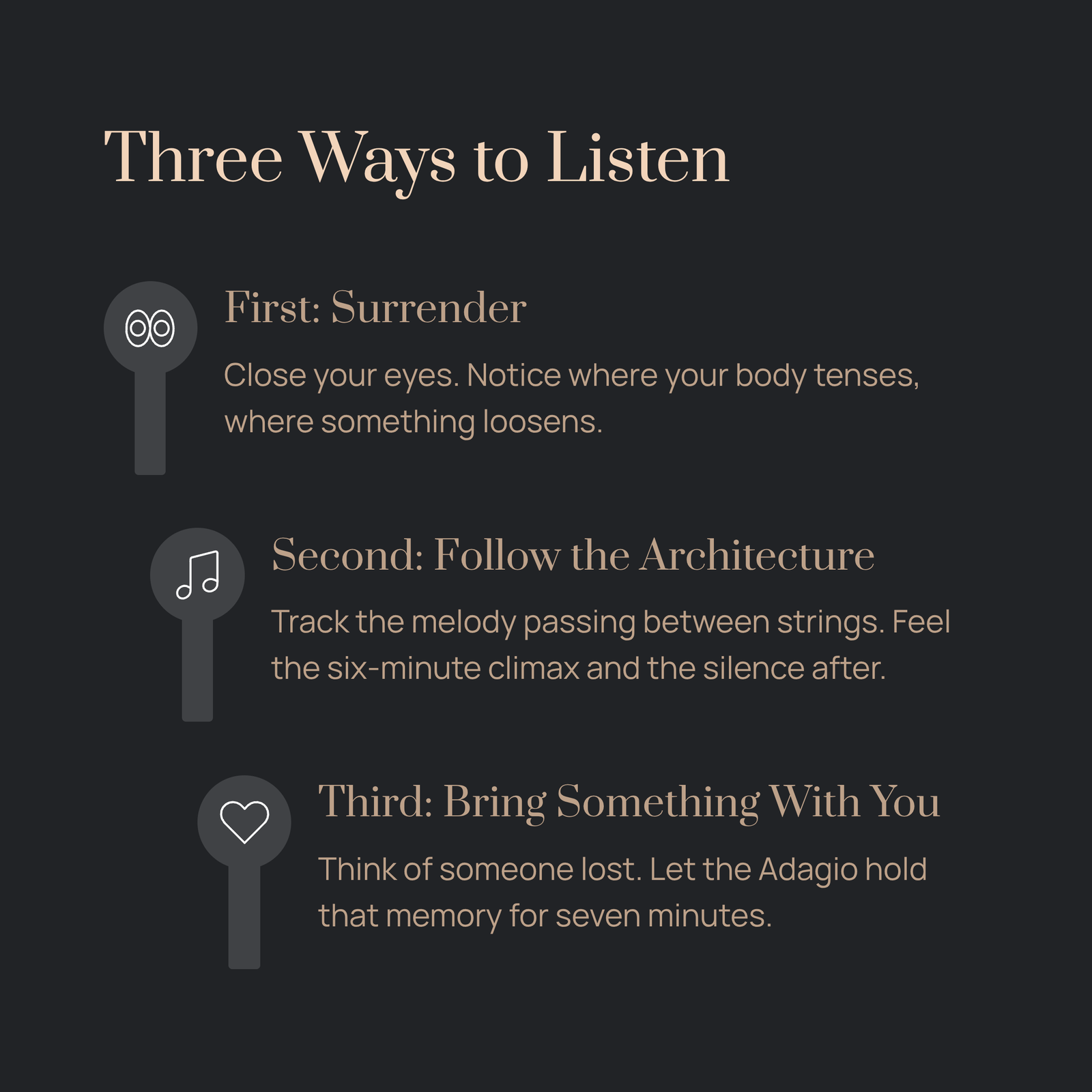
How to Listen — Three Paths Through the Same Masterpiece
If this is your first encounter with the Adagio, here are three ways to experience it.
First listen: Close your eyes and surrender. Don’t analyze. Don’t check the time. Let the melody lead you. Pay attention to where your body tenses, where you hold your breath, where something unexpectedly loosens. The piece does its deepest work when you stop trying to understand it.
Second listen: Follow the architecture. Notice how the opening melody in the first violins passes to the lower strings, each voice entering at a slightly different pitch. Listen for how the texture thickens as more instruments join. Track the slow ascent to the climax around the six-minute mark, and pay attention to what happens in your chest during the silence that follows.
Third listen: Bring something with you. Think of someone you’ve lost. A moment that changed you. A door that closed and never reopened. Let the Adagio hold that memory for seven minutes. This is what the piece was built for — not to fix grief, but to give it a shape, a container, a duration. There’s an odd comfort in that.
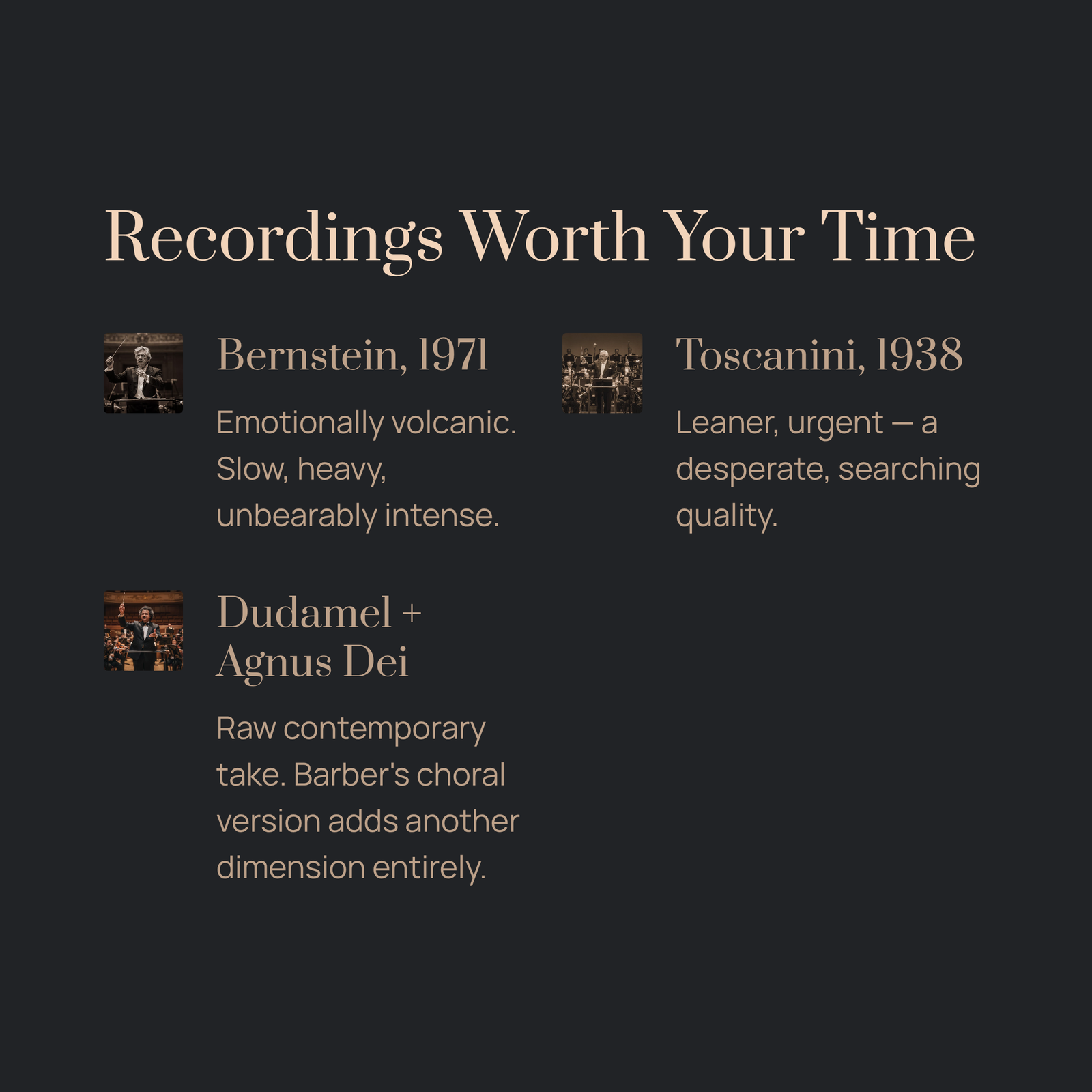
Recordings Worth Your Time
The range of interpretations is astonishing for such a deceptively simple piece.
Leonard Bernstein’s 1971 recording with the New York Philharmonic is emotionally volcanic — slower, heavier, almost unbearably intense. If you want to feel the piece as an act of mourning, start here.
The original Toscanini recording from 1938 offers historical resonance and a leaner, more urgent reading. It’s faster than most modern performances, and that urgency gives the melody a desperate, searching quality.
For a contemporary take, Gustavo Dudamel’s performance with the Simón Bolívar Symphony Orchestra carries a particular rawness. There’s also the choral arrangement — Agnus Dei — where Barber himself set the melody to the Latin text of the Mass. Hearing human voices carry this line adds another dimension entirely.
The Permission to Feel
There’s a reason the Adagio for Strings endures while countless other works from 1936 have faded. It does something rare: it gives you permission. Permission to sit with sorrow without rushing toward resolution. Permission to feel the full weight of being alive without pretending it doesn’t sometimes hurt.
Samuel Barber wrote this in his twenties, before the wars and funerals that would later claim it. Maybe that’s why it works. It wasn’t written about a specific tragedy. It was written from a place that understood tragedy was coming — for everyone, eventually — and that what we’d need most in those moments wasn’t explanation, but companionship.
Press play. Let it find the thing you’ve been carrying. Seven minutes is enough.