📑 Table of Contents
Imagine writing a heartfelt song for someone, and then that person simply vanishes from the world. That is, in a strange way, the story of this piece. In 1824, Franz Schubert sat down to write a sonata for a brand-new instrument called the arpeggione — a curious hybrid that looked like a guitar but was bowed like a cello. Within a few years, the instrument fell out of fashion and disappeared almost entirely.
The instrument died. The music did not.
Today the Arpeggione Sonata is performed by cellists, violists, and even flutists and clarinetists who borrow its aching melodies for their own instruments. And the opening movement, the Allegro moderato, has become one of those pieces that seems to reach directly into your chest the moment it begins. You do not need to know a single thing about music theory to feel it.
Who Was Schubert, and Why Does This Feel So Sad?
Franz Schubert (1797–1828) was a Viennese composer who lived an astonishingly short life — he died at just 31 — yet left behind more than 600 songs and a mountain of chamber music, symphonies, and piano works. He is often described as the great bridge between the Classical era of Mozart and Haydn and the Romantic era that followed.
What makes Schubert special is hard to explain until you hear it: he had an almost supernatural gift for melody, the kind of tune that sounds like someone is gently telling you something true. He was also, by 1824, a very sick man. He had been diagnosed with the illness that would eventually kill him, and you can hear a shadow hanging over much of his late music — a sweetness that keeps tipping into sorrow.
The Arpeggione Sonata was written in that shadowed period. It smiles, but the smile trembles a little.
The Story Behind the 1824 Sonata
The arpeggione itself was invented around 1823 by a Viennese instrument maker, and a musician friend asked Schubert to write something for it. Schubert obliged, producing this sonata in November 1824.
Here is the bittersweet irony: the instrument was already a fad on its way out, and the sonata was never even published in Schubert’s lifetime. It only appeared in print decades later, by which point no one could actually play the original instrument anymore. So performers adapted it — and in doing so, accidentally gave the work a far longer life than it would ever have had otherwise. A piece written for a dying instrument became immortal precisely because it had to be reinvented.
What to Listen For: A Guide for First-Timers
You do not need to follow along with a score. Just let these moments wash over you.
The opening (0:00). The piano plays a gentle, almost questioning melody first — soft, a little melancholy, like someone humming alone in a quiet room. Then the solo instrument (usually a cello or viola) takes up that same tune and sings it with even more warmth. Notice how the melody seems to sigh. That rise and gentle fall is the emotional heartbeat of the whole movement.
The shift to brightness. After the melancholy opening theme, Schubert opens a window. The music brightens and becomes more flowing and lyrical, like sunlight breaking through clouds. This contrast — sad, then hopeful, then sad again — is what gives the movement its emotional richness.
The conversation. Pay attention to how the piano and the solo instrument pass the melody back and forth, almost like two people finishing each other’s sentences. Schubert was a master of this intimate dialogue. Neither instrument dominates; they lean on each other.
The quiet ending. The movement does not end in triumph. It settles, gently, as if exhaling. That restraint is exactly what makes it so moving.
The whole movement runs roughly 11 to 13 minutes depending on the performer — slow enough to sink into, never long enough to lose you.
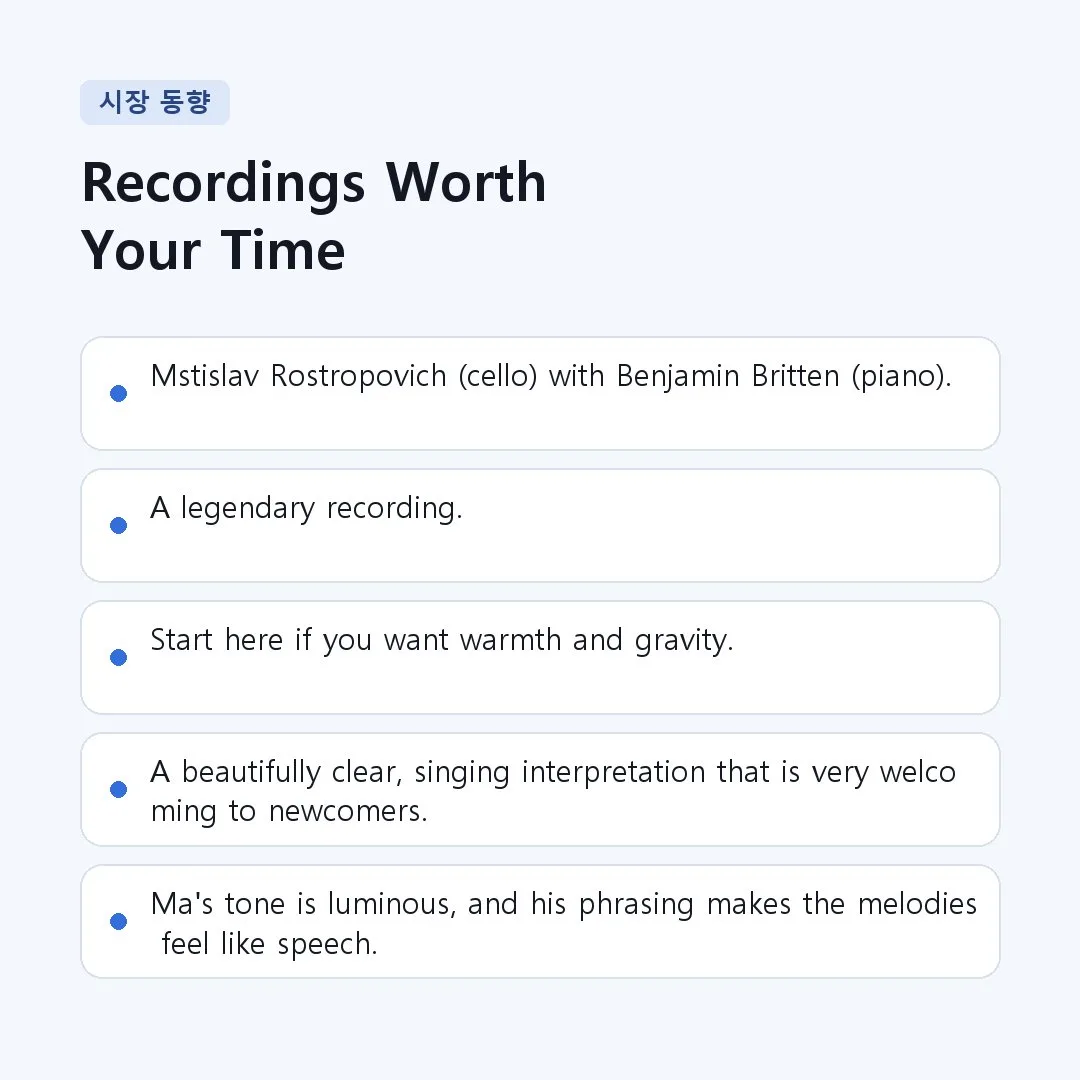
Recordings Worth Your Time
Because so many different instruments have claimed this piece, you get to choose the voice you most want to hear it in.
Mstislav Rostropovich (cello) with Benjamin Britten (piano). A legendary recording. Rostropovich’s cello is rich and human, and having the composer Britten at the piano gives it extraordinary sensitivity. Start here if you want warmth and gravity.
Yo-Yo Ma (cello). A beautifully clear, singing interpretation that is very welcoming to newcomers. Ma’s tone is luminous, and his phrasing makes the melodies feel like speech.
Tabea Zimmermann or Kim Kashkashian (viola). If you want to hear the piece in its slightly darker, more veiled viola color — which many listeners feel suits Schubert’s melancholy even better than the cello — these violists are wonderful guides.
Any of these is an excellent doorway. Put on a good pair of headphones, dim the lights, and let it play once without doing anything else.
Why This Piece Stays With You
There is something quietly profound about the Arpeggione Sonata. It was written by a dying man, for a dying instrument, and somehow it became a small piece of music that refuses to die. Every time a cellist or violist picks it up, they are reviving a melody that was supposed to be forgotten.
Maybe that is why it feels so tender. It carries, without ever saying so, a gentle truth: that beauty often outlives the things that made it, and that what we create with love can travel far beyond anything we imagined. Schubert never heard this sonata published. He never knew it would still be played two centuries later, on instruments he never wrote for, by people who would never know his name.
But here you are, listening. And that is its own kind of miracle.