📑 Table of Contents

There is a kind of music that doesn’t ask you to listen. It simply appears — the way frost forms on a windowpane overnight, the way a name you thought you’d forgotten suddenly surfaces in the middle of an ordinary afternoon. Remedios’ “A Winter Story” is that kind of music. You don’t choose to be moved by it. You just are.
This piece serves as the emotional backbone of Love Letter, the 1995 Japanese film directed by Shunji Iwai that quietly became one of the most beloved romantic dramas across East Asia. The story begins with a woman named Hiroko who, still grieving her fiancé two years after his death in a mountaineering accident, sends a letter to his old childhood address — an address she knows no longer exists. And yet, impossibly, a reply comes back. What unfolds is not a ghost story, but something far more delicate: a slow unraveling of memory, identity, and the love letters we write to our own pasts.
Against that narrative, “A Winter Story” plays like the heartbeat of the film itself — quiet, persistent, aching with something just beyond the reach of words.

Remedios: The Composer Behind the Snow
Remedios is the stage name of Reimy Horikawa (堀川 麗美), a Japanese singer-songwriter and composer born in 1965 in Ginowan, Okinawa. Her career has been deeply intertwined with the cinematic world of director Shunji Iwai, and Love Letter was both Iwai’s feature debut and Remedios’ first major soundtrack release — a pairing that would define an entire aesthetic movement in Japanese cinema often called the “Iwai World.”
The Love Letter soundtrack earned the Best Music Award at the 19th Japan Academy Awards, and for good reason. Remedios chose a strikingly minimal palette for the entire score: acoustic piano and strings alone. No synthesizers, no layered orchestrations — just the raw, breathing texture of a piano (performed by Yui Makino) and the warm embrace of the Masatsugu Shinozaki Strings. It was a bold restraint, one that mirrored the film’s own philosophy: that the most profound emotions live in the spaces between words, in the things left unsaid.
Following Love Letter, Remedios continued her collaboration with Iwai on works such as PiCNiC (1995), and her compositions have appeared in dramas like Mother (2010) and the celebrated anime Anohana: The Flower We Saw That Day (2011). But it is “A Winter Story” that remains her most recognized work — a piece that has taken on a life far beyond the film that gave it birth.

What You’re Actually Hearing: A Gentle Anatomy
“A Winter Story” opens with a piano figure so simple it almost sounds like someone thinking aloud. There’s no grand entrance, no dramatic announcement. The melody begins in the mid-register — that warm, conversational range of the piano where notes feel closest to the human voice — and unfolds with the unhurried patience of snowfall.
The harmonic language is deceptively understated. Remedios works primarily in a minor key, but she avoids the heavy gravity that minor keys often carry. Instead, the harmonies hover in a kind of luminous sadness — think of the way winter sunlight looks when it strikes fresh snow. There’s melancholy, yes, but there’s also an almost unbearable tenderness. The chord progressions move gently, often stepping through suspensions that delay resolution just long enough to make you hold your breath.
When the strings enter, they don’t compete with the piano. They cradle it. The string arrangement is sparse and achingly lyrical, moving in long, sustained lines that feel less like accompaniment and more like a second voice joining a private conversation. The interplay between piano and strings creates a kind of emotional counterpoint — the piano carrying the melody’s solitude, the strings offering the warmth of companionship from across some impossible distance.
Pay attention to how the dynamics work. The piece never truly crescendos into anything loud. Its climax, such as it is, arrives as an intensification of feeling rather than volume — a slight thickening of the string texture, a wider interval in the melody, a moment where the piano reaches just slightly higher than before. Then it retreats, gently, the way a wave pulls back from the shore.

Listening Through the Lens of Memory
I first heard “A Winter Story” not in a concert hall or through an algorithm’s recommendation, but through the ambient fog of a late-night rewatch of Love Letter during a particularly cold February. The film had ended, the credits were scrolling, and this piece was playing — and I realized I hadn’t moved. Not because the music demanded stillness, but because it had created a pocket of silence around me that felt too delicate to break.
What strikes me most about this piece is its relationship to time. There are compositions that pull you forward, that create urgency and momentum. “A Winter Story” does the opposite. It makes time feel circular. The repeating melodic phrases, the way the piece returns to its opening motif, the unhurried pacing — all of it evokes the peculiar experience of remembering. Not the sharp recall of a fact, but the slow, almost physical sensation of a memory surfacing: a face, a season, a feeling you can’t quite name but recognize instantly.
This is why, I think, the piece resonates so powerfully even for listeners who have never seen the film. It isn’t about a specific story. It’s about the universal architecture of longing — that strange, bittersweet space where love and loss share the same room, where writing a letter to someone who will never read it somehow makes perfect sense.
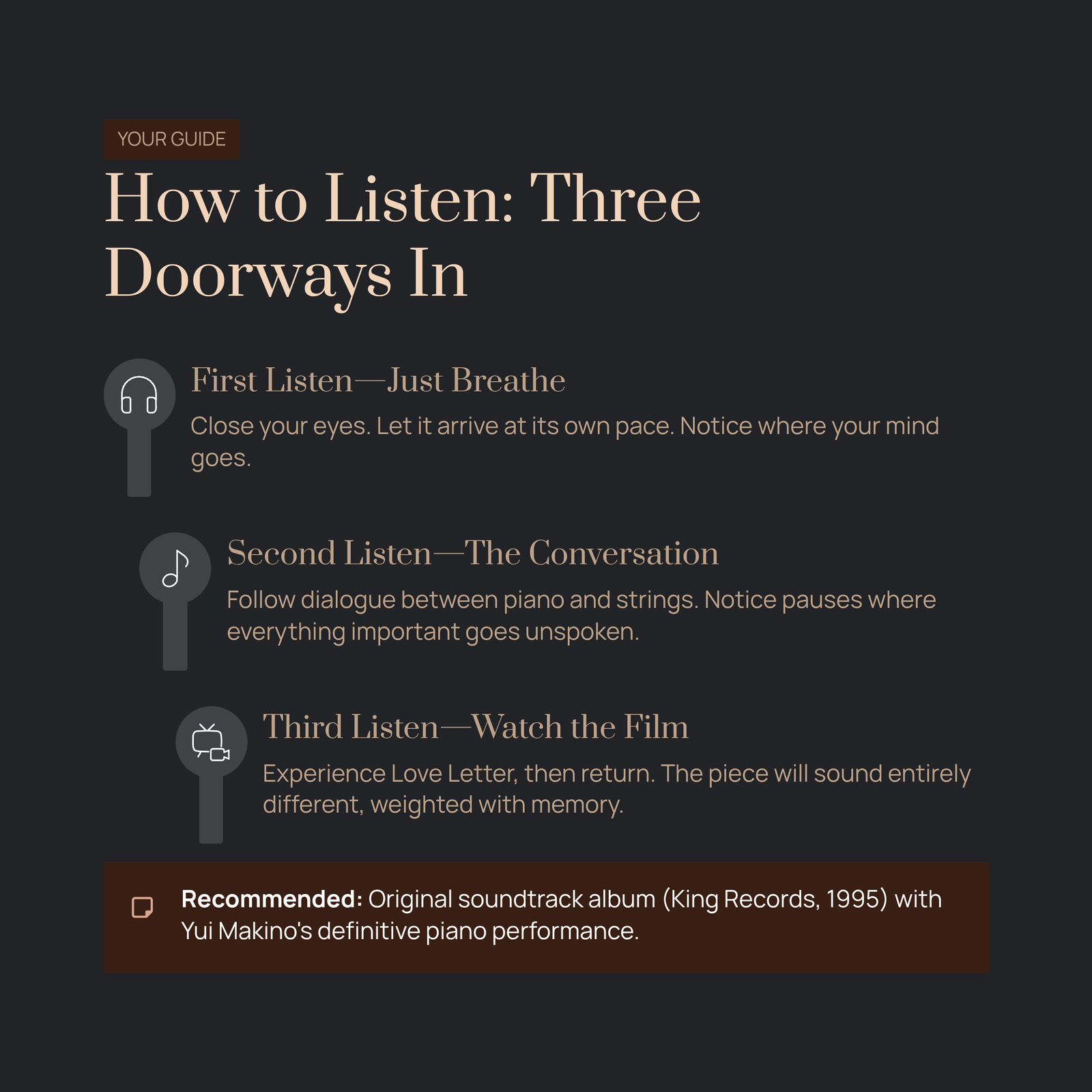
How to Listen: Three Doorways In
The First Listen — Just Breathe With It. Don’t read about the film first. Don’t look up the tracklist. Put on a pair of headphones, close your eyes, and let the piece arrive at its own pace. Notice where your mind goes. This music is remarkably good at finding whatever emotional frequency you’re already carrying and resonating with it. The first listen should belong entirely to you, unmediated by context.
The Second Listen — Follow the Conversation. Now, listen for the dialogue between piano and strings. Notice when the strings enter and how they change the emotional temperature of the piece. Pay attention to the moments of silence — the brief pauses where the piano lifts its hands and the strings hold a note alone. These are the piece’s most intimate moments, the equivalent of that pause in a conversation where everything important goes unspoken.
The Third Listen — Watch the Film. If you can, watch Love Letter and then return to “A Winter Story” immediately after. The piece will sound entirely different — not because the notes have changed, but because you’ll now carry the weight of Hiroko’s grief, of snow-covered Otaru, of letters crossing the boundary between the living and the dead. Music, like memory, is always shaped by what we bring to it.
Recommended recordings: The original soundtrack album (Love Letter Original Soundtrack, King Records, 1995) remains the definitive version, with Yui Makino’s piano performance capturing exactly the right balance of clarity and emotional weight. For a different texture, seek out the many piano cover arrangements available online — some add gentle rubato and personal interpretation that reveal new dimensions in Remedios’ deceptively simple writing.

The Letter You Send to Yourself
There is a scene in Love Letter where Hiroko stands in the snow and shouts toward the mountains where her fiancé died: “How are you? I am doing well.” It is, in the context of the film, both heartbreaking and healing — a farewell disguised as a greeting, a goodbye that is also a beginning.
“A Winter Story” captures exactly that paradox. It is music that mourns and comforts simultaneously. It doesn’t try to resolve grief or explain it away. It simply sits with you in the cold, in the quiet, in that tender space where you realize that the letters we write to the people we’ve lost are really letters we write to ourselves — reminders that we loved, that we still love, that love doesn’t require a reply to be real.
Thirty years after its creation, this small, unassuming piano piece continues to fall like snow on the shoulders of anyone willing to stand still long enough to feel it. And perhaps that is the highest achievement any piece of music can claim: not that it was heard, but that it was felt — quietly, persistently, like a winter story told in a language that needs no translation.