📑 Table of Contents
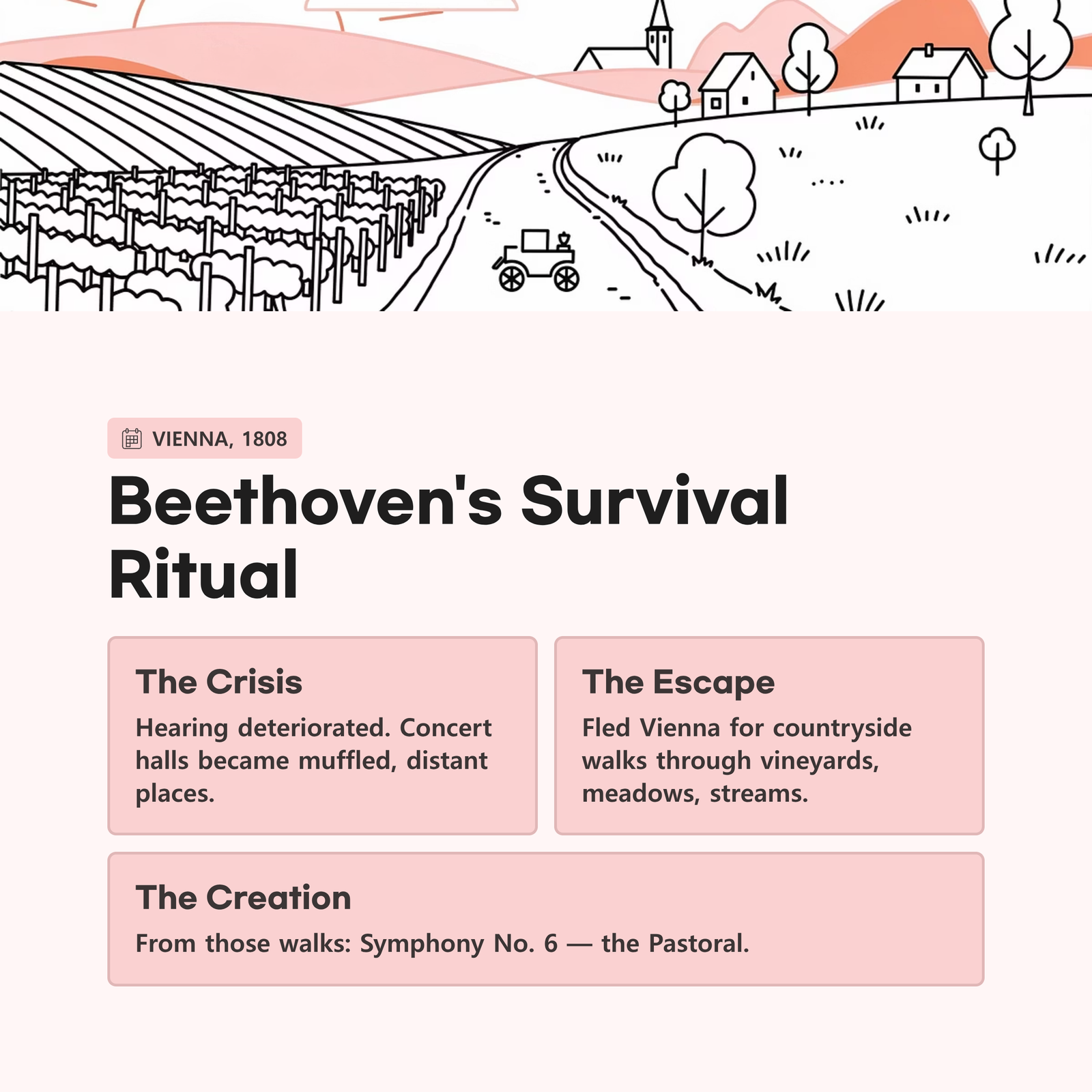
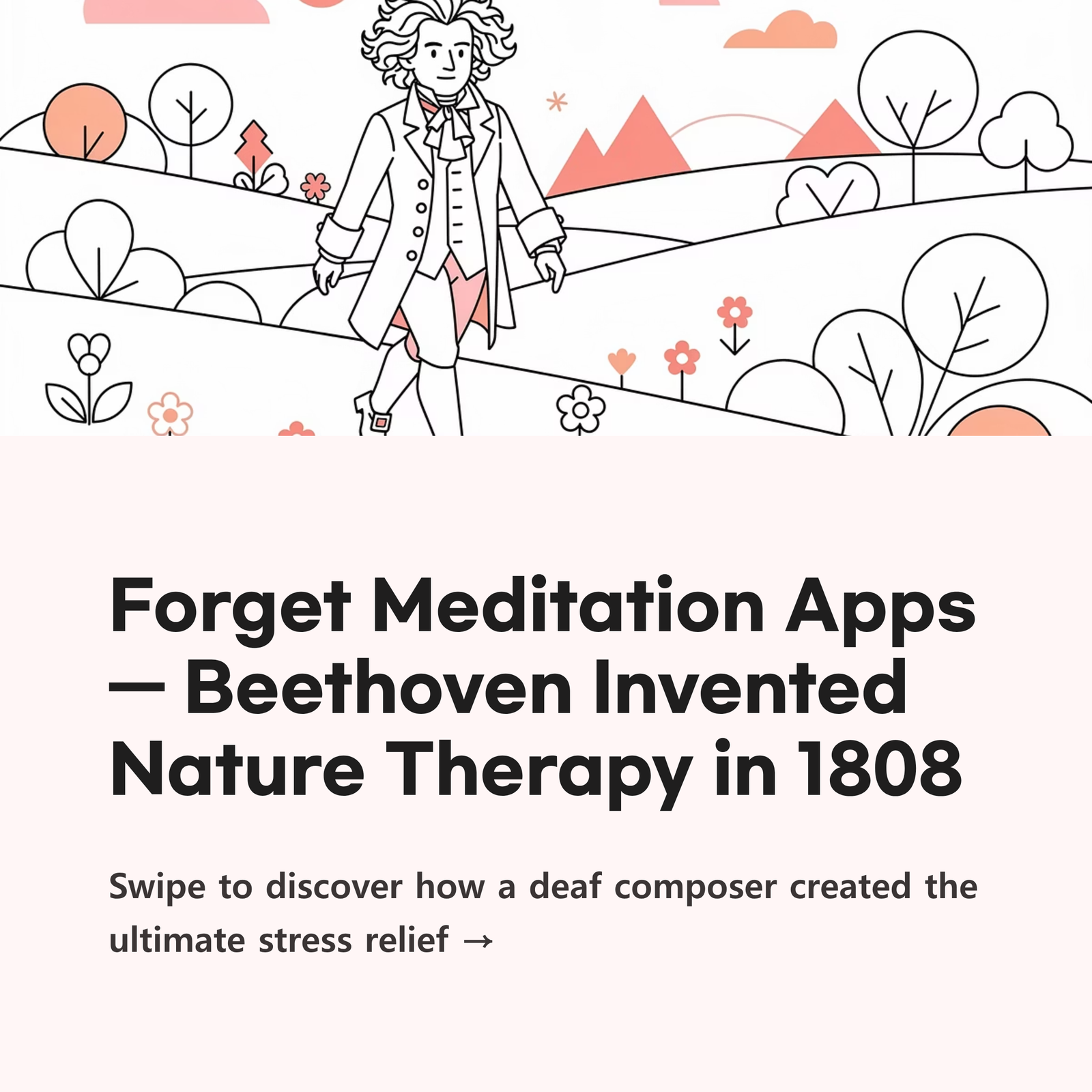
Picture this: Vienna, early 1800s. A stocky man with wild hair storms out of his cramped apartment, practically fleeing the city. He walks for hours — past vineyards, through meadows, along streams — until the noise of urban life fades into birdsong and wind. This was Ludwig van Beethoven’s ritual, and it wasn’t casual exercise. It was survival.
By 1808, Beethoven’s hearing had deteriorated to the point where conversation required shouting. The concert halls he once commanded were becoming muffled, distant places. But out in the countryside surrounding Vienna — in Heiligenstadt, in Baden — he could still feel something. The rustle of leaves wasn’t just sound; it was vibration, memory, presence. And from those walks, he distilled one of the most remarkable pieces of music ever written: his Symphony No. 6 in F major, Op. 68 — the Pastoral.
Today, we’re going to step into the first movement together. Not as a music theory lecture. More like lacing up your boots and following Beethoven’s footsteps down that country path.
Who Was Beethoven, and Why Does a Symphony About Nature Matter?
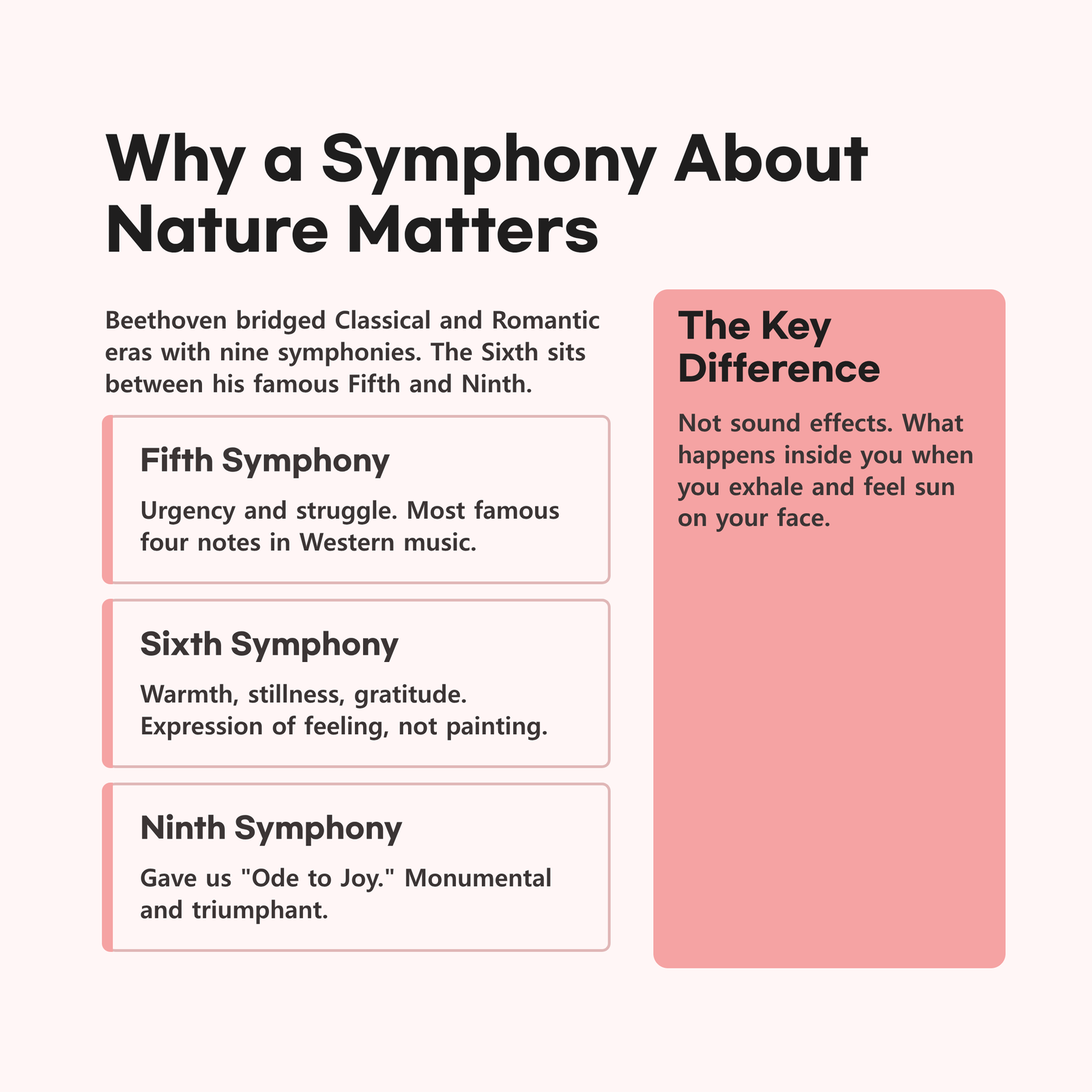
If you’re new to classical music, you’ve almost certainly heard Beethoven’s name. He’s the titan — the composer who bridged the Classical and Romantic eras, who wrote nine symphonies that collectively reshaped what orchestral music could express. His Fifth Symphony opens with perhaps the most famous four notes in all of Western music. His Ninth gave us the “Ode to Joy.”
But sandwiched between those monumental works sits the Sixth, and it’s a strikingly different animal. Where the Fifth is all urgency and struggle, the Sixth is warmth. Stillness. Gratitude. Beethoven himself gave it the subtitle Pastoral Symphony, or Recollections of Country Life and added a crucial note: “More an expression of feeling than painting.” He wasn’t trying to literally mimic nature — he was trying to bottle the emotion of being surrounded by it.
That distinction matters. This isn’t a sound effects reel. It’s what happens inside you when you finally exhale after a long week and feel the sun on your face.
The First Movement: “Awakening of Cheerful Feelings on Arrival in the Countryside”
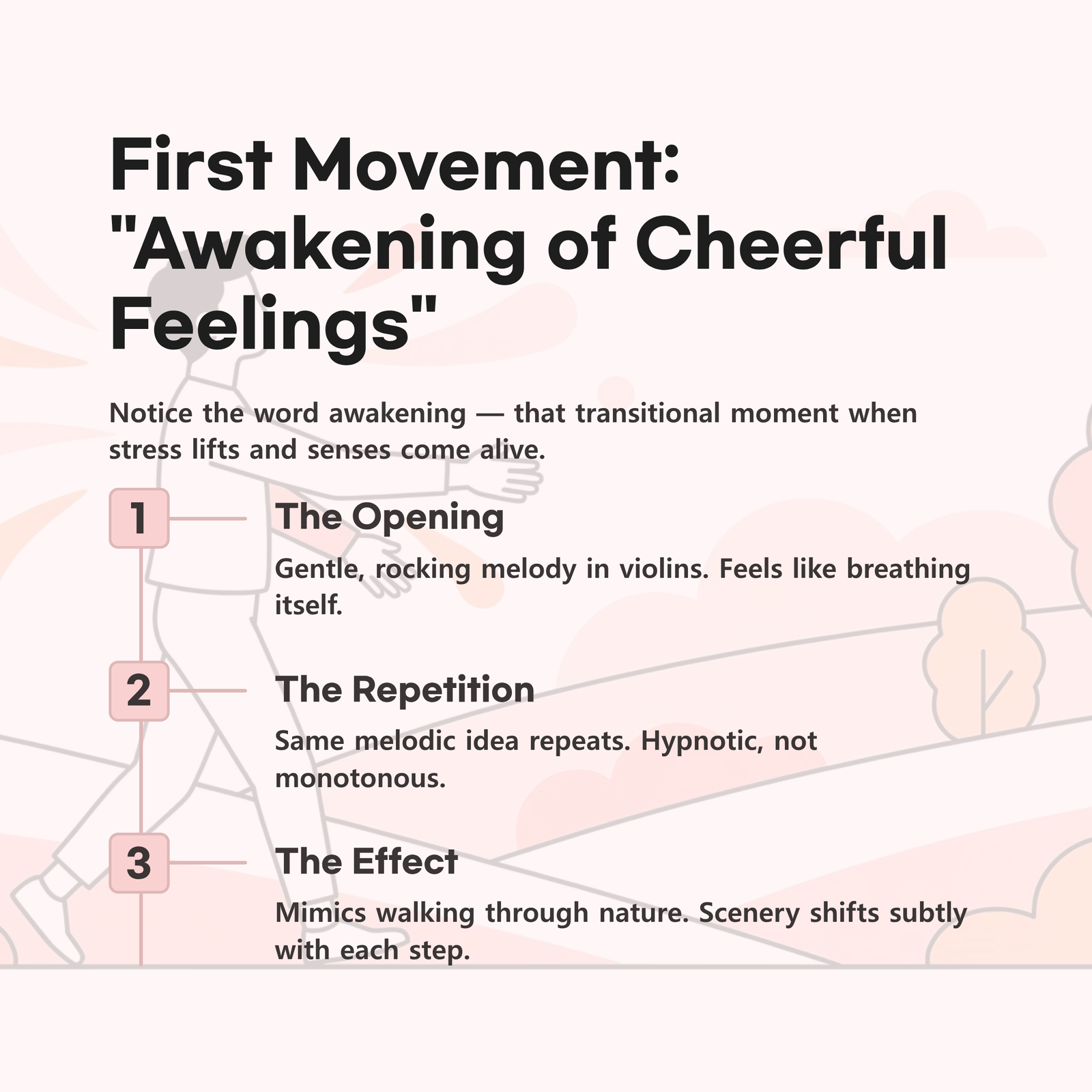
Beethoven gave each of the Pastoral Symphony’s five movements a descriptive title — almost unheard of in his time. The first movement carries one of the most evocative: Erwachen heiterer Empfindungen bei der Ankunft auf dem Lande — “Awakening of cheerful feelings on arrival in the countryside.”
Notice the word awakening. Not “cheerful feelings.” Not “being in the countryside.” The awakening — that transitional moment when the stress lifts and your senses come alive again. Anyone who’s ever driven out of a congested city and caught their first glimpse of open sky knows exactly this sensation. Beethoven nailed it over two hundred years ago.
The movement opens with a deceptively simple melody in the violins — a gentle, rocking figure that feels like breathing itself. It doesn’t announce. It doesn’t demand attention. It arrives, softly, the way a breeze does. And then something remarkable happens: Beethoven takes that small melodic idea and repeats it. And repeats it. And repeats it again.
In almost any other context, this level of repetition would feel monotonous. Here, it’s hypnotic — deliberately so. Beethoven is mimicking the experience of walking through nature, where the scenery doesn’t change dramatically from second to second. Instead, you notice a slightly different angle of light. A new wildflower at the path’s edge. The same meadow, seen from ten steps further along, somehow transformed.
What to Listen For: A Guided Walk Through the Music
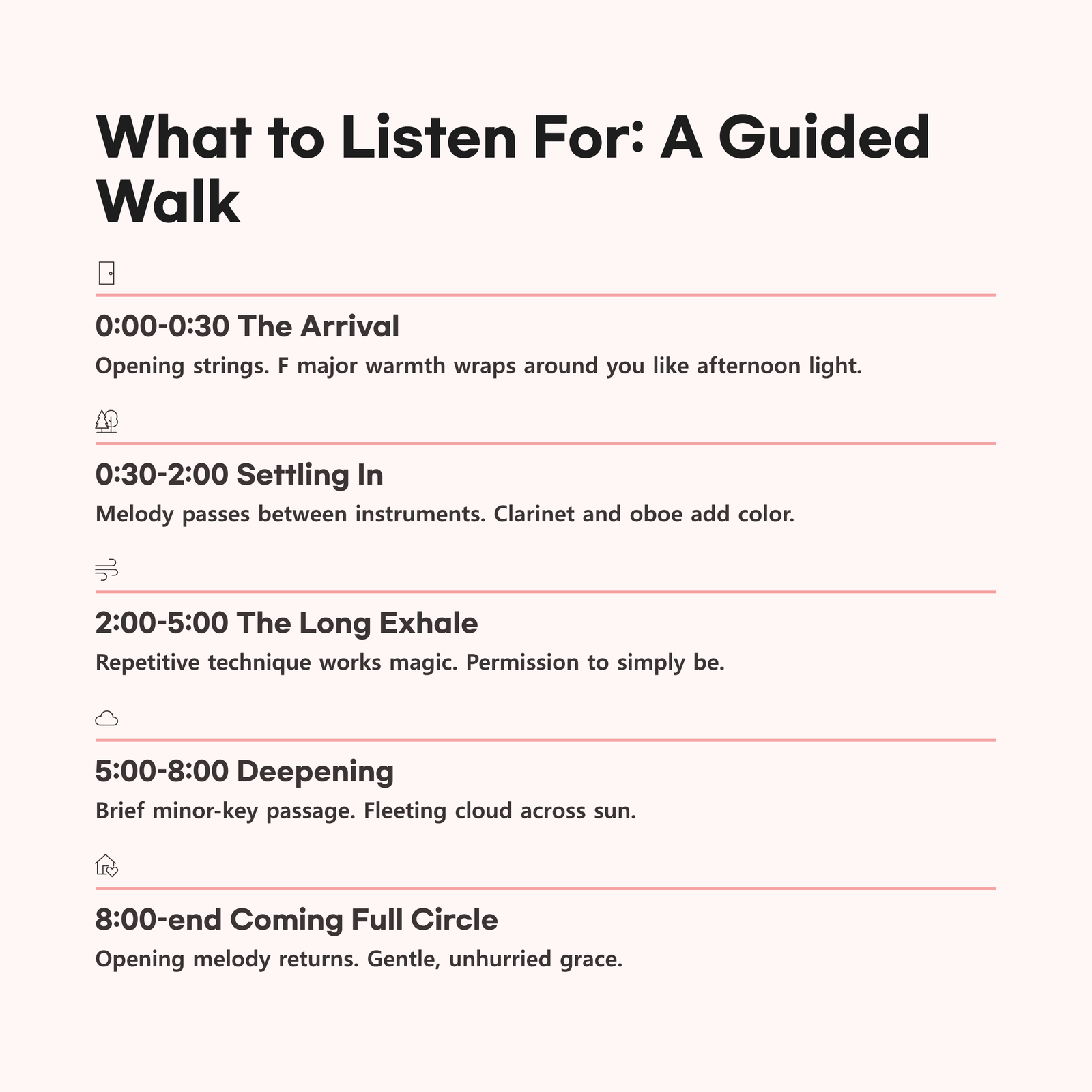
Here’s a simple listening roadmap for your first time through. Don’t worry about catching everything — let it wash over you, and return to these signposts whenever you like.
0:00–0:30 — The Arrival. Those opening bars in the strings are your threshold moment. You’ve stepped off the carriage, or closed the car door, or set down your bag. The countryside opens up around you. The key of F major — one of the warmest keys in the orchestral palette — wraps around you like afternoon light.
0:30–2:00 — Settling In. The melody passes between instruments — violins to woodwinds, cellos adding a gentle foundation below. Listen for how the clarinet and oboe pick up the tune, each adding their own color. It’s like noticing different elements of a landscape: first the field, then the trees at the edge, then the sky above.
2:00–5:00 — The Long Exhale. This is where Beethoven’s repetitive technique works its magic. Short melodic cells cycle and recombine, building not toward a climax but toward a state of being. The dynamic stays relatively soft. There are no sudden shocks, no dramatic key changes. You’re not being told a story — you’re being given permission to simply be.
5:00–8:00 — Deepening. The development section gently explores the opening material from new angles. A brief minor-key passage may catch your ear — a fleeting cloud across the sun — but it never darkens the mood for long. Beethoven isn’t interested in conflict here. He’s interested in the endless, subtle variety of a single peaceful afternoon.
8:00–end — Coming Full Circle. The recapitulation brings back the opening melody, now feeling like an old friend. By this point, if you’ve let yourself go with the music, the effect is cumulative. You’re not just hearing a tune — you’re inhabiting a space. The movement closes with a gentle, unhurried grace that seems to say: there’s nowhere else you need to be.
Recommended Performances to Start With
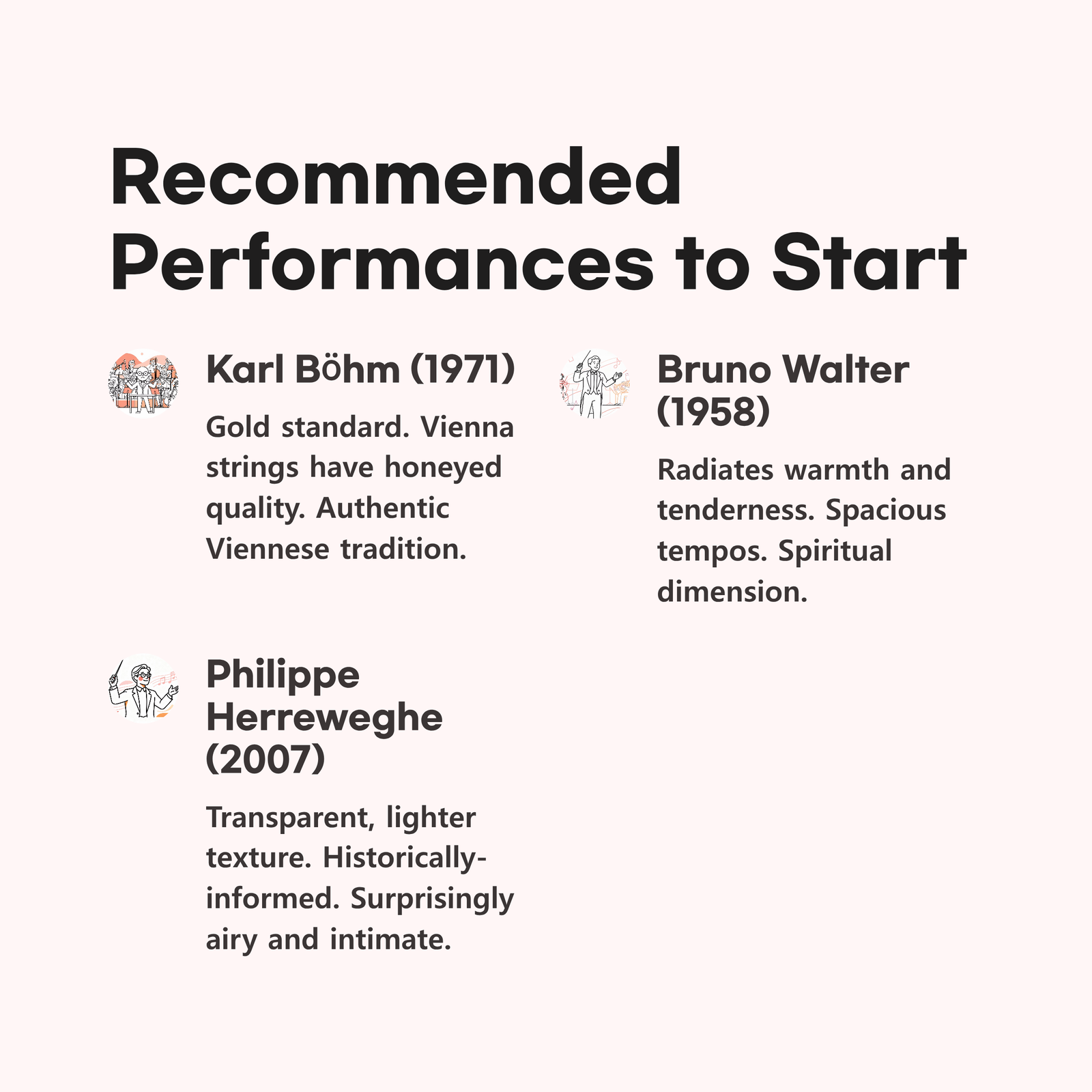
The Pastoral has been recorded countless times, but certain performances capture the spirit of the first movement with particular magic.
Karl Böhm with the Vienna Philharmonic (1971) — This is the gold standard for many listeners. Böhm doesn’t rush a single phrase. The Vienna strings have a honeyed quality that suits this music perfectly, and the whole performance breathes with an authenticity that comes from Böhm’s deep connection to the Viennese tradition. If you’re choosing one recording, start here.
Bruno Walter with the Columbia Symphony Orchestra (1958) — Walter was a conductor who genuinely believed in the spiritual dimension of music, and you can hear it. His Pastoral radiates a warmth that borders on tenderness. The tempos are spacious without ever dragging. This recording feels like it was made by someone who took those same countryside walks Beethoven did.
Philippe Herreweghe with the Royal Flemish Philharmonic (2007) — For a more transparent, lighter-textured approach, Herreweghe’s historically-informed perspective strips away some of the Romantic-era heaviness and reveals the architecture beneath. The result is surprisingly airy and intimate — like seeing an overgrown garden freshly cleared.
Why This Movement Still Matters
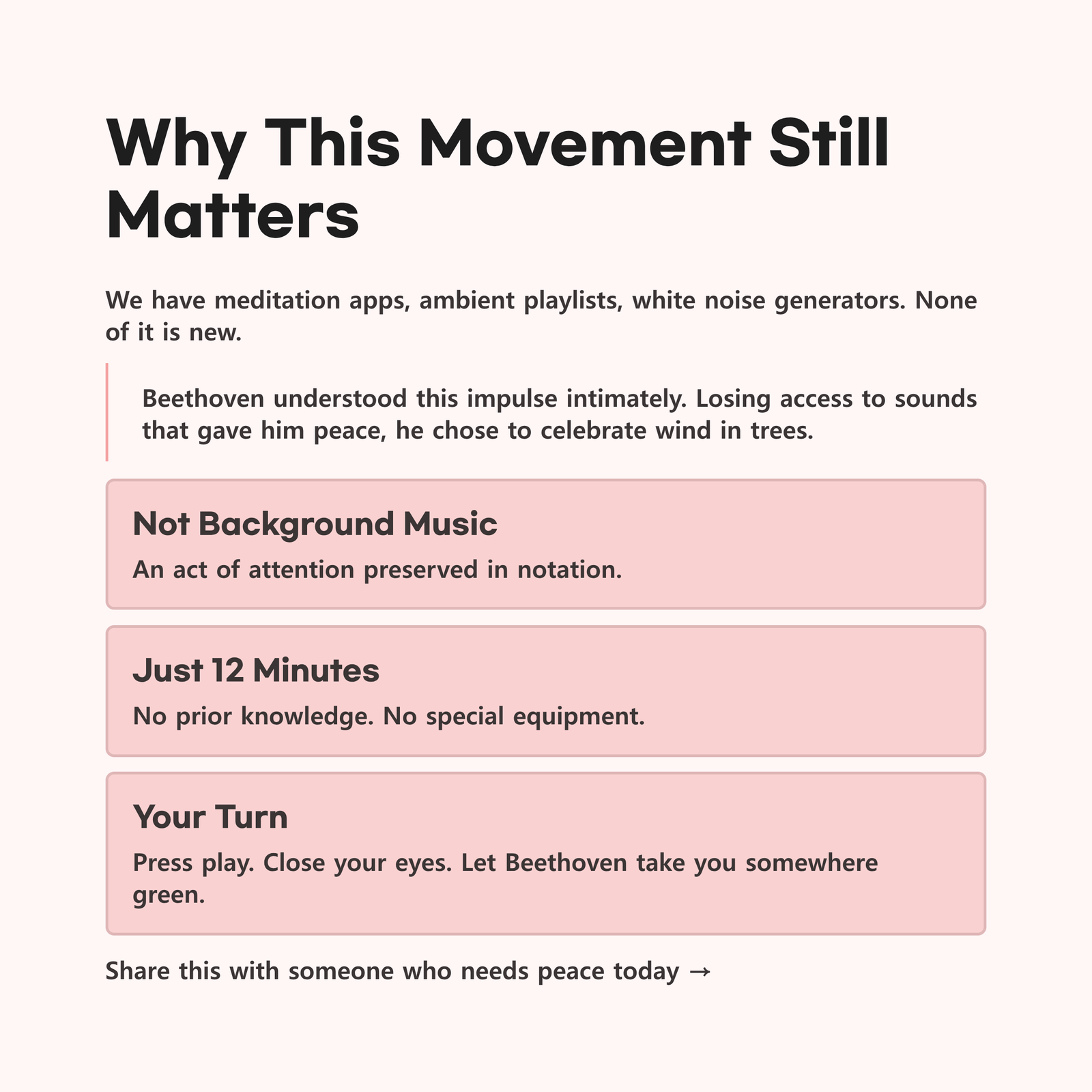
We live in an era saturated with content designed to relax us. There are meditation apps, ambient playlists, white noise generators, ASMR channels — an entire industry built around the idea that modern life is stressful and we need help unwinding. None of it is new. Beethoven understood this impulse intimately, perhaps more than anyone, because he was losing access to the very sounds that gave him peace.
The first movement of the Pastoral Symphony is not background music. It’s an act of attention — Beethoven’s attention to the natural world, preserved in notation, waiting for your attention in return. It asks nothing of you except twelve minutes of presence. No prior knowledge. No special equipment. Just your willingness to walk alongside a man who, in the face of encroaching silence, chose to celebrate the sound of the wind in the trees.
Press play. Close your eyes if you want to. And let Beethoven take you somewhere green.