📑 Table of Contents
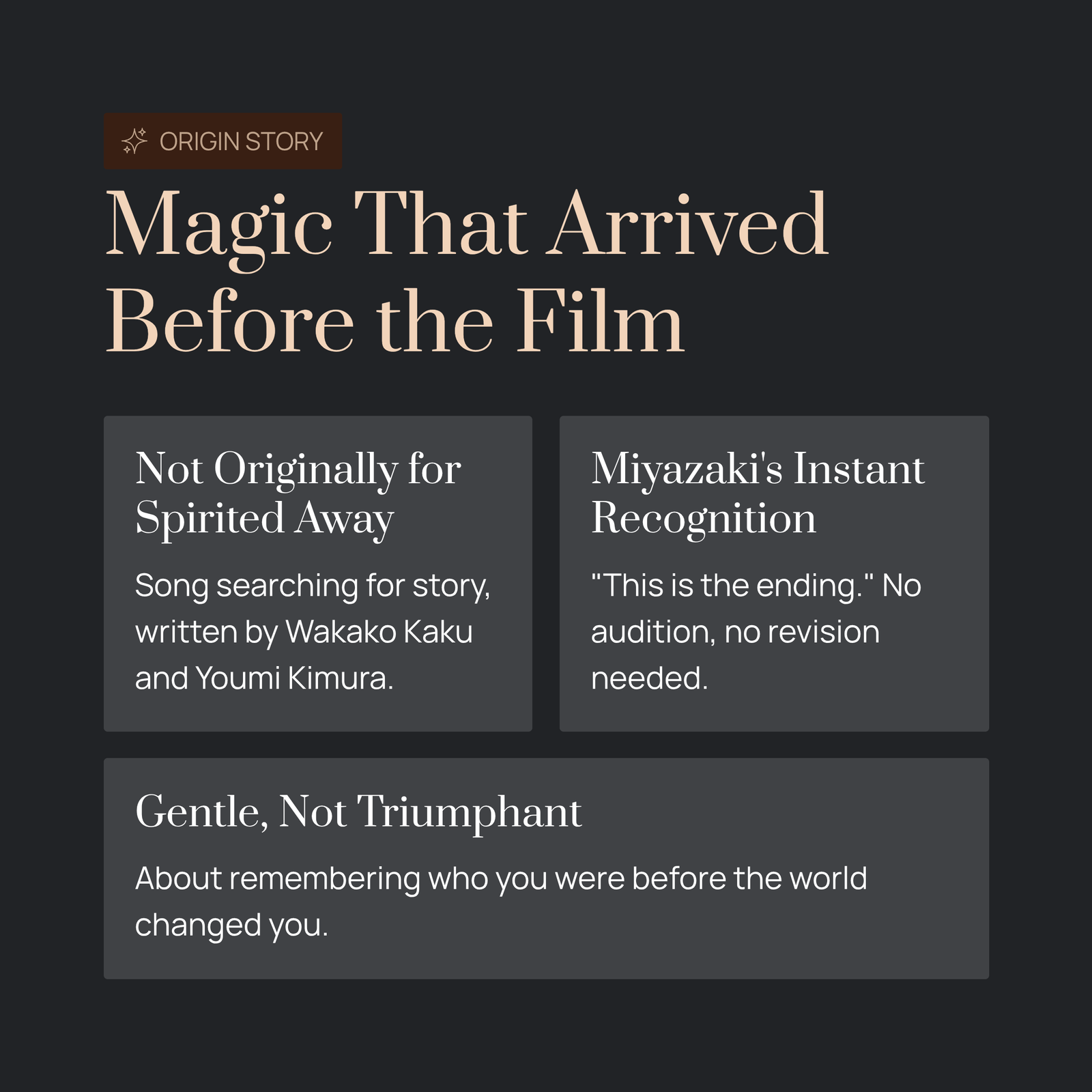
There is a strange kind of magic in music that arrives before a film even exists. “Always With Me” (Itsumo Nando Demo) was not originally composed for Spirited Away. It was a song searching for a story — written by Hayao Miyazaki’s longtime collaborator Wakako Kaku, with a melody by Youmi Kimura, and later embraced by Joe Hisaishi as part of the film’s emotional architecture. When Miyazaki heard it, he reportedly said, “This is the ending.” No audition, no revision. The song simply belonged.
That instinct proved prophetic. When ten-year-old Chihiro finally walks away from the spirit world, clutching nothing but a hair tie and every lesson she never asked to learn, this melody rises — not triumphantly, but gently, the way morning light enters a room you forgot you fell asleep in. It is not a song about victory. It is a song about remembering who you were before the world asked you to become someone else.
Joe Hisaishi: The Composer Who Paints in Sound
If you are new to Joe Hisaishi, here is the simplest way to understand him: he is to Studio Ghibli what John Williams is to Steven Spielberg — except quieter, more intimate, and far more interested in silence.
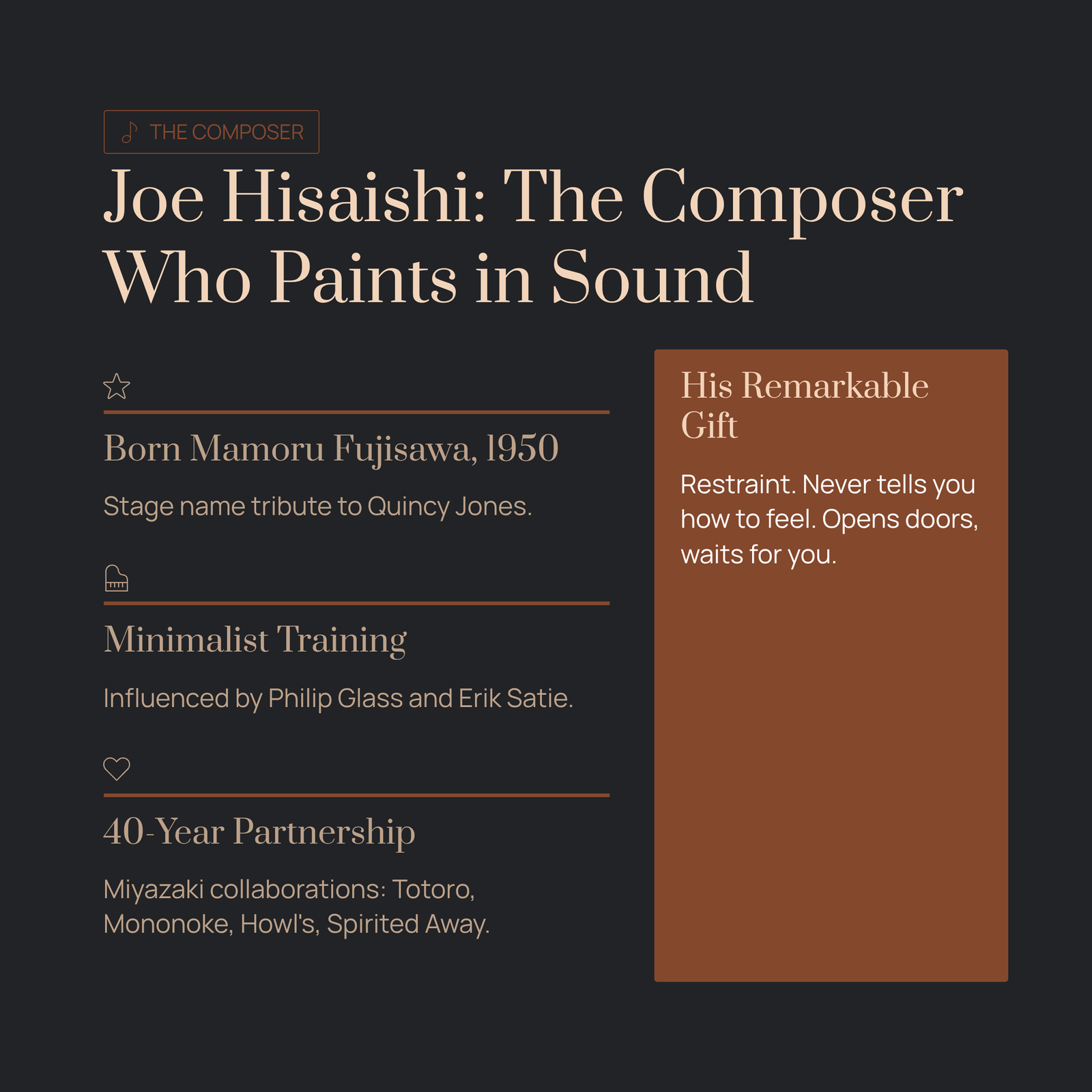
Born Mamoru Fujisawa in Nagano, Japan, in 1950, Hisaishi adopted his stage name as a playful phonetic tribute to Quincy Jones. He trained as a minimalist composer, deeply influenced by the repetitive structures of Philip Glass and the spacious textures of Erik Satie. But where Glass builds towering sonic cathedrals, Hisaishi builds paper lanterns — fragile, luminous, and somehow strong enough to hold enormous feeling.
His partnership with Miyazaki spans over four decades, producing some of the most beloved film scores in history: My Neighbor Totoro, Princess Mononoke, Howl’s Moving Castle, and of course, Spirited Away. What makes Hisaishi remarkable is his restraint. He never tells you how to feel. He simply opens a door and waits for you to walk through it.
The Story Behind the Song
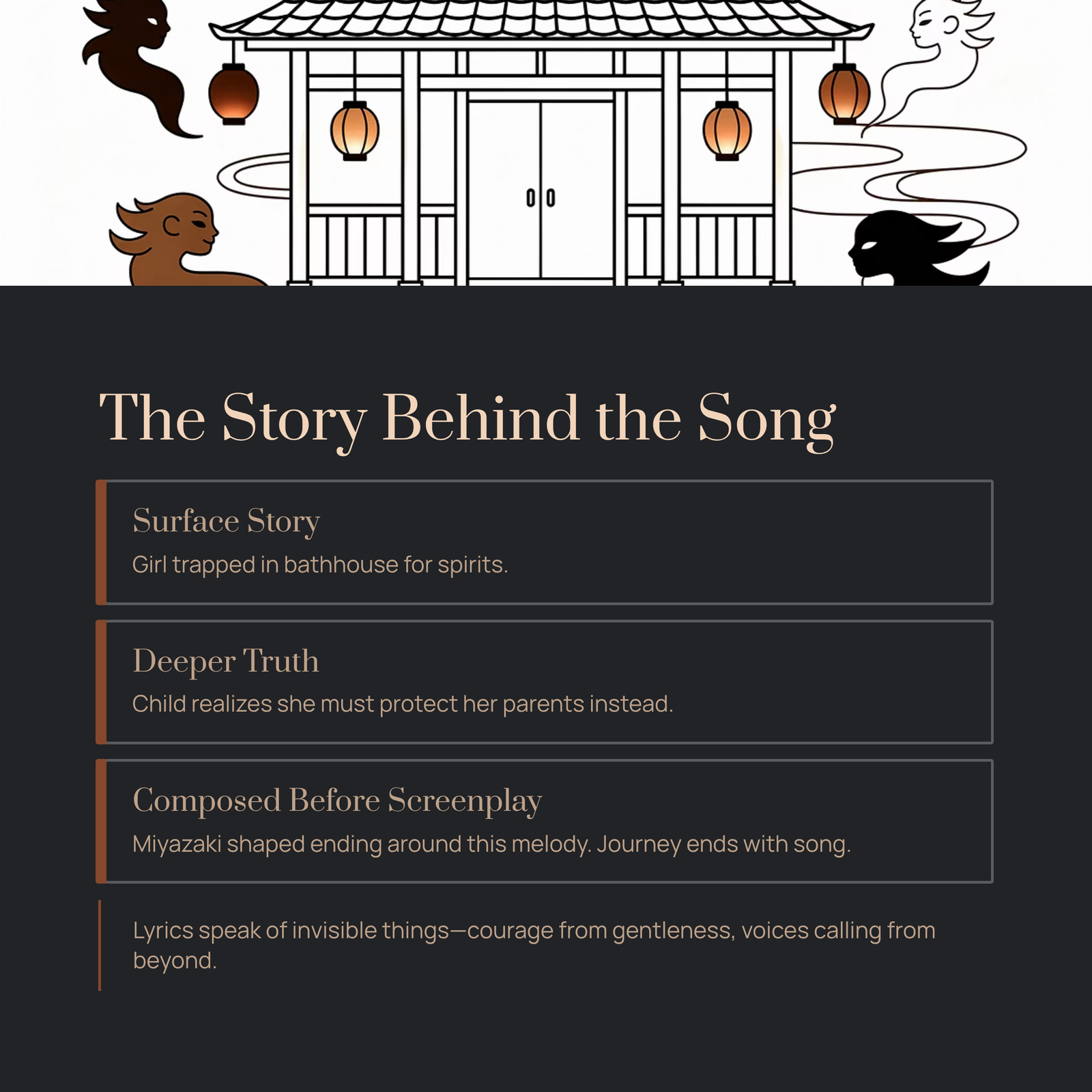
Spirited Away (2001) is, on the surface, a fantasy adventure about a girl trapped in a bathhouse for spirits. But beneath the dragons and the soot sprites, it is a story about growing up — about the terrifying moment when a child realizes that her parents cannot protect her, and she must protect them instead.
“Always With Me” carries this weight without ever becoming heavy. The original Japanese lyrics, penned by Wakako Kaku, speak of invisible things — voices calling from somewhere beyond, a courage that comes not from strength but from gentleness. The words are deceptively simple, almost childlike, yet they hold a philosophical depth that reveals itself slowly, like ink dissolving in water.
What many listeners do not realize is that the song was composed before the film’s screenplay was finalized. Miyazaki shaped the ending of Spirited Away around this piece of music, allowing the melody to dictate the emotional resolution of the story. In a very real sense, Chihiro’s journey ends not with a plot twist, but with a song.
What to Listen For: A Guide for First-Time Listeners
If you have never sat down to truly listen to “Always With Me,” here is an invitation to try.
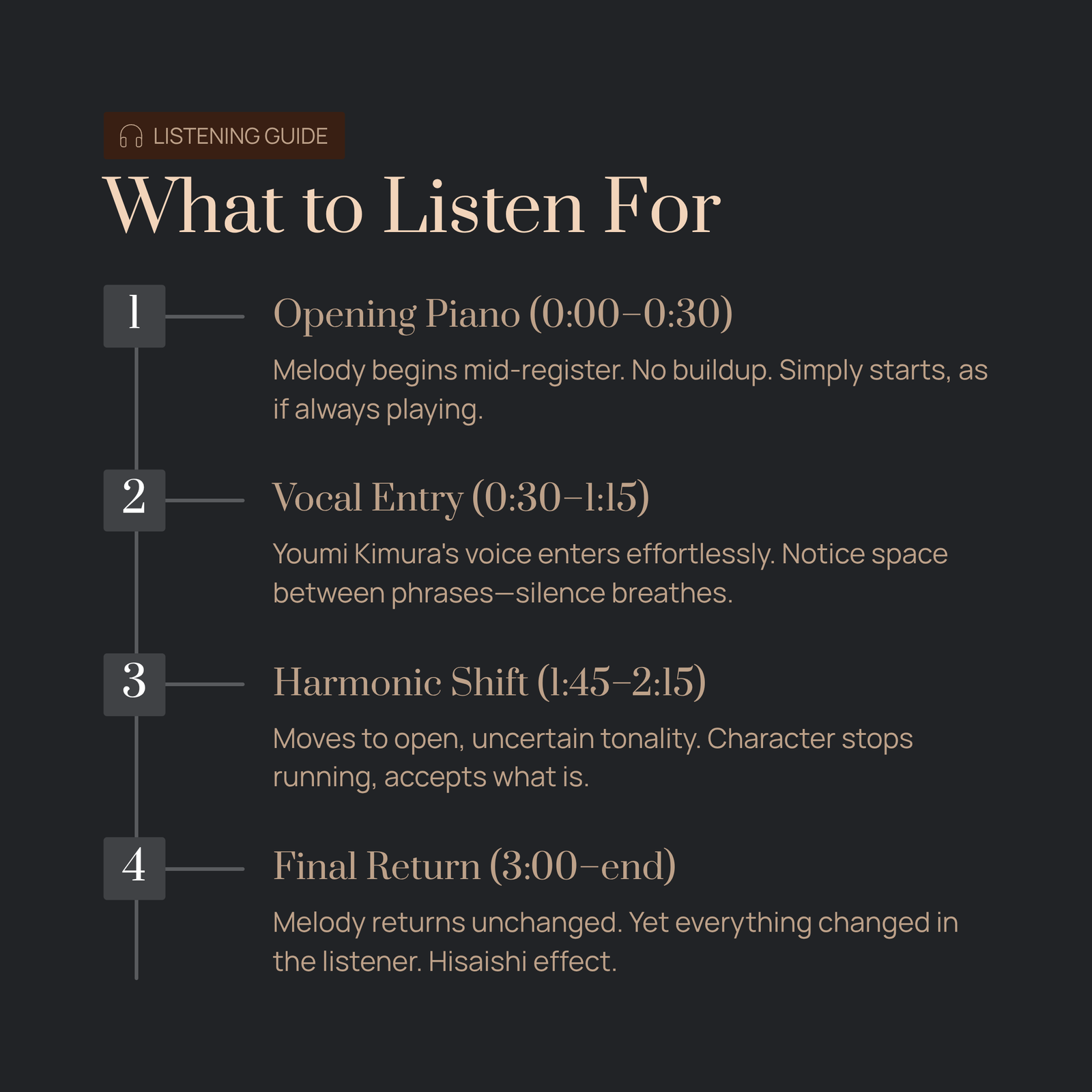
The opening piano phrase (0:00–0:30): Notice how the melody begins in the middle register — not too high, not too low. It feels like a voice speaking at exactly the right volume. There is no dramatic introduction, no buildup. It simply starts, as if it had been playing long before you pressed play.
The vocal entry (0:30–1:15): Youmi Kimura’s voice enters without effort, almost as if she is thinking aloud rather than performing. Pay attention to the space between her phrases. Hisaishi understands that silence is not the absence of music — it is where music breathes.
The harmonic shift (1:45–2:15): Around the midpoint, the harmony moves from a settled, warm tonality into something slightly more open, more uncertain. This is the emotional pivot of the piece. It mirrors the moment in every Ghibli film when a character stops running and simply stands still, accepting what is.
The final return (3:00–end): The melody comes back to where it started, but it feels different now. Nothing in the notes has changed, yet everything has changed in the listener. This is the Hisaishi effect — the realization that the music did not move; you did.

A Personal Reflection
I first heard “Always With Me” in a darkened theater at age twelve, not fully understanding what was happening on screen or inside me. I only knew that when the credits rolled and this song played, I did not want to move. Not because I was sad. Not because I was happy. Because I felt, for the first time, that particular ache of something ending exactly as it should.
Years later, I return to this piece the way some people return to a hometown — not to relive the past, but to check if it is still there. And it always is. The melody has not aged. It has not become nostalgic in the cheap sense of the word. It remains what it always was: a small, steady light in a noisy world.
This is what the greatest film music does. It outlives the film. It detaches from the screen and follows you into your actual life, appearing in unexpected moments — while washing dishes, while watching rain, while saying goodbye to someone you are not ready to let go of.
Recommended Listening
For your first encounter, I recommend Youmi Kimura’s original vocal version from the Spirited Away soundtrack album (2001, Tokuma Japan Communications). Let the voice guide you before exploring instrumental arrangements.
For a deeper, more contemplative experience, seek out Joe Hisaishi’s solo piano renditions performed during his live concert series, particularly the Melodyphony concert recordings. Stripped of orchestration, the piano version reveals the skeletal beauty of the composition — every note exposed, every silence intentional.
If you enjoy this piece, consider exploring Hisaishi’s broader piano works: “One Summer’s Day” from the same film, “The Rain” from Kikujiro, and “Merry-Go-Round of Life” from Howl’s Moving Castle. Each shares the same DNA — music that trusts the listener enough to leave space for their own story.
There are pieces of music that impress you, and there are pieces that simply stay. “Always With Me” does not demand your attention. It earns your memory. And perhaps that is the most quietly radical thing a piece of music can do — not to overwhelm you with beauty, but to sit beside you, patiently, until you are ready to hear what it has always been saying.