📑 Table of Contents
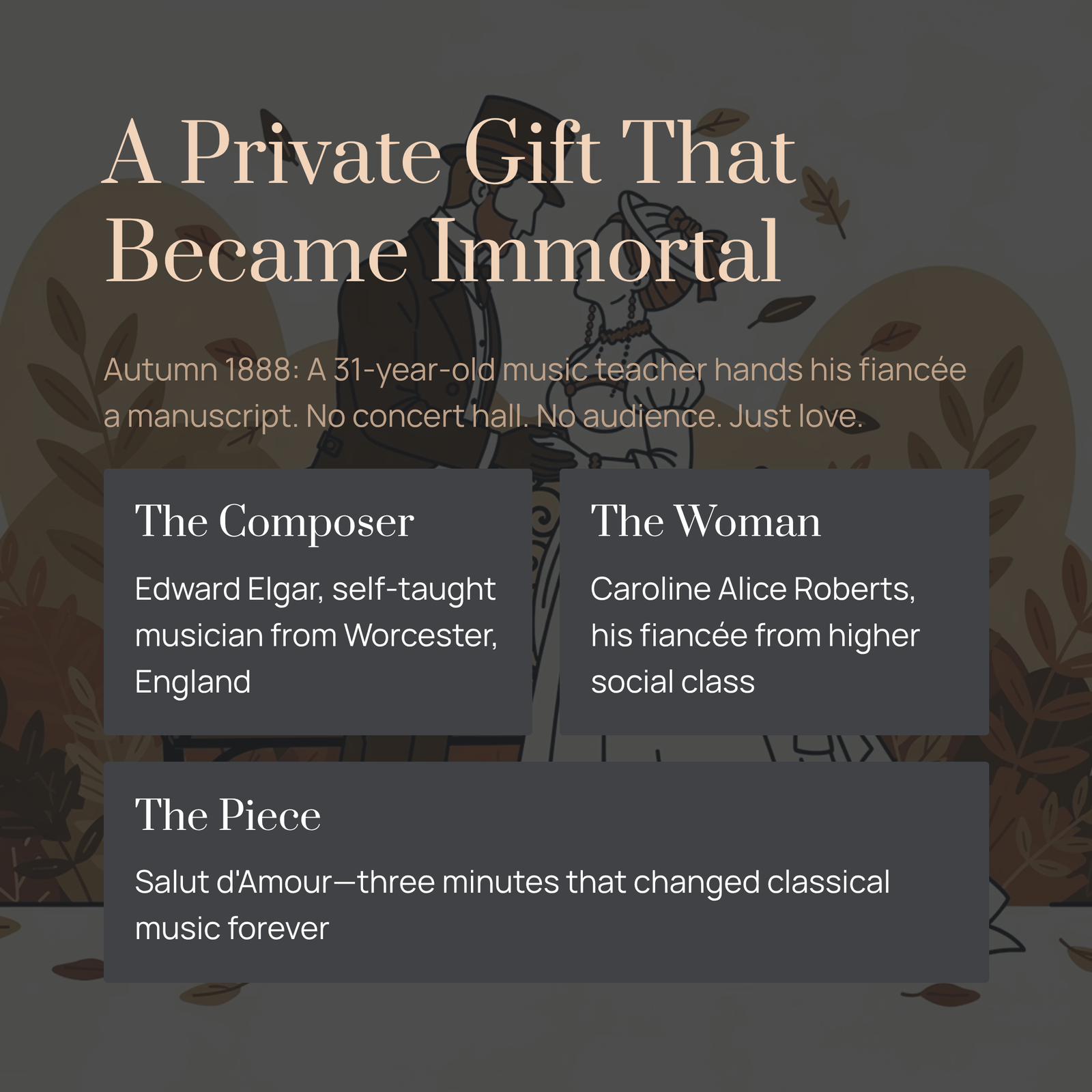
In the autumn of 1888, a 31-year-old music teacher in Worcester, England, handed a small manuscript to the woman he loved. No grand concert hall, no applauding audience — just a quiet, private gesture between two people about to start a life together. That manuscript was Salut d’Amour, and the woman was Caroline Alice Roberts, his fiancée.
What makes this moment remarkable isn’t just the tenderness of the music itself. It’s the fact that Edward Elgar — the man who would later compose the thundering Enigma Variations and the majestic Pomp and Circumstance marches — chose to begin his legacy with a whisper, not a shout. This three-minute piece, barely longer than a pop song, carries the kind of emotional honesty that most composers spend their entire careers trying to achieve.
And here’s the twist: Elgar sold the rights to this piece for almost nothing. He had no idea it would become one of the most beloved romantic miniatures in classical music history.
The Unlikely Composer Who Defied the Rules
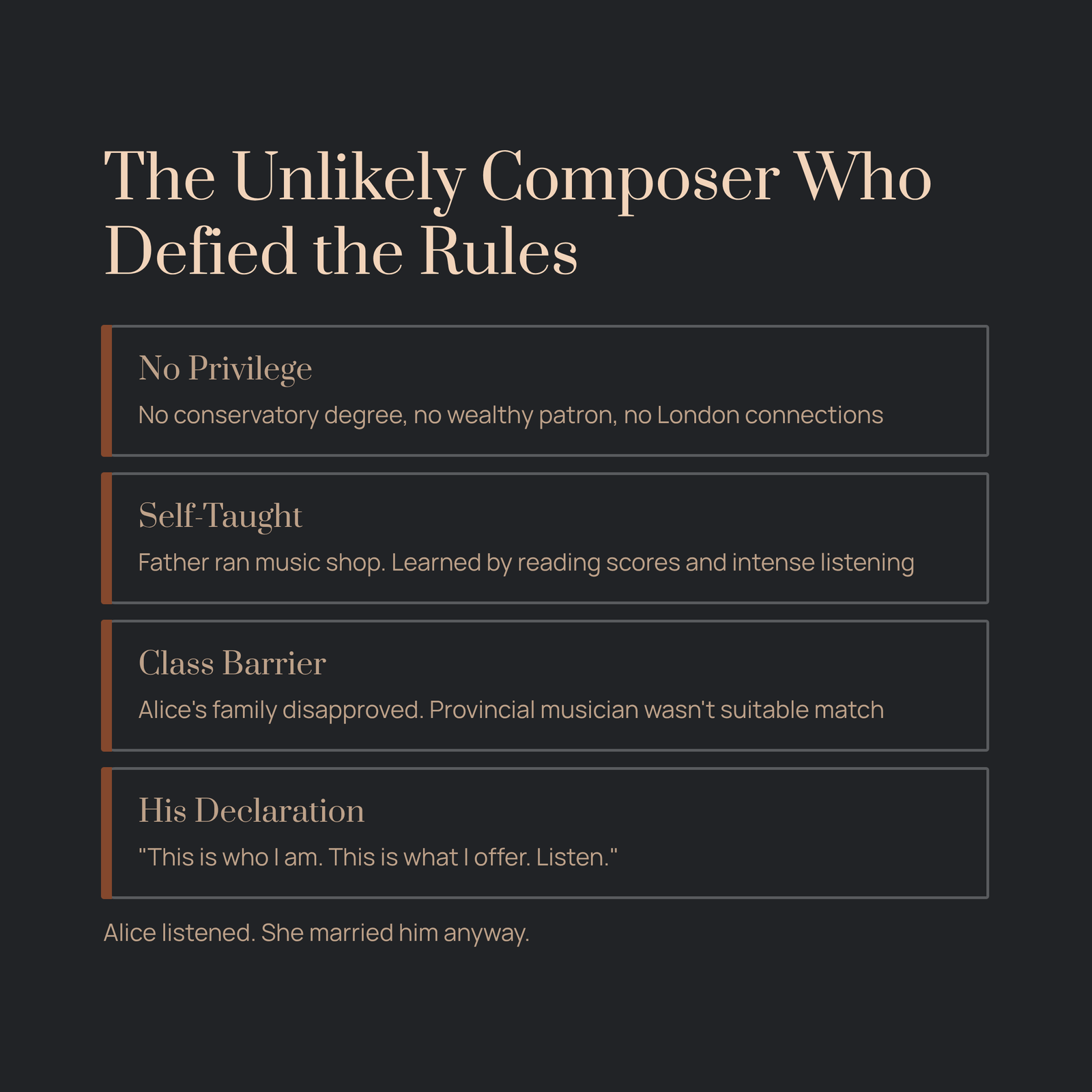
To understand why Salut d’Amour matters, you need to know something about the man who wrote it. Elgar was not born into the world of classical music privilege. He had no conservatory degree, no wealthy patron, no connections to the London elite. His father ran a music shop in a small English town. Everything Elgar learned, he taught himself — by reading scores, playing in local orchestras, and listening with an intensity that bordered on obsession.
In Victorian England, this mattered enormously. The classical music establishment was deeply class-conscious, and Elgar felt like an outsider his entire life. When he fell in love with Alice, a woman from a higher social class, her family disapproved. A self-taught provincial musician was hardly the match they had envisioned for their daughter.
So when Elgar composed Salut d’Amour and dedicated it to Alice with the German inscription Liebesgruss (Love’s Greeting), it wasn’t just a romantic gesture. It was a declaration: This is who I am. This is what I can offer you. Listen.
Alice listened. She married him anyway.
What You’re Actually Hearing
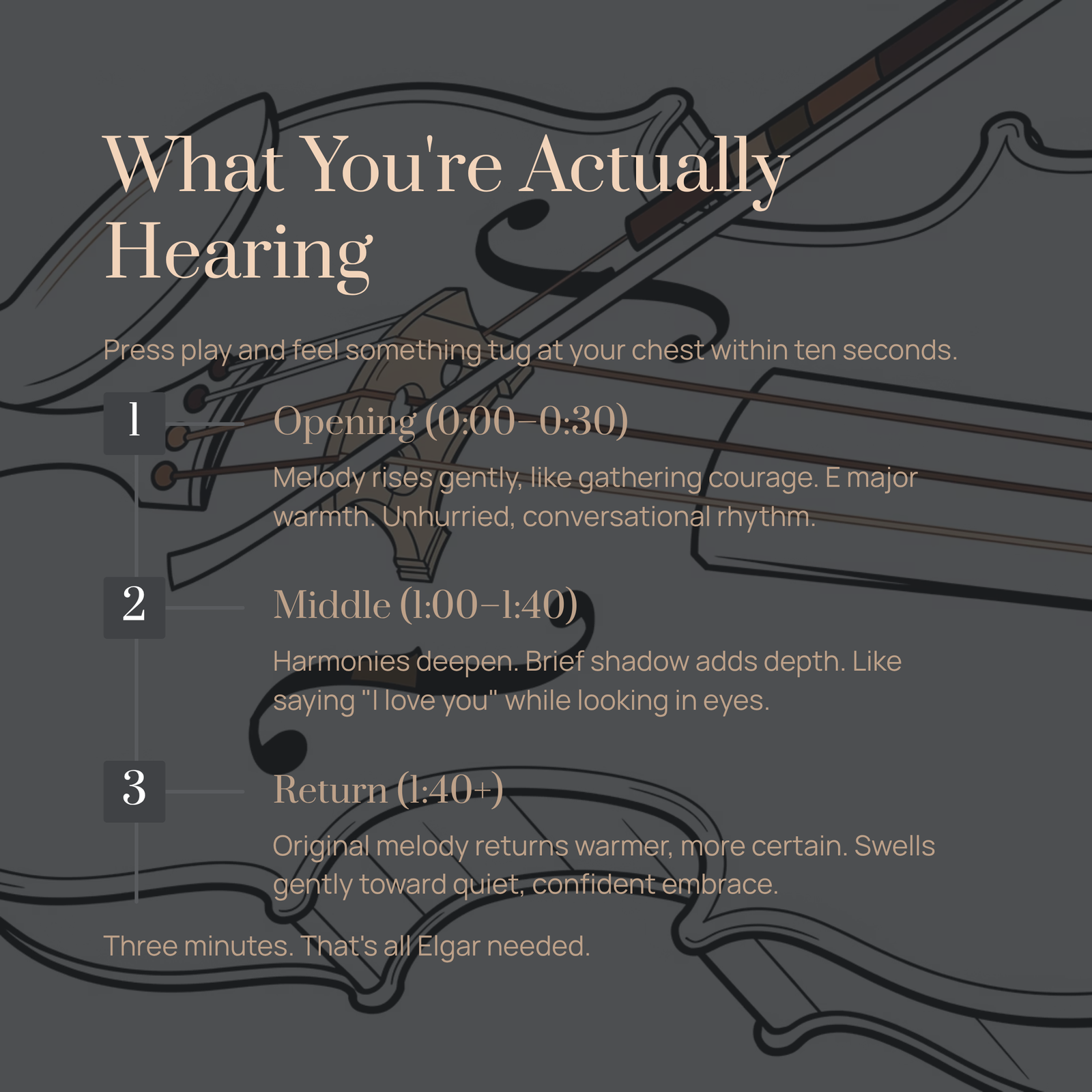
If you press play on Salut d’Amour without knowing any of this backstory, you’ll still feel something tug at your chest within the first ten seconds. The melody enters softly, almost shyly — a rising phrase that sounds like someone gathering the courage to say something important.
Here’s what to listen for, even if you’ve never studied a note of music theory:
The opening melody (0:00–0:30): Notice how the tune moves upward in gentle steps, like a hand reaching out. It’s written in E major, one of the warmest keys in classical music. The rhythm is unhurried, almost conversational — as if Elgar is speaking directly to one person, not performing for a crowd.
The middle section (around 1:00–1:40): The mood shifts slightly here. The harmonies become richer, a little more complex. There’s a brief moment of shadow — not sadness exactly, but depth. Think of it as the difference between saying “I love you” casually and saying it while looking someone in the eyes. This is the looking-in-the-eyes part.
The return (1:40 onward): The original melody comes back, but it feels different now. Warmer. More certain. The music swells gently toward its final notes, which resolve with a quiet confidence that feels like an embrace.
The entire piece lasts about three minutes. That’s all Elgar needed.
Why Three Minutes Can Be Enough
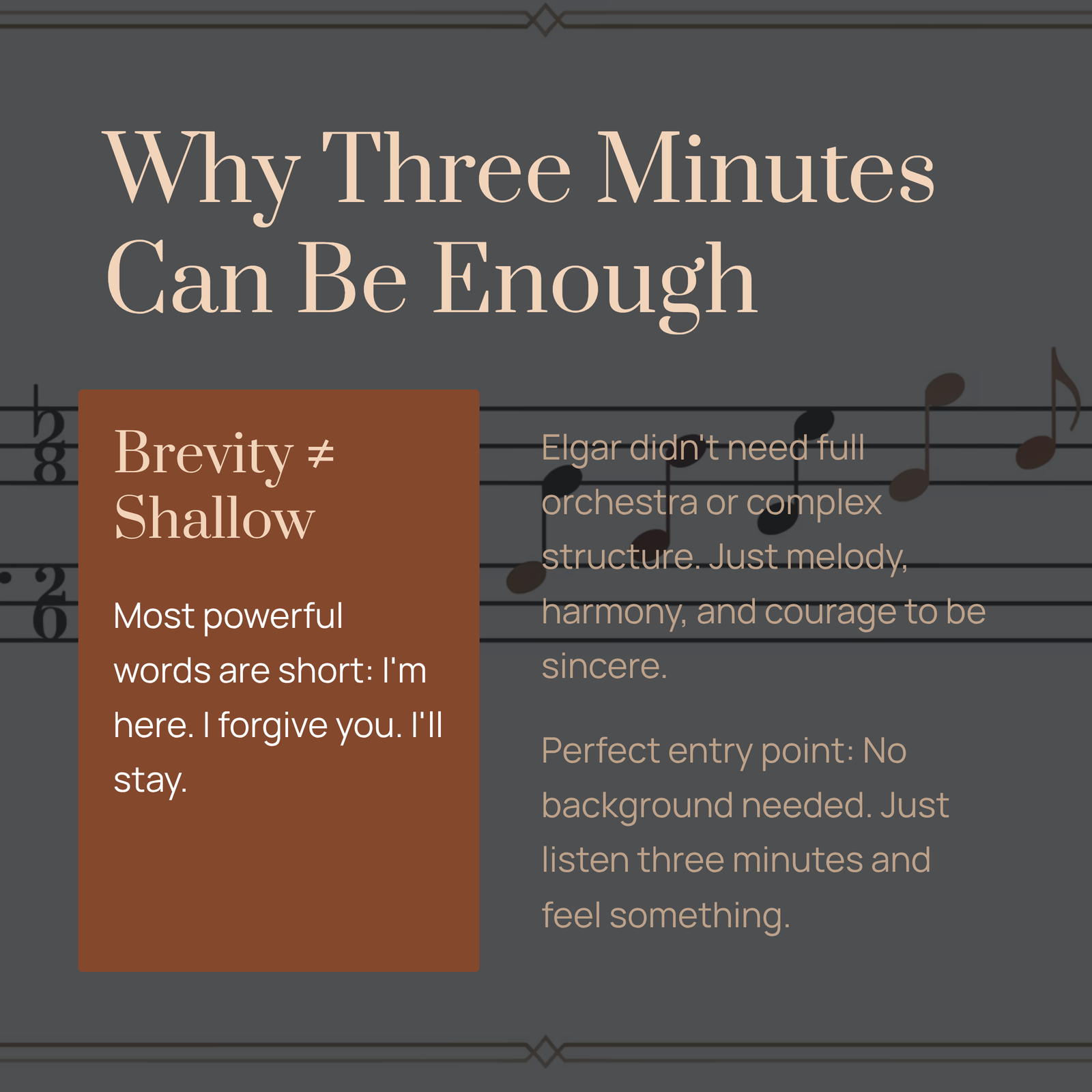
In a world of hour-long symphonies and four-act operas, it’s easy to overlook a piece this small. But Salut d’Amour teaches us something that even experienced listeners sometimes forget: brevity is not the enemy of depth.
Think about it this way. The most powerful things people say to each other are usually short. I’m here. I forgive you. I’ll stay. Elgar understood this instinctively. He didn’t need a full orchestra, a complex development section, or a dramatic climax to say what he wanted to say. He needed a melody, a few carefully chosen harmonies, and the courage to be sincere.
This is what makes Salut d’Amour such a perfect entry point for anyone curious about classical music. It doesn’t ask you to sit through a long, complicated structure. It doesn’t require any background knowledge. It simply asks you to listen for three minutes and feel something. If you do — and you almost certainly will — then you already understand what classical music is about at its core.
How to Listen: Three Different Doors
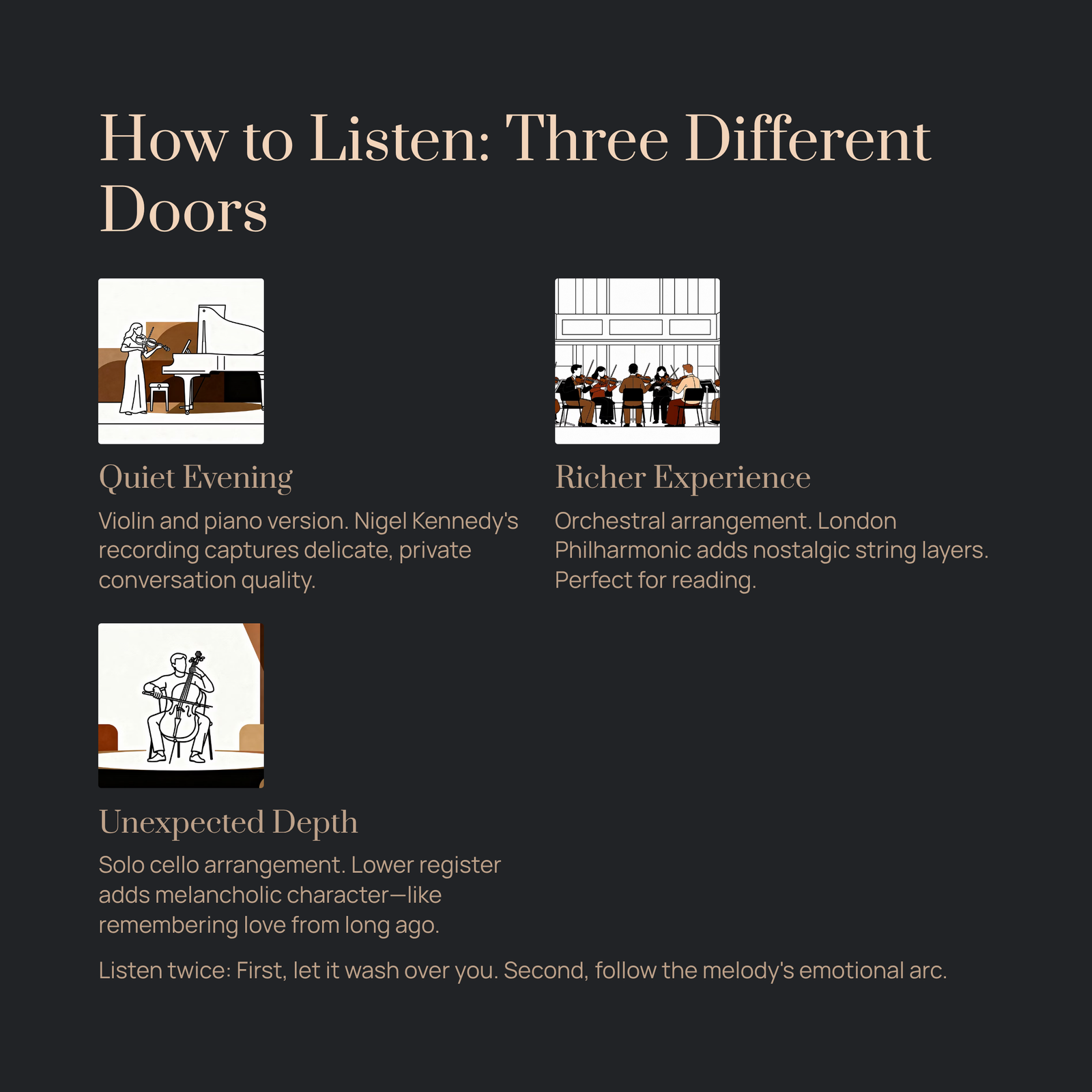
There’s no single “correct” way to experience this piece, but here are three approaches depending on your mood:
For a quiet evening: Find the version for violin and piano — the closest to what Elgar originally wrote. Nigel Kennedy’s recording captures a delicate, intimate quality, as though you’re overhearing a private conversation. Close your eyes and let the melody do its work.
For a richer experience: Try the orchestral arrangement. The version by the London Philharmonic under Adrian Boult wraps the melody in a lush string sound that adds a layer of nostalgia. This works beautifully as background music for reading, journaling, or simply sitting with your thoughts.
For something unexpected: Listen to a solo cello arrangement. The lower register gives the melody a darker, more melancholic character — like remembering a love from long ago. It’s the same notes, but the emotional color shifts dramatically. Jacqueline du Pré’s interpretation, though brief, is extraordinarily moving.
Whichever version you choose, try listening at least twice. The first time, just let it wash over you. The second time, follow the melody closely and notice how your emotional response changes as the music moves through its gentle arc.
The Quiet Power of Sincerity
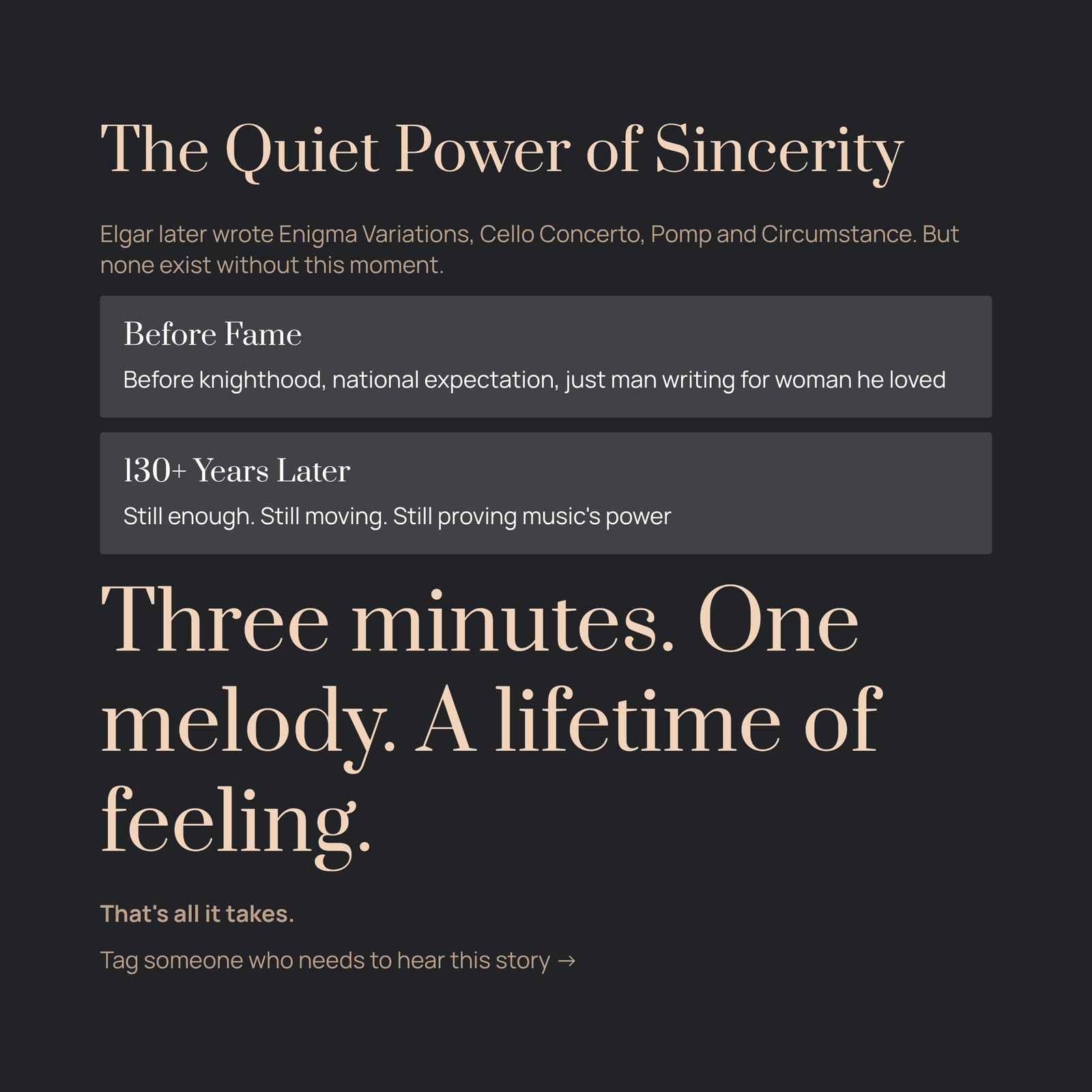
Elgar went on to write some of the grandest music in the English repertoire. The Enigma Variations cemented his reputation. The Cello Concerto became a monument of emotional expression. Pomp and Circumstance March No. 1 — the one you’ve probably heard at graduation ceremonies — made him a household name.
But none of those works exist without Salut d’Amour. Not because it’s technically groundbreaking or historically significant in the way scholars measure importance. But because it was the moment Elgar trusted his own voice. Before the fame, before the knighthood, before the weight of national expectation, there was just a man writing music for the woman he loved — hoping it would be enough.
It was. And over 130 years later, it still is.
The next time someone tells you that classical music is intimidating, or elitist, or requires years of study to appreciate, play them Salut d’Amour. Three minutes. One melody. A lifetime of feeling.
That’s all it takes.