📑 Table of Contents
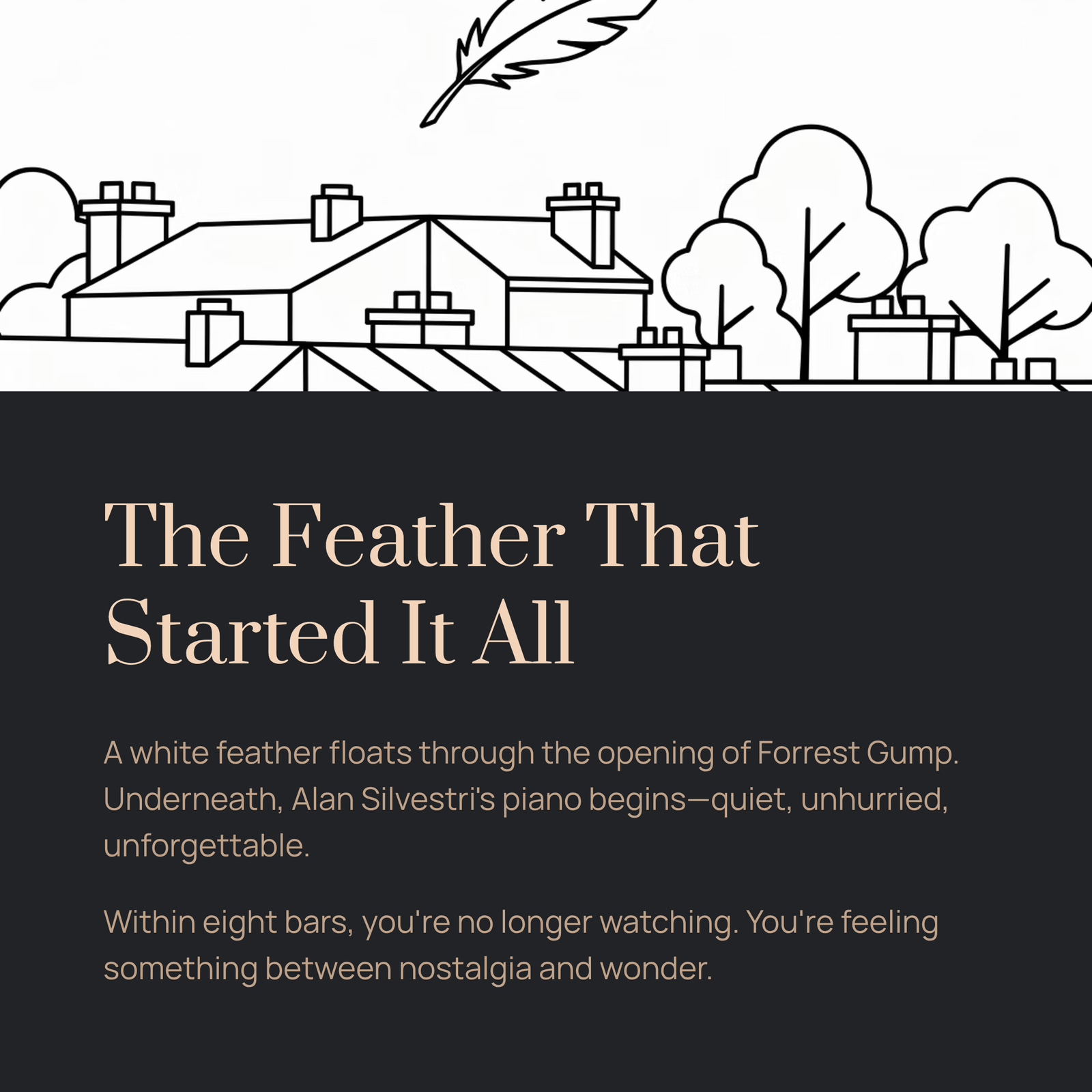
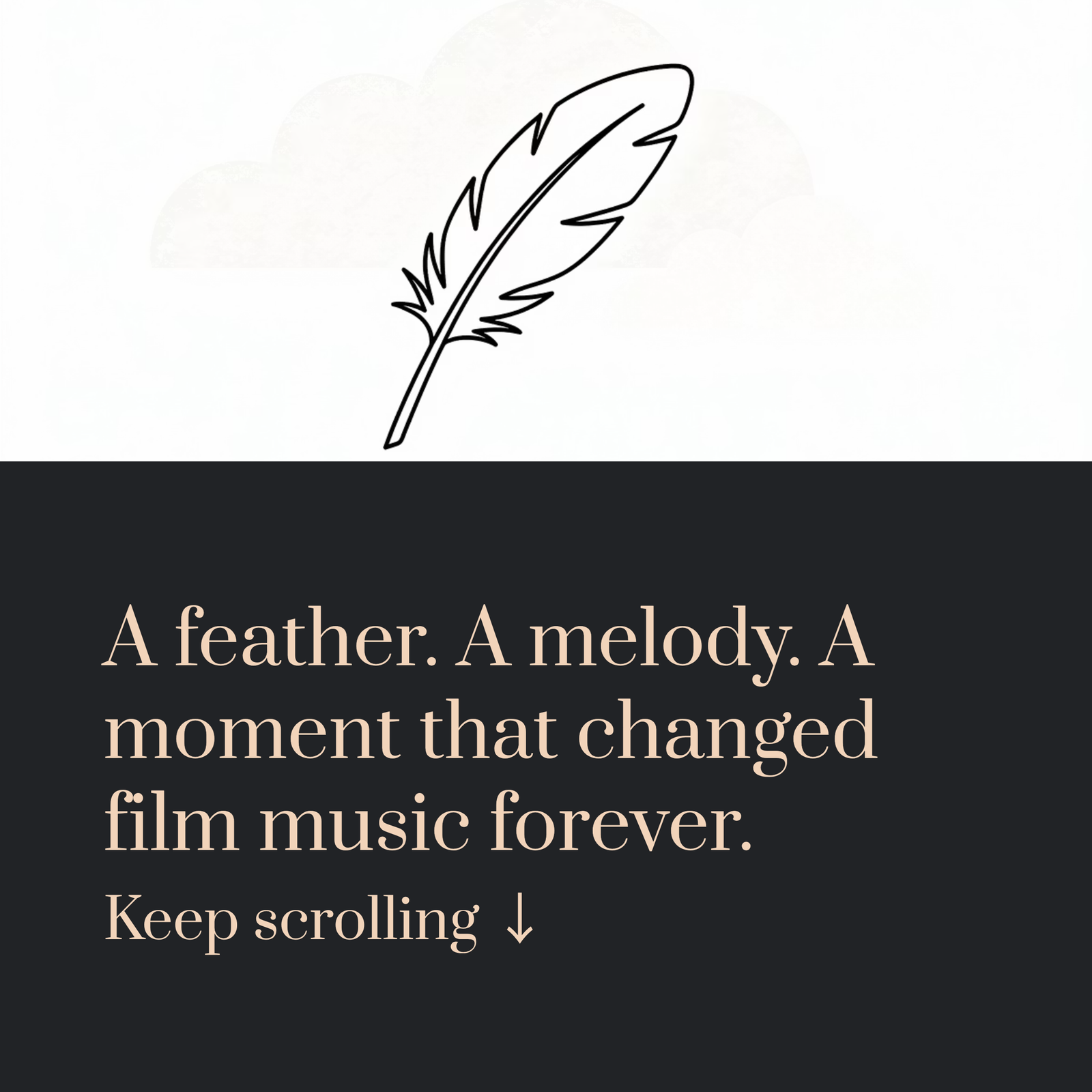
There is a moment at the very beginning of Forrest Gump that most people remember not for a line of dialogue, not for Tom Hanks sitting on that bench, but for something almost absurdly simple: a white feather drifting through the sky. It floats over rooftops, past trees, through open air — unhurried, weightless, entirely indifferent to where it lands. And underneath it, a piano begins to play.
That melody, composed by Alan Silvestri, does something extraordinary. It doesn’t announce itself. It doesn’t swell with dramatic intent or try to tell you what to feel. It simply arrives, the way a memory surfaces when you’re staring out a window on a quiet afternoon. Within the first eight bars, you’re no longer watching a movie. You’re sitting inside a feeling you can’t quite name — something between nostalgia and tenderness, between wonder and loss.
This is the Feather Theme. And for over three decades, it has remained one of the most quietly powerful pieces of music ever written for film.
The Composer Behind the Gentleness
Alan Silvestri is not a name most casual listeners associate with delicacy. Born in 1950 in New York City, he built his career on bold, propulsive scores — the kind that make your pulse quicken. If you’ve felt your heart race during Back to the Future, tensed up watching Predator, or felt a surge of heroic energy during The Avengers, you’ve already experienced Silvestri’s signature: rhythmic drive, muscular brass, and an almost architectural sense of momentum.
So when director Robert Zemeckis — Silvestri’s long-time collaborator — asked him to score Forrest Gump in 1994, the challenge was unlike anything he’d faced before. This wasn’t a film that needed to be pushed forward. It needed to breathe. Forrest’s story, spanning decades of American history filtered through the eyes of a gentle, unassuming man, demanded music that could be simultaneously simple and profound. Music that understood stillness.
Silvestri responded by stripping everything away. No thundering percussion. No soaring brass fanfares. Just a piano, played with the kind of restraint that makes every note feel like a confession whispered to an empty room.
Inside the Music: Why Simplicity Cuts So Deep
The Feather Theme is built on a deceptively simple foundation. The melody moves in a stepwise motion — notes climbing and descending gently, like breathing. The harmonic language stays rooted in warm, consonant territory, avoiding the dissonance or tension that might pull a listener into intellectual analysis. Instead, it invites you to simply feel.
But here’s what makes it remarkable from a compositional standpoint: the theme’s emotional power comes not from what Silvestri puts in, but from what he leaves out. There are gaps in the melody, pauses where the piano sustains a single note and lets the silence around it do the work. These silences aren’t empty — they’re filled with implication. They give your mind space to project your own memories, your own longing, your own version of what the feather might mean.
The orchestration, when it arrives in later iterations throughout the film, is handled with extraordinary care. Strings enter not as a wall of sound but as individual voices joining a conversation. A solo flute mirrors the piano melody at a higher register, adding a quality of airborne lightness that directly mirrors the feather’s trajectory on screen. The dynamic range stays remarkably narrow — Silvestri rarely lets the orchestra rise above a mezzo-forte, keeping the entire score in a kind of intimate whisper.
Pay attention around the 1:30 mark of the main theme recording. There’s a moment where the harmonic progression takes an unexpected turn — a brief modulation that introduces just a shadow of melancholy into what had been pure tenderness. It lasts only a few seconds, but it changes the emotional color of everything that follows. This is Silvestri acknowledging, with surgical precision, that Forrest’s story is not just sweet. It carries grief, confusion, and the ache of loving a world that doesn’t always love you back.
What the Feather Knows That We Forget
I return to this piece often, and not always intentionally. Sometimes it finds me — playing in a coffee shop, surfacing in a playlist algorithm, drifting into my head during a walk. And every time, it stops me in exactly the same place: that intersection between acceptance and sadness that most of us spend our lives trying to navigate.
The genius of the Feather Theme is that it captures something philosophy has struggled to articulate for centuries: the beauty of not knowing where you’re going. The feather doesn’t choose its path. It doesn’t resist the wind. It doesn’t grieve the places it passes over. It simply moves, and in its movement, there is a kind of grace that human beings rarely achieve. Silvestri’s melody embodies this grace. It doesn’t try to resolve every tension or answer every question. It sits with uncertainty and finds peace there.
There’s a reason this music affects people who have never seen the film, people who don’t speak English, people who know nothing about Alan Silvestri or Hollywood or the cultural moment of 1994. The Feather Theme operates below language, below narrative, below conscious thought. It speaks directly to the part of us that knows — even if we can’t say it — that life is brief, uncontrollable, and astonishingly beautiful.
A Listener’s Guide: How to Hear It Fresh
If you’ve heard this piece a hundred times, try these approaches to rediscover it:
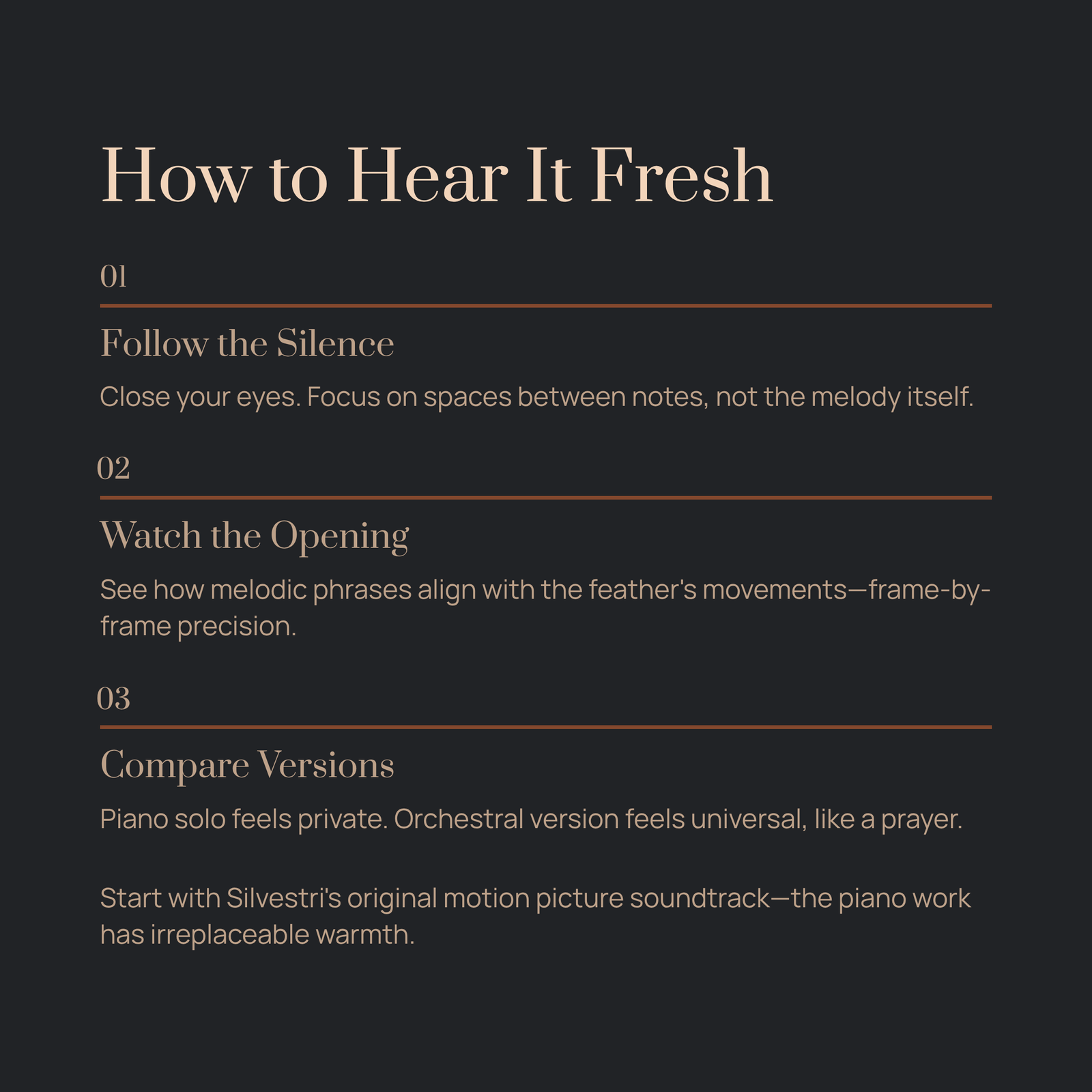
First listen — Close your eyes and follow the silence. Don’t track the melody. Instead, focus on the spaces between the notes. Notice how long Silvestri lets certain notes ring before the next one arrives. The rhythm of those silences is a composition within the composition.
Second listen — Watch the original film opening. Find the feather sequence from the movie and watch the music and image together. Pay attention to how precisely the melodic phrases align with the feather’s movements — the slight acceleration as it dips, the sustained notes as it floats. Silvestri scored this with frame-by-frame precision.
Third listen — Compare the piano solo with the full orchestral version. The solo piano version from the soundtrack album and the orchestrated version used in the film’s emotional climaxes are worth hearing back to back. Notice how the same melody transforms in meaning when surrounded by strings. The piano version feels private, like a diary entry. The orchestral version feels universal, like a prayer.
For recordings, the original motion picture soundtrack conducted by Silvestri himself remains definitive. The piano work has a particular warmth in the original recording that later covers and arrangements rarely capture. If you enjoy solo piano interpretations, several concert pianists have recorded thoughtful versions, but start with the source — Silvestri’s own orchestration understands this melody in a way no arrangement can replicate.
The Weight of a Feather
There is a paradox at the heart of this music that I think explains its lasting power: it is about weightlessness, and yet it carries enormous emotional weight. It sounds effortless, and yet its construction reveals meticulous craft. It belongs to a specific film, a specific character, a specific cultural moment — and yet it transcends all of them.
Alan Silvestri once said in an interview that the greatest challenge of scoring Forrest Gump was resisting the temptation to do too much. The story was already so full of emotion, so rich with meaning, that the music needed to step back and simply hold space for the audience’s own feelings. The Feather Theme is the purest expression of that philosophy — a piece of music that doesn’t tell you what to feel, but gently reminds you that you already feel everything.
Perhaps that’s why, after all these years, a melody this quiet still manages to stop people mid-step. Not because it’s grand or dramatic or technically dazzling. But because, like the feather itself, it arrives without warning, touches something we thought we’d forgotten, and moves on — leaving us standing there, wondering how something so light could settle so deep.