📑 Table of Contents
- There’s a Road Only the Wind Remembers
- The Composer Who Took His Name from Quincy Jones
- A Film About Absence, Disguised as a Children’s Story
- What You’ll Hear: Listening for the Spaces Between Notes
- Why This Piece Finds People When They Need It Most
- How to Listen: Three Ways Into the Wind
- The Path Doesn’t End — It Just Goes Quiet

There’s a Road Only the Wind Remembers
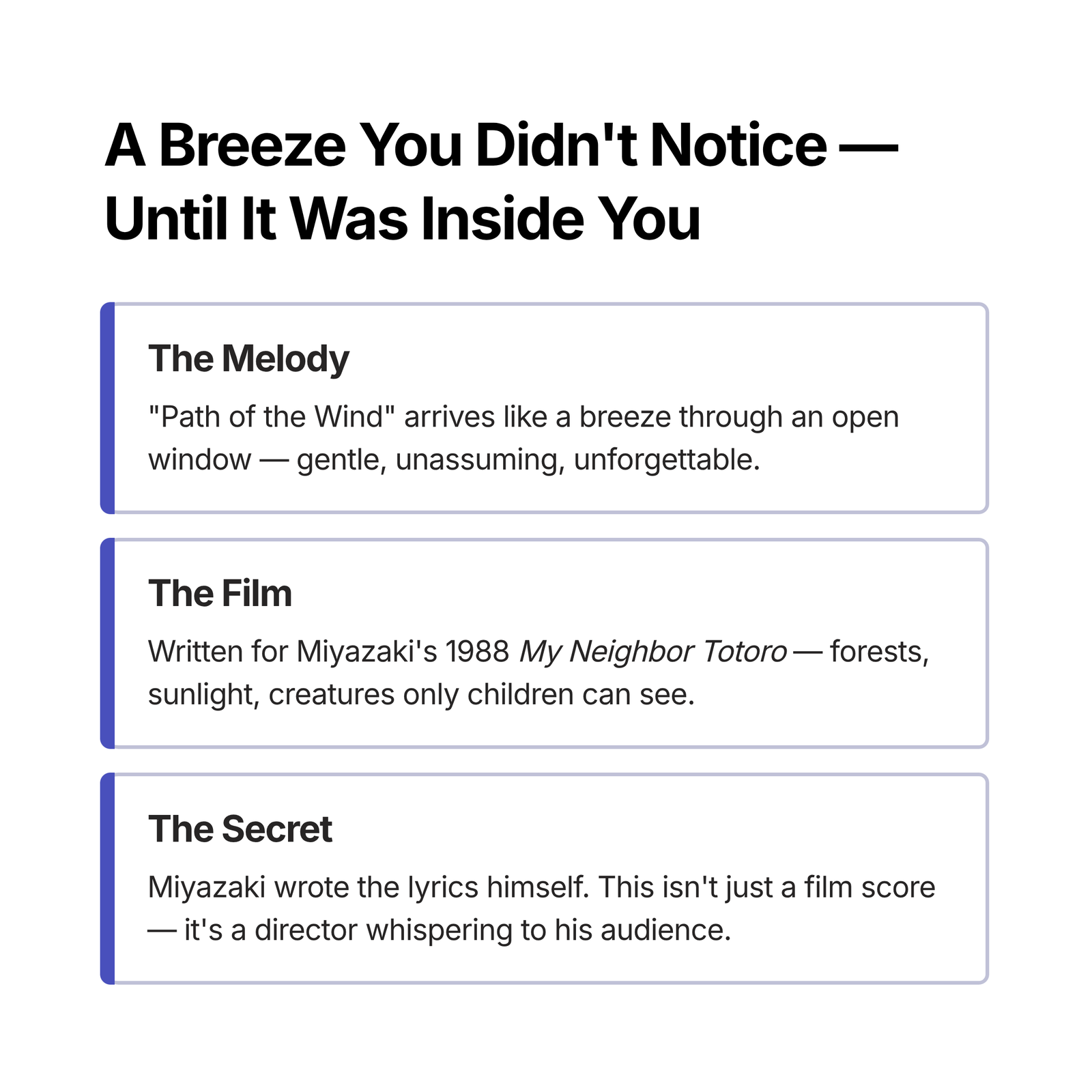
Some melodies don’t announce themselves. They don’t storm in with brass fanfares or thunder down from a full orchestra. They arrive the way a breeze does — through an open window you forgot you’d left ajar, brushing past the curtains before you even notice it’s there.
Joe Hisaishi’s “Path of the Wind” (Kaze no Toorimichi, 風のとおり道) is that kind of music. Written for Hayao Miyazaki’s 1988 animated film My Neighbor Totoro, it plays during the moments when two young sisters — Satsuki and Mei — wander through the forests of rural Japan, a landscape alive with camphor trees, sunlight, and creatures that only children can see. The melody is so gentle, so unassuming, that you might not even realize it has burrowed into you until you find yourself humming it days later, standing in line at a grocery store, suddenly missing a place you’ve never been.
What makes this piece extraordinary, though, isn’t just Hisaishi’s composition. It’s the fact that Hayao Miyazaki — a man known for drawing entire worlds into existence — sat down and wrote the lyrics himself. That small detail shifts everything. This isn’t merely a film score. It’s a director whispering directly to his audience about something he couldn’t express through images alone.
The Composer Who Took His Name from Quincy Jones
Before we walk down this wind-swept path, it helps to understand the man who composed it. Joe Hisaishi was born Mamoru Fujisawa in Nakano, Japan, in 1950 and grew up in Nagano Prefecture. He picked up the violin at age five and later studied composition at the Kunitachi College of Music, where he fell deeply under the spell of minimalist music.
His stage name is itself a piece of creative wordplay. The kanji characters in “Hisaishi” can also be read as “Kuishi,” which echoes “Quincy” as it’s transliterated into Japanese. “Joe” comes from “Jones.” So his very identity as a public artist is an homage to the great American producer — a fitting origin for a composer who would spend his career bridging Eastern and Western musical sensibilities.
In 1983, a young Hisaishi was recommended to an equally young animator named Hayao Miyazaki, who needed someone to score his upcoming film Nausicaä of the Valley of the Wind. That meeting sparked what many have compared to the Spielberg-Williams partnership: a collaboration spanning over four decades, eleven feature films, and some of the most emotionally resonant music in modern cinema. Their secret? According to Hisaishi himself, it’s purely professional — they don’t socialize, don’t grab dinner together. Just two artists who share a mutual respect so deep it doesn’t need small talk.
A Film About Absence, Disguised as a Children’s Story
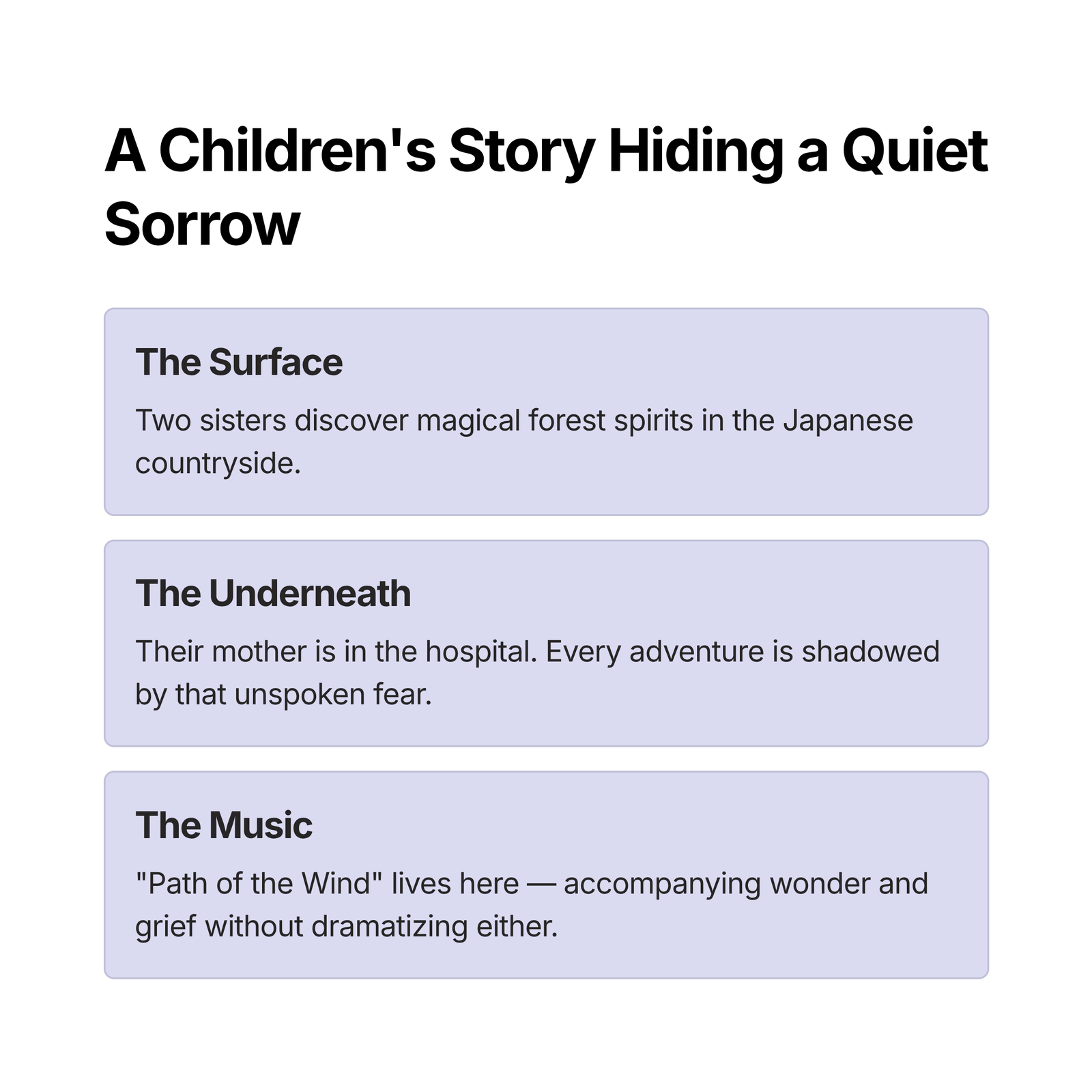
To truly hear “Path of the Wind,” you need to understand the quiet sorrow at the heart of My Neighbor Totoro. On the surface, it’s a story about two girls who discover magical forest spirits after moving to the countryside. Mei chases after acorns. Satsuki waits at the bus stop in the rain. A giant, grinning creature named Totoro roars at the sky.
But underneath all the wonder is a reality the film never looks away from: the girls’ mother is in the hospital, and nobody knows when — or if — she’s coming home. Every adventure Satsuki and Mei share with the forest spirits is underscored by that absence, that unspoken childhood fear of losing a parent. Miyazaki, who drew from his own childhood memories of his mother’s illness, didn’t soften this. He trusted children — and adults — to feel it.
“Path of the Wind” lives in that emotional territory. It plays during the scenes where the sisters interact most intimately with nature, when the boundary between the ordinary world and the magical one dissolves. The music doesn’t dramatize these moments. It simply accompanies them, the way wind accompanies a walk through the woods — always there, never demanding attention, but shaping the entire experience.
What You’ll Hear: Listening for the Spaces Between Notes
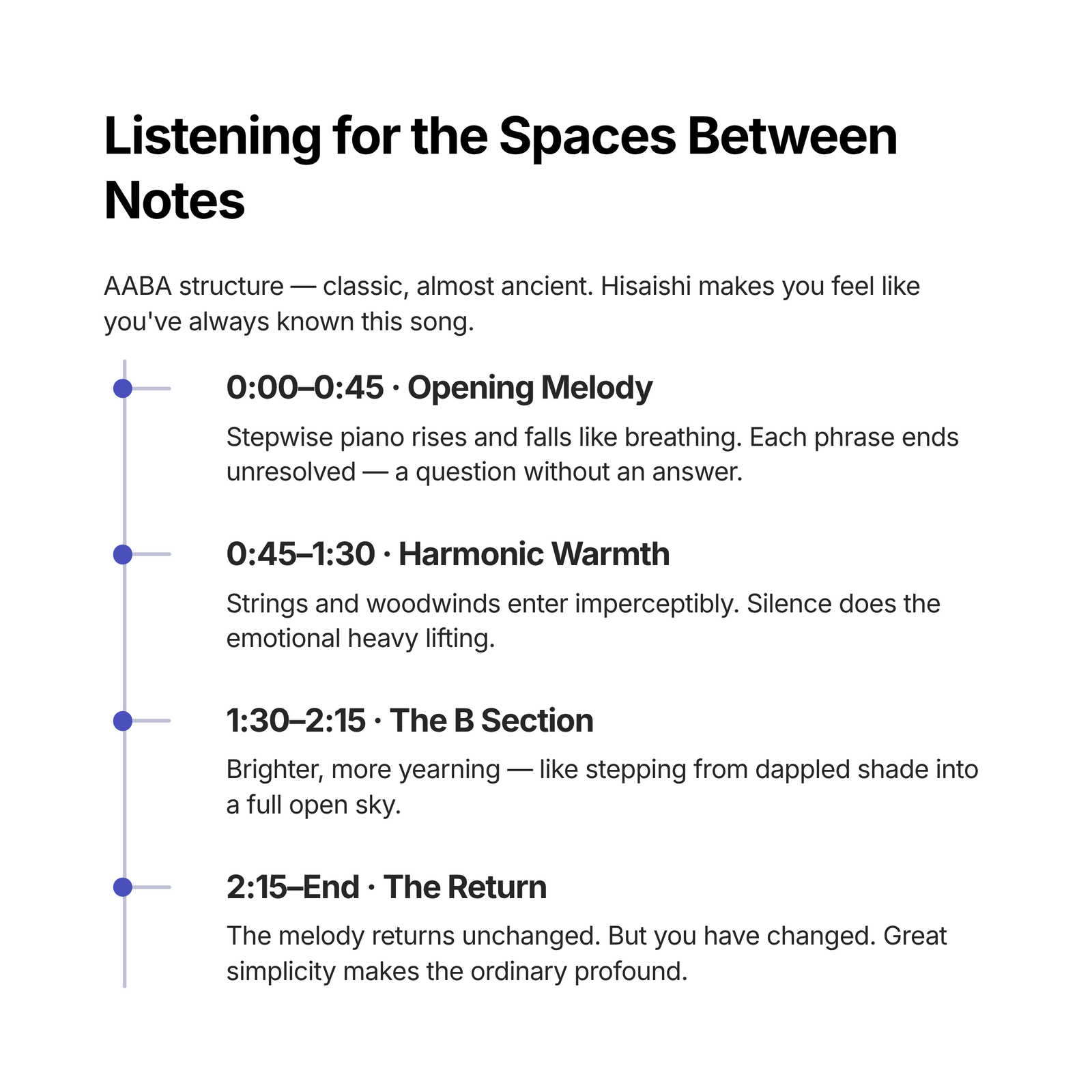
Musically, “Path of the Wind” is built on an AABA structure — two statements of the main melody, a contrasting middle section, and a return. It’s a form so classic it borders on ancient, and that’s precisely the point. Hisaishi isn’t trying to impress you with complexity. He’s trying to make you feel like you’ve always known this song.
Here’s what to listen for:
The opening melody (0:00–0:45): A gentle, stepwise piano line that rises and falls like breathing. Notice how each phrase ends on a slightly unresolved note, as if the music is asking a question it doesn’t expect to be answered. This is Hisaishi’s minimalism at work — saying more by saying less.
The harmonic warmth beneath (0:45–1:30): As the melody repeats, strings and woodwinds enter almost imperceptibly. They don’t take over; they surround the piano the way trees surround a forest path. Pay attention to the space between instruments. Hisaishi leaves gaps where silence does the emotional heavy lifting.
The B section (1:30–2:15): The middle passage shifts into a slightly different emotional register — a little brighter, a little more yearning. If the A sections feel like walking through dappled shade, this passage is the moment you step into a clearing and the full sky opens above you. It’s the compositional equivalent of looking up.
The return (2:15–end): The original melody comes back, but it feels different now. Not because the notes have changed, but because you have. You’ve taken the journey through the middle section, and the familiar tune now carries the weight of everything you’ve heard. This is what great simplicity does: it makes the ordinary feel profound upon repetition.
Why This Piece Finds People When They Need It Most
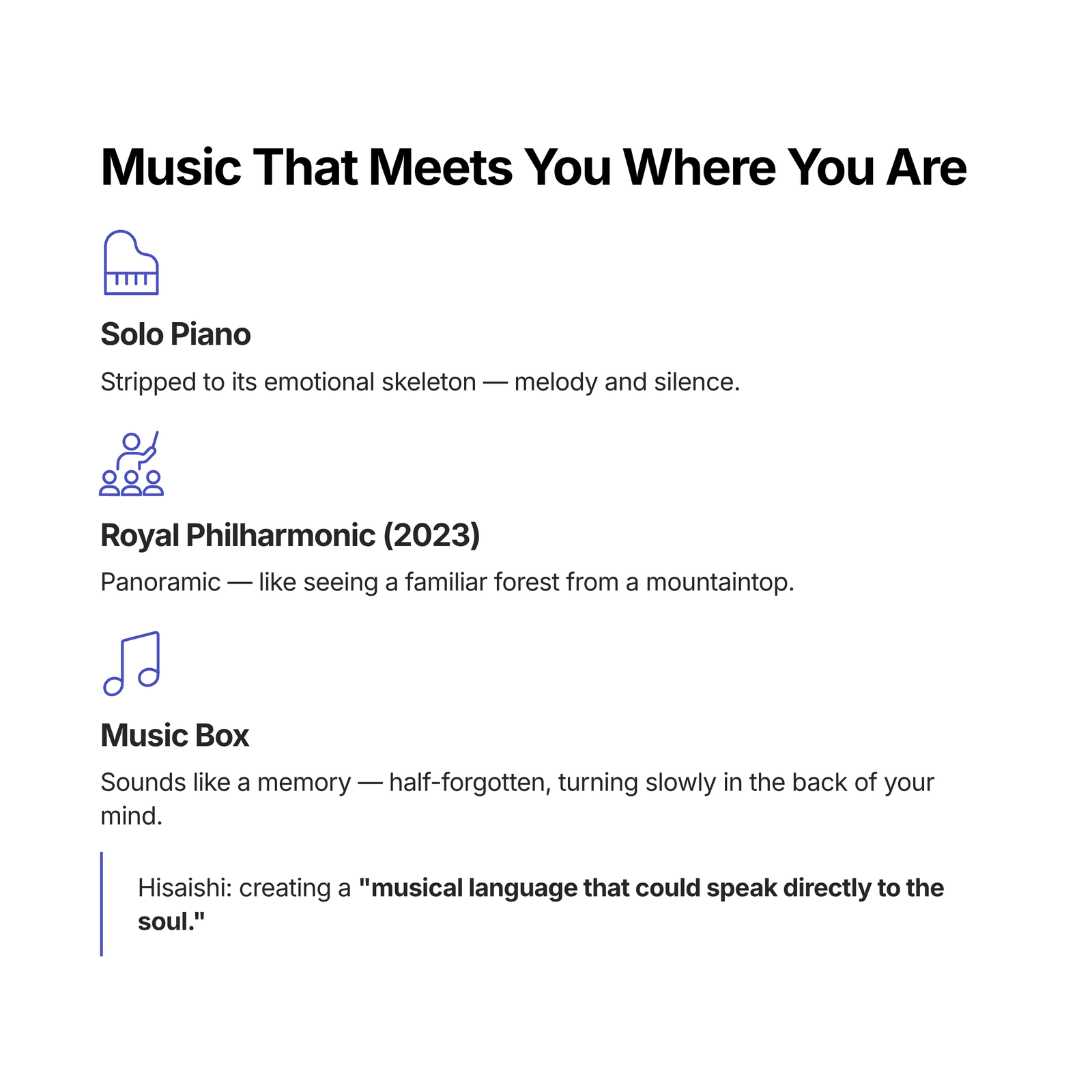
There’s a reason “Path of the Wind” has become one of the most covered, arranged, and reimagined pieces in the Ghibli catalog. It exists in versions for solo piano, piano with violin, piano with cello, acoustic guitar, harp, hand-cranked music box, and even a full orchestral arrangement recorded with the Royal Philharmonic Orchestra for Hisaishi’s 2023 album A Symphonic Celebration.
Each version reveals something different. The solo piano strips the piece to its emotional skeleton — just a melody and the silence around it. The orchestral version expands it into something panoramic, like seeing a familiar forest from the top of a mountain. The music box version, perhaps most movingly, makes it sound like a memory — something half-forgotten, turning slowly in the back of your mind.
But across all these arrangements, the core quality remains: this is music that meets you where you are. If you’re calm, it deepens your calm. If you’re carrying grief, it sits with your grief without trying to fix it. If you’re simply tired after a long day, it offers a few minutes where the world asks nothing of you.
That quality isn’t accidental. Hisaishi once described his approach to composing for Miyazaki as creating a “musical language that could speak directly to the soul.” And Miyazaki, by writing the lyrics himself for this particular piece, added a layer of personal intention that elevates it beyond a typical film score. These are words and notes shaped by two artists who understood that the deepest emotions often arrive not in climactic moments, but in quiet ones — in the space between the trees, on the path where the wind passes through.
How to Listen: Three Ways Into the Wind
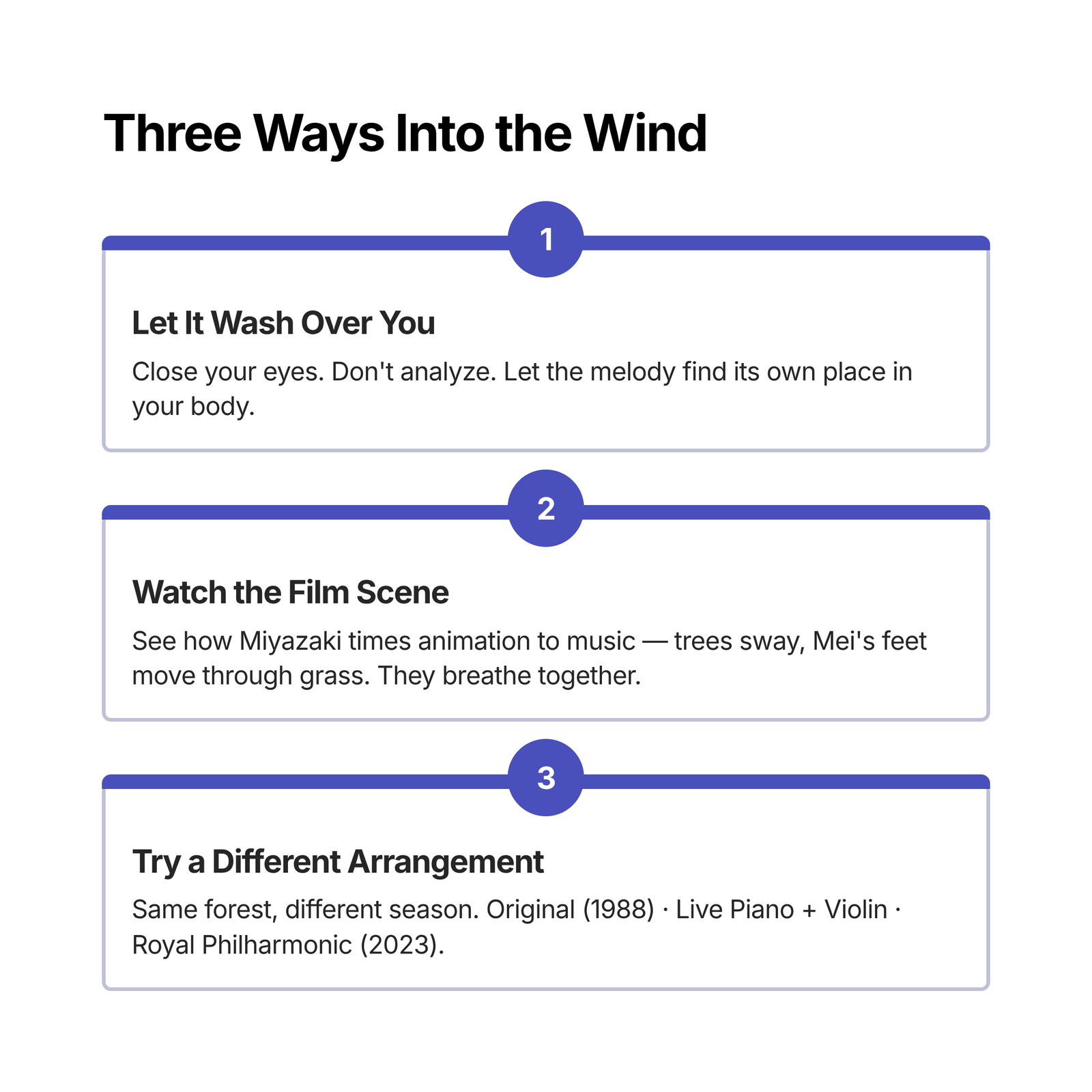
First listen — Let it wash over you. Don’t analyze. Don’t read along. Just press play, close your eyes, and let the melody find its own place in your body. You might feel it in your chest. You might feel it behind your eyes. Wherever it lands, that’s where it was meant to go.
Second listen — Watch the film scene. Find the moment in My Neighbor Totoro where this piece plays. Watch how Miyazaki times the animation to the music — the way the trees sway, the way Mei’s small feet move through the grass. Notice how the visuals and the sound don’t compete; they breathe together.
Third listen — Try a different arrangement. If you first heard the original soundtrack version, seek out Hisaishi’s live piano performance accompanied by violin or cello. Or find the orchestral version from A Symphonic Celebration with the Royal Philharmonic. Each arrangement is like visiting the same forest in a different season. The landscape is familiar, but the light has changed.
Recommended recordings:
– Original Soundtrack (1988): The definitive version, with its delicate balance of piano, strings, and woodwinds.
– Joe Hisaishi Piano + Violin (Live): An intimate, almost conversational reading where two instruments trade phrases like old friends.
– A Symphonic Celebration — Royal Philharmonic Orchestra (2023): The full orchestral treatment, lush and cinematic, perfect for listeners who want the experience writ large.
The Path Doesn’t End — It Just Goes Quiet
There’s a Japanese concept called komorebi — the interplay of light and leaves, the way sunlight filters through a forest canopy and scatters into shifting patterns on the ground. There is no single English word for it, but Joe Hisaishi has written the sound of it.
“Path of the Wind” doesn’t build toward a grand climax. It doesn’t resolve into a triumphant final chord. It simply fades, the way wind fades when it has passed through the trees and moved on to wherever wind goes. And in that fading, there’s a strange kind of comfort — the reassurance that some things don’t need to last forever to matter deeply.
Miyazaki knew this when he wrote the words. Hisaishi knew this when he wrote the notes. And now, more than three decades after a small animated film about two sisters and a forest spirit first flickered across screens in Japan, this quiet little piece of music continues to find people in their most unguarded moments, offering them exactly what they didn’t know they needed: a path through the wind, back to something they thought they’d lost.