📑 Table of Contents

There’s a particular thrill in stumbling onto music that almost nobody talks about. Everyone knows Grieg’s Peer Gynt — the morning sunrise, the trolls thundering through their mountain hall. But tucked away in his catalog is something far quieter and stranger: the Waltz-Caprices, Op. 37. Two short pieces, written for two pianists at one keyboard, that even Norwegians tend to forget exist.
That neglect is part of their charm. Listening to them feels less like attending a concert and more like overhearing a private conversation — two friends improvising at the piano late in the evening, trading phrases, laughing at a surprise turn neither of them planned. If you’ve ever wanted classical music that feels intimate rather than monumental, this is a perfect place to start.

Who Was Edvard Grieg?
Edvard Grieg (1843–1907) was Norway’s first truly international composer, the man who taught the rest of Europe what Norwegian music could sound like. Born in Bergen, trained in Leipzig, he spent his career distilling the folk melodies and landscapes of his homeland into music that was unmistakably his own — crisp, lyrical, and emotionally direct.
He worked best in miniature. While other Romantic composers chased the grand symphony, Grieg poured his genius into small forms: piano pieces, songs, short dances. He once compared himself to the Norwegian folk musicians he loved, saying he was happiest building intimate structures rather than cathedrals of sound. The Waltz-Caprices are exactly that kind of intimate structure.

The Story Behind the Music
The two Waltz-Caprices were written in 1883 as piano duets — one piano, four hands, two players sitting side by side. A few years later Grieg arranged them for solo piano as well, which is how many listeners encounter them today. Interestingly, these pieces stand slightly apart from the rest of his output: they carry surprisingly little of the obviously “Norwegian” folk flavor that runs through so much of his work, which may be one reason they slipped into obscurity.
But that’s also what makes them fascinating. Freed from the expectation of national color, Grieg leans into pure dance — the Viennese waltz tradition, the spin and sway of the ballroom — and then twists it with his own harmonic surprises. The word “caprice” is the key. A caprice is a whim, a sudden change of mind, and these waltzes are full of them: a phrase will set off in one direction and then dart somewhere unexpected.
What to Listen For
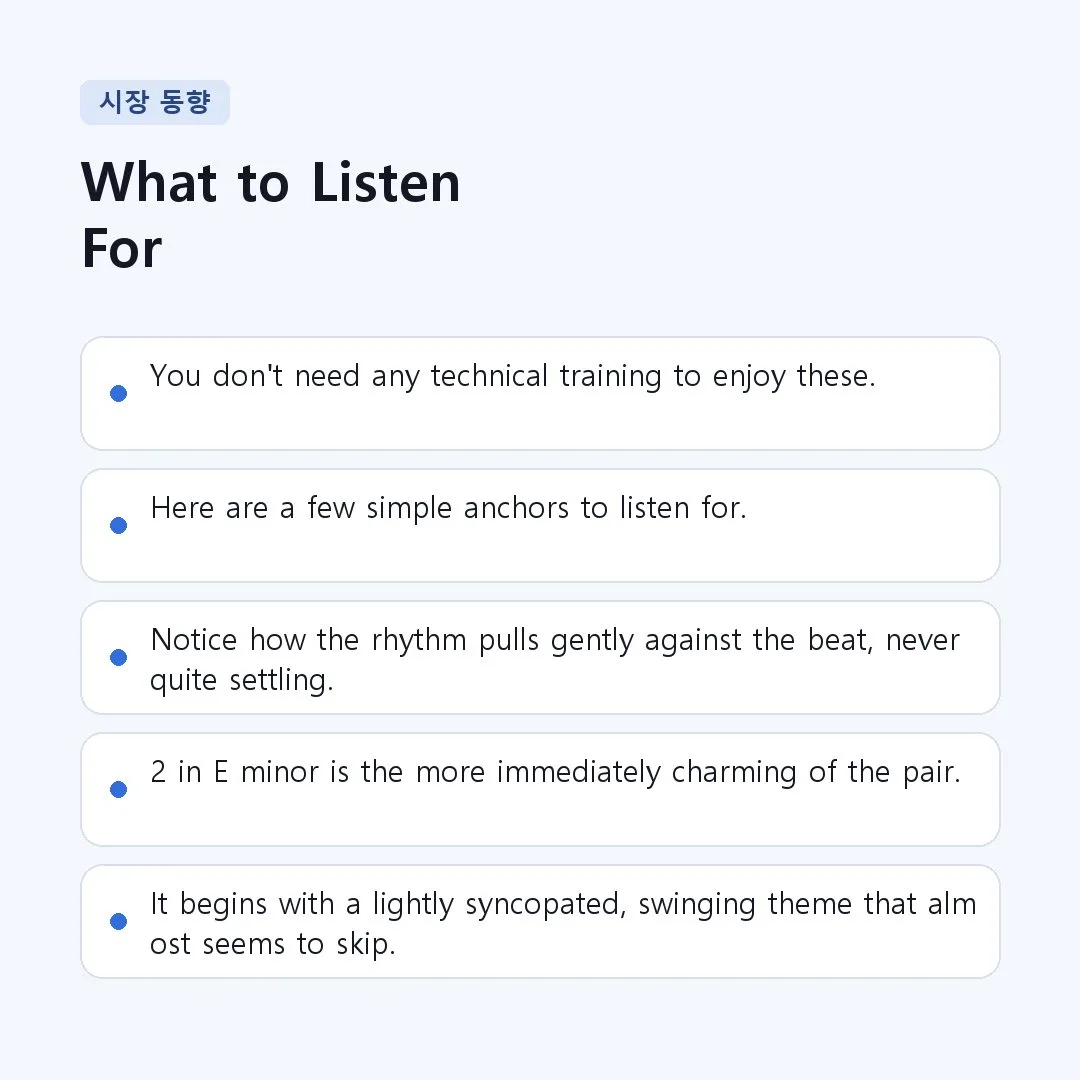
You don’t need any technical training to enjoy these. Here are a few simple anchors to listen for.
The No. 1 in C-sharp minor opens with a darker, more brooding lilt — elegant but with a shadow over it, like a waltz danced at dusk rather than noon. Notice how the rhythm pulls gently against the beat, never quite settling.
The No. 2 in E minor is the more immediately charming of the pair. It begins with a lightly syncopated, swinging theme that almost seems to skip. The real magic, though, is in the middle section. Grieg builds it from the slenderest material — a small repeated phrase, almost nothing on paper — and yet the effect is hypnotic. The same idea returns again and again, but each time the harmony underneath it shifts, so you’re left in a wonderful state of suspense, wondering where the music will turn next. It shouldn’t work. It absolutely does.
That trick — making magic out of repetition by quietly changing the ground beneath your feet — is something you’ll start to hear in music everywhere once you’ve noticed it here.

Where to Start Listening
Because these pieces exist in two forms, you have a choice, and hearing both is genuinely rewarding.
For the original four-hand duet version, seek out a piano-duo recording — the interplay between two players gives the music a conversational energy that’s hard to fake. The Noire Piano Duo’s performances of both caprices are a fine, warmly recorded entry point and easy to find online.
For the solo piano arrangement, look for collections of Grieg’s complete piano music, where the caprices usually appear alongside his better-known Lyric Pieces. Hearing them next to those famous miniatures helps you place them in context — same gift for the small gesture, slightly different mood.
If you only have a few minutes, start with No. 2. Its swing and that spellbinding middle section make the fastest case for why these forgotten pieces deserve a second life.

A Small Gem Worth Pocketing
Not every piece of great music announces itself with trumpets. Some of it waits quietly, like the Waltz-Caprices, for a curious listener to come along and notice. There’s something fitting about that — Grieg, the master of the small and the intimate, leaving behind a pair of dances that reward exactly the kind of close, unhurried attention he loved best.
Put one on some evening when you want something graceful but unguarded. You may find that the music nobody remembers becomes the music you can’t stop returning to.